Dorsey, Wright Client Sentiment Survey – 3/30/12

March 30, 2012

Here we have the next round of the Dorsey, Wright Sentiment Survey, the first third-party sentiment poll.  Participate to learn more about our Dorsey, Wright Polo Shirt raffle! Just follow the instructions after taking the poll, and we’ll enter you in the contest.  Thanks to all our participants from last round.

As you know, when individuals self-report, they are always taller and more beautiful than when outside observers report their perceptions!  Instead of asking individual investors to self-report whether they are bullish or bearish, we’d like financial advisors to weigh in and report on the actual behavior of clients.  It’s two simple questions and will take no more than 20 seconds of your time. We’ll construct indicators from the data and report the results regularly on our blog–but we need your help to get a large statistical sample!

Click here to take Dorsey, Wright’s Client Sentiment Survey.

Contribute to the greater good!  It’s painless, we promise.


Price Signals

March 30, 2012

Shortly after writing my article on the dual nature of prices, I ran across this wonderful article on price signals written by Jonathan Hoenig for Smart Money.

Whether it’s gasoline or groceries, blaming traders because you happen not to care for a market’s prices is like blaming the mailman because you don’t like the mail. They are price messengers, not manipulators.

It’s a nice read and probably especially germane to current bond investors.  And Mr. Hoenig may get the prize for the most bluntly named hedge fund in the industry!


Fund Flows

March 29, 2012

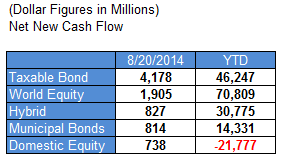
The Investment Company Institute is the national association of U.S.investment companies, including mutual funds, closed-end funds, exchange-traded funds (ETFs), and unit investment trusts (UITs).  Members of ICI manage total assets of $11.82 trillion and serve nearly 90 million shareholders.  Flow estimates are derived from data collected covering more than 95 percent of industry assets and are adjusted to represent industry totals.


Dorsey, Wright Client Sentiment Survey Results – 3/16/12

March 27, 2012

Our latest sentiment survey was open from 3/16/12 to 3/23/12. The Dorsey, Wright Polo Shirt Raffle continues to drive advisor participation, and we greatly appreciate your support! This round, we had 45 advisors participate in the survey. If you believe, as we do, that markets are driven by supply and demand, client behavior is important. We’re not asking what you think of the market—since most of our blog readers are financial advisors, we’re asking instead about the behavior of your clients. Then we’re aggregating responses exclusively for our readership. Your privacy will not be compromised in any way.

After the first 30 or so responses, the established pattern was simply magnified, so we are comfortable about the statistical validity of our sample. Most of the responses were from the U.S., but we also had multiple advisors respond from at least four other countries. Let’s get down to an analysis of the data! Note: You can click on any of the charts to enlarge them.

Question 1. Based on their behavior, are your clients currently more afraid of: a) getting caught in a stock market downdraft, or b) missing a stock market upturn?


Chart 1: Greatest Fear.  From survey to survey, the S&P 500 rallied +2.3%, and all of our client sentiment indicators responded positively.  The greatest fear number fell to its all-time lows, from 83% to 62%.  It’s hard to believe we’ve been running the survey for 2 whole years, and clients still have not even hit the high 50′s.  On the flip side, the opportunity group rose from 17% to 38%.

Chart 2. Greatest Fear Spread.  Another way to look at this data is to examine the spread between the two groups.  The spread fell to its all-time lows this round at 24%.

Question 2. Based on their behavior, how would you rate your clients’ current appetite for risk?

Chart 3: Average Risk Appetite.  The overall risk appetite number rose to just under its all-time highs which were set in April of 2011.  Close, but no cigar.  This round, we saw an average risk appetite of 3.02.  If the market continues to rally, so will the overall risk appetite number.

Chart 4: Risk Appetite Bell Curve. This chart uses a bell curve to break out the percentage of respondents at each risk appetite level.  The bell curve continues its recend trend towards more risk.  This round, over half of all respodents wanted a risk appetite of 3.

Chart 5: Risk Appetite Bell Curve by Group. The next three charts use cross-sectional data. This chart plots the reported client risk appetite separately for the fear of downdraft and for the fear of missing upturn groups.  This chart sorts out as expected, with the upturn group wanting more risk than the downturn group.

Chart 6: Average Risk Appetite by Group.  Historically, this is one of the most volatile indicators in the survey.  This round, the upturn group actually fell, while the dowturn group moved higher.  We’d expect both groups to move higher in a risingmarket, but the upturn group has been known to buck the trend.

Chart 7: Risk Appetite Spread.  This is a spread chart constructed from the data in Chart 6, where the average risk appetite of the downdraft group is subtracted from the average risk appetite of the missing upturn group.  The spread fell this round.

From survey to survey, the market was up +2.3%, and all the indicators performed as expected.  We’re now sitting at the lowest fear levels we’ve ever seen in the history of the survey.  The market has rallied roughly +23% from recent lows in September, and our sentiment indicators are responding to that information.  If the market continues to move higher, we will eventually hit par on the overall fear indicator (50-50 split), which might happen sooner than you expect.

No one can predict the future, as we all know, so instead of prognosticating, we will sit back and enjoy the ride. A rigorously tested, systematic investment process provides a great deal of comfort for clients during these types of fearful, highly uncertain market environments. Until next time, good trading and thank you for participating.


The Dual Role of Price in Financial Markets

March 26, 2012

Price has a dual role in financial markets.

  • Price represents the intersection of supply and demand.  It is the point at which buyers and sellers can agree on a value at which to exchange.  Everyone in the financial markets knows this.  Even economists get it.
  • Price also stimulates demand.  This price function is largely overlooked in the financial markets, but is the very reason why investors pile into strong stocks or strong assets.  Relative strength can obviously be a great help in identifying what those strong assets are.  Economists don’t understand how higher prices can drive demand, and just think investors are irrational.

If you are not convinced, here’s an excerpt from a Bloomberg article today:

Hedge funds trailing the Standard & Poor’s 500 (SPX) Index for the last five months are giving up on bearish bets and buying stocks at the fastest rate in two years.

The reason is obvious, and also mentioned in the article:

The benchmark gauge for U.S. equities is on track for the best first-quarter gain since 1998, according to data compiled by Bloomberg.

Yep.  A strong market stimulates demand for equities.  This tends to be true of all financial markets.

This runs counter to the traditional economic theory of supply and demand, where lower prices are expected to stimulate demand.  Traditional economic theory is correct in a special case—only if there is a concrete end use for the product.  For example, if gasoline prices went to $1.25 per gallon, users might be tempted to put tanks in their driveway and fill them up to take advantage of the low price, knowing they will use the gasoline later.  The same thing will be true of canned goods, toothpaste, and toilet paper.  People will buy as much as they can use before it spoils to take advantage of low prices.

Stocks are different.  Financial assets are intangible.  You can’t eat stock certificates or fuel your car with them.  Their end use is performance.  Performance is intangible, but performance depends on rising prices (assuming you are long, anyway).  When prices are rising strongly, it is a market signal that this asset may be useful for performance—and that is what stimulates additional demand.  Relative strength is like a neon sign in this respect.

Hedge funds and institutional investors are particularly subject to performance pressures, so they are very sensitive to market signals.  When markets are trending, they tend to go after the strongest assets first.  This is entirely rational economic behavior when continued poor performance can put you out of business.  Money flows follow performance.

Source: GlassGiant.com

[Endnote:  It is entirely possible, of course, to buy stocks when they are out of favor and make money too.  This is exactly what contrarian, value investors do.  One of the appeals of value investing is that buyers have very little competition when buying out-of-favor assets.  Yet even a value investor needs demand fueled by rising prices to ultimately profit.  It may be true that for every asset there is some "fair" or "intrinsic" value, but it's probably also true that the asset is correctly priced only twice each cycle---once on the way up, and once on the way down.]


From the Archives: Ken French Should Check His Website

March 26, 2012

A new paper from Eugene Fama and Ken French is circulating, suggesting that active mutual fund managers don’t add value.  Articles, like the one here at MarketWatch, have been appearing and the typical editorial slant is that you should just buy an index fund.

I have a bone to pick with this article and its conclusions, but certain things are not in dispute.  Fama and French, in their article Luck versus Skill in the Cross Section of Mutual Fund Returns, look at the performance of domestic equity funds from 1984 to 2006.  (You can find a summary of the paper here.)  They discover that the funds, in aggregate, are worse than the market by 80 basis points per year–basically the amount of the fees and expenses.  (After backing out fees and expenses, the funds are 10 basis points per year above the market.)  After that, Fama and French run 10,000 simulations with alpha set to zero to see if the distribution of returns from actual fund managers is any different from the distribution of returns from the random simulations.  They conclude it is not very different and suggest that any fund manager that outperforms is simply lucky.

Let me start my critique by pointing out that, based on their sample and their goofy experimental design, their conclusions are probably correct.  Existing mutual funds in aggregate pretty much own the market portfolio and underperform by the amount of fees and expenses.  There clearly are some above-average mutual fund managers, but as Fama and French point out, it’s difficult to tell statistically from just performance data if they are good or simply lucky.  Within a big sample of funds like they had, after all, a few are bound to have good performance just because the sample is so large.

This is quite a quandary for the individual investor, so let’s think about the realistic scenarios and their outcomes–in other words, let’s take actual investor behavior into account.

Scenario 1.  Buy a mutual fund after its good performance is advertised somewhere and bail out when it has a bad year.  Continue this behavior throughout your investment lifetime.  According to Dalbar’s QAIB and other data, this is what actually happens most of the time.  Not a good outcome–underperformance by a large margin, often 500 basis points or more annually.

Scenario 2.  Buy a decent mutual fund and make the radical decision to leave it alone, come hell or high water.  Do not be tempted by the blandishments of currently hot funds or panicked by underperformance in your fund when it inevitably happens.  Close eyes and hold on for dear life.  Continue your ostrich-with-its-head-in-the-sand routine throughout your investment lifetime.  Your outcome, as Fama and French point out, will probably be market returns less the 80 basis point per year in fees.  Your returns will probably be 400 basis points annually or more better than Scenario 1.

Scenario 3. Throw active management overboard entirely.  Buy an S&P 500 index fund or a total market index fund and proceed as in Scenario 2.  Your outcome might be 60-70 basis points per year better from reduced costs than the investor in Scenario 2.  (Your cost is that you don’t get to brag at cocktail parties on the occasions when your actively managed fund has a good year.)  On the other hand, you are no less likely to succumb to Scenario 1 than an actively managed mutual fund investor.  Unfortunately, index mutual funds tend to show the same pattern of lagging returns due to investor behavior as actively managed funds.

Scenario 4. Visit Ken French’s own website.  Look for factors that are tested and that have outperformed consistently over time.  Hint: relative strength.  (Academics tend to call it ”momentum,” I suspect because it would be very deflating to have to admit that anything related to technical analysis actually works.)  Find a manager that exposes a portfolio to the relative strength factor in a disciplined fashion over time.  Buy it and pretend you are Rip Van Winkle.  Continue this dolt-like behavior for your entire investment lifetime.  Your outcome, according to Ken French’s own website, is likely to be market outperformance on the magnitude of 500 basis points per year or more.  (You can link to an article showing a performance chart back to 1927 here, and the article also includes the link to Ken French’s database at Dartmouth University.)

I prefer Scenario 4, but maybe that’s just me.  Since it is well-known even to Eugene Fama and Ken French that momentum has outperformed over time, what is their study really saying?  It’s saying that essentially no one in the mutual fund industry is employing this approach.  That’s more a problem with the mutual fund industry than it is with anything else.  (Mutual fund firms are businesses and they have their reasons for running the business the way they do.)  One option, I guess, is to throw up your hands and buy an index fund, but maybe it would make more sense to seek out the rare firms that are employing a disciplined relative strength approach and shoot for Scenario 4.

Their flawed experimental design makes no sense to me.  Although I am still 6’5″, I can no longer dunk a basketball like I could in college.  I imagine that if I ran a sample of 10,000 random Americans and measured how close they could get to the rim, very few of them could dunk a basketball either.  If I created a distribution of jumping ability, would I conclude that, because I had a large sample size, the 300 people would could dunk were just lucky?  Since I know that dunking a basketball consistently is possible–just as Fama and French know that consistent outperformance is possible–does that really make any sense?  If I want to increase my odds of finding a portfolio of people who could dunk, wouldn’t it make more sense to expose my portfolio to dunking-related factors–like, say, only recruiting people who were 18 to 25 years old and 6’8″ or taller?  In the same fashion, if I am looking for portfolio outperformance, doesn’t it make a lot more sense to expose my portfolio to factors related to outperformance, like relative strength or deep value, rather than to conclude that managers who add value are just lucky?  No investigation of possible sub-groups that were consistently following relative strength or deep value strategies was done, so it is impossible to tell.  Fama and French are right, I think, in their assertion that plenty of luck is involved in year-to-year performance, but their overall conclusion is questionable.

In short, I think a questionable experimental design and possible sub-groups buried in the aggregate data (see this post for more information on tricks with aggregate data) make their conclusions rather suspect.

—-this article originally appeared 12/3/2009.  It turned out to be one of the blog readers’ favorite rants, so I am reprising it here.  I still think active management can add value over time through disciplined exposure to a reliable return factor.


Balanced Funds Make a Comeback

March 22, 2012

According to an article in Smart Money, balanced funds have been attracting client money this year.

So-called balanced funds, which invest in a mixture of stocks and bonds — and occasionally cash, commodities and other asset classes — suddenly are back in style. So far this year, investors added $7.1 billion to these portfolios, according to Lipper, a research firm. That is a huge reversal from last year, when investors yanked $20 billion from these funds.

The turnaround also stands in contrast to pure stock funds, which had inflows of just $56 million this year through March 14. And some investing experts say demand for balanced strategies is likely to rise. “There’s a little ‘Goldilocks’ appeal for investors,” says Russel Kinnel, director of fund research for Morningstar, meaning the funds are “just right” in finding a spot between timid and risky.

Indeed, advisers say they are using the funds to bring clients who are still spooked by last year’s extreme market volatility — but tired of record-low yields in the bond market — back into stocks. The pitch is that these funds offer most of the upside if the market surges but less of the downside if it tanks.

…advisers say balanced funds are often a good fit with younger investors, or those looking for a set-it-and-forget investment. Some also use the funds as core holdings for clients, and supplement them with alternative assets and funds to get even broader diversification.

Advisors are finding that clients are a bit more receptive to the equity story, but far from willing to go “all in.”  We’re seeing some glimmers of that in our own survey of investors’ risk appetite.  Investors are finally peeping out of the foxhole they have been in since 2008 and surveying the environment.  They are beginning to realize that today’s low bond yields will not get them to their goals, but they also seem to want some fixed income as a buffer from market volatility.  A balanced fund is a pretty good compromise.  (You can find more out about balanced funds generally here.)

The Arrow DWA Balanced Fund (DWAFX) that we sub-advise crossed its 5-year anniversary last summer, while outperforming 90% of its peers.  There are dedicated sleeves for fixed income, domestic equities, international equities, and alternative investments.  The alternative sleeve, which is something many balanced funds do not include, can come in pretty handy for inflation protection and always adds an additional layer of diversification.

I’ve included a snip with the asset allocation as of 12/31/2011 and the performance of each strategy sleeve.  Every sleeve has a positive return since inception in 2006, even with the 2008-2009 bear market.  I think it is primarily the hybrid nature of these funds that is making them attractive to clients right now—and DWAFX might be something to consider for clients just easing back to a more normal asset allocation.

Source: Arrow Funds

Click here to visit ArrowFunds.com for a prospectus & disclosures.  Click here for disclosures from Dorsey Wright Money Management.


From the Archives: Why Systematic Models Are Great

March 22, 2012

James Montier wrote this piece in 2006, but it is so great that I have to bring it up again!  This article is a gem, worth reading over and over again.

What could baseball, wine pricing, medical diagnosis, university admissions, criminal recidivism and I have in common? They are examples of simple quant models consistently outperforming so-called experts. Why should financial markets be any different? So why aren’t there more quant funds? Hubristic self belief, self-serving bias and inertia combine to maintain the status quo.

Montier gives numerous examples of situations in which the models outperform both experts and experts using the models as additional input.  Using your “expert knowledge” just makes it worse most of the time.  In fact, in a study of over 130 papers comparing systematic models with human decision-making, the models won out in 122 events.

So why don’t we see more quant funds in the market? The first reason is overconfidence. We all think we can add something to a quant model. However, the quant model has the advantage of a known error rate, whilst our own error rate remains unknown. Secondly, self-serving bias kicks in, after all what a mess our industry would look if 18 out of every 20 of us were replaced by computers. Thirdly, inertia plays a part. It is hard to imagine a large fund management firm turning around and scrapping most of the process they have used for the last 20 years. Finally, quant is often a much harder sell, terms like ‘black box’ get bandied around, and consultants may question why they are employing you at all, if ‘all’ you do is turn up and crank the handle of the model. It is for reasons like these that quant investing will remain a fringe activity, no matter how successful it may be.

Lack of competition may be the best reason of all to use a systematic approach.  How many investors are willing to go through a thorough and rigorous testing process to build a robust model—and are then willing to stick with the model through thick and thin?  As Montier points out, it may remain a “fringe activity” no matter how successful it is.

—-this article originally appeared 12/22/2009.  This is a powerful, powerful argument in favor of using a systematic model.  Montier’s discussion of why investors resist using models is still very true.


From the Archives: Capturing Trends

March 19, 2012

Intuitively, investors feel like the more nimble they are, the better they will do.  They put tremendous pressure of themselves to capture every wiggle in the market.  Yet, much of the time, going faster is counterproductive.

In this blog post, “Understanding How Markets Move,” noted psychologist and trader Brett Steenbarger uses the simple example of a moving average system applied to the S&P 500.  The more you speed up the moving average, the worse it does.  That seems counter-intuitive, but you have to keep in mind that trends are what make money and trends  are often slowThe faster you go, the more noise you capture, and thus, the worse you do.

We find exactly the same process at work when using relative strength.  Reacting to short-term relative strength does not perform well over time.  The best-performing models follow intermediate to long-term relative strength—and just tough out the periods that are rocky.  Many clients have trouble sitting still when going through a rocky period, but as Steenbarger points out in his post, you have to deal with the asset you’re trading.  Stocks have their own time frames for trends and an impatient investor isn’t going to speed it up.  If you want to trade financial assets, you have to work with them on their own terms.

—-this article originally appeared 12/16/2009.  Repeat after me: going faster is counterproductive.  The last nine months or so have been lousy for trends, so it’s prime time for thinking that trends could be captured if only one were more nimble.  Tough periods don’t last.  The market will trend again when it feels like it!


Dorsey, Wright Client Sentiment Survey – 3/16/12

March 16, 2012

Here we have the next round of the Dorsey, Wright Sentiment Survey, the first third-party sentiment poll.  Participate to learn more about our Dorsey, Wright Polo Shirt raffle! Just follow the instructions after taking the poll, and we’ll enter you in the contest.  Thanks to all our participants from last round.

As you know, when individuals self-report, they are always taller and more beautiful than when outside observers report their perceptions!  Instead of asking individual investors to self-report whether they are bullish or bearish, we’d like financial advisors to weigh in and report on the actual behavior of clients.  It’s two simple questions and will take no more than 20 seconds of your time. We’ll construct indicators from the data and report the results regularly on our blog–but we need your help to get a large statistical sample!

Click here to take Dorsey, Wright’s Client Sentiment Survey.

Contribute to the greater good!  It’s painless, we promise.


7 Questions to Consider When Doing Asset Allocation

March 13, 2012

Here are seven questions that can lay the foundation for a fruitful relationship between a financial advisor and their client:

Question #1:  What investments make up your investment universe?  Does your investment strategy allow you to invest in a broad range of asset classes, including U.S. equities, international equities, currencies, commodities, real estate, and fixed income?

Question #2:  What role do current market conditions play in the asset allocation decision-making process?  Does your investment strategy have a means of increasing exposure to asset classes in secular bull markets and decreasing exposure to asset classes in secular bear markets?

Question #3:  Does your portfolio include investments in complementary strategies?  Relative strength and value are both long-term winning investment factors.  They also tend to have low, or even negative correlations to each other, thereby providing useful diversification.

Question #4:  Is your asset allocation divided into segments?  Breaking a portfolio into an income segment, balanced segment, and growth segment can provide tremendous psychological benefits and therefore may increase the odds that you will stick with your investment plan over time.

Question #5:   Do you have a plan for systematic contributions?  There are many ways to accomplish this goal, including setting up a monthly automatic withdrawals from your bank to your brokerage account or regularly sending 15% of every dollar earned to your brokerage account, but the key is to have some systematic means of continuing to save money for your financial goals.

Question #6:  Do you have a plan for how you will approach distributions from your portfolio during retirement?

Question #7:  Do you have a financial advisor that will give you the TLC you will need to be educated and guided along all the inevitable bumps in the road?

Some relevant resources:

Savings or Growth? 

Expected Returns

Safe Withdrawal Rates

What’s Your Retirement Number?

Strategic Allocation Bites

The Upside of Mental Accounting

The Bucket List

Combining Global Macro & MDLOX

Why Tactical Asset Allocation

What is a Balanced Fund, and Why Should You Care?


Dorsey, Wright Client Sentiment Survey Results – 3/2/12

March 12, 2012

Our latest sentiment survey was open from 3/2/12 to 3/9/12. The Dorsey, Wright Polo Shirt Raffle continues to drive advisor participation, and we greatly appreciate your support! This round, we had 48 advisors participate in the survey. If you believe, as we do, that markets are driven by supply and demand, client behavior is important. We’re not asking what you think of the market—since most of our blog readers are financial advisors, we’re asking instead about the behavior of your clients. Then we’re aggregating responses exclusively for our readership. Your privacy will not be compromised in any way.

After the first 30 or so responses, the established pattern was simply magnified, so we are comfortable about the statistical validity of our sample. Most of the responses were from the U.S., but we also had multiple advisors respond from at least four other countries. Let’s get down to an analysis of the data! Note: You can click on any of the charts to enlarge them.

Question 1. Based on their behavior, are your clients currently more afraid of: a) getting caught in a stock market downdraft, or b) missing a stock market upturn?


Chart 1: Greatest Fear.  From survey to survey, the S&P 500 was up by a small margin (+0.5%).  Despite the market basically treading water, client fear levels rose by a significant margin from 69% to 83%.  On the flip side, the opportunity group fell from 61% to 17%.  The S&P experienced a moderate pullback during the survey voting, which probably explains the sudden drop in client sentiment.

Chart 2. Greatest Fear Spread.  Another way to look at this data is to examine the spread between the two groups.  The spread jumped this round from 38% to 67%.

Question 2. Based on their behavior, how would you rate your clients’ current appetite for risk?

Chart 3: Average Risk Appetite.  The overall risk appetite number fell from 2.93 to 2.79.  Just as we saw with the overall fear numbers, client sentiment took a hit over the last 2 weeks.

Chart 4: Risk Appetite Bell Curve. This chart uses a bell curve to break out the percentage of respondents at each risk appetite level.  The bell curve continues its recend trend towards more risk.  The most common risk appetite requested was 3.

Chart 5: Risk Appetite Bell Curve by Group. The next three charts use cross-sectional data. This chart plots the reported client risk appetite separately for the fear of downdraft and for the fear of missing upturn groups.  This chart sorts out as expected, with the upturn group wanting more risk than the downturn group.

Chart 6: Average Risk Appetite by Group.  Historically, this is one of the most volatile indicators in the survey.  This round, both groups moved higher this round, which is not what we’d expect.  Keep in mind that the overall risk appetite number did fall.

Chart 7: Risk Appetite Spread.  This is a spread chart constructed from the data in Chart 6, where the average risk appetite of the downdraft group is subtracted from the average risk appetite of the missing upturn group.  The spread fell slightly this survey round.

From survey to survey, the market was up just a bit.  Client fear levels rose higher despite a “rising market.”  What the data points fail to point out is that the market experienced a sharp pullback during the week of voting, which accounts for the rise in fear levels.  Most of the other indicators followed the greatest fear’s lead, with clients wanting less exposure to risk in a shaky market.  Keep in mind that the stock market has been rallying for a few months now, as has client sentiment.  It might not hurt to take a little breather, as both client sentiment and the overall market continue to improve.

No one can predict the future, as we all know, so instead of prognosticating, we will sit back and enjoy the ride. A rigorously tested, systematic investment process provides a great deal of comfort for clients during these types of fearful, highly uncertain market environments. Until next time, good trading and thank you for participating.


From the Archives: Constancy of Human Behavior

March 8, 2012

NY Magazine recently interviewed James Grant, well-known financial philosopher, to get his take on the economy and financial markets.  The article is full of nuggets of wisdom, including the following:

Grant’s second cause for optimism is an observation about human nature, summed up by an epigram he borrowed from the late British economist Arthur C. Pigou: “The error of optimism dies in the crisis, but in dying it gives birth to an error of pessimism. This new error is born not an infant, but a giant.” As peculiar as our economic circumstances may seem to us right now, the way people behave has a certain reassuring constancy—which is to say, we freak out and then we get over it.

Human behavior, if left unchecked, makes it virtually impossible to generate superior investment results over time.  The wide swings in optimism and pessimism that are part of the human condition present a serious challenge to the flexibility required to capitalize on investment opportunities.  Rather than trying to train ourselves to be emotionless (which won’t happen), our solution is to rely on systematic relative strength models (which are emotionless.)

The reality is that there are times when we should be pessimistic and times when we should be optimistic, but without a system to overcome behavioral tendencies, we are likely to be unable to capitalize on those opportunities.

—-this article was originally published 12/29/2009.  We are about three years from the market bottom in March 2009 now and it’s very clear that the error of pessimism was born a giant!  Investors have continued to pile into bonds that are now trading at 50x their coupon rate, while a 100% gain in the broad market indexes has gone unnoticed.  That Pigou was a pretty smart guy.


Robust Systems

March 6, 2012

One of the most important considerations for a systematic method is that it be robust—in other words, changing markets and changing parameters will not cause it to stop working.  Relative strength is extremely robust, something that can be shown with Monte Carlo testing.  In Michael Covel’s The Little Book of Trading, the section on trend follower David Druz has this to say:

Once a system’s algorithms and parameters are established, the system must be followed exactly and religiously. A system cannot be second-guessed or used intermittently. Values of variables cannot be altered. Parameters cannot be arbitrarily changed. A robust system works over many types of market conditions and over many timeframes. It works in German Bund futures and it works in wheat. It works when tested over 1950•1960 or over 1990•2000. Robust systems tend to be designed around successful trading tactics not designed around specific types of markets or market action. And here is the amazing thing about robust systems: The more robust a system, the more volatile it tends to be! Druz gives this advice: “There are whole families of trend trading ideas that seem to work forever on any market. The down side is they are very volatile because they are never curve-fit. They’re never exactly fit to any particular market or market condition. But over the long run, they do extract money from the market. You want to be focused on how you divvied up the risk in your portfolio, how much risk you take in each market, how many contracts you trade in each market, that’s the stuff that really counts…if you have money management wired, you can let volatility go because you know it doesn’t have any correlation with the risk of ruin. You can use volatility to your advantage.”

Druz’s points are well-taken.  A robust system works over many timeframes and can adapt to a lot of market conditions.  However, because they are not optimized, they tend to be volatile.  We see this especially during periods when markets are relatively trendless or are in the midst of a changing trend.  There is always some specific method that is optimized and perfectly adapted to the current market—but as soon as the market character changes, it may fail miserably.

With a robust system, you are accepting a different trade-off.  It will probably never work perfectly in any market environment, but it will probably work pretty well in a wide range of conditions.  That’s a pretty good description of how relative strength works.  It goes through rough stretches but generally manages to adapt enough over time to deliver good long-term performance.  The trick for investors is to sit on their hands during the rough stretches—a truism for any long-term winning method, whether relative strength or value.


Bull Market Needs a Psychotherapist

March 5, 2012

According to Bloomberg Businessweek, this bull market has serious self-esteem issues.  We are almost exactly three years from the March 2009 low, but fear of the market still has not worn off.

Next week marks the third anniversary of the current bull market cycle in U.S. stocks. Back on March 9, 2009, a day not easily forgotten in the annals of wealth destruction, the S&P 500 sank to a 12-year low of 676, the bottom of the worst bear market since the Great Depression. Since then, the S&P has more than doubled.

Investors for the most part are still curled up in the fetal position, preferring to put their money in bonds and money market accounts rather than stocks. Investors have pulled more money out of  U.S. domestic mutual funds than they’ve put in for five straight years.

Imagine how investors would be behaving if the market had a 100% run in three years without a bear market in front of it! Investors would probably be cashing in their bonds funds to buy stocks like there was no tomorrow. Investors are still carrying their bad feelings from 2008-2009 with them. One of the advantages of a systematic investment process is that feelings are not incorporated into it—the only thing factored into the investment decision is the relevant data.


Dorsey, Wright Client Sentiment Survey – 3/2/12

March 2, 2012

Here we have the next round of the Dorsey, Wright Sentiment Survey, the first third-party sentiment poll.  Participate to learn more about our Dorsey, Wright Polo Shirt raffle! Just follow the instructions after taking the poll, and we’ll enter you in the contest.  Thanks to all our participants from last round.

As you know, when individuals self-report, they are always taller and more beautiful than when outside observers report their perceptions!  Instead of asking individual investors to self-report whether they are bullish or bearish, we’d like financial advisors to weigh in and report on the actual behavior of clients.  It’s two simple questions and will take no more than 20 seconds of your time. We’ll construct indicators from the data and report the results regularly on our blog–but we need your help to get a large statistical sample!

Click here to take Dorsey, Wright’s Client Sentiment Survey.

Contribute to the greater good!  It’s painless, we promise.


What High IQ Investors Do Differently

March 2, 2012

This is the title of a New York Times article that looks at investing habits by IQ.  You can read the whole article here, but it boils down to two things:

  1. High IQ investors diversify more.
  2. High IQ investors buy more stocks.

Both of those things sound pretty smart.


Dorsey, Wright Client Sentiment Survey – 2/17/12

February 27, 2012

Our latest sentiment survey was open from 2/17/12 – 2/24/12. The Dorsey, Wright Polo Shirt Raffle continues to drive advisor participation, and we greatly appreciate your support! This round, we had 52 advisors participate in the survey. If you believe, as we do, that markets are driven by supply and demand, client behavior is important. We’re not asking what you think of the market—since most of our blog readers are financial advisors, we’re asking instead about the behavior of your clients. Then we’re aggregating responses exclusively for our readership. Your privacy will not be compromised in any way.

After the first 30 or so responses, the established pattern was simply magnified, so we are comfortable about the statistical validity of our sample. Most of the responses were from the U.S., but we also had multiple advisors respond from at least four other countries. Let’s get down to an analysis of the data! Note: You can click on any of the charts to enlarge them.

Question 1. Based on their behavior, are your clients currently more afraid of: a) getting caught in a stock market downdraft, or b) missing a stock market upturn?

Chart 1: Greatest Fear.  From survey to survey, the S&P 500 rose just over +1%.  Despite the moderate rally, client sentiment got worse this survey round, but not by much.  Overall client fear levels rose from 67% to 69%, while the missed opportunity group fell from 33% to 31%.  Despite a moderate pullback this week, it’s clear that client sentiment has improved significantly in the last three months with the market rally.

Chart 2. Greatest Fear Spread.  Another way to look at this data is to examine the spread between the two groups.  The spread jumped this round from 34% to 38%.

Question 2. Based on their behavior, how would you rate your clients’ current appetite for risk?

Chart 3: Average Risk Appetite.  The overall risk appetite number rose from 2.80 to 2.93.  Once again, I’d argue that the overall risk appetite number provides us with the best snapshot of client sentiment within this survey.

Chart 4: Risk Appetite Bell Curve. This chart uses a bell curve to break out the percentage of respondents at each risk appetite level.  The bell curve continues its recend trend towards more risk.  The most common risk appetite requested was 3.

Chart 5: Risk Appetite Bell Curve by Group. The next three charts use cross-sectional data. This chart plots the reported client risk appetite separately for the fear of downdraft and for the fear of missing upturn groups.  This chart sorts out as expected, with the upturn group wanting more risk than the downturn group.

Chart 6: Average Risk Appetite by Group.  Historically, this is one of the most volatile indicators in the survey.  This round, both groups moved higher with the market, which is what we’d expect to see in a rising market.

Chart 7: Risk Appetite Spread.  This is a spread chart constructed from the data in Chart 6, where the average risk appetite of the downdraft group is subtracted from the average risk appetite of the missing upturn group.  The spread fell slightly this survey round.

For this survey, the market rose just over +1% over two weeks, and the indicator responses were a mixed bag.  The overall fear numbers actually grew in the face of a rising market, which is not what we’d expect to see.  However, considering how much client sentiment has improved over the last few months, it’s not a stretch to see a slight pullback.  The overall risk appetite indicator continues to move higher with the market.  If the market rally can continue to gather steam, we should continue to see client sentiment improving into the future.

No one can predict the future, as we all know, so instead of prognosticating, we will sit back and enjoy the ride. A rigorously tested, systematic investment process provides a great deal of comfort for clients during these types of fearful, highly uncertain market environments. Until next time, good trading and thank you for participating.


The Myth of Buy-and-Hold

February 27, 2012

No one can dispute that Warren Buffett is a good investor—he’s made a ton of money over many years and it’s been well-documented.  He holds court periodically and even his public calls have been pretty good, like his “Buy American. I Am.” editorial in the New York Times on October 16, 2008.  (More recently he said bonds should come with a warning label, so take that for what it’s worth.)  You could do worse than trying to emulate Warren Buffett.

So what is St. Warren actually doing?  Well, fortunately some college professors did the heavy lifting.  They analyzed Berkshire Hathaway’s quarterly filings from 2006 all the way back to 1980, 2,140 quarter-stock observations.  CXO Advisory had a nice summary of their work.  In the words of the professors:

…we observe a median holding period of a year, with approximately 20% of stocks held for more than two years. At the other end of the spectrum, approximately 30% of stocks are sold within six months.

Yep, Warren Buffett has 100% turnover.  He blew out 30% of his portfolio selections within six months, and held about 20% of his picks for the longer run.  That is active trading by any definition.

A mythology has grown up around Mr. Buffett, that he has a somewhat magical ability to select stocks and then holds on to them forever.  The truth is far more pedestrian, and encouraging since it is something any investor can do.  He might be holding on to what is working, but his portfolio holdings are pared relentlessly.   If I had to guess, I suspect Warren Buffett is simply doing what every good investor does.  He’s using his best judgment to select stocks and then cutting the losers and letting the winners run.  (The casting-out process used in our Systematic Relative Strength portfolios does exactly the same thing.)

There’s no glory—or capital gain to be had—in holding an underperforming piece of garbage for the long run.  Mr. Buffett’s stock selection may be above average, but his genius is more likely in his discipline.

Don’t be conned by the myth of buy-and-hold.  Even Warren Buffett isn’t doing it.  Search everywhere for good investment opportunities, hang on to the winners and get rid of the losers.

Don't Be a Buy-and-Hold Sucker. I'm Not.

Source: Photobucket       (click on image to enlarge)


More on Buckets

February 23, 2012

From an article at AdvisorOne, a discussion of the advantages and disadvantages of buckets versus systematic withdrawals:

The bucket approach offers the client a greater feeling of self-control. “For retirees feeling overwhelmed by the many decisions they face as they enter retirement, a bucket strategy may help them divide what they see as one large, stress-inducing problem into smaller, more manageable pieces,” the analysis states.

The article references a paper done by Principal Financial, which goes into more depth.

According to an AARP study, the majority of people fear running out of money in retirement more than they fear death. It’s no wonder many people look to financial professionals for help as they enter retirement. While working with a financial professional on any type of retirement income strategy can help a retiree feel more confident in his or her plan, research has shown that the bucket strategy may provide some additional psychological benefits. A bucket strategy can address a human preference for smaller, simplified issues. For retirees feeling overwhelmed by the many decisions they face as they enter retirement, a bucket strategy may help them divide what they see as one large, stress-inducing problem into smaller, more manageable pieces. A bucket strategy that links portions of money directly to goals may also promote self-control.

The paper is well worth reading, although I have some reservations about it.  It makes a number of assumptions about how the bucket strategy is to be carried out and then tries to make a comparison with systematic withdrawals from a target date fund.  Suffice it to say that a glide path that holds more and more bonds as you age (and are more exposed to inflation) may not be an ideal solution.  In addition, I’ve written before that there is no necessary functional difference between a balanced account and a portfolio using buckets.  You can have the same allocation in both—it’s just a matter of controlling investor psychology.

In reality, most investment performance problems are investor behavior problems.  To the extent that a bucket approach can mitigate that for a client, I say to go for it.


Dorsey, Wright Client Sentiment Survey – 2/17/12

February 17, 2012

Here we have the next round of the Dorsey, Wright Sentiment Survey, the first third-party sentiment poll.  Participate to learn more about our Dorsey, Wright Polo Shirt raffle! Just follow the instructions after taking the poll, and we’ll enter you in the contest.  Thanks to all our participants from last round.

As you know, when individuals self-report, they are always taller and more beautiful than when outside observers report their perceptions!  Instead of asking individual investors to self-report whether they are bullish or bearish, we’d like financial advisors to weigh in and report on the actual behavior of clients.  It’s two simple questions and will take no more than 20 seconds of your time. We’ll construct indicators from the data and report the results regularly on our blog–but we need your help to get a large statistical sample!

Click here to take Dorsey, Wright’s Client Sentiment Survey.

Contribute to the greater good!  It’s painless, we promise.


Dividend Stocks as Bond Substitutes

February 14, 2012

Dividends are all the rage nowadays, especially since dividend stocks did very well last year.  We like dividends as much as the next guy.  Heck, we provide portfolios for a series of dividend UITs at First Trust.  But, as a recent Wall Street Journal article makes clear, dividend stocks are not bonds.

For many investors who crave steady income, bonds don’t look as good as they used to.

With U.S. Treasury yields languishing near historic lows, some people believe they’ve found a great alternative: dividend-paying stocks or dividend-focused mutual funds.

Many investment pros say it can be a reasonable move for at least part of an income-oriented portfolio. But they caution that investors need to understand the risks. The most basic concern: Equities don’t behave the way bonds do, and investors face a much greater chance of capital losses with stocks and stock funds.

“People may not appreciate that moving from bonds to stocks is a major change in asset allocation,” says Joseph Davis, chief economist and principal at Vanguard Group.

Investors should also remember that dividend-paying stocks don’t always behave like other stocks, either. Dividend payers are often larger, established companies—which means they often aren’t perceived to have the same potential for earnings and revenue growth as smaller firms. When the rest of the market is booming, dividend payers are often lagging behind the crowd.

It’s not that dividend stocks are a bad thing—far from it.  But they do act like stocks when the market sells off, and they don’t act like growth stocks when the market is roaring.  If you are using dividend stocks as part of your allocation, you need to be realistic about how they will behave in the marketplace.  If you sell out because they aren’t going up as much as the rest of your portfolio in a rally, you’re on the wrong track.  And if you panic and sell out because they drop 15% during a market correction, you’re missing the boat.  These behavioral characteristics are things you should understand before you add them to your portfolio.

That advice is not limited to dividend stocks—it is true for every investment you make.  Know what can reasonably be expected and don’t be shocked when it happens!

Dividend Stocks are not Bonds!

(click on image to enlarge to full size)

Source: Wall Street Journal/Morningstar


Dorsey, Wright Client Sentiment Survey Results – 2/3/12

February 13, 2012

Our latest sentiment survey was open from 2/3/12 – 2/10/12. The Dorsey, Wright Polo Shirt Raffle continues to drive advisor participation, and we greatly appreciate your support! This round, we had 64 advisors participate in the survey. If you believe, as we do, that markets are driven by supply and demand, client behavior is important. We’re not asking what you think of the market—since most of our blog readers are financial advisors, we’re asking instead about the behavior of your clients. Then we’re aggregating responses exclusively for our readership. Your privacy will not be compromised in any way.

After the first 30 or so responses, the established pattern was simply magnified, so we are comfortable about the statistical validity of our sample. Most of the responses were from the U.S., but we also had multiple advisors respond from at least four other countries. Let’s get down to an analysis of the data! Note: You can click on any of the charts to enlarge them.

Question 1. Based on their behavior, are your clients currently more afraid of: a) getting caught in a stock market downdraft, or b) missing a stock market upturn?

Chart 1: Greatest Fear.  From survey to survey, the S&P 500 rose around +2.2%.  Overall client fear numbers continue to improve, with the fear of a downfall group falling from 81% to 67%.  On the other side, we saw the opportunity group rise from 19% to 33%.  The overall fear numbers are now sitting at their best levels we’ve seen since in just under one year.  If the market can continue to rally, we’ll probably continue to see an improvement in client sentiment levels.

Chart 2. Greatest Fear Spread.  Another way to look at this data is to examine the spread between the two groups.  The spread continues to fall, from 63% to 34% this round.

Question 2. Based on their behavior, how would you rate your clients’ current appetite for risk?

Chart 3: Average Risk Appetite.  The overall risk appetite number moved higher with the market, from 2.70 to 2.80.

Chart 4: Risk Appetite Bell Curve. This chart uses a bell curve to break out the percentage of respondents at each risk appetite level.  The bell curve continues its recend trend towards more risk.  The heaviest concentration remains in 2 and 3, but the risk appetite of 4 is creeping higher.

Chart 5: Risk Appetite Bell Curve by Group. The next three charts use cross-sectional data. This chart plots the reported client risk appetite separately for the fear of downdraft and for the fear of missing upturn groups.  This chart sorts out as expected, with the upturn group wanting more risk than the downturn group.

Chart 6: Average Risk Appetite by Group.  Here we have a bit of a mixed bag.  The upturn group’s risk average shot higher with the rising market, while the downturn group’s average fell.  Both groups went their “correct” way, with the upturn group wanting risk and the downturn group wanting safety.

Chart 7: Risk Appetite Spread.  This is a spread chart constructed from the data in Chart 6, where the average risk appetite of the downdraft group is subtracted from the average risk appetite of the missing upturn group.  The spread continues its recent trend of whipsawing (again).

This survey round, we saw the market rise a respectable +2.2% over two weeks, and most of our indicators respond as they should.  The greatest fear numbers hit the best levels we’ve seen in one year, with the downturn group at a respectable 67%.  The overall risk appetite number continues to click higher, in-line with a rising market.  Client sentiment levels have definitely been improving as the market rallies, and should continue to do so if the rally can hold on.

No one can predict the future, as we all know, so instead of prognosticating, we will sit back and enjoy the ride. A rigorously tested, systematic investment process provides a great deal of comfort for clients during these types of fearful, highly uncertain market environments. Until next time, good trading and thank you for participating.


Quote of the Month #2

February 13, 2012

Individuals who cannot master their emotions are ill-suited to profit from the investment process.—-Benjamin Graham


Learning From History

February 8, 2012

The only thing we learn from history is that we learn nothing from history. — Friedrich Hegel

Bloomberg had an interesting article on how much investors currently hate stocks.  Consider, for example, the following excerpts:

[The S&P 500] traded at an average of 14.1 times earnings since the start of 2011, the lowest annual valuation since 1989. More than $469 billion has been pulled from U.S. equity mutual funds over five years…

Sentiment is the worst since the early 1980s, when 17 years of equity market stagnation gave way to the biggest rally in history.

Investors pulled money from mutual funds that buy U.S. stocks for a fifth year in 2011, the longest streak in data going back to 1984, according to the Investment Company Institute in Washington.

Valuations have fallen even as the S&P 500 rallied 21 percent since the end of 2009 because profits increased five times as fast. The price-earnings ratio for the benchmark gauge of American equities has fallen to 14 times reported income, down from 24 at the end of 2009.

That’s the backdrop.  Profits have increased five times as fast as the market has gone up, but money is still flowing out of US stocks!  What happened last time sentiment was so negative?

The past decade parallels the span between Dec. 31, 1964, and the end of 1981, when the Dow added less than 1 point after surging interest rates diminished the appeal of equities. While the 115-year-old stock gauge ended the period at 875, it ranged between 577.60 and 1,051.70.

After stalling for 17 years, the U.S. stock market staged the biggest bull market in history through early 2000, driving the Dow up 15-fold from its low point in 1982.

The retreat leaves stocks in position to rally because so many bearish investors can be lured back to equities and the market is cheap, according to Scott Minerd, the chief investment officer of Santa Monica, California-based Guggenheim Partners LLC, which oversees more than $125 billion.

“Stocks are poised for a generational bull market, whether it starts this year, or next year, or in five years, is anybody’s call,” he said. “Even if we had a 50 percent increase in multiples, stocks would still be cheap.”

History is useful principally because we can go back and check what happened last time.  The caveat is that things are never exactly like last time.  There’s also no requirement that things operate on the same timetable as before.  What does seem apparent, however, is that there is a bigger margin of safety built into the valuations of many stocks than there was even a few years ago.  I wouldn’t even hazard a guess as to when the market might take off, but if it does, relative strength will probably be a pretty good way to identify the leadership.