Weekly RS Recap

May 20, 2013

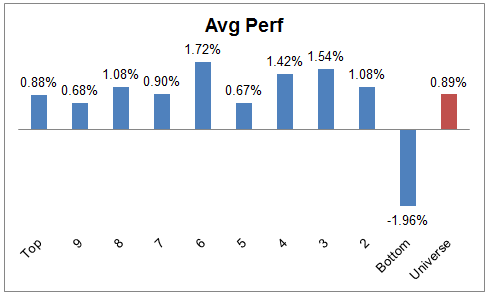
The table below shows the performance of a universe of mid and large cap U.S. equities, broken down by relative strength decile  and then compared to the universe return.  Those at the top of the ranks are those stocks which have the best intermediate-term relative strength.  Relative strength strategies buy securities that have strong intermediate-term relative strength and hold them as long as they remain strong.

Last week’s performance (5/13/13 – 5/17/13) is as follows:

ranks 05.20.13 Weekly RS Recap

Posted by:


Sector and Capitalization Performance

May 17, 2013

The chart below shows performance of US sectors and capitalizations over the trailing 12, 6, and 1 month(s).  Performance updated through 5/16/2013.

s c 5.17.13 Sector and Capitalization Performance

Numbers shown are price returns only and are not inclusive of transaction costs.  Source: iShares

Posted by:


Fund Flows

May 16, 2013

Mutual fund flow estimates are derived from data collected by The Investment Company Institute covering more than 95 percent of industry assets and are adjusted to represent industry totals.

5 16 2013 7 47 51 AM Fund Flows

Posted by:


High RS Diffusion Index

May 15, 2013

The chart below measures the percentage of high relative strength stocks that are trading above their 50-day moving average (universe of mid and large cap stocks.)  As of 4/30/13.

Capture3 High RS Diffusion Index

The 10-day moving average of this indicator is 84% and the one-day reading is 92%.

Posted by:


From the Archives: Investing Lies We Grew Up With

May 15, 2013

This is the title of a nice article by Brett Arends at Marketwatch.  He points out that a lot of our assumptions, especially regarding risk, are open to question.

Risk is an interesting topic for a lot of reasons, but principally (I think) because people seem to be obsessed with safety.  People gravitate like crazy to anything they perceive to be “safe.”  (Arnold Kling has an interesting meditation on safe assets here.)

Risk, though, is like matter–it can neither be created nor destroyed.  It just exists.  When you buy a safe investment, like a U.S. Treasury bill, you are not eliminating your risk; you are just switching out of the risk of losing your money into the risk of losing purchasing power.  The risk hasn’t gone away; you have just substituted one risk for another.  Good investing is just making sure you’re getting a reasonable return for the risk you are taking.

In general, investors–and people generally–are way too risk averse.  They often get snookered in deals that are supposed to be “low risk” mainly because their risk aversion leads them to lunge at anything pretending to be safe.  Psychologists, however, have documented that individuals make more errors from being too conservative than too aggressive.  Investors tend to make that same mistake.  For example, nothing is more revered than a steady-Eddie mutual fund.  Investors scour magazines and databases to find a fund that (paradoxically) is safe and has a big return.  (News flash: if such a fund existed, you wouldn’t have to look very hard.)

No one goes looking for high-volatility funds on purpose.  Yet, according to an article, Risk Rewards: Roller-Coaster Funds Are Worth the Ride at TheStreet.com:

Funds that post big returns in good years but also lose scads of money in down years still tend to do better over time than funds that post slow, steady returns without ever losing much.

The tendency for volatile investments to best those with steadier returns is even more pronounced over time. When we compared volatile funds with less volatile funds over a decade, those that tended to see big performance swings emerged the clear winners. They made roughly twice as much money over a decade.

That’s a game changer.  Now, clearly, risk aversion at the cost of long-term returns may be appropriate for some investors.  But if blind risk aversion is killing your long-term returns, you might want to re-think.  After all, eating Alpo is not very pleasant and Maalox is pretty cheap.  Maybe instead of worrying exclusively about volatility, we should give some consideration to returns as well.

—-this article originally appeared 3/3/2010.  A more recent take on this theme are the papers of C. Thomas Howard.  He points out that volatility is a short-term factors, while compounded returns are a long-term issue.  By focusing exclusively on volatility, we can often damage long term results.  He re-defines risk as underperformance, not volatility.  However one chooses to conceptualize it, blind risk aversion can be dangerous.

Posted by:


High RS Spread

May 14, 2013

The chart below is the spread between the relative strength leaders and relative strength laggards (universe of mid and large cap stocks).  When the chart is rising, relative strength leaders are performing better than relative strength laggards.    As of 5/13/2013:

Capture2 High RS Spread

Posted by:


Weekly RS Recap

May 13, 2013

The table below shows the performance of a universe of mid and large cap U.S. equities, broken down by relative strength decile and then compared to the universe return.  Those at the top of the ranks are those stocks which have the best intermediate-term relative strength.  Relative strength strategies buy securities that have strong intermediate-term relative strength and hold them as long as they remain strong.

Last week’s performance (5/6/13 – 5/10/13) is as follows:

ranks 05.13.13 Weekly RS Recap

Posted by:


Sector and Capitalization Performance

May 10, 2013

The chart below shows performance of US sectors and capitalizations over the trailing 12, 6, and 1 month(s). Performance updated through 5/9/2013.

gics 05.10.13 Sector and Capitalization Performance

Numbers shown are price returns only and are not inclusive of transaction costs. Source: iShares

Posted by:


PIE: Named Ticker of the Week

May 9, 2013

Bloomberg ETF Analyst, Erick Balchunas, names the PowerShares DWA Emerging Markets ETF (PIE) as the ticker of the week.  His commentary about PIE starts around the 1:18 mark.

Posted by:


Tax Rate Reminder

May 9, 2013

From Wesley Gray at Turnkey Analyst comes a reminder about tax rates.  Tax rates are going up, and how your investment is taxed may be as important as how it performs.  Here’s his table of maximum rates for high-bracket investors:

TaxRates zpsf11c682c Tax Rate Reminder

Source: Turnkey Analyst      (click on image to enlarge)

Most advisors have a lot of clients in the highest tax bracket, so this is quite applicable.  It’s pretty clear that the most tax efficient way to get growth is through long-term capital gains, and the most efficient way to get an income stream is through tax-free bonds and qualified dividends.

Two things strike me about these tax rates.  1) I would rather not pay them, and 2) It makes sense to think about how to structure your investment accounts and investment strategies to be tax efficient.

Tax-deferred accounts like IRAs and 401ks are perhaps even more valuable now that rates have gone up.  It might make sense to stuff in as much as you can.  For taxable accounts, muni bonds are even more attractive than before.  And equity strategies that cut losses and let the winners run (like relative strength) are going to be helpful due to their tax efficiency.  It also occurs to me that ETFs, especially those with smart beta that aim for market-beating performance, could be very attractive because of their tax efficiency.  (I’m partial to PDP, PIZ, PIE, and DWAS, but the point is generally applicable.)

Posted by:


Fund Flows

May 9, 2013

Mutual fund flow estimates are derived from data collected by The Investment Company Institute covering more than 95 percent of industry assets and are adjusted to represent industry totals.

ici 05.09.13 Fund Flows

Posted by:


High RS Diffusion Index

May 8, 2013

The chart below measures the percentage of high relative strength stocks that are trading above their 50-day moving average (universe of mid and large cap stocks.)  As of 4/30/13.

Capture1 High RS Diffusion Index

The 10-day moving average of this indicator is 77% and the one-day reading is 89%.

Posted by:


Investment Risk Re-imagined

May 8, 2013

Risk is fundamental to investing, but no one can agree what it is.  Modern Portfolio Theory defines it as standard deviation.  Tom Howard of AthenaInvest thinks investment risk is something completely different.  In an article at Advisor Perspectives, he explains how he believes investment risk should be defined, and why the MPT definition is completely wrong.  I think his point is a strong one.  I don’t know how investment risk should be defined—there’s a lot of disagreement within the industry—but I think he makes, at the very least, a very clear case for why volatility is not the correct definition.

Here’s how he lays out his argument:

The measures currently used within the investment industry to capture investment risk are really mostly measures of emotion. In order to deal with what is really important, let’s redefine investment risk as the chance of underperformance. As Buffett  suggests, focus on the final outcome and not on the path travelled to get there.

The suggestion that investment risk be measured as the chance of underperformance is intuitively  appealing to many investors. In fact, this measure of risk is widely used in a number of industries. For example, in industrial applications, the risk of  underperformance is measured by the probability that a component, unit or service will fail. Natural and manmade disasters use such a measure of risk. In each situation, the focus is on the chances that various final outcomes might occur. In general, the path to the outcome is less important and has little influence on the measure of risk.

I added the bold to highlight his preferred definition.  Next he takes on the common MPT measurement of risk as volatility and spells out why he thinks it is incorrect:

In an earlier article I reviewed the evidence regarding stock market volatility and showed that most volatility stems from crowds overreacting to information. Indeed, almost no volatility can be explained by changes in underlying economic fundamentals at the market and individual stock levels.  Volatility measures emotions, not necessarily investment risk. This is also true of other measures of risk, such as downside standard deviation, maximum drawdown and downside capture.

But unfortunately, the investment industry has adopted this same volatility as a risk measure that, rather than focusing on the final outcome, focuses on the bumpiness of the ride. A less bumpy ride is thought to be less risky, regardless of the final outcome. This leads to the unintended consequence of building portfolios that result in lower terminal wealth and, surprisingly, higher risk.

This happens because the industry mistakenly builds portfolios that minimize short-term volatility relative to long-term returns, placing emotion at the very heart of the long-horizon portfolio  construction process. This approach is popular because it legitimizes the  emotional reaction of investors to short-term volatility.

Thus risk and volatility are frequently thought of as being interchangeable. However, focusing on short-term volatility when building long horizon portfolios can have the unintended consequence of actually increasing investment risk. Since risk is the chance of underperformance, focusing on short-term volatility will often lead to investing in lower expected return markets with little impact on long-term volatility.1 Lowering expected portfolio return in an effort to reduce short-term volatility actually increases the chance of underperformance, which means increasing risk.

A clear example of this is the comparison of long-term stock and bond returns. Stocks dramatically outperform bonds over the long run. By investing in bonds rather than stocks, short-term volatility is reduced at the expense of decreasing long-term wealth. Equating short-term volatility with risk leads to inferior long-horizon portfolios.

The cost of equating risk and emotional volatility can be seen in other areas as well. Many investors pull out of the stock market when faced with heightened volatility. But research shows this is exactly when they should remain in the market and even increase their stock holdings, as subsequent returns are higher on average.2  It is also the case that many investors exit after market declines only to miss the subsequent rebounds. Following the 2008 market crash, investors withdrew billions of dollars from equity mutual funds during a period in which the stock market more than doubled.

The end result is that investors frequently suffer the pain of losses without capturing the subsequent gains. Several studies confirm that the typical equity mutual fund investor earns a return substantially less than the fund return because of poorly timed movements in and out of the fund. Again, these are the dangers of not carefully distinguishing emotions from risk and thus allowing emotions to drive investment decisions.

I added the bold here as well.  I apologize for such a big excerpt, but I think it’s important to get the full flavor here.  The implication, which he makes explicit later in the article, is that current risk measures are largely an agency issue.  The advisor is the “agent” for the client, and thus the advisor is likely to pander to the client’s emotions—because it results in less business risk (i.e., the client leaving) for the advisor.  Of course, as he points out in the excerpt above, letting emotions drive the bus results in poor investment results.

Tom Howard has hit the nail on the head.  Advisors often have the choice of a) pandering to the client’s emotions at the cost of substantial long-term return or b) losing the client.  Since investment firms are businesses, the normal decision is to retain the client—which, paradoxically, leads to more risk for the client.  While “the customer is always right” may be a fine motto for a retail business, it’s usually the other way around in the investment business!

There’s another wrinkle to investment risk too.  Regardless of how investment risk is defined, it’s unlikely that human nature is going to change.  No matter how much data and logic are thrown at clients, their emotions are still going to be prone to overwhelm them at inopportune times.   It’s here, I think, that advisors can really earn their keep, in two important ways, through both behavior and portfolio construction.

  1. Advisor Behavior: The advisor can stay calm under pressure.  Hand-holding, as it is called in the industry, is really, really important.  Almost no one gets good training on this subject.  They learn on the job, for better or worse.  If the advisor is calm, the client will usually calm down too.  A panicked advisor is unlikely to promote the mental stability of clients.
  2. Portfolio Construction: The portfolio can explicitly be built with volatility buckets.  The size of the low-volatility bucket may turn out to be more a function of the client’s level of emotional volatility than anything else.  A client with a long-horizon and a thick skin may not need that portfolio piece, but high-beta Nervous Nellies might require a bigger percentage than their actual portfolio objectives or balance sheet necessitate—because it’s their emotional balance sheet we’re dealing with, not their financial one.  Yes, this is sub-optimal from a return perspective, but not as sub-optimal as exceeding their emotional tolerance and having the client pull out at the bottom.  Emotional blowouts are financially expensive at the time they occur, but usually have big financial costs in the future as well in terms of client reluctance to re-engage.  Psychic damage can impact financial returns for multiple market cycles.

Tom Howard has laid out a very useful framework for thinking about investment risk.  He’s clearly right that volatility isn’t risk, but advisors still have to figure out a way to deal with the volatility that drives client emotions.  The better we deal with client emotions, the more we reduce their long-term risk.

Note: This argument and others are found in full form in Tom Howard’s paper on Behavioral Portfolio Management.  Of course I’m coming at things from a background in psychology, but I  think his framework is excellent.  Behavioral finance has been crying out for an underlying theory for years.  Maybe this is it.  It’s required reading for all advisors, in my opinion.

Posted by:


Client Sentiment Survey Results – 4/26/13

May 7, 2013

Our latest sentiment survey was open from 4/26/13 to 5/3/13.  The Dorsey, Wright Polo Shirt Raffle continues to drive advisor participation, and we greatly appreciate your support!  This round, we had 57 advisors (same as last time! thanks!) participate in the survey. If you believe, as we do, that markets are driven by supply and demand, client behavior is important.  We’re not asking what you think of the market—since most of our blog readers are financial advisors, we’re asking instead about the behavior of your clients.  Then we’re aggregating responses exclusively for our readership.  Your privacy will not be compromised in any way.

After the first 30 or so responses, the established pattern was simply magnified, so we are fairly comfortable about the statistical validity of our sample. Some statistical uncertainty this round comes from the fact that we only had four investors say that thier clients are more afraid of missing a stock upturn than being caught in a downdraft. Most of the responses were from the U.S., but we also had multiple advisors respond from at least two other countries. Let’s get down to an analysis of the data! Note: You can click on any of the charts to enlarge them.

Question 1. Based on their behavior, are your clients currently more afraid of: a) getting caught in a stock market downdraft, or b) missing a stock market upturn?

greatestfear 60 zps564a8972 Client Sentiment Survey Results   4/26/13

Chart 1: Greatest Fear.  From survey to survey, the market was basically flat.  Our indicators were once again a mixed back.  The fear of downdraft group rose from 74% to 79%, while the upturn group fell from 26% to 21%.

fearspread 4 zpse923fb13 Client Sentiment Survey Results   4/26/13

Chart 2: Greatest Fear Spread. Another way to look at this data is to examine the spread between the two groups.  The spread moved higher again, from 47% to 58%.

Question 2. Based on their behavior, how would you rate your clients’ current appetite for risk?

avgriskapp 50 zpsa30298ff Client Sentiment Survey Results   4/26/13

Chart 3: Average Risk Appetite.  Average risk appetite bounced this round, from 2.85 to 3.05.  We’re sitting just off of all-time risk appetite highs.

riskappcurve 2 zpsfa89f1b8 Client Sentiment Survey Results   4/26/13

Chart 4: Risk Appetite Bell Curve.  This chart uses a bell curve to break out the percentage of respondents at each risk appetite level.  This round, over 50% of all respondents wanted a risk appetite of 3.

riskappbell 8 zps7317964f Client Sentiment Survey Results   4/26/13

Chart 5: Risk appetite Bell Curve by Group.  The next three charts use cross-sectional data.  The chat plots the reported client risk appetite separately for the fear of downdraft and for the fear of missing upturn groups.  We can see the upturn group wants more risk, while the fear of downturn group is looking for less risk.

avgriskgroup 8 zps41a997a9 Client Sentiment Survey Results   4/26/13

Chart 6: Average Risk Appetite by Group.  This round, both groups’ risk appetite moved higher in a flat market.

riskappspread 50 zps5508b085 Client Sentiment Survey Results   4/26/13

Chart 7: Risk Appetite Spread.  This is a chart constructed from the data in Chart 6, where the average risk appetite of the downdraft group is subtracted from the average risk appetite of the missing upturn group.  The spread continues to trade within it’s normal range.

From survey to survey, the S&P was basically flat.  Client sentiment improved in some of our indicators, and fell in others.  Once again we see the overall risk appetite average acting as the most consistent indicator.  With client risk appetite near all-time survey highs, and the stock market currently hitting all-time highs, we hope to see those trends remain intact.

No one can predict the future, as we all know, so instead of prognosticating, we will sit back and enjoy the ride.  A rigorously tested, systematic investment process provides a great deal of comfort for clients during these types of fearful, highly uncertain market environments.  Until next time, good trading and thank you for participating.

Posted by:


Stock Market Valuation

May 7, 2013

Stock market valuation is always a concern for investors.  Presumably it always helps to buy when valuation is low.  However, I’m no expert on stock market valuation.  In the past, I’ve shown some bottom-up valuations constructed by Morningstar analysts.  They suggest the market is fairly valued right now.  Another way to look at it is top-down; that is, taking the big picture view of valuations.

That’s what Ed Yardeni of Dr. Ed’s Blog does.  From a big picture perspective, there are just two main variables in stock market valuation: earnings, and the multiple you put on those earnings.  Lots of firms estimate aggregate S&P 500 earnings.  (Top-down estimates actually tend to be a little more accurate than bottom-up estimates.)  In this version, he uses the Thomson Reuters IBES estimate.  For his estimate of the appropriate multiple, he uses 20 minus the 10-year yield.  That kind of thinking makes sense.  With low interest rates, the market has typically traded at a higher multiple.  When interest rates or inflation are high, the PE multiple tends to get compressed.  He points out that other versions of this chart, like using a multiple of 20 minus CPI inflation come out in the same ballpark.

Here’s the chart from his recent article on valuation:

YardeniValuation zps4bb27b89 Stock Market Valuation

Source: Dr. Ed’s Blog    (click on image to enlarge)

It’s an interesting chart, is it not?  Based on earnings, it suggested the market was significantly overvalued in the late 1990s, and then fairly valued from 2002 to 2007 or so.  The market dropped appropriately in response to weak earnings during the financial crisis, but is now about 30% undervalued, not having kept up with the rapid earnings growth we’ve seen since then.  The suggestion is that if earnings hold up, current stock prices are not out of line with the past decade.

It’s well worth reading the rest of the article, as Dr. Yardeni also discusses the relative valuation of stocks versus bonds.  (The whole blog is worth reading!  He is one of the more practically grounded economists out there.)

My takeaway on this is simply that the current market may not warrant the incredible amount of hand-wringing that we’ve seen as the S&P 500 has pushed to new highs.  Given the powerful corporate earnings we’ve seen, coupled with very low interest rates, the market’s valuation may be reasonable.  Yes, it feels scary because we are in new high ground, but the data looks different than we might feel emotionally.

Posted by:


Weekly RS Recap

May 6, 2013

The table below shows the performance of a universe of mid and large cap U.S. equities, broken down by relative strength decile and then compared to the universe return.  Those at the top of the ranks are those stocks which have the best intermediate-term relative strength.  Relative strength strategies buy securities that have strong intermediate-term relative strength and hold them as long as they remain strong.

Last week’s performance (4/26/13 – 5/3/13) is as follows:

Capture Weekly RS Recap


Posted by:


Sector and Capitalization Performance

May 3, 2013

The chart below shows performance of US sectors and capitalizations over the trailing 12, 6, and 1 month(s).  Performance updated through 5/2/2013.

gics 05.03.13 Sector and Capitalization Performance

Numbers shown are price returns only and are not inclusive of transaction costs.  Source: iShares

Posted by:


Clueless: The Stock Market is not the Economy

May 3, 2013

Morgan Housel has a fun article at Motley Fool with a possible explanation for why investors are so clueless.  His argument, essentially, is that investors confuse the stock market with the economy.  If the economy is bad, they assume the stock market must be bad too.  Although it’s certainly true that many investors are confused about the linkage between the stock market and the economy, I don’t know if that’s the real explanation or not—but it’s plausible.  Maybe I’ve just given up hope that we’ll ever understand investor irrationality!  To me, the most staggering part of his article is where he quotes an investor study from Franklin:

Take an annual survey by Franklin Templeton Investments. Near the start of each year, it asks 1,000 investors whether the S&P 500 went up or down in the previous year.

Now, we live in the age of CNBC and Yahoo! Finance and iPhone apps, where no one lacks the data to know a simple statistic like whether the market went up or down.

Yet year after year, the survey shows that swarms of investors are utterly clueless:

  • In 2010, 66% of investors said the S&P 500 fell in 2009. Yet it was actually up 26.5%.

  • In 2011, about half of investors said the market fell in 2010. Yet it was actually up 15%.

  • In 2012, 53% of investors said the market fell in 2011. Yet it was up 2%.

  • Just recently, 31% of investors said the market fell last year. Yet it was up 16%.

Mind-boggling, isn’t it?  During a strong three-year run in the market (2009-2011), more than half of the investors they polled thought it was going down!  Last year, the idea that the market might be going up began to sink in.  Given that the economy was actually growing slowly during much of that time, perhaps investors are imagining market performance is related to their own economic confidence or linked to their own desire to invest.  Whatever the linkage, it’s pretty clear they weren’t basing it on market data.

The more data-centric your investing approach is, the more likely it is that you’ll get somewhere close to reality.  If you are looking at relative strength data, it’s easier to see where the strongest trending markets have been—and also to see what’s been sinking.  A systematic investment process might be your best insurance policy.

Posted by:


From the Archives: Psychology That Drives Bull Markets

May 2, 2013

The Leuthold Group’s Doug Ramsey on the psychology that drives bull markets:

Cashing in on bull markets is not a matter of waiting for everything to line up, anyway.  There must be a set of intellectually appealing bear arguments keeping some players on the sidelines…it is these same players who will eventually drive prices even higher when “new” and intellectually appealing bull arguments belatedly appear on the scene.  I have found that some of the best bull market action occurs when the “bull/bear” arguments superficially appear to be in relative balance, confounding many market players.  When the balance tips too heavily to one side or the other, the odds are that most of the related market move is already in the books.

—-this article originally appeared 3/3/2010.  Thinking about this paradox is one of the things that led us to start our own sentiment survey focusing on client investment behavior.  Even now, many years into the bull market, clients are still behaving fairly cautiously, indicating they do not yet fully believe the bull argument.

Posted by:


Fund Flows

May 2, 2013

Mutual fund flow estimates are derived from data collected by The Investment Company Institute covering more than 95 percent of industry assets and are adjusted to represent industry totals.

ici 05.02.13 Fund Flows

Posted by:


DWTFX Leading the Pack YTD

May 1, 2013

According to Morningstar, The Arrow DWA Tactical Fund (DWTFX) is now outperforming 95% of its peers in the World Allocation category YTD.  Through April, the fund is up 9.79%

DWTFX DWTFX Leading the Pack YTD


You can access the fact sheet for the fund by clicking below:

fact sheet DWTFX Leading the Pack YTD


See www.arrowfunds.com for more information.  Past performance is not indicative of future results.  Potential for profits is accompanied by possibility of loss.

Posted by:


Financial Repression Primer

May 1, 2013

Research Affliliates published a very nice primer on financial repression on Advisor Perspectives.  It’s well worth reading to get the lay of the land.  Here’s how they define financial repression:

Financial repression refers to a set of governmental policies that keep real interest rates low or negative and regulate or manipulate a captive audience into investing in government debt. This results in cheap funding and will be a prime tool used by governments in highly indebted developed market economies to improve their balance sheets over the coming decades.

When you hear talk about “the new normal,” this is one of the features.  Most of us have not had to deal with financial repression during our investment careers.  In fact, for advisors in the 1970s and early 1980s, the problem was that interest rates were too high, not too low!

There are disparate views on the endgame from financial repression.  Some are expecting Japanese-style deflation, while others are looking for Weimar Republic inflation.  Maybe we will just muddle through.  In truth, there are many possible outcomes depending on the myriad of policy decisions that will be made in coming years.

In our view, guessing at the outcome of the political and economic process is hazardous.  We think it makes much more sense to be alert to the possibilities embedded in tactical asset allocation.  That allows you to pursue returns wherever they can be found at the time, without having to have a strong opinion on the eventual outcome.  Relative strength can often be a very useful guide in that process.

Posted by:


High RS Diffusion Index

May 1, 2013

The chart below measures the percentage of high relative strength stocks that are trading above their 50-day moving average (universe of mid and large cap stocks.)  As of 4/30/13.

diffusion 05.01.13 High RS Diffusion Index

The 10-day moving average of this indicator is 65% and the one-day reading is 76%.

Posted by:


Relative Strength Spread

April 30, 2013

The chart below is the spread between the relative strength leaders and relative strength laggards (universe of mid and large cap stocks).  When the chart is rising, relative strength leaders are performing better than relative strength laggards.    As of 4/29/2013:

spread 04.30.13 Relative Strength Spread

Posted by:


Weekly RS Recap

April 29, 2013

The table below shows the performance of a universe of mid and large cap U.S. equities, broken down by relative strength decile and then compared to the universe return.  Those at the top of the ranks are those stocks which have the best intermediate-term relative strength.  Relative strength strategies buy securities that have strong intermediate-term relative strength and hold them as long as they remain strong.

Last week’s performance (4/22/13 – 4/26/13) is as follows:

ranks 04.29.13 Weekly RS Recap

Posted by: