Netflix CEO: Willing To Cannibalize His Own Business

November 18, 2010

Fortune has an interesting profile of Reed Hastings, CEO of Netflix, that provides some color on how Netflix has been able to generate such exceptional performance:

Reed Hastings isn’t supposed to be here — not on a list of the year’s top businesspeople, and certainly not on the cover of Fortune. His DVD-by-mail company, Netflix, was supposed to have flamed out by now, a one-trick pony that was destined to be crushed by Blockbuster or Wal-Mart or Apple or you name it. He and his little red envelopes were supposed to be long gone, with Hastings toiling at some new startup, or perhaps enjoying an early retirement in Santa Cruz, Calif., the laid-back seaside city he calls home.

Whoops. Not only has Hastings earned the No. 1 spot on Fortune’s Businessperson of the Year list, he and Netflix (NFLX) are also killing it: The company he founded in 1997 is the stock of the year, up more than 200% since January, vs. the S&P 500′s tepid 7% gain. Its shares have run laps around even Apple’s. Expanding at home, and now internationally, Hastings has built his company on a hard-driving and risk-taking culture that has made him a guru to a new generation of Silicon Valley entrepreneurs. And his reach extends far beyond the Valley. Hastings already upended the movie distribution business; now he’s changing the media game again by streaming movies and television shows over the Internet — at the expense of Netflix’s still-booming DVD business. Cable companies hate him. Hollywood studios aren’t sure whether to embrace him or fend him off. Virtually every movie deal today includes an online-distribution component. Declares film producer Harvey Weinstein: “It’s because of Netflix.”

My emphasis added below on what seems to be his key to success.

An obsession with failure inspires Hastings to try new things, like offering $1 million to anyone who can make Netflix’s movie recommendation algorithms better. It also drives him to do what so many CEOs are afraid to do: cannibalize their own businesses.
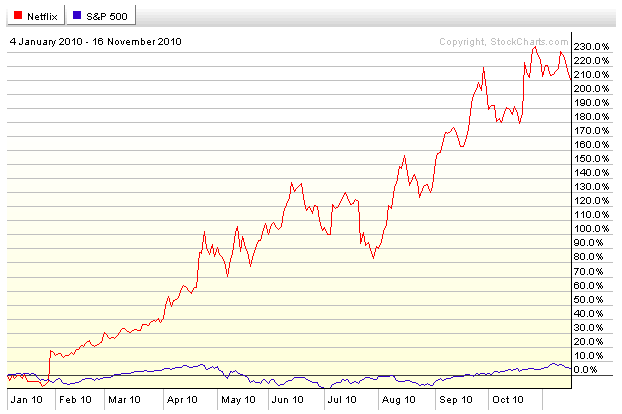
Source: StockCharts.com

The article also includes the following nugget:

In January 2005, Wedbush Securities stock analyst Michael Pachter called Netflix a “worthless piece of crap.” He put a price target of $3 on the stock, at the time trading around $11.

NFLX is currently trading at $168.

Disclosure: Dorsey Wright currently owns NFLX in our Aggressive portfolios and it is a holding in the PowerShares DWA Technical Leaders Index (PDP). A list of all trades over the previous 12 months is available upon request.


Who Has the Better Business Model?

September 23, 2010

And we didn’t even have to look at any fundamental data to answer this question.

(Click to Enlarge)

Disclosure: Dorsey Wright currently owns Netflix.


Who Makes Money In The Markets?

September 3, 2010

Derek Hernquist on who makes money in the markets:

Who makes money in the markets? Sometimes it’s the guy with the opinion, and he gets books written about him like John Paulson. Good for him…I think it was more about the low risk/high reward purchase he made on those credit default swaps, but his prediction paid off.

Generally two types of investors make money over time…value investors and momentum investors. Why? Because they’re willing to act when most aren’t. Their success doesn’t hinge on predicting an outcome…it hinges on someone later paying a much higher price than you pay now. The value investor scours the balance sheet, develops a thesis on what “fair value” is, and if it’s well enough below, buys the stock and waits. If fundamentals improve, it’s a home run instead of a double…but the payoff is not contingent on that outcome.

On the other spectrum, the momentum investor looks at rising price or explosive growth and joins in…seems silly, but since most are afraid to pay up there’s actually only a small % of participants aboard. He’s not making a prediction, he’s making an observation…this thing is going up, and I’m going to be involved until it stops going up. Simple, but often effective as most are too worried they missed the boat already…how many people do you know that have actually owned NFLX or CRM or BIDU for more than a week?

Full disclosure: Dorsey Wright owns NFLX, CRM, and BIDU.


Adapt or Die Chronicles

March 23, 2010

Our subject today is Blockbuster Entertainment. This article on the Atlantic Business Channel brought to my attention that Blockbuster is on the verge of bankruptcy. Back in the day of the VCR tape, Blockbuster was the largest and healthiest video rental chain. So what happened?

Atlantic’s article suggests three different possible reasons for Blockbuster’s demise, one of which was Netflix. I’m not so interested in why Blockbuster’s fundamentals deteriorated, but I am pretty interested to see what the comparative performance was for the two stocks in the market. That’s what relative strength is, after all.

source: Yahoo Finance. Click to enlarge.

If you are curious too, here are the charts for the last two years or so. Netflix is up substantially, while Blockbuster has gone nearly to zero. Relative strength sorted out the fundamentals just fine, by letting the market be the judge.

Relative strength is powerful because it is objective and because it measures market performance directly. Analysts who examine fundamentals try to ascertain what the ultimate impact will be on the market price; relative strength just measures the market price directly. As you can see, the signal from the market is often worth paying attention to.

Disclosure: Some Dorsey, Wright managed accounts currently have a position in Netflix (NFLX).