Dollar Under Pressure

June 27, 2009

The U.S. dollar has occupied a very privileged position since World War II—it has effectively become the world’s reserve currency. This privilege was earned by having a robust economy and a stable political system. Other countries, when they wanted to hold cash, often opted for dollars because they were safe and readily exchangeable.

A huge benefit of being the owner of the world’s reserve currency is that the U.S. has always been able to float government and corporate debt on very favorable terms because there has been such a strong demand for dollars outside the U.S. If other countries want to do government spending, it is much more expensive because they have to entice buyers outside their domestic market (with higher interest rates) to hold their currency. The U.S. has gained a significant economic advantage by being able to borrow money more cheaply than everyone else.

While the U.S. still has the largest economy in the world, it is not growing right now. Emerging economies like China, India, and Brazil have much higher growth rates than the U.S., and they are beginning to assert their economic clout. Fueled by decades of deficit spending, and perhaps egged on by its low borrowing costs, the U.S. government has now borrowed so much money that other countries are beginning to complain. The Chinese central bank, in particular, would like to replace the dollar with Special Drawing Rights (SDRs) as the de-facto reserve currency. SDRs are currently composed of a basket of four currencies: the dollar, the yen, the euro, and the pound. China would like to add the yuan to the basket as a fifth currency, so that they too could become a preferential borrower.

It’s unclear how the politics of the reserve currency will play out this time around, but with continuing massive deficit spending, enormous amounts of U.S. debt outstanding, and so much of it owned abroad, it’s clear that this will not be the last challenge to the special status of the dollar. Domestic investors are going to need to think globally and allocate globally to have investment success in the future.

Posted by:


The “Impossible” Happens!

June 26, 2009

Clients often flock to advisors who “made a good call on the market.” They have the mistaken belief that markets—or things generally—are much more predictable than they really are.

The New York Times reports that Betfair, a London online wagering service, has gathered total bets worldwide of only $51(!) for the U.S. soccer team to win the Confederations Cup. Yet the U.S. team, by virtue of beating world #1 Spain, will be facing Brazil in the final. It just wasn’t supposed to happen.

Financial markets are much the same way. Unlikely or “impossible” things happen all the time. Rather than trying to guess what will happen, doesn’t it make more sense to stop predicting and use a method that adapts as markets change?

Posted by:


Emerging Markets Lead

June 26, 2009

As this article from the New York Times and International Herald Tribune points out, the quickest economic recovery has been seen in Brazil, China, and India. I’m not surprised that is the case, since the EAFE index has demonstrated recent strength against the S&P; 500. Our Systematic RS International portfolio is running well ahead of EAFE so far this year, probably due to its emphasis on Asia and Latin America. This is not due to any insight on our part, but simply because that’s where relative strength has been highest.

Americans tend to have a Ptolemaic worldview, where we believe everything revolves around us. Yet our economy is increasingly linked to the rest of the world through intricate mercantile relationships. It might take a while, but we’re going to need to get used to looking globally for investment themes.

Posted by:


Recessionary Inflection Points And High RS

June 26, 2009

More often than not in investing, the trend is your friend. But from March 9th until June 16th the opposite was true: previous losers outperformed previous winners by a staggering 135% (best 10% minus worst 10% of O’Shaughnessey’s All Stock Universe).

(click to enlarge)

As pointed out by Jim O’Shaughnessey, there have been several other periods in which low momentum stocks outperformed high momentum stocks. In general, these periods are aligned with recessionary inflection points where stock leadership changes dramatically. Importantly, following the 10 worst periods for momentum investing, the strategy has returned to form and beaten the market by an average of roughly 7% annually over the subsequent 12 months.

We have noticed that high relative strength stocks seemed to have turned the corner in the last couple weeks.

The chart below is the spread between the relative strength leaders and relative strength laggards (universe of mid and large cap stocks). When the chart is rising, relative strength leaders are performing better than relative strength laggards.
(click to enlarge)

I suspect we could be embarking on a favorable period for relative strength strategies.

Posted by:


4 Investment Rules to Ignore

June 25, 2009

Christine Benz, the personal finance expert at Morningstar, has an excellent article about the four investment rules to ignore. These “rules” are in wide practice throughout the industry, but they don’t hold up under close inspection. In fact, they will destroy your long-term returns if you let them.

1. Consistency of returns is important in investment selection.

2. If an investment has been a laggard over the past three or five years, cut it loose.

3. Your risk tolerance should determine your asset allocation.

4. It’s ok to go to cash when you are nervous about the market.

This article is a must-read.

Posted by:


Inflation Forecasts

June 25, 2009

Paul McCulley of PIMCO thinks that we are a long way away from inflation. He believes that with the deflation in asset prices and consequent deleveraging, the surplus in labor and productive capacity will keep inflation at bay for many years. Warren Buffet believes that inflation is not an immediate problem, but that so much money has been pumped into the system that we could have an inflation problem in a year or two. And economist John Williams of Shadowstats thinks that the U.S. is likely to experience hyperinflation as early as 2010.

All three commentators are widely respected for their acumen, but their opinions on inflation cover the entire spectrum. I probably wouldn’t have to look very hard to find another economist with a good reputation that is voting for deflation.

How should you handle this as an investor? If you position your portfolio to take advantage of one of these scenarios, what do you do if it turns out a different opinion was correct? Perhaps a more flexible, tactical methodology is required.

We think this is one of the strongest arguments in favor of a systematic, trend following approach using relative strength. Regardless of the scenario that unfolds, relative strength will identify the strongest trends and get exposure to them.

Posted by:


AAPL vs. PALM

June 24, 2009

After reading this you’d probably never guess that PALM stock is 284% ahead of AAPL in 2009.

Disclosure: We own positions in both stocks in some of our managed products.

Posted by:


You’re On Your Own

June 24, 2009

According to a recent article in the Economist, the U.S. is one of the leaders in having retirement income come from private sources (i.e., pension plans rather than government checks). This could mean that our Social Security system is meager compared to many other countries, or it could mean that our industrial companies have traditionally been very, or perhaps, overly generous in the benefits paid out.

Over the last decade or so, there has been a very strong trend in place whereby corporate American has moved away from defined-benefit pension plans based on earnings and years of service and toward defined-contribution plans like 401k’s, where the employee saves his or her own money and makes the investment decisions. It’s an open question as to whether these defined-contribution plans at retirement will be able to supply anywhere near the same level of income as the traditional defined-benefit plans.

Will American retirees simply make do with less? If nothing else, it’s clear that retirement planning is more important than ever before.

Posted by:


Currency tailwind

June 24, 2009

The fact that investors hold modest amounts of foreign equity has been well documented. People simply are more comfortable investing in their home country, despite the potential benefits of increasing their international equity exposure.

Much has been written about the risks of a continued slide in the dollar given the massive amounts of debt that the U.S. government is taking on. However, a falling dollar is a big benefit to U.S. investors holding international investments as a result of the currency tailwind.

Consider the significant difference to performance that a falling dollar has made so far this year:

Source: The Economist, June 20, 2009, based on year-to-date national stock indexes through June 17, 2009

Posted by:


To add to your confusion

June 23, 2009

If you have experienced significant losses in the stock market over the last year and a half, are already in retirement, and are a little confused about what changes to make to your investments, reading Tara Bernard’s article in the New York Times will insure even greater confusion! Should you become more aggressive to combat the coming inflation, become more defensive to prepare for the possibility of a Japan-like anemic recovery, have a bond position equal to your age, ratchet your stock exposure down by 2% every year once you turn 60, further diversify by owning more real estate, have at least 30% in international equities, wade back into the domestic equity market over the next 2 years so that you avoid doing anything in a hurry, set aside 8-15 years in cash and bonds for food, utilities, and insurance, invest 10% of annual expenses in a bond ladder with equal amounts due every six months, purchase an immediate annuity…? Each financial planner interviewed for that article had a different opinion.

With so many investors reading articles like that in an attempt to stay informed it is no wonder so many are flat out confused.

Thank goodness for global tactical asset allocation strategies, like our Global Macro strategy, which provide a clear framework for allocating among a broad range of asset classes. Come what may, Global Macro is designed to be flexible enough to systematically adapt.

Click here for disclosures from Dorsey Wright Money Management.

Posted by:


Inside Today’s Performance

June 23, 2009

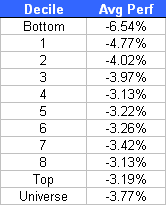
It was a unremarkable day for stocks today. Not much action at all. In terms of RS performance, both the highest and lowest deciles didn’t fare as well as the universe average. The best performance came from the lower ranked stocks, but not from the lowest ranked stocks (if that makes any sense).

Decile

A lot of the poor performance in the top decile RS stocks came from the restaurant group. I checked a couple of the names for a news item, but didn’t find anything that would usually cause such a large amount of underperformance from an entire group. CAKE, BOBE, DRI, EAT, and CMG were all down substantially more than the market today. When you look at the performance of the top 3 deciles for today you can see that in other areas the performance of high RS stocks was actually stronger than it looks.

DecileGroup

Posted by:


Most Investors are Killing Themselves in ETFs

June 23, 2009

In this interesting article from Index Universe, John Bogle points out that investors are not acting in their own best interests when they trade ETFs. First, he phrases it as ETFs aren’t in the best interests of investors. Then he amends it to say that really investors aren’t acting in their own best interests.

In truth, these results, which show ETF investor results lagging mutual fund investor results, have nothing to do with the vehicle and everything to do with investor time horizons and emotional trading. ETFs are simply easier to trade, which allows people to either fine tune their entries and exits, or to completely muck it up.

The evidence is largely in favor of the “muck it up” theory. I’m sure investors are trying to do better by trading, but they are objectively making their results worse. This is the result of trading emotionally and not having a systematic method for executing your plan.

Posted by:


Today’s RS Performance

June 22, 2009

It was a terrible day for the stock market. The broad market indexes all dropped 3% or more on concerns that the global economy might not be doing as well as people had thought. It’s amazing how quickly sentiment can change!

When stocks were going well, the areas that were leading were the Banks, Energy, and Commodity groups. These are all areas that would benefit from a growing global economy. These are also the areas that have been hit the hardest during the current pullback. High RS stocks have held up much better than the laggards over the last week or so. Today’s performance showed a huge spread between the High RS stocks and Low RS stocks:

Decile

The top 6 deciles all outperformed the equal weighted universe. The real damage was done in the bottom decile – 277 bps worse than the average. When you break the universe out by decile and industry group you get a clear picture of where the real damage came from:

(click to enlarge image)

The Materials, Energy, and Financials stocks from the bottom decile got hammered today. Energy stocks from our bottom decile were down over 10% on average.

Technology stocks as a group had marginal outperformance today. QQQQ and SPY were down about the same amount, but in out equal weighted universe Technology outperformed by about 20-25 bps. This outperformance is certainly not earth shattering, but what I find interesting is that Tech did well during the rally and seems to be holding its gains better than some of the other leading groups. Even the bottom deciles in Technology performed OK today.

Posted by:


Interview with Louis S. Harvey

June 22, 2009

Click here to read my recent interview with Louis S. Harvey, president of Dalbar. Dalbar has been studying behavioral finance since 1990, well before it even had a name. This should make you think twice about investing based on what feels right. The bottom line: Investment return is far more dependent on investor behavior than on fund performance.

Posted by:


“The Uninvestables”

June 19, 2009

The Quantitative Investing Team at Turner Investment Partners has a great report (click here for the full report) about the characteristics of the current rally off the bottom. We have written about this laggard rally quite a bit in the last month. It has been such a historic laggard rally that we are seeing a lot of research coming out that puts things into perspective.

Turner’s team focuses on small cap stocks, which is different than our universe. We tend to focus on the mid to large cap universe, but it seems the small and micro caps have seen the exact same phenomenon. They have a couple of fundamental factors they examine, but also include price momentum. Their conclusion:

“In our analysis, this rally was an atypical, perverse phenomenon, a statistical fat tail, an investing anomaly. We doubt that any time soon we will encounter a stock market rally that so lavishly rewards The Uninvestables….”

In financial markets it seems the “statistical fat tail” occurs much more often than people think, so I’m not sure if we will see this type of rally again soon or not. The proverbial 100 year storm seems to come every 5 years or so. But I do agree that with their analysis that this rally has been statistically out of the norm, and one that has been difficult to navigate if you invest in strong RS or momentum securities.

Posted by:


Leverage and Its Discontents

June 18, 2009

There are lots of culprits in the current financial crisis and now major regulatory changes have been proposed to deal with all of the presumed issues. But underlying almost every one of the individual issues from commercial real estate lending, subprime mortgages, credit default swaps, home foreclosures, and corporate and personal bankruptcies is a more global meta-issue: leverage. Even significant declines in asset prices are manageable, albeit unpleasant, if leverage is not excessive.

This Ahead of the Tape piece from the Wall Street Journal points out the need for a leverage scorecard and transparency about who is borrowing what. Something this simple would go a long way toward preventing future systemic problems. (I’m crossing my fingers that the link is public!)

Posted by:


Fixing Fund Manager Behavior

June 18, 2009

Cabot Research is on the cutting edge of behavioral finance. (You can read a recent article here.) They gather fund manager transactional data and try to figure out what the manager is doing right and what can be improved by changing behavior. They claim to be able to improve performance by up to 100 basis points, even with professional fund managers, simply by addressing the systematic errors in behavior that are being made.

At Dorsey, Wright Money Management, we’ve taken a slightly more rigorous approach. Instead of trying to modify our behavior—and hoping that the fixes persist over time—we test everything. That makes it easy to see what happens when one variable is changed. The whole investment process can be de-constructed and examined, which is something of an ongoing project here. Like Cabot, we find that correct long-term investment decisions are sometimes counter-intuitive. You wouldn’t be able to sort that out without testing.

Posted by:


Target Date Fund Regulation?

June 18, 2009

There is more controversy about target date funds–their asset allocation, disclosure requirements, and whether and/or how they should be regulated. The root of the problem is that many target date funds did poorly in 2008 because they had large equity allocations in their glide path to retirement. There seems to be some pressure to make them more “conservative” by boosting the allocation to bonds. So what happens to workers who become retirees in a rising interest rate environment? How is that any better?

In my opinion, target date funds were oversold as the answer to every investor’s problem of how to handle their 401k. Target date funds were presented as the ultimate “set it and forget it” solution. Eventually, investors may come around to realize that strategic allocation solutions are not the be-all-and-end all. A tactical product can adapt to the situation at hand, rather than simply continuing down a potentially flawed glide path. Even though they require more thought and expertise, well-executed tactical solutions (like our Systematic RS Global Macro product or the Arrow DWA Balanced Fund) have a lot to recommend them.

Click here to visit ArrowFunds.com for a prospectus & disclosures. Click here for disclosures from Dorsey Wright Money Management.

Posted by:


Dalbar

June 17, 2009

Dalbar recently released their 2009 edition of their Quantitative Analysis of Investor Behavior (QAIB). (You can access an extract here.)

As usual, the news is not pretty. Investors managed equity returns of 1.87% over the last 20 years, while the S&P; 500 returned 8.35%. In other words, investors lagged the market by almost 6.5% annually. In fact, investor returns in equities were lower than inflation.

Dalbar’s conclusion–under the heading Bad Decisions Lead to Poor Results (!)– is that when the going gets tough, investors panic. This is the fifteenth year that they have put out their QAIB, so they’ve got a pretty good idea they’re right on this point. I would have to agree with them, since everyone in the industry sees the same pattern in their account flows.

But perhaps there is more to it. It’s easy to imagine investors getting panicked out of the stock market. It’s quite volatile at times and can have some hair-raising declines. Fixed income, on the other hand, is generally thought of as a very staid investment, something appropriate for the old and stuffy, like the classic t-shirt with the Monopoly guy that reads “Gentlemen Prefer Bonds.” Fixed income is presumed to be something that you buy and hold for the income stream, not something that is actively traded. Yet, surprisingly, fixed income investors do no better on a relative basis. Their return over the last 20 years was just 0.77%, again about 6.5% annually worse than the Barclays Aggregate Bond Index, which came in at 7.43%.

One unfortunate commonality between stock fund and bond fund investors was their average holding period: way, way too short. Equity investors held for an average of 3.11 years, while fixed income investors held for 2.69 years. The average business cycle is longer than that! Think about it–the only “expertise” an equity investor had to have to earn 8.35% over the past 20 years was patience. The investor didn’t have to do anything clever or perform any market analysis. The returns were there if you were simply willing to be a slug and not do anything! If you are wiggling in your seat every time you invest, perhaps you have RDD–Return Deficit Disorder.

Active investment management attempts to improve upon market returns, and there are several proven methods for achieving those excess returns. But none of them are going to be very successful until the investor can sit still through at least a couple of market cycles. Do your due diligence thoroughly, choose carefully, and then sit tight and let the process work.

Posted by:


Things That Make You Go Hmmm….

June 17, 2009

I’m not a conspiracy theorist at heart. But sometimes something comes across your desk (or since we’re in the 21st century, comes through your e-mail) that makes you go hmmmmm……..

Weeden & Co. is estimating over $7 Billion in flows at the market close on Friday to rebalance a number of indexes. Because shares outstanding have changed due to tons of secondary offerings (i.e. Banks), lots of sector weights will change. The biggest change will be an increase in the weighting for Financials.

In a shocking concidence, S&P; lowered the credit ratings on 18 Banks this morning. They announced the downgrade two days before they are going to buy a bunch of these banks and increase the weighting in their own index.

The big picture is that with the proliferation of ETF’s, index performance has become competitive. Indexes no longer represent the overall economy, market, or something else. They are now a means to get assets under management, and when one index outperforms another people move money from one ETF to another. It’s real money we’re talking about, and adding a few extra basis points of performance might add up to millions in licensing fees.

The timing is nothing short of remarkable. The index might be “passive” but the news you can release is active! If you’re an investor in SPY or an S&P; 500 index fund buying financials on the cheap will most likely help your performance so you certainly have nothing to complain about. What is a concern is how the performance derby will affect these indexes over time.

Posted by:


Fallibility of Journalism

June 11, 2009

Jeff Jarvis recently discussed the ongoing argument between old media (like newspapers and television) and new media (like blogs). I find the superiority complex of the old media to be amusing and incredibly pathetic. I’ve got some beach front property in Nevada to sell anyone who believes that journalism is largely about “seeking nothing less lofty than the truth.”

Jarvis points out that journalism, whether in old media or new media, is far from infallible.

“Nobody’s perfect – not even journalists . . . especially not journalists.

Reporters and editors make mistakes. Indeed, they are probably more likely than most to do so. For just as bartenders break more glass because they handle more beer, so journalists who traffic in facts are bound to drop some along the way.

Yet too often, they won’t admit that. What is plainly obvious – even a matter of liturgical confession for people of many faiths – is heretical to the reporting cult: People are fallible. But journalists too often believe they are not.”

When it comes to investing, relying on the opinions of others is a sure way to failure. I prefer to accept journalism (whether found in the old media or new media) for what it often is: agenda driven opinion.

When it comes to investing, I rely on a single, simple, reliable core piece of information: price.

Posted by:


Buying High and Selling Low

June 10, 2009

Everyone knows that you aren’t supposed to buy high and sell low, but many do it anyway.

The following chart is taken from The Fundamental Index by Robert Arnott, Jason C. Hsu, & John M. West. The chart shows the magnitude of underperformance for the average mutual fund investor.

Successfully investing has more to do with controlling emotions (which generally lead you do do the wrong thing at the wrong time) than anything else.

Posted by:


Crosscurrents

June 9, 2009

A laggard rally always produces quite a few crosscurrents that makes using an RS strategy very difficult. Many of the big returns since the market low have been in the beaten down Banking stocks. That group has been getting quite a bit of media attention (both good and bad) during their decline and subsequent ascent. Whenever the media focuses on something it often makes it difficult to find the forest through the trees! How well have these stocks really done?

We track a number of RS factors here. One set we track is simple price return over X months. While very simple, this type of factor is used extensively in academic research so it makes sense to track them. The periods we will look at for this exercise are 3 months, 6 months, 9 months and 12 months. We do track a 1 month RS factor, but everyone’s research (including our own) indicates a 1 month RS factor is a sure way to underperform over the long term so we will exclude it. The best returns usually come from the 6 to 12 month periods. In addition to better returns, the longer RS measures tend to have much less turnover compared to the shorter measures.

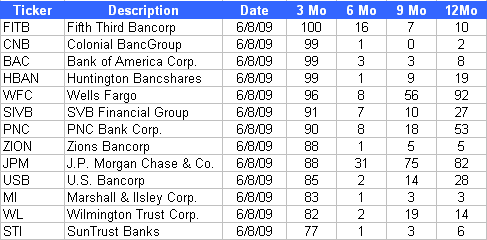
The chart below shows all of the Banking stocks in our universe that are in the top quartile for 3 month return. We have also included the percentile rankings for 6, 9, and 12 months.

Banks

Keep in mind that at a 3 month RS interval there is a ton of turnover. Another way of looking at it: there are a lot of whipsaws. More often than not, buying securities in the top ranked quartile or decile based on a 3 month trailing return doesn’t work out. Sometimes it does; we won’t know for sure in this case for another few months.

Also notice the ranks on the longer term RS factors. Many of these stocks are still in the bottom decile on a trailing 12 month return. If you’ve owned these stocks for any length of time you still aren’t happy. WFC and JPM score well out to a 12 month horizon, but even those two stocks don’t score that well on 6 and 9 month lookbacks. The ranks are all over the place! If you’re using a very short term RS factor you might be picking some of these stocks up already. However, using a very short term RS factor doesn’t test as well over the long term as longer term lookbacks.

So what do you do about this? Well, I’m not sure a whole lot can be done. We know there are quite a few whipsaws at lookbacks of 3 months and shorter. This could be one of those times. If not, and these stocks keep moving higher, they will eventually find their way into the upper ranks of the longer term RS factors. These are the areas that have proven to be more durable over time. It’s very tricky to make tweaks to your strategy based on short-term performance. Usually you make the change at the wrong time. When you have a long term factor that has the proven ability to find and exploit trends you have to accept the short term gyrations that the market throws at you.

Posted by:


Side-effect of inefficient markets

June 9, 2009

In Robert Shiller’s case for the continued decline of home prices in the U.S., he makes the following statement:

“Steady housing price declines seem to defy both common sense and the traditional laws of economics, which assume that people act rationally and that markets are efficient. Why would a sensible person watch the value of his home fall for years, only to sell for a big loss? Why not sell early in the cycle? If people acted as the efficient-market theory says they should, prices would come down right away, not gradually over years, and these cycles would be much shorter.”

People don’t change their views about asset values all at once, as believed by the efficient market types. There is a cascading effect that leads to long term trends.

Now if there were just a way to identify those long-term trends…:)

Posted by:


Bill Gross to Policy Portfolio: Drop Dead!

June 4, 2009

At the recent Morningstar Investment Conference, Bill Gross of Pimco laid out his “Seven Commandments” for investing in the current environment. At the top of the list was this: the policy portfolio (the standard 60% stocks/40% bonds) is dead.

Several of his other commandments stressed the importance of international markets and the dollar. All of these things are a little unfamiliar to domestic investors. We’ve gotten used to having the largest, more liquid, and best equity market in the world. We didn’t need to look anywhere else.

It turns out that this has been a narrow view. Investment management firms from small countries like the Netherlands or Scotland have been evaluating opportunities overseas and investing in them for centuries. Much of the world, in fact, has been explored and settled largely in the search for outside investment opportunities!

What is going to replace the now moribund policy portfolio? I suppose the jury is still out, but I suspect it will be a more global multi-asset portfolio that could bear a striking resemblance to our Systematic RS Global Macro portfolio or to the Arrow DWA Balanced Fund (DWAFX).

Click here to visit ArrowFunds.com for a prospectus & disclosures. Click here for disclosures from Dorsey Wright Money Management.

Posted by: