From the Archives: Investing Lies We Grew Up With

May 15, 2013

This is the title of a nice article by Brett Arends at Marketwatch.  He points out that a lot of our assumptions, especially regarding risk, are open to question.

Risk is an interesting topic for a lot of reasons, but principally (I think) because people seem to be obsessed with safety.  People gravitate like crazy to anything they perceive to be “safe.”  (Arnold Kling has an interesting meditation on safe assets here.)

Risk, though, is like matter–it can neither be created nor destroyed.  It just exists.  When you buy a safe investment, like a U.S. Treasury bill, you are not eliminating your risk; you are just switching out of the risk of losing your money into the risk of losing purchasing power.  The risk hasn’t gone away; you have just substituted one risk for another.  Good investing is just making sure you’re getting a reasonable return for the risk you are taking.

In general, investors–and people generally–are way too risk averse.  They often get snookered in deals that are supposed to be “low risk” mainly because their risk aversion leads them to lunge at anything pretending to be safe.  Psychologists, however, have documented that individuals make more errors from being too conservative than too aggressive.  Investors tend to make that same mistake.  For example, nothing is more revered than a steady-Eddie mutual fund.  Investors scour magazines and databases to find a fund that (paradoxically) is safe and has a big return.  (News flash: if such a fund existed, you wouldn’t have to look very hard.)

No one goes looking for high-volatility funds on purpose.  Yet, according to an article, Risk Rewards: Roller-Coaster Funds Are Worth the Ride at TheStreet.com:

Funds that post big returns in good years but also lose scads of money in down years still tend to do better over time than funds that post slow, steady returns without ever losing much.

The tendency for volatile investments to best those with steadier returns is even more pronounced over time. When we compared volatile funds with less volatile funds over a decade, those that tended to see big performance swings emerged the clear winners. They made roughly twice as much money over a decade.

That’s a game changer.  Now, clearly, risk aversion at the cost of long-term returns may be appropriate for some investors.  But if blind risk aversion is killing your long-term returns, you might want to re-think.  After all, eating Alpo is not very pleasant and Maalox is pretty cheap.  Maybe instead of worrying exclusively about volatility, we should give some consideration to returns as well.

—-this article originally appeared 3/3/2010.  A more recent take on this theme are the papers of C. Thomas Howard.  He points out that volatility is a short-term factors, while compounded returns are a long-term issue.  By focusing exclusively on volatility, we can often damage long term results.  He re-defines risk as underperformance, not volatility.  However one chooses to conceptualize it, blind risk aversion can be dangerous.

Posted by:


From the Archives: Life Expectancy at Retirement

May 13, 2013

retirement From the Archives: Life Expectancy at Retirement

Source: The Economist, via Greg Mankiw.

Americans, as well as citizens of many other advanced nations, now spend about twice as many years in retirement as they did a generation or two ago.  Aggressive saving and adherence to a well-thought-out investment plan are more important today than they have ever been.  It is a big mistake for today’s 65-year olds to no longer consider themselves to be “long-term investors.”

—-this article originally appeared 3/1/2010.  As you can see from the graphic, the average US 66-year old retiree spends another 15-20 years in retirement.  That’s long enough that investment performance is going to be important.

Posted by:


From the Archives: Forecasting, Schmorecasting

May 6, 2013

We’ve written about the uselessness of forecasting in the past and even cited James Montier’s wonderful piece, The Seven Sins of Fund Management.  This citation comes from Mebane Faber’s World Beta blog.  Montier writes:

The two most common biases are over-optimism and overconfidence. Overconfidence refers to a situation whereby people are surprised more often than they expect to be. Effectively people are generally much too sure about their ability to predict. This tendency is particularly pronounced amongst experts. That is to say, experts are more overconfident than lay people. This is consistent with the illusion of knowledge driving overconfidence.

Dunning and colleagues have documented that the worst performers are generally the most overconfident. They argue that such individuals suffer a double curse of being unskilled and unaware of it. Dunning et al argue that the skills needed to produce correct responses are virtually identical to those needed to self-evaluate the potential accuracy of responses. Hence the problem.

This is irony in action.  Knowledge drives overconfidence, so people who actually know something about a topic are more prone to think they can forecast, and they probably even sound more believable.  And finally, the worst performers are the most overconfident!

This may be one of the few instances in which ignorance is bliss.  If you have the Zen “beginner’s mind” and don’t make any assumptions about what might happen, you’re going to be better off than if you are knowledgeable and try to guess.

Systematic trend-following eliminates the need to forecast (although apparently not the desire, since we have clients constantly asking us what we think is going to happen).  We use relative strength to drive our trend-following; it is able to pick out the strongest trends, and those are the trends we are interested in following.  We stay with an asset as long as it remains strong.  When it weakens, we kick it out of the portfolio and replace it with something stronger.  This kind of casting-out method allows the portfolio to adapt to the market environment, as it is constantly refreshed with new, strong assets.

Despite having a logical and simple method that performs well over time and eliminates the need to forecast, soothsayers will probably always be with us—but your best bet is to ignore them.

—-this article originally appeared 3/2/2013.  Of course the lesson is timeless.

Posted by:


From the Archives: Psychology That Drives Bull Markets

May 2, 2013

The Leuthold Group’s Doug Ramsey on the psychology that drives bull markets:

Cashing in on bull markets is not a matter of waiting for everything to line up, anyway.  There must be a set of intellectually appealing bear arguments keeping some players on the sidelines…it is these same players who will eventually drive prices even higher when “new” and intellectually appealing bull arguments belatedly appear on the scene.  I have found that some of the best bull market action occurs when the “bull/bear” arguments superficially appear to be in relative balance, confounding many market players.  When the balance tips too heavily to one side or the other, the odds are that most of the related market move is already in the books.

—-this article originally appeared 3/3/2010.  Thinking about this paradox is one of the things that led us to start our own sentiment survey focusing on client investment behavior.  Even now, many years into the bull market, clients are still behaving fairly cautiously, indicating they do not yet fully believe the bull argument.

Posted by:


From the Archives: I Want to Buy Losers

April 4, 2013

I cringe every time I read an article by a value investor that says something like, “You should buy stocks that are on sale, just like you buy [pick your consumer item] on sale.”  In the financial markets that can be dangerous.

In a great essay titled, I Want to Buy Losers, Clay Allen of Market Dynamics discusses the problems with this analogy.  [You've got to read the whole essay to really appreciate it.]

Many investors buy stocks the way many consumers buy paper towels or any other staple. They are attracted to a sale and loss leaders are a proven method for a retailer to increase the traffic in their store. The value of the item is well known and a sale price gets the attention of potential buyers.

Mr. Allen explains brilliantly and succinctly why this analogy is bunk:

But stocks are not like paper towels. Paper towels can be used to satisfy a need and this is what gives the item its value to the consumer.  What gives a stock its value?  A stock cannot be used to satisfy a need or accomplish a task.  The value of a stock is derived from the financial performance of  the company, either actual or expected.  The fact that the stock is down in price is usually a sure sign that the financial performance of the company is declining.

…if the value of the stock was constant, then buying bargain stocks would be the correct way to invest in stocks. But stock values are constantly changing as business conditions change for the company and the expectations of investors change.

All in all, it seems to me that relative strength often more closely reflects what the expectations of investors are–and the expectations are what counts.  Let’s face it: strong stocks are usually strong because business conditions or fundamentals are good, and weak stocks are usually weak for a reason.

—-this article was originally published 3/26/2010.  In the intervening years, my friend Clay Allen has passed away.  His wisdom, however, is still with us.  His point that a stock is not a paper towel is absolutely correct.  The only purpose of an equity investment is to make money.

Posted by:


From the Archives: Hobo Investing

March 12, 2013

Investing, at its core, is a simple process.  You need to determine if the train is going north or south, or just sitting on a track siding doing nothing.  Once you’ve found a train going north, you need only to hop aboard.  If the train starts to go south, you need to jump off.

The concept is simple, but sometimes investors make the execution more complicated.  For us, relative strength and trend following provide the tools and methodology to find the northbound trains.  The same tools and methodology can be used to tell you when the switch engine has come along and started to move the train south.

The problems happen when investors deviate from the simple goal-directed hobo mentality and get too clever for their own good.  Can you imagine how irrational some investor behavior must look to a hobo?  Here are the top six dysfunctional hobo sayings:

1. I wanted to go north, so I hopped on an out-of-favor southbound train, hoping it would go north eventually.  (value hobo)

2. I got on a northbound train, but it only went north a few miles.  A switch engine came along and started to take my boxcar south.  How embarrassing!  This train owes me.  I’m not getting off.  (ego-attached hobo)

3. There are so many trains going north.  I want to hop on one eventually, but I’m afraid it will go south right after I get on it.  (failure to launch hobo)

4.  This northbound train is picking up speed.  I’d better get off.  (premature ejection hobo)

5. I want to go north, but my train pulled on to a siding and stopped.  Maybe I’ll just sit here and see what happens.  (buy-and-hold hobo)

6. There are so many trains going north without me.  Eventually they will all have to go south, and then I’ll have my revenge!  (bitter hobo with economics background)

If you want to go north, get on a northbound train.  KISS really applies here.  On our good days, we all know this, but it’s so easy to forget.

—-this article originally appeared 5/26/2010.  Investing need not be complicated.  Relative strength investing, in fact, is pretty simple.  However, simple is not the same thing as easy!  There is a real skill to the disciplined execution of this strategy—or any other strategy.

Posted by:


From the Archives: Was It Really a Lost Decade?

February 28, 2013

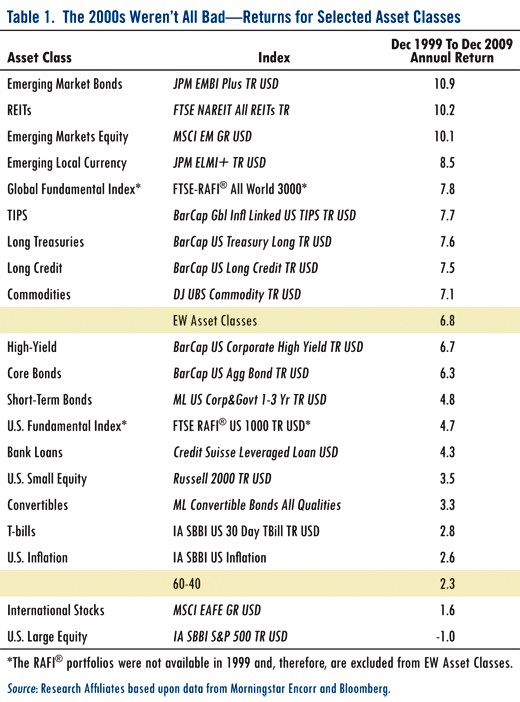
Index Universe has a provocative article by Rob Arnott and John West of Research Affiliates.  Their contention is that 2000-2009 was not really a lost decade.  Perhaps if your only asset was U.S. equities it would seem that way, but they point out that other, more exotic assets actually had respectable returns.

The table below shows total returns for some of the asset classes they examined.

 From the Archives: Was It Really a Lost Decade?

click to enlarge

What are the commonalities of the best performing assets? 1) Lots of them are highly volatile like emerging markets equities and debt, 2) lots of them are international and thus were a play on the weaker dollar, 3) lots of them were alternative assets like commodities, TIPs, and REITs.

In other words, they were all asset classes that would tend to be marginalized in a traditional strategic asset allocation, where the typical pie would primarily consist of domestic stocks and bonds, with only small allocations to very volatile, international, or alternative assets.

In an interesting way, I think this makes a nice case for tactical asset allocation.  While it is true that most investors–just from a risk and volatility perspective–would be unwilling to have a large allocation to emerging markets for an entire decade, they might find that periodic significant exposure to emerging markets during strong trends would be quite acceptable.  And even assets near the bottom of the return table like U.S. Treasury bills would have been very welcome in a portfolio during parts of 2008, for example.  You can cover the waterfront and just own an equal-weighted piece of everything, but I don’t know if that is the most effective way to do things.

What’s really needed is a systematic method for determining which asset classes to own, and when.  Our Systematic Relative Strength process does this pretty effectively, even for asset classes that might be difficult or impossible to grade from a valuation perspective.  (How do you determine whether the Euro is cheaper than energy stocks, or whether emerging market debt is cheaper than silver or agricultural commodities?)  Once a systematic process is in place, the investor can be slightly more comfortable with perhaps a higher exposure to high volatility or alternative assets, knowing that in a tactical approach the exposures would be adjusted if trends change.

—-this article originally appeared 2/17/2010.  There is no telling what the weak or strong assets will be for the coming decade, but I think global tactical asset allocation still represents a reasonable way to deal with that uncertainty.

Posted by:


From the Archives: Rob Arnott and the Key to Better Returns

February 21, 2013

Rob Arnott is a thought leader in tactical asset allocation, currently well-known for his RAFI Fundamental Indexes.  In his recent piece, Lessons from the Naughties, he discusses how investors will need to find return going forward.

The key to better returns will be to respond tactically to the shifting spectrum of opportunity, especially expanding and contracting one’s overall risk budget.

It’s a different way to view tactical asset allocation–looking at it from a risk budget point of view.  The general concept is to own risk assets in good markets and safe assets in bad markets.

It turns out that systematic application of relative strength accomplishes this very well.  The good folks at Arrow Funds recently asked us to take a look at how the beta in a tactically managed portfolio changed over time.  When we examined that issue, it showed that as markets became risky, relative strength reduced the beta of the portfolio by moving toward low volatility (strong) assets.  When markets were strong, allocating with relative strength pushed up the beta in the portfolio, thus taking good advantage of the market strength.

 From the Archives: Rob Arnott and the Key to Better Returns

click to enlarge

Using relative strength to do tactical asset allocation, the investor was not only able to earn an acceptable rate of return over time, but was able to have some risk mitigation going on the side.  That’s a pretty tasty combination in today’s markets.

—-this article originally appeared on 2/26/2010.  Amid all of the publicity given recently to risk parity, Arnott’s approach, which is to vary the risk budget over time depending on the opportunities available, has been largely ignored.  I think this is unfortunate.  His approach, although perhaps not easy, has merit.  Tactical asset allocation driven by relative strength is one way to do that.

Posted by:


From the Archives: Getting Torched By Expert Opinion

January 29, 2013

Barry Ritholtz has posted a 5 minute clip of some of Ben Bernanke’s public comments between 2005-2007 on the housing market and the broader economy.  The point of me posting this is not to say that Bernanke is a complete moron because I have little doubt that he is one of the brightest financial minds in the country.  However, talk about being dead wrong!  If you relied on these opinions in order to make investment decisions, you likely got torched.  If you can’t rely on expert opinion when making investment decisions, then what options do you have?

This highlights the value of trend-following systems.   Trend following requires zero reliance on expert opinion; it simply allows the investor to adapt to whatever trends the market offers, whether or not experts expected things to play out in a given way.  With trend following, you’ll have plenty of losing trades, but you’ll also avoid sitting in losing trades for long periods of time.  Furthermore, systematic trend-following has an excellent track record (see here and here.)  Trend following allows you to cut your losses short and to hold on to your winners.  Frequently, the strongest trends end up being very different from what even the brightest experts predicted.

—-this article originally appeared 2/11/2010.  Well, heck, if you can’t trust Ben Bernanke, who can you trust?  The answer should be obvious: follow the price trend and forget about the random guessing of experts.

Posted by:


From the Archives: Why We Like Price

January 25, 2013

Relative strength calculations rely on a single input: price.  We like price because it is a known quantity, not an assumption.  In this deconstruction of the Price-to-Earnings Growth (PEG) ratio, the author, Tom Brakke, discusses all of the uncertainties when calculating even a simple ratio like PEG.  And amidst all of the uncertainties he mentions is this:

In looking at that calculation, only one of the three variables has any precision:  We can observe the market price (P) at virtually any time and be assured that we have an accurate number.  The E is a different matter entirely.  Which earnings?  Forward, trailing, smoothed, operating, adjusted, owner?  Why?  How deep into accounting and the theory of finance do you want to go?

For most investors, not very far.  We like our heuristics clean and easy, not hairy.  So, in combining the first two variables we get the P/E ratio, the “multiple” upon which most valuation work rests, despite the questionable assumptions that may be baked in at any time.  The addition of the third element, growth (G), gives us not the epiphany we seek, but even more confusion.

The emphasis is mine.  This isn’t a knock on fundamental analysis.  It can be valuable, but there is an inherent squishiness to it.  The only precision is found in price.  And price is dynamic: it adapts in real time as expectations of the asset change.  (Fundamental data is often available only on a quarterly schedule.)  As a result, systematic models built using relative strength adapt quite nicely as conditions change.

—-this article originally appeared 2/10/2010.  We still like using prices as an input, especially now that there are so many cross-currents.  Every pundit has a different take on what will happen down the road, but prices in a free market will eventually sort it all out.

Posted by:


From the Archives: Irrational Loss Aversion

January 22, 2013

It’s well known in behavioral finance that investors experience a loss 2-3x more intensely than a gain of the same magnitude.  This loss aversion leads investors to avoid even rational bets, according to a Reuters story on a recent study by a Cal Tech scientist.

Laboratory and field evidence suggests that people often avoid risks with losses even when they might earn a substantially larger gain, a behavioral preference termed ‘loss aversion’,” they wrote.

For instance, people will avoid gambles in which they are equally likely to either lose $10 or win $15, even though the expected value of the gamble is positive ($2.50).

The study indicates that people show fear at even the prospect of a loss.  Markets are designed to generate fear, not to mention all of the bearish commentators on CNBC.  Fear leads to poor decisions, like selling near the bottom of a correction.  Unless you are planning to electrically lesion your amygdala, the fear is going to be there–so what’s the best way to deal with it?

The course we have chosen is to make our investment models systematic.  That means the decisions are rules-based, not subject to whatever fear the portfolio managers may be experiencing at any given time.  Once in a blue moon, excessive caution pays off, but studies suggest that more errors are made being excessively cautious than overly aggressive.  A rules-based method treats risk in a even-handed, mathematical way.  In other words, take risks that historically are likely to pay off, and keep taking them regardless of your emotional state.  Given enough time, the math is likely to swing things in your favor.

—-this article originally appeared 2/10/2010.  In the two years since this was written, investors have continued to pay a high price for their fear as the market has continued to advance.  There are always scary things around the corner, but a rules-based process can often help you navigate through them.  Investors seem to have a hard time learning that scary things don’t necessarily cause markets to perform poorly.  In fact, the opposite is often true.

Posted by:


From the Archives: The 80/20 Rule in Action

January 17, 2013

According to a fascinating study discussed in Time Magazine based on 27 million hands of Texas Hold’em, it turns out that the more hands poker players win, the more money they lose!  What’s going on here?

I suspect it has to do with investor preferences–gamblers often think the same way.  Most people like to have a high percentage of winning trades; they are less happy with a lower percentage of winning trades, even if the occasional winner is a big one.  In other words, investors will often prefer a system with 65% winning trades over a system with 45% winning trades, even if the latter method results in much greater overall profits.

People overweigh their frequent small gains vis-à-vis occasional large losses,” Siler says.

In fact, you are generally best off if you cut your losses and let your winners run.  This is the way that systematic trend following tends to work.  Often this results in a few large trades (the 20% in the 80/20 rule) making up a large part of your profits.  Poker players and amateur investors obviously tend to work the other way, preferring lots of small profits–which all tend to be wiped away by a few large losses.  Taking lots of small profits is the psychological path of least resistance, but the easy way is the wrong way in this case.

—-this article was originally published 2/10/2010.  Investors still have irrational preferences about making money.  They usually want profits—but apparently only if they are in a certain distribution!  Real life doesn’t work that way.  Making money is a fairly messy process.  Only a few names turn out to be big winners, so you’ve got to give them a chance to run.

Posted by:


From the Archives: Zut Alors!

December 9, 2012

If you need another reason to hate the French, besides envy of their excellent cuisine, it turns out that a bevy of winemakers were fined and given suspended sentences for foisting cheap, lousy wine on American consumers and charging them premium prices for it.

On the other hand, it shows that cognitive biases are everywhere.  Neither the American company the wine was shipped to nor consumers drinking it ever complained! Because the wine was labeled as premium pinot noir, wine enthusiasts apparently thought it tasted great.  In fact, it turns out that wine drinkers think expensive wine tastes better, even when you trick them and give them two glasses of wine from the same bottle.

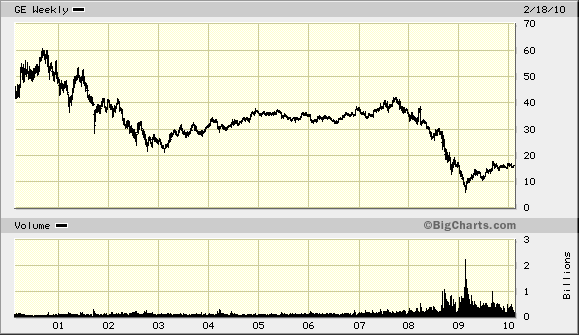
This behavior is not unknown in the stock market, where cognitive biases run unbridled down Wall Street.  Ten years ago, everyone was in love with General Electic.  It, too, was high-priced and tasted great.  Ten years later, GE is considered cheap swill that leaves a bitter taste in the mouths of investors.

 From the Archives: Zut Alors!

The moral of the story is that you can’t fall in love with your stocks or your wine.  You have to like it on its own merits.  In the case of our Systematic RS accounts, we like a stock only as long as it has high relative strength.  When it becomes weaker and drops in its ranking–indicating that other, stronger stocks are available–we sell it and move on to a better class of grape.  (We’ve been known to break a bottle here and there, but the idea is to adapt as tastes change.)  In this way, we strive to keep our wine cellar stocked with the best vintages all the time.

 From the Archives: Zut Alors!

—-this article originally appeared 2/19/2012.  Cognitive biases are still running wild on Wall Street.

Posted by:


From the Archives: Markets Act Like Real People

July 3, 2012

Critics of the Efficient Markets Hypothesis continue to get more press.  Newsweek’s Barrett Sheridan recently wrote an article that discusses the Efficient Markets Hypothesis (EMH) versus the adaptive-markets hypothesis (AMH).  He mentions one of the key flaws in EMH: that market participants are rational.

He goes on to focus on MIT professor Andrew Lo and his AMH work.  Lo does not share the EMH tenet that the financial markets consist of cool, calm, and rational investors. He suggests that investors will behave differently depending on their psychology at any given moment.  (Some of the old brokers I knew called it the fear-greed pendulum.) It follows that any investment rule based on a fixed measurement of value for the market such as yield, P/E ratio, etc. will work only sporadically over time if the AMH is valid.  Nothing is set in stone because investors continually change and adapt to the market ecosystem.

Our Systematic RS portfolios use relative measurements.  We believe in an adaptive approach to investing that recognizes that since markets are controlled by real people, they act like real people.

—-this article originally appeared 1/5/2010.  Every advisor knows that the risk tolerance of clients changes over the course of a market cycle.  I still can’t figure out why anyone thinks that the Efficient Markets Hypothesis ever made sense.

Posted by:


From the Archives: Two Approaches to Motivating Clients

June 28, 2012

Ken Haman, a managing director at the Advisor Institute at AllianceBernstein responds to the following question posed by an advisor and published in Investment News:

Q: I’ve had some frustrating conversations with clients recently—trying to get them back in the market. Very few are taking my advice, even though they seem to know that staying on the sidelines is a mistake. What’s going on, and how can I get them “unstuck”?

A: Problems like this have to do with how people make decisions. Behavioral finance uses the term “inappropriate extrapolation”–and insights about it can help you understand your clients and respond to them more effectively.

To make any decision, human beings create a mental picture of the future. That’s what “expectations” are–the ability to take information from the past and present, and project it into the future. Unlike most animals, human beings can project far into the future; as a result, we are able to “plan ahead.” Unfortunately, we usually don’t create these future images terribly well. Instead of making a thoughtful assessment of what’s likely to happen in the future, we typically picture the future as just a continuation of the recent past.

Essentially, you want to learn how to install a positive picture of the future that the client feels is likely to happen in reality. Start by explaining the mechanisms of the market and illustrating visually how those mechanisms work. Many investors have only the vaguest understanding of the cause-effect dynamics in the markets. Instead of making thoughtful, well-informed decisions, they react to their perception of patterns and trends. Market “mechanisms” are those cause-effect relationships that equip financial professionals to invest rationally instead of speculating randomly.

By looking at how market mechanisms operated in both the recent and more distant past, you teach your clients how to think more strategically about the markets. This allows them to build a more vivid mental picture of market behaviors in the future. Make sure you explain market mechanisms visually as well as verbally: use charts and graphs that show market behaviors over time. Whenever possible, connect your investment recommendations to a clear explanation of the mechanism that is involved.

Second, provide an adequate level of detail about the mechanisms you explain. There’s a commonly held myth that clients aren’t interested in hearing about the markets. So, many financial advisors gloss over important information and rush to their proposal without creating a case the client understands. But clients are interested in understanding the mechanisms that drive their investment results–as long as your explanation is clearly illustrated and easy to understand.

Finally, you have to deliver your message with personal conviction–that you fully believe the future will look the way you anticipate. Your clients need to borrow your conviction and clarity about the future. That’s how they’ll build their sense of confidence in the decisions you’re asking them to make. Take a stand on what you believe about the future, and add the courage of your own convictions to the clarity of your explanation.

There is also an alternative approach of just being frank with the client and telling them that you don’t know exactly what the future holds, nor does anyone else.  However, you adhere to a systematic relative strength process that gives you great flexibility to allocate to a wide range of asset classes depending on how the future unfolds.  At times, the approach can be allocated very conservatively and at times it can be allocated quite aggressively.  My experience has been that clients appreciate the honesty and are willing to embrace a trend-following approach that deals very effectively with not being able to see into the future.

—-this article originally appeared 1/12/2010.  More than two years later, many clients are still on the sidelines.    Many of them definitely do engage in inappropriate extrapolation!  An advisor’s first duty is to be honest, but you’ve got to do it in a way that is motivating and not paralyzing.

Posted by:


From the Archives: The $ Value of Patience

June 25, 2012

The annals of investor behavior make for some pretty scary reading.  Yet this story from the Wall Street Journal may take the cake.  It is an article about the top-performing mutual fund of the decade and it shows with remarkable clarity how badly investors butcher their long-term returns.  The article hits the premise right up front:

Meet the decade’s best-performing U.S. diversified stock mutual fund: Ken Heebner’s $3.7 billion CGM Focus Fund, which rose more than 18% annually and outpaced its closest rival by more than three percentage points.

Too bad investors weren’t around to enjoy much of those gains. The typical CGM Focus shareholder lost 11% annually in the 10 years ending Nov. 30, according to investment research firm Morningstar Inc.

It’s hard to know whether to laugh or cry.  In a brutal decade, Mr. Heebner did a remarkable job, gaining 18% per year for his investors.  The only investment acumen required to reap this 18% return was leaving the fund alone.  Yet in the single best stock fund of the decade investors managed to misbehave and actually lose substantial amounts of money—11% annually.

Even Morningstar is not sure what to do with Mr. Heebner:

The fund, a highly concentrated portfolio typically holding fewer than 25 large-company stocks, offers “a really potent investment style, but it’s really hard for investors to use well,” says Christopher Davis, senior fund analyst at Morningstar.

I beg to differ.  It’s really hard to use well??  What does that even mean?  If it is, it’s only in the sense that a pet rock is really hard to care for.

Investor note: actively managed or adaptive products need to be left alone!   The whole idea of an active or adaptive product is that the manager will handle things for you, instead of you having to do it yourself.

Unfortunately, there is an implicit belief among investors—and their advisors—that they can do a better job than the professionals running the funds, but every single study shows that belief to be false.  There is not one study of which I am aware that shows retail investors (or retail investors assisted by advisors) outperforming professional investors.  So where does that widespread belief come from?

From the biggest bogeyman in behavioral finance: overconfidence.  Confidence is a wonderful trait in human beings.  It gets us to attempt new things and to grow.  From an evolutionary point of view, it is probably quite adaptive.  In the financial arena, it’s a killer.  Like high blood pressure, it’s a silent killer too, because no one ever believes they are overconfident.

At a Harvard conference on behavioral finance, I heard Nobel Prize winner Daniel Kahneman talk about the best way to combat overconfidence.  He suggested intentionally taking what he called an “outside view.”   Instead of placing yourself—with all of your incredible and unique talents and abilities—in the midst of the situation, he proposed using an outside individual, like your neighbor, for instance.  Instead of asking, “What are the odds that I can quit my day job and open a top-performing hedge fund or play in the NBA?” ask instead, “What are the odds that my neighbor (the plumber, or the realtor, or the unemployed MBA) can quit his day job and open a top performing hedge fund or play in the NBA?”  When you put things in an outside context like that, they always seem a lot less likely according to Kahneman.  We all think of ourselves as special; in reality, we’re pretty much like everyone else.

Why, then, are investors so quick to bail out on everyone else?  Overconfidence again.  Our generally mistaken belief that we are special makes everyone else not quite as special as us.  Overconfidence and belief in our own specialness makes us frame things completely differently:  when we have a bad quarter, it was probably bad luck on a couple of stock picks; if Bill Miller (to choose a recent example) has a bad quarter, it’s probably because he’s lost his marbles and his investment process is irretriveably broken.  We’d better bail out, fast.  (A lot of people came to that conclusion over the past couple of years.  In 2009, Legg Mason Value Trust was +40.6%, more than 14% ahead of its category peers.)

Think about an adaptive Dorsey, Wright Research model like DALI.  As conditions change, it attempts to adapt by changing its holdings.  Does it make sense to jump in and out of DALI depending on what happened last quarter or last year?  Of course not.  You either buy into the tactical approach or you don’t.  Once you decide to buy into—presumably because you agree with the general premise—a managed mutual fund, a managed account, or an active index, for goodness sakes, leave it alone.

In financial markets, overconfidence is the enemy of patience.  Overconfidence is expensive; patience with managed products can be quite rewarding.  In the example of the CGM Focus Fund, Mr. Heebner grew $10,000 into $61,444 over the course of the last ten years.  Investors in the fund, compounding at -11% annually, turned $10,000 into $3,118.  The difference of $58,326 is the dollar value of patience in black and white.

—-this article originally appeared 1/6/2010.  Unfortunately, human nature has not changed in the last two years!  Investors still damage their returns with their impatience.  Try not to be one of them!

Posted by:


From the Archives: Is Buy-and-Hold Dead?

June 20, 2012

The  Journal of Indexes has the entire current issue devoted to articles on this topic, along with the best magazine cover ever.  (Since it is, after all, the Journal of Indexes, you can probably guess how they came out on the active versus passive debate!)

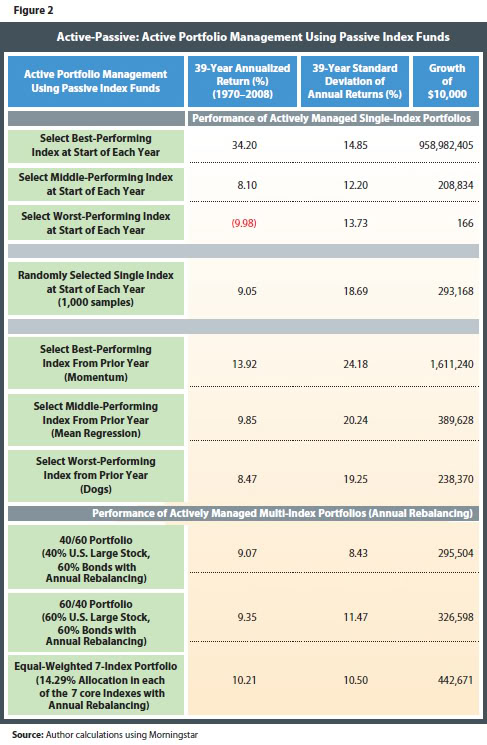
One article by Craig Israelson, a finance professor at Brigham Young University, stood out.  He discussed what he called “actively passive” portfolios, where a number of passive indexes are managed in an active way.  (Both of the mutual funds that we sub-advise and our Global Macro separate account are essentially done this way, as we are using ETFs as the investment vehicles.)  With a mix of seven asset classes, he looks at a variety of scenarios for being actively passive: perfectly good timing, perfectly poor timing, average timing, random timing, momentum, mean reversion, buying laggards, and annual rebalancing with various portfolio blends.  I’ve clipped one of the tables from the paper below so that you can see the various outcomes:

 From the Archives: Is Buy and Hold Dead?

Click to enlarge

Although there is only a slight mention of it in the article, the momentum portfolio (you would know it as relative strength) swamps everything but perfect market timing, with a terminal value more than 3X the next best strategy.  Obviously, when it is well-executed, a relative strength strategy can add a lot of return.  (The rebalancing also seemed to help a little bit over time and reduced the volatility.)

Maybe for Joe Retail Investor, who can’t control his emotions and/or his impulsive trading, asset allocation and rebalancing is the way to go, but if you have any kind of reasonable systematic process and you are after returns, the data show pretty clearly that relative strength should be the preferred strategy.

—-this article originally appeared 1/8/2010.  Relative strength rocks.

Posted by:


From the Archives: The Future of Decision-Making

June 13, 2012

Man versus machine, art versus science, intuition versus logic—all of these are ways of expressing what we often think of as contradictory approaches to problem solving.  Should we be guided more by data and precedent, or is it more important to allow for the human element?  Is it critical to be able to step aside and say, with the benefit of our judgment, “maybe this time really is different?”

The Harvard Business Review recently took on this topic and a few of their points were quite provocative.

A huge body of research has clarified much about how intuition works, and how it doesn’t. Here’s some of what we’ve learned:

  • It takes a long time to build good intuition. Chess players, for example, need 10 years of dedicated study and competition to assemble a sufficient mental repertoire of board patterns.
  • Intuition only works well in specific environments, ones that provide a person with good cues and rapid feedback . Cues are accurate indications about what’s going to happen next. They exist in poker and firefighting, but not in, say, stock markets. Despite what chartists think, it’s impossible to build good intuition about future market moves because no publicly available information provides good cues about later stock movements. [Needless to say, I don't agree with his assessment of stock charts!] Feedback from the environment is information about what worked and what didn’t. It exists in neonatal ICUs because babies stay there for a while. It’s hard, though, to build medical intuition about conditions that change after the patient has left the care environment, since there’s no feedback loop.
  • We apply intuition inconsistently. Even experts are inconsistent. One study determined what criteria clinical psychologists used to diagnose their patients, and then created simple models based on these criteria. Then, the researchers presented the doctors with new patients to diagnose and also diagnosed those new patients with their models. The models did a better job diagnosing the new cases than did the humans whose knowledge was used to build them. The best explanation for this is that people applied what they knew inconsistently — their intuition varied. Models, though, don’t have intuition.
  • We can’t know or tell where our ideas come from. There’s no way for even an experienced person to know if a spontaneous idea is the result of legitimate expert intuition or of a pernicious bias. In other words, we have lousy intuition about our intuition.
  • It’s easy to make bad judgments quickly. We have many biases that lead us astray when making assessments. Here’s just one example. If I ask a group of people “Is the average price of German cars more or less than $100,000?” and then ask them to estimate the average price of German cars, they’ll “anchor” around BMWs and other high-end makes when estimating. If I ask a parallel group the same two questions but say “more or less than $30,000″ instead, they’ll anchor around VWs and give a much lower estimate. How much lower? About $35,000 on average, or half the difference in the two anchor prices. How information is presented affects what we think.

We’ve written before about how long it takes to become world-class.  Most studies show that it takes about ten years to become an expert if you apply yourself diligently.  Obviously, the “intuition” of an expert is much better than the intuition of a neophyte.  If you think about that for a minute, it’s pretty clear that intuition is really just judgment in disguise.  The expert is better than the novice simply because they have a bigger knowledge base and more experience.

Really, the art versus science debate is over and the machines have won it going away.  Nowhere is this more apparent than in chess.  Chess is an incredibly complex mental activity.  Humans study with top trainers for a decade to achieve excellence.  There is no question that training and practice can cause a player to improve hugely, but it is still no contest.  As processing power and programming experience has become more widespread, a $50 CD-ROM off-the-shelf piece of software can defeat the best players in the world in a match without much problem.  Most of the world’s top grandmasters now use chess software to train with and to check their ideas.  (In fact, so do average players since the software is so cheap and ubiquitous.)

How did we get to this state of affairs?  Well, the software now incorporates the experience and judgment of many top players.  Their combined knowledge is much more than any one person can absorb in a lifetime.  In addition, the processing speed of a standard desktop computer is now so fast that no human can keep it with it.  It doesn’t get tired, upset, nervous, or bored.  Basically, you have the best of both worlds—lifetimes of human talent and experience applied with relentless discipline.

A 2000 paper on clinical versus mechanical prediction by  Grove, Zald, Lebow, Snitz, & Nelson  had the following abstract:

>The process of making judgments and decisions requires a method for combining data. To compare the accuracy of clinical and mechanical (formal, statistical) data-combination techniques, we performed a meta-analysis on studies of human health and behavior. On average, mechanical-prediction techniques were about 10% more accurate than clinical predictions. Depending on the specific analysis, mechanical prediction substantially outperformed clinical prediction in 33%–47% of studies examined. Although clinical predictions were often as accurate as mechanical predictions, in only a few studies (6%–16%) were they substantially more accurate. Superiority for mechanical-prediction techniques was consistent, regardless of the judgment task, type of judges, judges’ amounts of experience, or the types of data being combined. Clinical predictions performed relatively less well when predictors included clinical interview data. These data indicate that mechanical predictions of human behaviors are equal or superior to clinical prediction methods for a wide range of circumstances.

That’s a 33-47% win rate for the scientists and a 6-16% win rate for the artists, and that was ten years ago.  That’s not really very surprising.  Science is what has allowed us to develop large-scale agriculture, industrialize, and build a modern society.  Science and technology are not without their problems, but if the artists have stayed in charge we might still be living in caves, although no doubt we would have some pretty awesome cave paintings.

This is the thought process behind our Systematic Relative Strength accounts.  We were able to codify our own best judgment, include lifetimes of other experience from investors we interviewed or relative strength studies that we examined, and have it all run in a disciplined fashion.  We chose relative strength because it was the best-performing factor and also because, since it is relative, it is adaptive.  There is always cooperation between man and machine in our process, but moving more toward data-driven decisions is indeed the future of decision making.

—-this article originally appeared 1/15/2010.  Our thought process hasn’t changed—we still believe that a systematic, adaptive investment process is the way to go.

Posted by:


From the Archives: A Wakeup Call for Investors

June 5, 2012

If you have money left over after paying your bills, you fall into the category of “investor.”  You could invest your surplus money in having a good time in Vegas, a mattress, a bank savings account, or any manner of financial instruments.  Some investments have a financial return; others only a psychic return if you are lucky.

Most people invest for a simple reason: to provide income when they are no longer able to work.  Some people might actually want to retire, so they invest to provide income for the time after they voluntarily choose to stop working.  To get from “investor” status to actual retirement status, a few difficult things have to happen correctly.

1. You actually need to save money.  And you have to save a lot.  In today’s America, this means becoming a cultural outlaw and foregoing some current consumption.  Welcome to the radical underground.

2. You need to save the money in assets that produce income or capital gains.  (Income-producing assets are nice, but capital gains can be spent just as effectively.)  These assets are often volatile, leveraged like real estate, or intangible like stocks and bonds.  Scary stuff, in other words.   Investing your surplus funds in Budweiser, while it may confer certain social benefits, will not provide a retirement income.

3. You need to manage not to muck up your returns.  The DALBAR numbers don’t lie.  To earn decent real returns, you need to select  quality money managers and/or funds and then leave them to do their work.

4. You need to be able to do realistic math.  For example, most people think their home is a great investment—but they never subtract from the returns all of the property taxes and maintenance that are required, or remove the effects of leverage.  Every study that does shows that homes are not a good financial investment.  In addition, in order to make a projection of how much money you will require to retire, you need to be able to make a reasonable estimate of your real net-net-net returns (after inflation, taxes, and expenses) over your compounding period.  Investors, imbued with overconfidence, almost always make assumptions that are far too bullish.

Jason Zweig has an excellent article in the Wall Street Journal discussing realistic assumptions for net-net-net rates of return.

Since 1926, according to Ibbotson Associates, U.S. stocks have earned an annual average of 9.8%. Their long-term, net-net-net return is under 4%.

All other major assets earned even less. If, like most people, you mix in some bonds and cash, your net-net-net is likely to be more like 2%.

Mr. Zweig points out that many investors, even some institutional investors, are assuming net-net-net returns of 7% or more.  When he asked truly sophisticated investors what return they thought was reasonable, he got very different answers.

I asked several investing experts what guaranteed net-net-net return they would accept to swap out their own assets. William Bernstein of Efficient Frontier Advisors would take 4%. Laurence Siegel, a consultant and former head of investment research at the Ford Foundation: 3%. John C. Bogle, founder of the Vanguard Group of mutual funds: 2.5%. Elroy Dimson of London Business School, an expert on the history of market returns: 0.5%.

The reality is pretty shocking, isn’t it?  This is why the investor has an uphill battle.  And the consequences of messing any of the four steps up along the way can be pretty steep.  In Mr. Zweig’s eloquent words,

The faith in fancifully high returns isn’t just a harmless fairy tale. It leads many people to save too little, in hopes that the markets will bail them out. It leaves others to chase hot performance that cannot last. The end result of fairy-tale expectations, whether you invest for yourself or with the help of a financial adviser, will be a huge shortfall in wealth late in life, and more years working rather than putting your feet up in retirement.

Saving too little can become a big problem.  I would add that ruining your returns by thrashing about impulsively will only add to the amount you will need to save.  Almost everyone has a number in mind for the amount of assets they will need in retirement.  Try redoing the math with realistic numbers and see if you are really saving enough.

—-this article originally appeared 1/19/2010.  Americans are still under-saving to an alarming extent.  Given that we are currently in a very low yield environment, a high savings level is more important than ever.

Posted by:


From the Archives: The Math Behind Manager Selection

May 31, 2012

Hiring and firing money managers is a tricky business.  Institutions do it poorly (see background post here ), and retail investors do it horribly (see article on DALBAR  ).  Why is it so difficult?

This white paper on manager selection from Intech/Janus goes into the mathematics of manager selection.  Very quickly it becomes clear why it is so hard to do well.

Many investors believe that a ten-year performance record for a group of managers is sufficiently long to make it easy to spot the good managers. In fact, it is unlikely that the good managers will stand out.  Posit a good manager whose true average relative return is 200 basis points (bps) annually and true tracking error (standard deviation of relative return) is 800 bps annually. This manager’s information ratio is 0.25. To put this in perspective, an information ratio of 0.25 typically puts a manager near or into the top quartile of managers in popular manager universes.

Posit twenty bad managers with true average relative returns of 0 bps annually, true tracking error of 1000 bps annually, hence an information ratio of 0.00.

There is a dramatic difference between the good manager and the bad managers.

The probability that the good manager beats all twenty bad managers over a ten-year period is only about 9.6%.  This implies that chasing performance leaves the investor with the good manager only about 9.6% of the time and with a bad manager about 90.4% of the time.

In other words, 90% of the time the manager with the top 10-year track record in the group will be a bad manager!  Maybe a longer track record would help?

A practical approach is to ask how long a historical performance record is necessary to be 75% sure that the good manager will beat all the bad managers, i.e., have the highest historical relative return. Assuming the same good manager as before and twenty of the same bad managers as before, a 157 year historical performance record is required to achieve a 75% probability that the good manager will beat all the bad managers.

It turns out that it would help, but since none of the manager databases have 150-year track records, in practice it is useless.  The required disclaimer that past performance is no guarantee of future results turns out to be true.

There is still an important practical problem to be solved here.  Assuming that bad managers outnumber good ones and assuming that we don’t have 150 years to wait around for better odds, how can we increase our probability of identifying one of the good money managers?

The researchers show mathematically how combining an examination of the investment process with historical returns makes the decision much simpler.  If the investor can make a reasonable assumption about a manager’s investment process leading to outperformance, the math is straightforward and can be done using Bayes’ Theorem to combine probabilities.

…the answer changes based on the investor’s assessment of the a priori credibility of the manager’s investment process.

It turns out that the big swing factor in the answer is the credibility of the underlying investment process.  What are the odds that an investment process using Fibonacci retracements and phases of the moon will generate outperformance over time?  What are the odds that relative strength or deep value will generate outperformance over time?

The research paper concludes with the following words of wisdom:

A careful examination of almost any investor’s investment manager hiring and firing process is likely to reveal that there is a substantial component of performance chasing. Sometimes it is obvious, e.g., when there is a policy of firing a manager if he has negative performance after three years. Other times it is subtle, e.g., when the initial phase of the manager search process strongly weights attractive historical performance. No matter the form that performance chasing takes, it tends to produce future relative returns that are disappointing compared to expectations.

Historical performance alone is not an effective basis for identifying a good manager among a group of bad managers. This does not mean that historical performance is useless. Rather, it means that it must be combined efficiently with other information. The correct use of historical performance relegates it to a secondary role. The primary focus in manager choice should be an analysis of the investment process.  [emphasis added]

This research paper is eye-opening in several respects.

1) It shows pretty clearly that historical performance alone–despite what our intuition tells us–is not sufficient to select managers.  This probably accounts for a great deal of the poor manager selection, the subsequent disappointment, and rapid manager turnover that goes on.

2) It is very clear from the math that only credible investment processes are likely to generate long-term outperformance.  Fortunately, lots of substantive academic and practitioner research has been done on factor analysis leading to outperformance.  The only two broadly robust factors discovered so far have been relative strength and value, both in various formulations–and, obviously, they have to be implemented in a disciplined and systematic fashion.  If your investment process is based on something else, there’s a decent chance you’re going to be disappointed.

3) Significant time is required for the best managers to stand out from the much larger pack of mediocre managers.

This is a demanding process for consultants and clients.  They have to willfully reduce their focus on even 10-year track records, limit their selection to rigorous managers using proven factors for outperformance, and then exercise a great deal of patience to allow enough time for the cream to rise to the top.  The rewards for doing so, however, might be quite large–especially since almost all of your competition will ignore the correct process and and simply chase performance.

—-this article originally appeared 1/28/2010.  I have seen no evidence since then that most consultants have improved their manager selection process, which is a shame.

Posted by:


From the Archives: Is Modern Portfolio Theory Obsolete?

May 29, 2012

It all depends on who you ask.  Apologists for MPT will say that diversification worked, but that it just didn’t work very well last go round.  That’s a judgment call, I suppose.  Correlations between assets are notoriously unstable and nearly went to 1.0 during the last decline, but not quite.  So I guess you could say that diversification “worked,” although it certainly didn’t deliver the kind of results that investors were expecting.

Now even Ibbotson Associates is saying that certain aspects of modern portfolio theory are flawed, in particular using standard deviation as a measurement of risk.  In a recent Morningstar interview, Peng Chen, the president of Ibbotsen Associates, addresses the problem.

It’s one thing to say modern portfolio theory, the principle, remained to work. It’s another thing to examine the measures. So when we started looking at the measures, we realized, and this has been documented by many academics and practitioners, we also realized that one of the traditional measures in modern portfolio theory, in particular on the risk side, standard deviation, does not work very well to measure and present the tail risks in the return distribution.

Meaning that, when you have really, really bad market outcomes, modern portfolio theory purely using standard deviation underestimates the probability and severity of those tail risks, especially in short frequency time periods, such as monthly or quarterly.

Leaving aside the issue of how the theory could work if the components do not, this is a pretty surprising admission.  Ibbotson is finally getting around to dealing with the “fat tails” problem.  It’s a known problem but it makes the math much less tractable.  Essentially, however, Mr. Chen is arguing that market risk is actually much higher than modern portfolio theory would have you believe.

In my view, the debate about modern portfolio theory is pretty much done.  Stick a fork in it.  Rather than grasping about for a new theory, why not look at tactical asset allocation, which has been in plain view the entire time?

Tactical asset allocation, when executed systematically, can generate good returns and acceptable volatility without regard to any of the tenets of modern portfolio theory.  It does not require standard deviation as the measure of risk, and it makes no assumptions regarding the correlations between assets.  Instead it makes realistic assumptions: some assets will perform better than others, and you ought to consider owning the good assets and ditching the bad ones.  It’s the ultimate pragmatic solution.

—-this article originally appeared 1/21/2010.  As we gain distance from the 2008 meltdown, investors are beginning to forget how badly their optimized portfolios performed and are beginning to climb back on the MPT bandwagon.  Combining uncorrelated strategies always makes for a better portfolio, but the problem of understated risk remains.  The tails are still fat.  Let’s hope that we don’t get another chance to experience fat tails with the Eurozone crisis.  Tactical asset allocation, I think, may still be the most viable solution to the problem.

Posted by:


From the Archives: Inflation Rears Its Ugly Head

May 25, 2012

Howard Marks is chairman of Oaktree Capital, a large and well-known institutional alternative fixed income manager.  Mr. Marks’s memos are always thoughtful and worth reading.  This go round he has a discussion of all of the things that could go wrong with the world economy—essentially a list of all of the things that could go wrong.  One of the things that could go wrong is inflation.

He believes rates are more likely to go higher than lower, and that inflation, long forgotten as a risk factor, might return.  In addition, he has a list of suggestions on how to deal with inflation including TIPs, floating rate debt, gold, real assets like commodities, oil, and real estate, and foreign currencies.  His catalog of alternatives is even longer, but you get the idea.  (If you want to read the whole memo, you can find it here.)

That’s quite a list, but the first thing that I noticed about it is that not one of these items is generally considered as an investment option by retail investors.  Most investors are mentally stuck in the domestic stocks/domestic bonds arena.  Diversification consists of hitting more than one Morningstar style box.  If inflation does come back, that’s not going to cut it.  In fact, Mr. Marks asks investors, “How much of your portfolio are you willing to devote to protect against these macro forces?”  He says if the answer is 5%, or 10%, or 15% that those levels are pretty close to doing nothing.  He thinks a portfolio will need to devote at least 30-40% of assets toward inflation protection if it recurs.

Investment flexibility and risk diversification were the primary reasons that we launched the Systematic RS Global Macro account as a retail product last year.  Many of the inflation hedges in Mr. Marks’ list are asset classes that are available in the Global Macro portfolio, including TIPs, gold, commodities, oil, real estate, and foreign currencies.  Given our basket rotation strategy and our adherence to relative strength, the Global Macro portfolio could easily have 40% of its assets, or more, in inflation hedges if inflation were to recur.  I think the jury is still out about how the world economy will respond to decreased levels of fiscal stimulus, but it’s good to know that you have options.

—-this article originally appeared 1/25/2010.  We have not seen runaway inflation so far, but the point Howard Marks makes is valid.  If/when inflation does occur, you might need to devote a lot of your portfolio to inflation protection.  Is your investment process up for the challenge?

Posted by:


From the Archives: Essence of Relative Strength

March 27, 2012

sailboat From the Archives: Essence of Relative Strength

“I can’t change the direction of the wind, but I can adjust my sails to always reach my destination.” – Jimmy Dean

—-this article originally appeared 12/11/2009.  Who knew the sausage king knew anything about relative strength?

Posted by:


From the Archives: Ken French Should Check His Website

March 26, 2012

A new paper from Eugene Fama and Ken French is circulating, suggesting that active mutual fund managers don’t add value.  Articles, like the one here at MarketWatch, have been appearing and the typical editorial slant is that you should just buy an index fund.

I have a bone to pick with this article and its conclusions, but certain things are not in dispute.  Fama and French, in their article Luck versus Skill in the Cross Section of Mutual Fund Returns, look at the performance of domestic equity funds from 1984 to 2006.  (You can find a summary of the paper here.)  They discover that the funds, in aggregate, are worse than the market by 80 basis points per year–basically the amount of the fees and expenses.  (After backing out fees and expenses, the funds are 10 basis points per year above the market.)  After that, Fama and French run 10,000 simulations with alpha set to zero to see if the distribution of returns from actual fund managers is any different from the distribution of returns from the random simulations.  They conclude it is not very different and suggest that any fund manager that outperforms is simply lucky.

Let me start my critique by pointing out that, based on their sample and their goofy experimental design, their conclusions are probably correct.  Existing mutual funds in aggregate pretty much own the market portfolio and underperform by the amount of fees and expenses.  There clearly are some above-average mutual fund managers, but as Fama and French point out, it’s difficult to tell statistically from just performance data if they are good or simply lucky.  Within a big sample of funds like they had, after all, a few are bound to have good performance just because the sample is so large.

This is quite a quandary for the individual investor, so let’s think about the realistic scenarios and their outcomes–in other words, let’s take actual investor behavior into account.

Scenario 1.  Buy a mutual fund after its good performance is advertised somewhere and bail out when it has a bad year.  Continue this behavior throughout your investment lifetime.  According to Dalbar’s QAIB and other data, this is what actually happens most of the time.  Not a good outcome–underperformance by a large margin, often 500 basis points or more annually.

Scenario 2.  Buy a decent mutual fund and make the radical decision to leave it alone, come hell or high water.  Do not be tempted by the blandishments of currently hot funds or panicked by underperformance in your fund when it inevitably happens.  Close eyes and hold on for dear life.  Continue your ostrich-with-its-head-in-the-sand routine throughout your investment lifetime.  Your outcome, as Fama and French point out, will probably be market returns less the 80 basis point per year in fees.  Your returns will probably be 400 basis points annually or more better than Scenario 1.

Scenario 3. Throw active management overboard entirely.  Buy an S&P 500 index fund or a total market index fund and proceed as in Scenario 2.  Your outcome might be 60-70 basis points per year better from reduced costs than the investor in Scenario 2.  (Your cost is that you don’t get to brag at cocktail parties on the occasions when your actively managed fund has a good year.)  On the other hand, you are no less likely to succumb to Scenario 1 than an actively managed mutual fund investor.  Unfortunately, index mutual funds tend to show the same pattern of lagging returns due to investor behavior as actively managed funds.

Scenario 4. Visit Ken French’s own website.  Look for factors that are tested and that have outperformed consistently over time.  Hint: relative strength.  (Academics tend to call it ”momentum,” I suspect because it would be very deflating to have to admit that anything related to technical analysis actually works.)  Find a manager that exposes a portfolio to the relative strength factor in a disciplined fashion over time.  Buy it and pretend you are Rip Van Winkle.  Continue this dolt-like behavior for your entire investment lifetime.  Your outcome, according to Ken French’s own website, is likely to be market outperformance on the magnitude of 500 basis points per year or more.  (You can link to an article showing a performance chart back to 1927 here, and the article also includes the link to Ken French’s database at Dartmouth University.)

I prefer Scenario 4, but maybe that’s just me.  Since it is well-known even to Eugene Fama and Ken French that momentum has outperformed over time, what is their study really saying?  It’s saying that essentially no one in the mutual fund industry is employing this approach.  That’s more a problem with the mutual fund industry than it is with anything else.  (Mutual fund firms are businesses and they have their reasons for running the business the way they do.)  One option, I guess, is to throw up your hands and buy an index fund, but maybe it would make more sense to seek out the rare firms that are employing a disciplined relative strength approach and shoot for Scenario 4.

Their flawed experimental design makes no sense to me.  Although I am still 6’5″, I can no longer dunk a basketball like I could in college.  I imagine that if I ran a sample of 10,000 random Americans and measured how close they could get to the rim, very few of them could dunk a basketball either.  If I created a distribution of jumping ability, would I conclude that, because I had a large sample size, the 300 people would could dunk were just lucky?  Since I know that dunking a basketball consistently is possible–just as Fama and French know that consistent outperformance is possible–does that really make any sense?  If I want to increase my odds of finding a portfolio of people who could dunk, wouldn’t it make more sense to expose my portfolio to dunking-related factors–like, say, only recruiting people who were 18 to 25 years old and 6’8″ or taller?  In the same fashion, if I am looking for portfolio outperformance, doesn’t it make a lot more sense to expose my portfolio to factors related to outperformance, like relative strength or deep value, rather than to conclude that managers who add value are just lucky?  No investigation of possible sub-groups that were consistently following relative strength or deep value strategies was done, so it is impossible to tell.  Fama and French are right, I think, in their assertion that plenty of luck is involved in year-to-year performance, but their overall conclusion is questionable.

In short, I think a questionable experimental design and possible sub-groups buried in the aggregate data (see this post for more information on tricks with aggregate data) make their conclusions rather suspect.

—-this article originally appeared 12/3/2009.  It turned out to be one of the blog readers’ favorite rants, so I am reprising it here.  I still think active management can add value over time through disciplined exposure to a reliable return factor.

Posted by:


From the Archives: Why Systematic Models Are Great

March 22, 2012

James Montier wrote this piece in 2006, but it is so great that I have to bring it up again!  This article is a gem, worth reading over and over again.

What could baseball, wine pricing, medical diagnosis, university admissions, criminal recidivism and I have in common? They are examples of simple quant models consistently outperforming so-called experts. Why should financial markets be any different? So why aren’t there more quant funds? Hubristic self belief, self-serving bias and inertia combine to maintain the status quo.

Montier gives numerous examples of situations in which the models outperform both experts and experts using the models as additional input.  Using your “expert knowledge” just makes it worse most of the time.  In fact, in a study of over 130 papers comparing systematic models with human decision-making, the models won out in 122 events.

So why don’t we see more quant funds in the market? The first reason is overconfidence. We all think we can add something to a quant model. However, the quant model has the advantage of a known error rate, whilst our own error rate remains unknown. Secondly, self-serving bias kicks in, after all what a mess our industry would look if 18 out of every 20 of us were replaced by computers. Thirdly, inertia plays a part. It is hard to imagine a large fund management firm turning around and scrapping most of the process they have used for the last 20 years. Finally, quant is often a much harder sell, terms like ‘black box’ get bandied around, and consultants may question why they are employing you at all, if ‘all’ you do is turn up and crank the handle of the model. It is for reasons like these that quant investing will remain a fringe activity, no matter how successful it may be.

Lack of competition may be the best reason of all to use a systematic approach.  How many investors are willing to go through a thorough and rigorous testing process to build a robust model—and are then willing to stick with the model through thick and thin?  As Montier points out, it may remain a “fringe activity” no matter how successful it is.

—-this article originally appeared 12/22/2009.  This is a powerful, powerful argument in favor of using a systematic model.  Montier’s discussion of why investors resist using models is still very true.

Posted by: