Data Integrity

July 31, 2009

One of the reasons that we are fond of using price as an input to calculate relative strength is not it does not rely on forecasting and is not subject to revision. If you subscribe to the “garbage in, garbage out” school of thought as we do, having reliable data is somewhere near the top of your wish list.

Fundamental analysts often forecast earnings for their valuation models, which creates another set of complication to getting things right. Economists, on the other hand, often have to deal with data that is revised after the fact. The Commerce Department recently revised U.S. GDP data going all the way back to 1929! (Click here for Eddy Elfenbein’s hilarious take on the data revisions.)

This just seems ridiculous to me. Pity the poor economists. It is no wonder that economic forecasting is so difficult with data like this! It brings to mind the old saying that the only function of economists is to make weather forecasters look good.

Posted by:


Money Still in the Till

July 31, 2009

Last fall and early this year, the financial crisis seemed exceedingly dire. Governments and citizens across the globe felt as if the entire commerce and banking system might implode. So governments rode to the rescue and pledged to bail out various banks and financial institutions, along with providing all sorts of related credit facilities and backstops.

According to the International Monetary Fund, it turns out that governments have only had to spend about 40% of the money they pledged so far. It’s a good thing that governments haven’t spent all the money, by the way. The forecast for the pile up of debt in industrialized nations over the next five years is not pretty, and the massive U.S. share can’t be too helpful to the dollar.

The economic crisis may not have been as bad as believed, but in my view, it is more likely that financial institutions adapted very rapidly to the new environment and stemmed some of their own bleeding. Even big banks are not fond of going out of business or operating under government mandate. The government kick-start might have been necessary, but the healing has happened faster than anyone guessed.

The underlying problem may really be one of forecasting. Economists often make straight line forecasts—which would be accurate if no one reacted to the situation. An economist would probably forecast that you would drive your car off the road at every turn. You don’t, because each time a turn comes up you react by adjusting the steering wheel. Adaptation is a wonderful thing—and a necessary one, since forecasts can often be so far off the mark.

Posted by:


How to Level the Playing Field

July 30, 2009

David Swensen is a legendary endowment manager at Yale University. In a recent interview with Consuelo Mack on Wealthtrack, the following exchange occurred. (You can read the full interview here.) Mr. Swensen is talking about the difficulty that individuals have succeeding in the market. It turns out that Yale outsources all of the management to firms who have found an edge they can exploit. It’s the only way to level the playing field because, as he points out, most people “have something they do with their lives other than studying financial markets.” We believe that relative strength has been proven to be just such an exploitable edge. He makes the point elsewhere in the interview that most firms do not have any kind of quantifiable edge. I was also struck by the fact that, although he is surrounded by talent at Yale, his group outsources all of the management. They focus on the overall asset allocation and spend their time trying to identify the managers that have an edge. Recommended reading.

CONSUELO MACK: It seems so unfair. So you think that individuals are always going to be, essentially, at a disadvantage, so the best that we can hope for is to have market returns and to have a portfolio that has some noncorrelated assets? Is that -

DAVID SWENSEN: Yeah, it seems unfair in a sense, but most everybody has something that they do with their lives other than studying financial markets.

CONSUELO MACK: Right.

DAVID SWENSEN: And I know how hard it is to beat the markets. They’re actually quite efficient. And so I’ve got an incredibly highly qualified, wonderfully motivated group of colleagues at Yale, and we work really, really hard to put together these market-beating portfolios.

CONSUELO MACK: And the market-beating portfolios, our viewers should know — you’re not investing the money yourself.

DAVID SWENSEN: No.

CONSUELO MACK: You outsource.

DAVID SWENSEN: With outside stock managers.

CONSUELO MACK: Right. So is there one or two things that you insist upon in choosing a manager? I mean, what are the things that you look for in choosing a good investment manager? Criteria.

DAVID SWENSEN: If we talked about this 20 years ago, I probably would have come up with a list of objective criteria.

CONSUELO MACK: And now?

DAVID SWENSEN: And now, I just say it’s all about the people. You want to have really high quality people, great integrity, very intelligent, hard-working, people that have found an edge that they can exploit.

CONSUELO MACK: In their particular niche.

DAVID SWENSEN: In their particular niche. And I would say it’s people first, people second, people third. You just want to be partners with great people.

Posted by:


Triple the Leverage, Triple the Fun

July 30, 2009

This post from Seeking Alpha has a nice graphic on just how bizarre price movement can be in a triple leverage ETF over a longer holding period. They use, as an example, the financial sector triple leverage ETFs. Even though the Russell 1000 financials are down only about 2% YTD, both the leveraged long and leveraged inverse funds are down more than 60%.

We do not use leveraged ETFs in our Global Macro product for good reason! I’m not against giving investors the choice to use them if they want, but I do wonder how many members of the public really understand how these leveraged funds work.

Click here for disclosures from Dorsey Wright Money Management.

Posted by:


Discipline Wins!

July 29, 2009

Intuition can be a very helpful guide to decision-making in many areas, but it turns out to be a detriment in finance. Vanessa Drucker reviews David Adler’s new book Snap Judgement and paraphrases Mr. Adler’s suggested approach as “if you want to make money, stick to a steely discipline, and override your emotions.”

This is the entire thought process behind our family of Systematic Relative Strength portfolios: identify a factor with a strong record of outperformance and continue to pound stocks with high factor rankings into the portfolio. Not every transaction will work, of course, but over time exposure to the factor—in our case, relative strength-should lead to strong results.

We frequently get phone calls—and by frequently, I mean almost every day—from clients telling us that we could have improved our performance last quarter if we had only done thus and such, which always represents some form of temporary deviation from our disciplined approach. And very often, in that one particular case, the caller is correct. However, each one of these calls misses the larger point: how do you know when to deviate and when to switch back to a tested approach that has delivered good results over time? (Not to mention that our hindsight is 20-20 also.) Studies of systematic processes show that things are made worse by attempts to apply one’s “expertise” to the process. We applied our expertise at the front end of the process, when we built it. We believe in continuous improvement, so we are always examining ways to tweak it, but changes have to be based on data and results, not emotions and hindsight.

Mr. Adler is the not first writer on behavioral finance to say this, and I am sure he will not be the last. One can only hope that the public will eventually heed the message.

Posted by:


Markets and Politics Don’t Mix

July 29, 2009

I first saw this study presented at a conference of the Market Technicians Association in 1990 or so by the brilliant Jim Bianco of Bianco Research. Now it looks like a couple of academics have picked up on it. Mark Hulbert reports that the stock market does worse when Congress is in session. Thank goodness Congress will be in recess shortly!

Posted by:


Oh, What an Untangled Web We Weave

July 29, 2009

My wife and I were enjoying an outdoor summer supper over the weekend when I noticed a spider weaving a web. It was an orb spider and it was weaving a web similar to the one in this photo.

 Oh, What an Untangled Web We Weave

As I watched, it occurred to me that the spider was in fact an investor and the web was his investment. His capital was the protein from his body that is used to make the web. Another thing that I noted is that the spider is a systematic investor. His web is always woven in the same pattern. In this case, the web was constructed near a light which would attract insects. There was no guarantee that this web would result in a return to the spider; however, his prospects of success seemed good. Why? Well, he was investing using a proven, systematic method that had stood the test of time and he would not abandon it if it did not produce immediate results. Perhaps we can all learn something from the spider.

Posted by:


The Madness of Crowds

July 29, 2009

Even a genius can get suckered, by Thomas Levenson at CNN.

All, even geniuses, are susceptible to the “madness of crowds.” The fact that we rely on a systematic process to manage money doesn’t mean that we avoid all of the negative effects of bubbles. However, to us, the bubble is just a strong trend. We participate on the way up, never forecasting when the trend will end. After a reversal in the trend, our models rotate out of that area. This systematic process, though filled with periods of pain, has a well-documented history of leading to superior investment results over time.

There are ways to deal with the volatility experienced when trends end, such as mixing a trend-following strategy with a value strategy. The value strategy will likely pick up and perform very well when the trend-following strategy experiences underperformance. You can also maintain a minimum level of exposure to all asset classes (like we do with DWAFX), while overweighting the strongest asset classes. When the strongest of the trends reverse, the exposure to the other asset classes acts to buffer some of the volatility experienced at the turns.

Just in the past ten years, we have seen bubbles in technology stocks, real estate, and commodities. It is highly unlikely that the government is going to be able to regulate them away. Bubbles are here to stay. The question for investors is do they have an organized and logical way to capitalize on these bubbles?

Posted by:


International Opportunities

July 28, 2009

Brandes has a nice report in which they make the case for International Investing.

U.S. investors who focus only on U.S. companies are overlooking opportunities in a large portion of the universe of stocks, as can be seen in the image below which shows that 55% of the total market capitalization in the MSCI All Country World Index is in Non-U.S. companies.

(Click to Enlarge)

It may also be surprising for U.S. investors to realize that over the past 20 years, in which the S&P 500 posted an annualized return of 7.1%, there were seven other countries that performed better than the United States.

(Click to Enlarge)

If you are interested in learning more about Dorsey Wright’s Global Macro and International Equity strategies , please send an e-mail to [email protected] and I will e-mail you the fact sheets.

Posted by:


The Razor’s Edge

July 28, 2009

200 (!) Chinese officials descended on Washington, D.C. to remind the administration that financial monkey business in the U.S. has to stop. China owns about $800 billion in U.S. Treasury bonds and has overall investments in the U.S. of about $1.5 trillion. China is suddenly concerned about the value of the dollar and we are suddenly less concerned about their human rights violations.

This is a new situation for the U.S.—dependence on another major power for funding. It’s got to be as uncomfortable in Washington as it is on Main Street. It shouldn’t, however, come as a complete surprise. The late John Templeton said a long time ago that nations who spend too much will eventually be owned by nations who are thrifty.

These are huge changes in the global financial landscape. It will be difficult, or maybe even impossible, to forecast how these new global relationships will evolve. I suspect it will be extremely worthwhile to watch relative strength relationships between asset classes for clues. Call me a cynic, but it might be easier to get the truth from the markets than from either government.

Posted by:


Evidence-Based Investing

July 27, 2009

Evidence of long-term outperformance is the first and foremost reason to invest in any actively managed strategy. There is no need to guess which strategies are likely to deliver outperformance over the long-term when empirical data is so readily accessible.

On our website, we have archived nearly 20 research papers that present the evidence for relative strength investing, including the following.

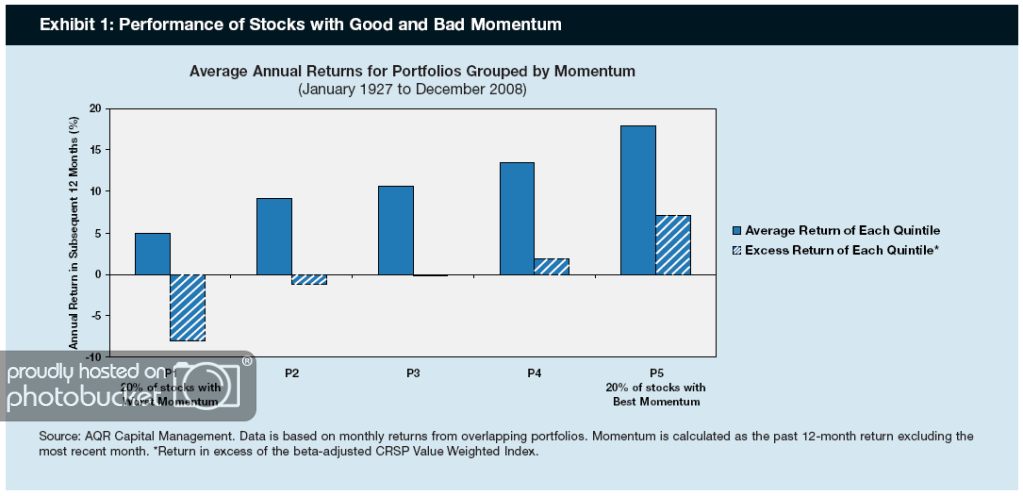
AQR Capital Management recently published a paper in which they present the results of a momentum strategy (as defined by trailing 12 month price return) from 1927 to 2008. They compared the performance of U.S. stocks, broken into quintiles as defined by momentum.

AQR Evidence Based Investing

(Click to Enlarge)

The top two quintiles were able to generate significant excess return over time. A proper understanding of the historical nature of relative strength investing is a critical factor in being able to commit to the strategy for the long run.

Posted by:


You Can’t Be Serious

July 25, 2009

As far as I can tell, this article’s advice is not tongue in cheek. In fact, I think the author is quite earnest. His idea is that first you get to guess whether the economy going forward will have inflation, deflation, or be just right. Second, you put in a completely different asset allocation depending on your guess, incorporating insurance (in the form of assets that are expected to hedge your bet) in case you are wrong. Third—although this is not explicitly discussed in the article—you have to hope that the various assets in the portfolio, including the “insurance,” perform the way they are expected to depending on the scenario that unfolds.

Let’s hope your crystal ball isn’t in the shop! Given that we are dealing with an economic scenario that no one has seen in their lifetimes, what are your odds of forecasting correctly and then having all of the assets perform as expected? Yet, unless you are using some type of tactical, trend-following approach, this is the kind of silliness you are forced to deal with. Do you really want your retirement or your children’s college educations to depend on your ability to guess correctly?

Posted by:


RS In Depth

July 24, 2009

Most investors misunderstand—or maybe “over-simplify” is the right term- Relative Strength (RS). I think a big part of the problem is the inherent desire to make RS sound more simple and basic than it really is. Simple processes are easier for a novice to understand and accept as a viable investment strategy. From the standpoint of the expert talking to a novice this is preferable because a novice doesn’t have the time or inclination to learn all of the complexities of the strategy. In other words, a novice doesn’t need to know how to build a watch; they just need to know how to tell time.

The reality is that RS is much more complicated than people actually think. When we talk to advisors they are often under the impression that a strong stock is a strong stock and there is only one way to measure strength. It just so happens that the best measure of momentum, according to whoever you are talking to, is the method that person has been using lately! RS is much more complicated than that. There are numerous ways to measure the strength of a stock.

It is no different than a value strategy. If you ask a room full of value managers what defines a “value stock,” you’re going to get a room full of answers. Some people define value in terms of dividend yield, while others might use a price-to-cash flow model. If you look at the portfolios of these two individuals, they are going to have different holdings even though they are both buying “cheap” stocks. More importantly, the portfolios are going to perform differently during different parts of the market cycle. The market rewards different factors to different degrees at different times. Both factors might outperform over a long time horizon, but over any short time period the performance might be dramatically different. There is nothing wrong with this! If the dividend yield manager underperforms the cash flow manager during a given time period, it might not have anything to do with the skill of the two managers-it might simply be a matter of the market rewarding different value factors at different times.

Just as there are numerous value factors, relative strength can be calculated in many different ways. Even something as straightforward as point & figure relative strength has numerous calculation methodologies. You can use a 3.25% box size, 6.50% box size, the old Chartcraft standard boxes, a matrix (using any box size you want), or anything else you can dream up. You can also favor an RS column change, and RS buy signal, or some combination of the two. Dorsey Wright doesn’t even advocate one superior calculation method, as the research database makes all of these different calculation tools available to you. The market will reward these different RS factors at different times. Sometimes short term strength is rewarded more than long term strength; sometimes it’s the other way around. It is no different than the value stock example discussed above. If one person uses a 12-month price return model to measure RS and another uses a 3-month price return model, their portfolios are going to hold different securities, have different turnover, and performance might be completely different during any given time period. Both managers are using relative strength and buying strong stocks-they are just defining RS slightly differently.

For example, take a look at how several different RS calculation methodologies performed during the first 6 months of 2009. As part of our research and ongoing process of continuous improvement, we track lots of RS factors in the Money Management office (besides our own proprietary measurement). Here, we are just using some simple price-return-over-time models to illustrate our point.

table1 RS In Depth

The data in the table above shows that the way you define relative strength leads to very different return profiles over short time periods. All of these models outperform the broad market over long periods of time (we do have the data on that!) so they are all acceptable ways to determine strength. However, over half a year the market has rewarded each factor very differently.

In addition to the variation in returns between RS factors there will also be variation in returns within an RS factor model. Unless two managers buy the entire basket of high RS securities, their portfolios are going to look different. This may seem obvious, but it is something many people don’t consider when evaluating an RS strategy. While the chosen factor might be robust enough to deliver market-beating returns over time, any sub-set of the high RS basket might perform better or worse than any other sub-set over a given time period. There can be massive variation between portfolios, even ones using the exact same RS factor. Here, we use 100 different random trials to give you some sense of the possible variation. The following table illustrates this point.

table2 RS In Depth

Using exactly the same factor, your returns could range from -21% to +8%, depending on which stocks in the group you ended up with.

We use a unique and robust testing protocol here in the Money Management office. We try to make everything as “real world” as possible. In a paper our portfolio staff wrote way back in 2005, we designed a random trade process that allowed us to randomly select high RS securities for a concentrated portfolio. The theory is this: if you can select stocks at random from a predefined sub-set of a universe and still outperform a benchmark over time you have a remarkably robust process. That random trade generation process was used to test the model in the table above. You can see that with the same parameters and same investment universe there can be wildly different results over a short time period. Over a longer testing period (1995 through mid-2009) all 100 random trials of the simple 6-month model outperformed the broad market. But over a short period of time, it is quite possible to get stuck with a low-probability, lousy outcome. (You can even get quarters where about half the trials outperform and half underperform.)

There is a tendency for investors, when they get stuck with a lousy outcome, to believe the process is broken. It isn’t. Most people want to believe they are in control of every situation so having to think in terms of probabilities often makes them uneasy. However, it’s the reality of investing: not just in an RS strategy, but in every other strategy as well.

As you can see, there is variation in relative strength strategies just like there is variation in returns with every other investment strategy. There isn’t one right or wrong way to calculate RS, although we do know that some ways are better than others! (We happen to be fans of our proprietary method.) Every calculation methodology has strengths and weaknesses. Both the strengths and weaknesses will be exposed at some point during the market cycle. There is no way to avoid this phenomenon. There is no magic unicorn that’s going to appear and tell you the best way to identify a strong stock this week—and it will change next week anyway. You’re better off to stop looking for the unicorn and spend your time testing for a robust method that will work over a long period of time, and then understanding everything you can about the tradeoffs you are making. Our bias is to use exhaustive testing and data analysis to investigate and make decisions about the tradeoffs we need to live with. Perhaps not everyone has the resources and programming ability to make that feasible, but you can spend time thinking about how your factor is constructed and where it might be vulnerable. There are very few guarantees in finance, but I can make this one: if you truly understand everything about the statistical parameters of your process, the next time someone tries to tell you your model is broken, you might have a knowing smile instead of a concerned frown.

Posted by:


Bear Markets and Recoveries

July 24, 2009

(Click to Enlarge)

If the March lows hold, this will have been the second worst bear market in U.S. history. It interesting to note that this bear market declined nearly 57% in only 17 months. Since the lows on March 9th, the Dow has risen almost 40%.

Some of the names of the thrill rides at Six Flags (Dive Devil, Scream…) seem appropriate for the stock market over the last year and a half!

While the stock market experiences periodic destructive bear markets, the historical resiliency of the stock market is impressive, as is detailed in this report by The Russell Investment Group, leading to long-term annualized returns of roughly 11%.

Posted by:


Stupid Investment of the Week

July 24, 2009

Chuck Jaffe writes a “Stupid Investment of the Week” column for Marketwatch. This week it is cash. We’ve been talking about the problem of holding cash on our periodic conference calls for some time.

We are at a funny spot in the economic and market cycle. Depending on which economic forecaster you listen to, the economy is either at the bottom, beginning to recover, or in the eye of the storm before another drop. Depending on the market action that day, investors are either fearful of further declines or of missing the rally. Investors tried to diversify and stick it out in 2008, and, for the most part, that didn’t work for them. Almost everything went down. Now retail investors don’t know what to do.

They do recognize that the current market environment is something that no one has seen before. They seem to recognize that globalization has occurred and their investment policy now needs to address multiple scenarios with risks of inflation, deflation, a weak dollar, and so on. And they do know, with today’s low yields, that sitting in cash will not get them to their investment goals.

It has occurred to most investors that it might be wise to consider a tactical approach that offers wide flexibility and exposure to different asset classes, but they don’t have any idea how to go about it. I think this is the primary reason why clients have been so interested in our Systematic RS Global Macro portfolio. It uses relative strength to handle the timing and exposure to equities, fixed income, inverse funds, commodities, currencies, and real estate-and then continues to systematically adjust those positions in response to changing market conditions. The attraction of such an approach may be particularly strong now due to the low yields on cash.

Click here for disclosures from Dorsey Wright Money Management.

Posted by:


Doubling Down

July 24, 2009

The California Public Employees’ Retirement System (Calpers) recently reported a fiscal year loss of $56 billion. The pensions of California retirees are now only 66% funded, which means they have only 66 cents in the kitty for every promised future dollar of benefits. Funding for Calpers is predicated on a 7.75% annual rate of return on investment. Of course, for the last 10 years they have fallen far short of that. They either have to increase funding—quite unpopular in this economy—or increase their investment returns. Their pension head is making a big bet. He is increasing exposure to the most risky asset classes. If it works, he will be a hero. If it doesn’t, well, he probably won’t be pension head for long. And who knows what will happen to California’s retirees, not to mention blowing an even larger hole in the already faltering state budget.

This type of investor behavior is typical of clients with a gambling mentality—maybe I can “make it back.” Suffice it to say that most investment professionals would not necessarily think this was a good idea. As always, however, most investment problems can be traced back in the end to investor behavior. I find it quite remarkable that the largest pension in the country chose as its head an individual with a background in politics-he has no background in finance. It will be interesting, and potentially tragic, to see how all of this turns out down the road.

Posted by:


Big Day For The Laggards

July 23, 2009

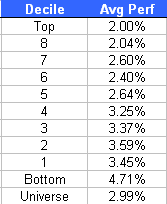
So far this quarter we haven’t had a really big spread day between the laggards and leaders. That is until today. The low ranked RS stocks did much better than the highly ranked RS stocks today. The broad market was up dramatically today, but all of the good performance came from the low ranked stocks. Looking at the performance by RS decile you can see a steady progression in the performance as the RS ranks get worse.

decile1 Big Day For The Laggards

You can see from the data that any decile that outperformed the universe average was at least in the bottom half of the ranks. It is very rare to find an RS strategy that even holds stocks ranked in the bottom half, let alone buys them. On a day like today, the more levered you are to the high RS stocks, the worse you performed.

Posted by:


The Times They are A Changin’ (some more)

July 23, 2009

One of the few constants in my investment career has been that New York City was the hub of the financial world. That may be in the process of changing. Luigi Zingales, a professor at the University of Chicago’s Booth School of Business, recently wrote a commentary that suggests a major change is underway. Like the Italian city-states, Amsterdam, or London of the past, New York may be in the process of forfeiting the world’s financial crown. Dr. Zingales points out a wide variety of factors that may contribute to this change. They include tax policy, brain drain, and poor regulation.

I have witnessed NYC being wheeled into the morgue in the past, but it has always managed to walk out. Will it be different this time? I don’t know, but I will be watching the relative strength of foreign markets for a clue.

Posted by:


Housing Shock

July 22, 2009

When is the last time you saw this advice? Right about never. At least not very frequently in the last 25 years that I can remember. I’m shocked. Maybe fiscal responsibility is actually setting in. Wouldn’t it be nice if Congress got the memo?

Posted by:


Pillow Fight

July 22, 2009

Ibbotson Associates has put out, for many years, the familiar multi-color mountain chart of stock returns beating bond returns. They contended that equity returns historically were far superior to fixed income returns, and this was used as fuel by many to hold large equity allocations in every market environment, regardless of client circumstances.

The last decade has not been kind to stocks, so now bond returns have exceeded stock returns over the last 40 years. Various commentators have begun to attack Ibbotson’s position by suggesting that retail investors should just own bonds, since they have done better than stocks. Now Ibbotson is firing back with new justifications for why stocks should do better than bonds going forward.

I’m imagining that when economists disagree on important topics like unknowable future returns that they would pull hair or hit each other with pillows if they weren’t able to write journal articles to fight with one another.

Ultimately, the whole argument is silly. No one knows the future, so it is impossible to know who will be right 10 years down the road. Is there some rule that you have to guess which asset will be better? Why not just hold stocks when they are strong, and switch to bonds (or some other asset) when stocks weaken?

Posted by:


Failure to Adapt

July 22, 2009

“Since the beginning of the financial crisis, there have been two principal explanations for why so many banks made such disastrous decisions. The first is structural. Regulators did not regulate. Institutions failed to function as they should. Rules and guidelines were either inadequate or ignored. The second explanation is that Wall Street was incompetent, that the traders and investors didn’t know enough, that they made extravagant bets without understanding the consequences. But the first wave of postmortems on the crash suggests a third possibility: that the roots of Wall Street’s crisis were not structural or cognitive so much as they were psychological.

In “Military Misfortunes,” the historians Eliot Cohen and John Gooch offer, as a textbook example of this kind of failure, the British-led invasion of Gallipoli, in 1915. Gallipoli is a peninsula in southern Turkey, jutting out into the Aegean. The British hoped that by landing an army there they could make an end run around the stalemate on the Western Front, and give themselves a clear shot at the soft underbelly of Germany. It was a brilliant and daring strategy. “In my judgment, it would have produced a far greater effect upon the whole conduct of the war than anything [else],” the British Prime Minister H. H. Asquith later concluded. But the invasion ended in disaster, and Cohen and Gooch find the roots of that disaster in the curious complacency displayed by the British.

The invasion required a large-scale amphibious landing, something the British had little experience with. It then required combat against a foe dug into ravines and rocky outcroppings and hills and thickly vegetated landscapes that Cohen and Gooch call “one of the finest natural fortresses in the world.” Yet the British never bothered to draw up a formal plan of operations. The British military leadership had originally estimated that the Allies would need a hundred and fifty thousand troops to take Gallipoli. Only seventy thousand were sent. The British troops should have had artillery—more than three hundred guns. They took a hundred and eighteen, and, for the most part, neglected to bring howitzers, trench mortars, or grenades. Command of the landing at Sulva Bay—the most critical element of the attack—was given to Frederick Stopford, a retired officer whose experience was largely administrative. Stopford had two days during which he had a ten-to-one advantage over the Turks and could easily have seized the highlands overlooking the bay. Instead, his troops lingered on the beach, while Stopford lounged offshore, aboard a command ship. Winston Churchill later described the scene as “the placid, prudent, elderly English gentleman with his 20,000 men spread around the beaches, the front lines sitting on the tops of shallow trenches, smoking and cooking, with here and there an occasional rifle shot, others bathing by hundreds in the bright blue bay where, disturbed hardly by a single shell, floated the great ships of war.” When word of Stopford’s ineptitude reached the British commander, Sir Ian Hamilton, he rushed to Sulva Bay to intercede—although “rushed” may not be quite the right word here, since Hamilton had chosen to set up his command post on an island an hour away and it took him a good while to find a boat to take him to the scene.

Cohen and Gooch ascribe the disaster at Gallipoli to a failure to adapt—a failure to take into account how reality did not conform to their expectations. (my emphasis) And behind that failure to adapt was a deeply psychological problem: the British simply couldn’t wrap their heads around the fact that they might have to adapt. “Let me bring my lads face to face with Turks in the open field,” Hamilton wrote in his diary before the attack. “We must beat them every time because British volunteer soldiers are superior individuals to Anatolians, Syrians or Arabs and are animated with a superior ideal and an equal joy in battle.”

This long quotation about the failure to adapt is taken from Malcolm Gladwell’s article in The New Yorker on the psychology of overconfidence. (You can read the complete article here.) Just as the problems in the banking system were born of overconfidence, so too were the problems in asset allocation. The failure to adapt can have serious consequences whether in Gallipoli or your client’s portfolio.

Proponents of strategic asset allocation believed so strongly that their approach was superior that they ignored existing problems with the theory, such as instances of rising correlations in previous declines. Even now, after widespread failure in 2008, I continue to read articles about how strategic asset allocation performed like it was expected to. James Montier of Societe Generale recently referred to the efficient markets hypothesis as “the financial equivalent of Monty Python’s Dead Parrot. No matter how much you point out that it is dead, the believers just respond that it is simply resting!” The argument that 2008 was a one-time aberration and that things will soon be back to normal might be true—and it also might not be true.

If you assume for a moment, as we did, that strategic asset allocation might not be ideal, you would be motivated to do research and explore other options. When we used relative strength as the engine to do tactical asset allocation across a broad range of asset classes, we discovered that periodic trends generated returns that were not dependent on the assumption of lack of correlation between asset classes for their success. It would be entirely possible for assets that should be uncorrelated to be trending the same way at the same time, since we made no a priori assumptions. Rather than having to forecast forward returns to re-jigger allocations or to re-optimize correlation matrixes on a frequent basis, we designed the portfolio to flow with the trends. The result is a clean, simple, and understandable process that, we think, turns out to be as good a description of reality as strategic asset allocation.

Posted by:


Cheeseburger in Paradise

July 21, 2009

Relative strength is simply the measurement of an item or items relative to a common benchmark. One of the more tasty applications of relative strength is the Economist’s Big Mac Index. In short, this index compares the price of a Big Mac (in US$ equivalent) in various foreign countries to the price of a Big Mac here in the United States.

As the most recent article points out, the lowest relative prices for Big Macs are in Asia and the highest are in Europe. It is not surprising that China, where the Big Mac is $1.83, is exporting so many other goods to us here in the U.S. where the same burger goes for $3.57. The Economist updates their burger index each quarter and it will be interesting to see how the prices change as the world continues to deal with the tumultuous global economy.

Local has become global—and vice versa. It makes sense to consider a tactical investment approach that can cope with new environments.

Posted by:


Uncharted Waters

July 21, 2009

Apparently for the first time since sometime in the Truman Administration, Americans actually paid down household debt last quarter. Of course the total debt load is still growing, no doubt due to the interest expense, but the turnaround has been shocking for economists. Goldman’s chief U.S. economist, Jan Hatzius is quoted in the article as saying “We’ve never seen a pullback like this.”

The U.S. consumer accounts for approximately 17% of world GDP and U.S. consumers are cutting back spending and trying to live within their means for a change. Unless there is big offsetting spending from somewhere else, profit growth is not going to come from revenue growth. If it is uncharted territory for economists, it’s very likely their forecasts will be a long way off the mark too. It seems safer to use an adaptive, systematic method like relative strength to deal with the markets than hope all the gurus guess correctly.

Posted by:


Dangerous Profession

July 21, 2009

Being a financial advisor is a dangerous profession!

Posted by:


The Times They Are A-Changing

July 17, 2009

This is stunning news. I am probably a typical American who had no idea that the equity market in China had grown so rapidly. Sure, we all know about China ETFs and a few of the large-cap names, but I am still surprised. The amount of capital formation that has occurred in Asia since WWII is astounding. First, Japan overtook London during its period of phenomenal growth rebuilding after the war. Now, the forces of capitalism that have been unleashed in China have caused the market cap to exceed that of Japan.

This is a good wake-up call. Capital will migrate to wherever the innovation is taking place, wherever it is treated best. And this will also be true of your investment capital. We are all going to need to learn to think globally.

Posted by: