A New Definition of Diversification

August 31, 2009

Andrew Lo was recently interviewed by Consuelo Mack on the Wealthtrack program. Professor Lo is one of the leading detractors of the Efficient Markets Hypothesis, starting with his book A Non-Random Walk Down Wall Street. Here’s an interchange about diversification:

CONSUELO MACK: Let’s talk about that, because that’s one of the hallmarks of what you’ve been saying, is that there’s a new definition of diversification. It’s not your grandmother’s diversification. So what is the new definition of diversification that we as individuals can follow?

ANDREW LO: Well, it really has to do with asset classes, as opposed to the number of securities in your portfolio. 30 years ago a well-diversified portfolio was probably 100 stocks and a few bonds.

CONSUELO MACK: U.S. stocks for that matter.

ANDREW LO: That’s right. Exactly. And little by little we’ve made advances, so at some point we went international, at some point we decided to focus on style, value versus growth. At some point we looked at market cap- small cap versus large cap. All those different kind of portfolios lost money last year in 2008. So now we have to focus much more broadly on different asset classes: commodities, currencies, TIPS, real estate.

Obviously, we agree with Dr. Lo. His listing of asset classes essentially defines what is included in the Systematic RS Global Macro portfolio. In addition, other work Dr. Lo has done on his replacement for the Efficient Market Hypothesis, the Adaptive Markets Hypothesis (AMH), shows that it is quite possible to earn excess returns from tactical allocation. As usual in finance, however, progress moves forward one funeral at a time, so it will be decades before many of the false beliefs will be swept away.

(You can read a transcript of Dr. Lo’s interview here. If you prefer the video version of the interview, it can be seen here.)

Click here for disclosures from Dorsey Wright Money Management.

Posted by:


AQR on Momentum

August 31, 2009

Barron’s has a nice interview with Cliff Asness and David Kabriller of AQR Capital (click here to read.) Subscription required. One noteworthy exchange:

Why do you think momentum investing works?

Asness: No one has nailed down why. We have a lot of theories. When I say “we,” I don’t just mean AQR. I mean the academic community and the practitioner community. Underreaction is probably our universally favorite story. Good news comes out. There is a phenomenon in behavioral finance called anchoring and adjustment, where people go, “Oh, that’s great news,” and they move halfway but they don’t move all the way to incorporate the great news. So if you buy what’s gone up, there’s a little more to go. I won’t pretend I have told you all the different theories.

Posted by:


Dr. Doom Stumbles

August 28, 2009

Prophecy: two bull’s eyes out of a possible million.
—Mark Twain

It seems there is always an active market for doomsayers, but apparently Nouriel Roubini’s recent forecasts haven’t worked out so well. I’m sure ours wouldn’t be any better, but that’s why we are trend followers.

Posted by:


Thank Goodness We Have Learned Our Lesson!

August 28, 2009

There’s almost no printable comment you can make about this story on Bloomberg.

Posted by:


Deflation Bites

August 28, 2009

A very interesting article by Randall Forsyth in Barron’s discusses the problem conservative investors are having right now. Economists are worried about inflation down the road if the government chooses to monetize its debt. But the current problem for investors is deflation.

Deflation has driven interest rates on cash to near zero. Interest income is $50 billion lower than a year ago. The recession has caused corporations—many of them financials—to cut dividends as well. I was surprised to learn that overall dividend income is down 25% from a year ago. And it is projected to get worse.

This can’t have a positive effect on consumer spending. And when consumer incomes drop, tax revenues also drop, which puts more pressure on the national deficit.

Investors are also in a bind. The best yields are available, as always, on the riskiest paper. Most of the time, if CDs and Treasurys have reasonable yields, the “widows and orphans” investors ignore high-yield debt. But under the current circumstances, I suppose there is a risk of investors stretching out their risk parameters to reach for yield. Given that bond mutual fund sales have recently been running at five times the level of stock fund sales, I’ve got to wonder whether all of that cash is ending up in an appropriate place on the risk spectrum.

Posted by:


Balance of Economic Power Shifts

August 28, 2009

Economists have assumed for some time that Asian economies would eventually be larger than the U.S. economy, mainly because the population is already large and some of the economies are relatively undeveloped with lots of room for upside growth. None of them expected it to happen this soon. One economist in this article in the International Herald Tribune thinks that the current recession was the turning point. Asia’s resurgence is still dependent on U.S. and European consumer spending, but economic development there has been extraordinary.

Economic realities will eventually translate into investment realities, so it is imperative that your investment policy be able to address changes as they occur.

Posted by:


The Growth Illusion

August 28, 2009

The faster the economy of a country grows, the better it is for that country’s stock market, right? Uh, not exactly. Click here to read the Economist’s summary of the work done by Elroy Dimson, Paul Marsh and Mike Staunton at the London Business School back in 2005. Over the 17 countries they studied, going back to 1900, there was actually a negative correlation between investment returns and growth in GDP per capita.

Emerging markets are doing great right now and that trend may persist for years. However, it would be incomplete to conclude that they are doing so solely because of growth in GDP. Supply and demand determine all prices. Prices trend. Investors who follow those trends in a systematic way can generate superior investment results over time. It is not necessary to get more complicated than that.

Posted by:


Gopher Mounds

August 28, 2009

Technicians have known it forever. Most investors have learned it the hard way. The “Level Playing Field” is full of gopher mounds. There is always someone who has an advantage in the market. It might be that they have more knowledge of an industry or a particular company. It might be that they are more disciplined. Or, as this article and video point out, it might be that they are large clients of a large firm. As Mr. Blodget points out, the playing field will never be level.

Neither the market nor life is fair. Once you accept that, you can focus on finding tools to overcome that problem. Technicians use price as a tool because it reflects the constant battle between supply and demand, regardless of whether it is a result of “huddles” or published material. We have chosen to use relative price (strength) because we have found it to be the best way for us to eavesdrop on the other teams’ huddles.

Posted by:


Master of Disaster

August 27, 2009

Ken Rogoff is just a brilliant guy. First of all, he is an International Grandmaster in chess and in the 1970s won the U.S. Under 21 Championship when he was only 16. After getting his Ph.D. in Economics from M.I.T., he served as the chief economist at the International Monetary Fund, where he had to deal with systemic banking failures in a number of nations. He and Carmen Reinhart have written insightfully on the banking crisis in the past. Mr. Rogoff might know more about how to solve banking crises than anyone, and certainly more than Congress or their lobbyists.

His latest piece is important reading. He concludes “within a few years, western governments will have to sharply raise taxes, inflate, partially default, or some combination of all three.” Possibly like the rest of us, he sees little prospect that Congress will ever actually cut spending.

Most western nations, and certainly the U.S., have not been in that position in the recent past. If Mr. Rogoff’s scenario comes to pass, having a Global Macro-type portfolio could be a lifesaver. The only way to protect hard-earned capital might be to have investment access to a wide range of asset classes around the globe.

Click here for disclosures from Dorsey Wright Money Management.

Posted by:


Trend Following and Randomness

August 27, 2009

Clay Allen of Market Dynamics has an outstanding and lucid piece about the relationship between random price activity and trends. He presents the case for the importance of observing and following trends without worrying about prediction. Must reading, in my opinion.

Posted by:


Sit and Take It

August 27, 2009

Buy and hold investing (I like to refer to it as “sit and take it”) has such a hold on the population that a recent Wall Street Journal story points out that the majority of investors—61%—have made no changes to their 401k allocations since the stock market began to decline. If investor behavior works like it has historically, most of the 39% who did make changes probably did the wrong thing.

Frankly, even investors who did nothing had their allocations change dramatically, because the market movement changed their allocation for them—although maybe not in the way they intended. Standing pat has just as many consequences as any other choice.

Various financial advisors quoted in the article give widely varying advice on what clients should do, as if they weren’t confused enough already. One advisor says many new clients “are arriving with portfolios heavily weighted in cash and questions about when and how to enter the market.” In other words, they are dazed and confused.

I can’t think of a better argument for an adaptive, systematic investing strategy. A systematic strategy gives you a plan of action that can be followed in all markets. An adaptive plan changes holdings as the market environment changes. Not every change will work out perfectly, of course, but a systematic, adaptive plan that exploits a factor known to outperform over time (like relative strength) gives you a good shot to do the right thing.

Posted by:


Gentlemen Prefer Bonds

August 25, 2009

Although flows into equity funds have picked up recently, flows into bond funds are currently five times higher than flows into stock funds. (The link to the graphic is here.)

Many investors have apparently given up on the stock market and now they are all about income. This is an interesting proposition with $11.7 trillion in U.S. debt outstanding and no clear way to pay it back. The bonds with the most income, high-yield corporates, are expected to have rapidly rising default rates.

Maybe nothing bad will happen to all of the income seekers, although I would point out that more money has been lost reaching for yield than at the point of a gun. At the very least, it might be a positive sign for the equity markets in a contrary opinion sort of way.

Posted by:


Disconnect

August 25, 2009

Even though Fannie Mae and Freddie Mac owe the government nearly $100 billion and must pay massive dividends each year to the U.S. Treasury, investors are piling in. FRE is up 181% and FNM is up 124% this year (1/1/09 – 8/24/09).

As the Washington Post points out, there is not much that is rational about that. “It’s very hard to come up with scenarios where they’re worth any money,” Bose George, an analyst at Keefe, Bruyette & Woods, said of Fannie and Freddie.

These are just a couple of the many examples of the disconnect that frequently exists between stock prices and company fundamentals.

Posted by:


IFTA Conference

August 25, 2009

There is a conference for professional technical analysts from all over the world being held in Chicago from October 8th-10th . It is sponsored by the International Federation of Technical Analysts (IFTA), but it is open to anyone who is interested in technical analysis and will be a great opportunity to learn about some of the latest developments in the field. Conferences like this are also good for getting to know other professionals in the field. Please see http://www.ifta2009.com for more conference details.

Dorsey, Wright has no connection, commercial or otherwise, with IFTA. I just thought the conference might be of interest to some of our readers.

Posted by:


The Fluid State of A-List Status

August 24, 2009
The spring and summer box office has not been kind to many A-list movie stars like Denzel Washington, Julia Roberts, Eddie Murphy, John Travolta, Russell Crowe, Tom Hanks, Adam Sandler, and Will Ferrell as discussed in this recent article in The New York Times. Movies headlined by those stars have earned only a fraction of the cost of producing them. However, Brad Pitt has been one A-List movie star to show that he can still open a movie and justify A-list-type money. It has largely been a number of lesser-known actors, like Shia LaBoeuf, Ed Asner, and Daniel Radcliffe, that have exceeded expectations at the box office this year.
A-list movie stars have long been measured by their ability to fill theaters on opening weekend. This NYT article provides insight into the current changing of the guard.
A-list status is not a permanent distinction in Hollywood or on Wall Street.
Wall Street also routinely identifies A-list stocks. For example, Microsoft outperformed the S&P; 500 by 9225% in the 1990s, but has underperformed the S&P; 500 by 23% so far in this decade. Investors who dragged their feet too long waiting for things to return to their previous state missed out on better opportunities elsewhere. Apple, for instance, underperformed the S&P; 500 by 124% in the 1990s, but has outperformed the S&P; 500 by 588% so far in this decade. (Disclosure: Apple is a current holding in one of our Dorsey Wright managed products)
Relative strength excels by constantly adapting to the marketplace. Our models are not susceptible to the sentimental attachment associated with winners of past decades. Rather, our models are only attached to securities as long as their relative performance justifies their place in the portfolio.

The spring and summer box office has not been kind to many A-list movie stars like Denzel Washington, Julia Roberts, Eddie Murphy, John Travolta, Russell Crowe, Tom Hanks, Adam Sandler, and Will Ferrell as discussed in this recent article in The New York Times. Movies headlined by those stars have earned only a fraction of the cost of producing them. However, Brad Pitt has been one A-List movie star to show that he can still open a movie and justify A-list-type money. It has largely been a number of lesser-known actors, like Shia LaBoeuf, Ed Asner, and Daniel Radcliffe, that have exceeded expectations at the box office this year.

A-list movie stars have long been measured by their ability to fill theaters on opening weekend. This NYT article provides insight into the current changing of the guard.

A-list status is not a permanent distinction in Hollywood or on Wall Street.

Wall Street also routinely identifies A-list stocks. For example, Microsoft outperformed the S&P; 500 by 9225% in the 1990s, but has underperformed the S&P; 500 by 23% so far in this decade. Investors who dragged their feet too long waiting for things to return to their previous state missed out on better opportunities elsewhere. Apple, for instance, underperformed the S&P; 500 by 124% in the 1990s, but has outperformed the S&P; 500 by 588% so far in this decade. (Disclosure: Apple is a current holding in one of our Dorsey Wright managed products)

Relative strength excels by constantly adapting to the marketplace. Our models are not susceptible to the sentimental attachment associated with winners of past decades. Rather, our models are only attached to securities as long as their relative performance justifies their place in the portfolio.

Posted by:


Every Big Idea That Works

August 24, 2009

“Every big idea that works is marked by simplicity, by clarity. You can understand it when you hear it, and you can explain it to people.” —Peggy Noonan, Wall Street Journal

Relative strength investing is just such an idea that works, is marked by clarity, and can be easily explained.

Most investors find investing to be incredibly complex. For an experiment, ask 10 investors what makes a stock go up or down and observe the disparity in responses. Some may say that it is the earnings of the company that determine the stock price. Other responses may focus on the perceived value of the company, a good story of the company’s prospects, market psychology, the overall health of the economy, availability and cost of money, fads, pronouncements of the President or Chairman of the Fed, analyst ratings, share buybacks, dividends, mergers and acquisitions, or speculation of the price itself.

Without minimizing the influence of any of these factors, a technician looks at the bigger picture to conclude that stock prices change every day and over time because of all of these reasons and more. In any given period, buyers and sellers of securities will be influenced more by some factors than others. The culmination of all of the factors influencing the buying and selling decisions of investors tends to cause prices to move in trends– often multi-year trends. Relative strength simply provides a framework for ranking securities by the strength of those trends and investing in the strongest of those trends.

Posted by:


Efficient Frontier Analysis

August 21, 2009

In this recent post we showed how the annual standard deviation of a portfolio may be reduced by mixing one of our relative strength strategies with a value strategy.

Now you can go to our website and create your own efficient frontier by inputting the quarterly returns of a strategy of your choosing with one of our relative strength strategies. Click here to go to our website and then scroll to the bottom of the page and click on the “Efficient Frontier” to access this spreadsheet.

Please let us know when you find strategies that are a good complement.

Posted by:


Currency Craziness

August 20, 2009

When Lehman Brothers failed, central banks around the world acted to flood financial markets with liquidity. Now the crisis appears to be past and central banks seem to be more inclined to pursue their own national interest. A couple of recent articles at Marketwatch and Bloomberg discuss some of the possible outcomes for the dollar and for other currencies.

Suffice it to say it is complicated. I have no idea if any of their predictions will come to pass, but it is clear that we are entering an unprecedented period where central banks are going to try to stuff the genie back in the bottle. It may well be that a trend-following approach that just waits to see where relative strength appears will be the best way to navigate such complications.

Posted by:


YTD Country Stock Market Performance

August 20, 2009

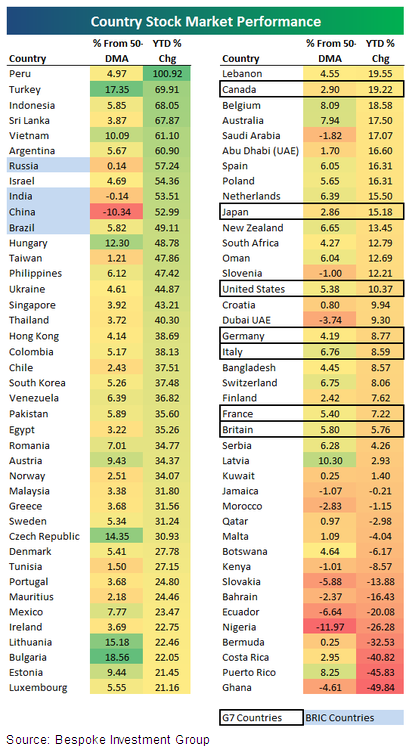
We’re number 56…the U.S., that is. Does your portfolio have exposure to markets other than the U.S.? Performance 1/1/09 – 8/19/09.

(Click to Enlarge)

You are probably already aware that we manage the PowerShares DWA Technical Leaders Portfolio (PDP), but we also manage the PowerShares DWA Developed Market Technical Leaders Portfolio (PIZ) and the PowerShares DWA Emerging Market Technical Leaders Portfolio (PIE).

Fact sheets for all three can be found below:

PDP

PIZ

PIE

Posted by:


Marriage of Deep Value and Momentum

August 20, 2009

Sam Mamudi, MarketWatch, recently profiled deep-value-pioneer Mutual Shares Corp. Click here to read the article. As explained by Peter Langerman, CEO of Mutual Shares Corp, deep value strategies are looking for companies in pre-bancruptcy or that are distressed. As Langerman puts it, “It’s about buying a dollar value for 50 cents.”

Deep value managers, like Mutual Shares Corp, have found an exploitable market inefficiency. This happens to be a very different market inefficiency than we are focused on at Dorsey Wright, but they are very good at what they do. A momentum or relative strength strategy is rarely involved in buying companies in pre-bancruptcy because our methodology leads us to securities that have been the best relative performers over an intermediate time horizon. Both deep value and momentum have a well-documented history of being able to beat the market over time.

However, each strategy has its vulnerabilities. Deep value traps result when distressed securities are bought only to see them become more distressed. Momentum underperforms during every major change in leadership. However, mix the two strategies together and the benefits of diversification become apparent. Creating two strategies so opposite in spirit and opposite in construction, and therefore so negatively correlated with each other, and still having them both produce positive average returns is an area where financial advisors can add meaningful value to their client.

The chart below is the efficient frontier of Dorsy Wright’s Systematic Relative Strength Global Macro strategy and Mutual Shares Corp’s flagship deep-value strategy, TESIX. As you can see, over this time period having 100% of the portfolio in the Global Macro strategy produced the best returns. However, it is possible to lower the annual standard deviation by having a mix of the two. For reference, the S&P; 500 generated annualized returns of -1.80% and standard deviation of 17.32% over this same time.

(Click to Enlarge)

Yes, in this case mixing the two results in lower overall returns, but that is fine with many people. After all, sticking to a winning discipline for decades is the key to investment success. Many investors get twitchy after very short periods of underperformance. Mixing uncorrelated strategies is a way to address this problem. It is not going to result in outperforming every quarter, but it is likely to result in a smoother ride over time. Such an approach may be enough to keep investors from succumbing to the behavioral biases that will cause them to constantly chase the hottest manager.

Certainly, this type of approach is not without its risks. It is not enough to identify uncorrelated strategies. The goal is to identify uncorrelated strategies that are also both able to generate above average returns over time.

Shortly, we will offer the ability to use our website to create efficient frontiers on your own.

To receive information about our Global Macro strategy, including important performance disclosures, please send an e-mail to [email protected].

Click here for disclosures from Dorsey Wright Money Management.

Posted by:


Warren Buffet on the Dollar

August 19, 2009

Buffet on the status of the fiscal predicament of the United States:

…Last fall, our financial system stood on the brink of a collapse that threatened a depression. The crisis required our government to display wisdom, courage and decisiveness. Fortunately, the Federal Reserve and key economic officials in both the Bush and Obama administrations responded more than ably to the need.

They made mistakes, of course. How could it have been otherwise when supposedly indestructible pillars of our economic structure were tumbling all around them? A meltdown, though, was avoided, with a gusher of federal money playing an essential role in the rescue.

The United States economy is now out of the emergency room and appears to be on a slow path to recovery. But enormous dosages of monetary medicine continue to be administered and, before long, we will need to deal with their side effects. For now, most of those effects are invisible and could indeed remain latent for a long time. Still, their threat may be as ominous as that posed by the financial crisis itself…

Buffet on the solution to the fiscal predicament of the United States:

…Legislators will correctly perceive that either raising taxes or cutting expenditures will threaten their re-election. To avoid this fate, they can opt for high rates of inflation, which never require a recorded vote and cannot be attributed to a specific action that any elected official takes. In fact, John Maynard Keynes long ago laid out a road map for political survival amid an economic disaster of just this sort: “By a continuing process of inflation, governments can confiscate, secretly and unobserved, an important part of the wealth of their citizens…. The process engages all the hidden forces of economic law on the side of destruction, and does it in a manner which not one man in a million is able to diagnose….”

Unchecked greenback emissions will certainly cause the purchasing power of currency to melt. The dollar’s destiny lies with Congress.

In case you don’t have faith in Congress to do the politically difficult things, like cutting expenditures, investors can find some solace in the fact that a weakening dollar will benefit your foreign investments immediately because it helps drive those international returns higher as international assets appreciate in value relative to the dollar.

For example, a U.S. investor in the MSCI EAFE Index over the past five years (8/18/04 – 8/18/09) is up 12.74%, while the European investor in the same index and over the same time period is down 1.74% – all thanks to a declining U.S. dollar.

Click here to read Buffet’s complete Op-Ed in today’s NYT.

Posted by:


The Benefits of Currency Diversification

August 18, 2009

A recent Fortune article discusses diversifying with currencies, in an interview with a portfolio manager. We agree with a lot of his points, although rather than maintaining a strategic allocation to currencies all the time, we think it can be fruitful to tactically allocate to currencies when they are strong. The larger point is that currencies have valuable characteristics for diversification–they have very different volatility from many other asset classes and they often operate on a different cycle from other assets. For these reasons, we explicitly chose to include currencies among our asset baskets for the Systematic RS Global Macro portfolio and the Arrow DWA Tactical Fund. Currencies just don’t tend to be thought about by U.S. investors, but that makes them no less valuable.

Click here to visit ArrowFunds.com for a prospectus & disclosures. Click here for disclosures from Dorsey Wright Money Management.

Posted by:


The Biggest Thing Since E-Mail

August 18, 2009

Jim Cramer makes the case for why smartphones are “obliterating the old way of doing things.”

Currently, there are as many as 4 billion cell-phone users worldwide, but only 12 percent use smartphones. Given the superiority of the product and the aggressive pricing, I expect we will see a total replacement of dumb phones with smart ones rather quickly.

Long-term trends are where all of our relative strength models make their money. Smartphones, and Technology more broadly, may be the next major trend. They have certainly been among the best performers YTD and over the last 12 months. This will be an important trend to watch. YTD (1/1/09 – 8/17/09) performance of the stocks mentioned in Cramer’s article are listed in the table below:

(Click to Enlarge)

Disclosure: Dorsey Wright currently has positions in Palm, Cypress Semiconductor, Cree Research, and Apple in our managed products.

Posted by:


Less Can Be More

August 18, 2009

The WSJ reports that the average stock fund has 172 holdings. What is the point of having that many holdings? Diversification? The table below reveals that there is very little incremental reduction in annual standard deviation once you get past about 20 holdings.

(Click to Enlarge)

Source: M. Statman, “How Many Stocks Make a Diversified Portfolio?” Journal of Financial and Quantitative Analysis 22 (September 1987), pp. 353-64.

The real reason mutual funds own so many stocks was revealed in an academic study conducted by researchers from Yale. The real goal of most mutual fund managers is to reduce tracking error (volatility of portfolio return around a benchmark index.) Many fund managers have realized the challenges associated with deviating from the benchmark and have chosen to increase the number of holdings so that they will never be too much worse than the benchmark. Of course, they will never be too much better either. With the impact of fees, such a closet-indexing approach is very unlikely to add any value over time. However, that doesn’t keep the manager from telling a great story and attracting investors based on their perceived investment prowess. The active-share study completed by K. J. Martijn Cremers and Antii Petajisto examined the proportion of stock holdings in a mutual fund’s composition that was different from the composition found in its benchmark. The greater the difference between the asset composition of the fund and its benchmark, the greater the active share. According to active-share study, there was a positive correlation between a fund’s active-share value and the fund’s performance against its benchmark. For example, a mutual fund with an active-share percentage of 75% indicates that 75% of its assets differed from its index, while the remaining 25% mirrored the index.

The study found that funds with a higher active-share value would tend to be more consistent in generating high returns against their benchmark indexes, which implies that more actively managed funds have more skilled managers. However, higher active share necessarily means higher tracking error. Since the 1980s there has been a steady rise in closet-indexing.

Investors need to understand the real reason that most mutual funds have so many holdings. After all, an active manager can only add value relative to the index by deviating from it. If an investor’s goal is to beat the benchmark over time, buying a mutual fund with over 100 holdings (a closet indexer) is not likely the way to go. To beat the benchmark over time an investor needs to invest in strategies that have fewer holdings and, of course, a winning investment strategy. On the other hand, if the investor’s goal is to match the benchmark over time then it is more cost effective to buy an index fund from Vanguard for 9 basis points.

We make no secret about the fact that our relative strength strategies have high active-share (most above 90%). Most of our strategies have 20-25 holdings. While others serve the closet-indexing market, we have chosen to serve the active-investors market.

Posted by:


A Flair for the Dramatic

August 17, 2009

(Click to Enlarge)

Perfect for a day like today.

HT: CW

Posted by: