Only 3 Percent!

December 30, 2009

It has been a banner year for emerging markets, with the MSCI Emerging Markets index up 73% in 2009, compared to a 25% jump for the S&P; 500 index. A recent article in the NYT details the success that emerging markets have had in the “Roaring ’00s” and why their prospects continue to be bright in the coming decade, including some of the following highlights:

  • In Ukraine’s PFTS Stock Exchange — a Wild East of investing that did not even exist until 1997 — shares soared more than 1,350 percent over the last decade.
  • In Peru, stocks jumped more than 660 percent over the last decade.
  • In India, the Sensex index leaped more than 240 percent over the past decade.
  • Since the 1998 debacle, some developing countries have cleaned up their acts, balancing their budgets and improving their trade balances. As their economies grow, domestic investors have become big supporters of these countries’ stock markets. With interest rates low around the world, companies based in emerging markets, like their counterparts in the developed world, enjoy access to cheap money. High commodities prices have buoyed stock and bond markets in nations that are big exporters of commodities.
  • As long-term investments go, emerging markets seem to have a lot going for them. On average, developing countries have less sovereign, corporate and household debt than developed countries.
  • Their economies are also growing faster than industrialized ones. Merrill Lynch predicts that emerging market economies will grow 6.3 percent next year, while the global economy expands by 4.4 percent.
  • Imports to the BRIC nations are likely to surpass imports to the United States for the first time ever in 2009, according to Morgan Stanley.
  • Even if developed countries recover completely in 2010, emerging economies will account for 70 to 75 percent of the growth in global output “for the foreseeable future,” said Mr. Conway of Schroders.
  • Morgan Stanley predicts that developing countries, including those in the Middle East, will account for 36 percent of total global gross domestic product in 2010, up from 21 percent in 1999.

Of course, the article also detailed some of the risks involved with investing in emerging markets, but the tone of the analysis was overwhelmingly positive.

Then came the point that I found fascinating:

Even after that influx, emerging markets still account for only a small fraction of investment portfolios in United States and Europe, the world’s money management centers. Less than 3 percent of assets managed by United States fund managers are invested in emerging markets.

For whatever reason (home-country bias, habit, fear…) Americans still are hesitant to allocate much of their portfolio to emerging markets. Perhaps, it is time to expand the investment universe!

Posted by:


Clash of the Titans

December 30, 2009

Wow. The International Monetary Fund expects the economy of China to pass up the economy of Japan next year for the title of the world’s second largest economy. I guess all of those articles from a few years ago talking about how China would be a world power in 20 or 30 years were off a little bit on their timing!

The world is changing rapidly and it is important that your investment policy have the flexibility to adapt.

Posted by:


RS Primer

December 29, 2009

Good primer on relative strength by CSS Analytics:

I have done a lot of research in this area and the first conclusion I can make is that it should be a major portion of any trader or investors portfolio strictly because it is so durable and robust. Whether its asset classes, sectors, stocks, commodities, currencies—-you pick a time frame over the last 40-50 years and this simple method of buying strength and selling weakness has outperformed traditional buy and hold strategies. This outperformance or alpha is also robust to most transaction cost assumptions.

Four-stage model depicting how relative strength occurs:

Based on my own observation and theory I feel that a simple four-stage model best depicts how relative strength occurs and why it takes time to develop rather than occuring instantaneously. The relative strength effect is driven by behavioural feeback loops where investors sequentially pour money into the asset du jour for a plethora of reasons including positive perceived fundamentals, psychological beliefs such as fear or greed, or for positive economic or default risk factor sensitivity. Essentially it starts when certain investors create a theory such as: “emerging markets will outperform because of the accelerated pace of development” and begin to accumulate investments in assets tied to this theory (Stage 1: the early adopters). As time goes on the theory itself becomes more widely known and the rationale becomes more widely accepted. Others quickly catch on and start investing in the same idea (Stage 2: recognition and acceptance). The next stage (and longest stage) is where initial investors wait for hard proof that the idea or theory is supported by tangible evidence in a variety of forms whether economic indicators, qualitative or anectdotal accounts to mention a few. (Stage 3: validation). The “Validation Stage” tends to last long as the early investors are looking for ongoing proof that supports or refutes their theory. The nature of economic data and other information sources is that they require multiple readings to establish that a trend is in fact statistically valid. This is why it is impossible for markets to adjust instantaneously even with purely rational investors. There are two paths the validation stage can take—either the evidence to refute the theory is strong , and as a consequence momentum will fail as early investors bail out. Or if the evidence continues to support and even exceed expectations, the early investors will add to their positions alongside the second stage investors. This added money flowcements the trend and the relative strength begins to really accelerate. At this point we reach the final stage where everyone agrees that a given market is and should go up and people are hopping on the bandwagon simply because the market is going up. This is both the fastest stage and the most rewarding per unit of time (Stage 4: mania).

Posted by:


Constancy of Human Behavior

December 29, 2009

NY Magazine recently interviewed James Grant, well-known financial philosopher, to get his take on the economy and financial markets. The article is full of nuggets of wisdom, including the following:

Grant’s second cause for optimism is an observation about human nature, summed up by an epigram he borrowed from the late British economist Arthur C. Pigou: “The error of optimism dies in the crisis, but in dying it gives birth to an error of pessimism. This new error is born not an infant, but a giant.” As peculiar as our economic circumstances may seem to us right now, the way people behave has a certain reassuring constancy—which is to say, we freak out and then we get over it.

Human behavior, if left unchecked, makes it virtually impossible to generate superior investment results over time. The wide swings in optimism and pessimism that are part of the human condition present a serious challenge to the flexibility required to capitalize on investment opportunities. Rather than trying to train ourselves to be emotionless (which won’t happen), our solution is to rely on systematic relative strength models (which are emotionless.)

The reality is that there are times when we should be pessimistic and times when we should be optimistic, but without a system to overcome behavioral tendencies, we are likely to be unable to capitalize on those opportunities.

Posted by:


Diversification Mixup

December 29, 2009

One of the principles of strategic asset allocation is that you can reduce your risk by combining assets that have low or negative correlations. It requires the correlations between asset classes to be stable. Unfortunately, that is not the case. As a recent article in the Wall Street Journal points out:

As stocks retreated and recovered in the past 15 months, commodities investments moved in step with the U.S. market.

That wasn’t supposed to happen.

Investing in commodities long has been pushed as a useful way to cushion portfolio risk. “We haven’t seen the independence [in commodities returns] that you’d hope for in a diversified portfolio,” says Jay Feuerstein, chief executive of Chicago commodity-trading adviser 2100 Xenon Group.

This time, instead of moving independently of stocks, commodities have moved almost in lockstep with equities. The diversified portfolio you thought you built really isn’t diversified at all. To my way of thinking, this argues strongly in favor of tactical asset allocation where the portfolio is based on the current behavior of the individual components and not on some pretend correlation.

Posted by:


Monetary Base and Inflation

December 28, 2009

Bill Tedford is a market-beating bond manager at Stephens Inc. A recent Wall Street Journal article profiled his market outlook for higher inflation. Although I was not familiar with Mr. Tedford, the article had an interesting comment on his thoughts about the linkage between the monetary base and subsequent inflation.

The key data point in Mr. Tedford’s model: the monetary base, basically money circulating through the public or reserves banks on deposit with the Federal Reserve. Over long sweeps of time, he says, inflation closely tracks increases in the monetary base that exceed economic growth.

For instance, he notes, in the 40 years to 2007 the U.S. monetary base grew at 7.08% a year. Gross domestic product, meanwhile, grew at 3.04%. The resulting surplus monetary-base growth of 4.04% closely matches CPI and the personal-consumption-expenditures price index, another measure of overall inflation.

I always love models that are based on actual data, so that’s a pretty interesting relationship. Of course, recently the monetary base has exploded. According to the article, the monetary base has grown 11% in the past 15 months, during which GDP has actually declined 2%. The article also notes some caveats to his thesis, but it’s intriguing nonetheless.

One troubling aspect of recent media coverage is this: quite a few notable bond managers including Bill Gross, Dan Fuss, and now Mr. Tedford expect bond yields to go higher (and thus prices to decline) at the same time that the public is piling into bond funds. It’s too early to tell how things will really work out, but it certainly something to keep a close watch on.

Posted by:


Econ 101

December 28, 2009

As every Econ 101 student learns, people respond to incentives and the Federal Reserve has created some of the strongest incentives possible with their policy of keeping interest rates near zero. As discussed in this NYT article, millions of Americans are paying a high price for a safe place to put their money: extremely low interest rates on savings accounts and certificates of deposit.

Mr. Gross said he read his monthly portfolio statement twice because he could not believe that the line “Yield on cash” was 0.01 percent. At that rate, he said, it would take him 6,932 years to double his money.

As the sting of market losses in 2008 fades with time, coupled with no reward for saving money, the continued flight to risky assets like stocks, real estate, and commodities, seems highly likely.

Posted by:


Weekly RS Recap

December 28, 2009

The table below shows the performance of a universe of mid and large cap U.S. equities, broken down by relative strength decile and quartile and then compared to the universe return. Those at the top of the ranks are those stocks which have the best intermediate-term relative strength. Relative strength strategies buy securities that have strong intermediate-term relative strength and hold them as long as they remain strong.

Last week’s performance (12/21/09 – 12/24/09) is as follows:

High RS stocks outperformed the universe by a healthy margin in what was a huge up-week for the market.

Posted by:


Dear Santa

December 24, 2009

[As it is of general interest this time of year, we opted to include one of our client letters, with the client’s permission, of course. Although we have many notable clients, this particular client is both unique and well-known. My comments are in brackets.]

Annual Managed Account Review for the Trustees of North Pole Inc. and Elf Ltd. Pension Plan

Dear Nick, [we’re on a first name basis]

As always, we appreciate your business. It’s quite a feather in our cap to have a client such as yourself. It was great to talk to you periodically this year [unlisted number, sorry], especially since you were always of good cheer in what was quite a turbulent year in the financial markets.

Probably no one else on the planet has as good a view of the global recession as you and your elves. I was surprised to find out that even business at the North Pole was affected when you mentioned to me that you had to cut back the reindeer, except for Rudolph, to seasonal employment and reduce their hourly earnings this year. [This year was just tough all around–when there is a bull market in coal, I can tell there were a lot of bad little boys and girls. Indicted politicians and Bernie Madoff come to mind.] As you know, consumer spending is still weak, but there are some very hopeful signs for the market and economy in 2010.

In terms of the economy, the yield curve is very steep right now. The market is suggesting that economic growth next year could surprise on the upside. That might provide a nice lift for the market as well.

The best sign of all, though, particularly for your pension plan is–finally!–an indication that relative strength could be returning to favor as a return factor in 2010. The spread between the leaders and laggards had been very weak for most of the year, but has now flattened out. Very recently, there are even signs that the relative strength spread could be moving in a favorable direction once again. We expect that most investors will not notice or take advantage of the trend until it is in place for a year or so, which is part of the reason we appreciate your patience and steadfast good cheer. It’s quite possible that you and the elves will have a lot to celebrate next holiday season. [And we hope the reindeer will be back at work full-time.]

Say hello to Mrs. Claus for us, and good luck with your upcoming journey.

Yours truly,

Dorsey, Wright Money Management

Posted by:


Unpredictable, But Not Unexpected

December 23, 2009

Jim O’Shaughnessy, author of What Works on Wall Street, has done a great deal of research on momentum investing. He recently produced commentary in which he pointed out that strong returns in the stock market this year have been driven by stocks that had been pushed down the worst in the six months leading up to the March 9th bottom. Since then, previous losers (low-momentum stocks) have outperformed previous winners (high-momentum stocks) by a staggering amount. O’Shaughnessy stated the following:

As with any strategy, there have been and will be periods where momentum underperforms. Since 1926, there have been several other periods when low-momentum stocks outperformed high-momentum stocks. In general, these periods are aligned with recessionary inflection points when stock leadership changes. These periods are unpredictable, but not unexpected.

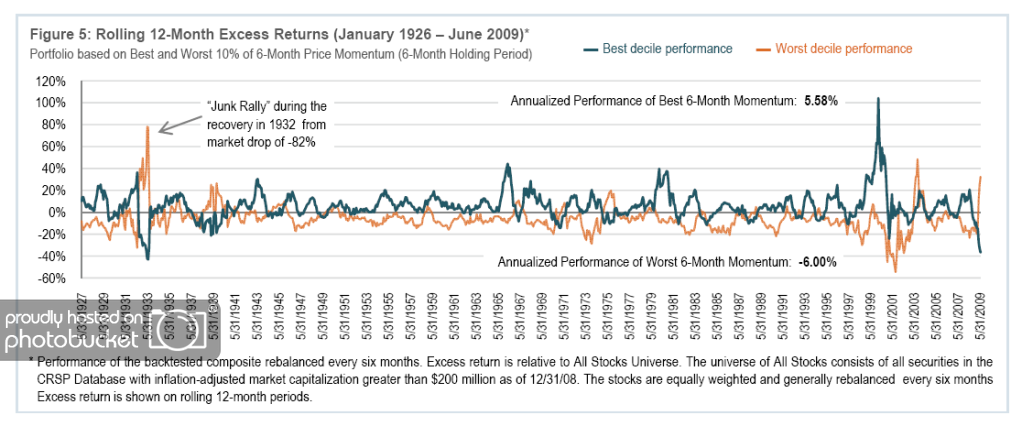
Using the CRSP database, O’Shaughnessy studied momentum investing back to 1926 and concluded that there is a consistent advantage to buying high-momentum stocks. The stocks in the best six-month price momentum decile had excess returns of 5.6 percent per year over his All Stocks Universe, while the stocks in the worst six-month price momentum decile lost 6.0 percent per year versus the All Stocks Universe. Click here for disclosures of the testing process. Historically, investing in “out-performers” versus “underperformers” has created a spread of 11.6 percentage points, as seen in the chart below:

(Click to Enlarge)

As seen in the chart above, historical periods where the worst 6-month momentum outperformed the best 6-month momentum were followed by periods– often multi-year stretches–where high momentum performed very well.

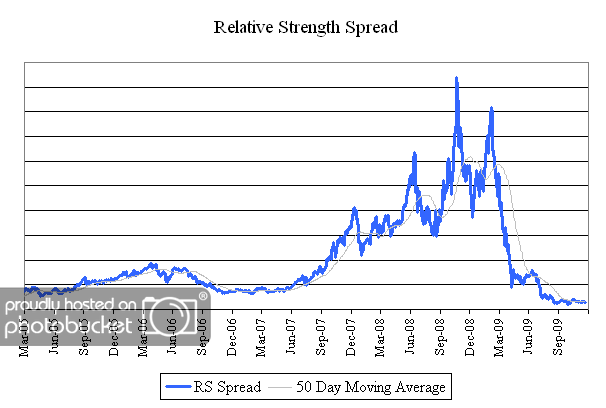
The chart below is the spread between the relative strength leaders and relative strength laggards of U.S. mid and large cap stocks. When the chart is rising, relative strength leaders are performing better than relative strength laggards. Given the historical tendency for high momentum to bounce back strongly from periods of underperformance, the chart below will be important to watch in coming months.

(Click to Enlarge)

Posted by:


More on the Yield Curve

December 23, 2009

In light of Mike’s recent commentary on how the yield curve seems to be forecasting powerful economic growth, I wanted to make you aware of a great tool at StockCharts.com that allows you to watch how the yield curve has developed this decade. Click here, and then click “Animate” to watch how it has changed over time.

You will notice that the yield curve was inverted or flat for most of 2006, 2007, and the early part of 2008, correctly predicting big trouble ahead. Right now, the difference between long and short Treasury rates is as wide as any time in history, signaling powerful economic growth ahead.

Larry Kudlow also has a nice commentary in NRO on the yield curve that is worth the read.

Posted by:


Debtor Nations

December 22, 2009

The Economist has a brief article on the debt loads of the G20 developed nations versus the emerging market countries. Because the developed countries are very dependent on their financial services sectors for economic growth, they have seen tax revenues plummet (just as the master of disaster, Harvard professor and former IMF chief economist Kenneth Rogoff, indicated had happened in all of the previous crises). At the same time, developed countries tend to have much more extensive social welfare safety nets—an expense that accelerates as the economy gets worse. The net result is that debt as a percentage of GDP has exploded as The Economist’s graphic below indicates.

The political implications of the developed world being dependent on the emerging market countries to finance them will be interesting to see unfold. The G20 nations are going to have much less leverage in global negotiations. Gone is the ability to boss everyone else around—we need their money as much as they need our expertise and technical assistance. Multi-lateralism has arrived whether we like it or not.

Posted by:


Inflation versus Deflation

December 22, 2009

Economists still have a battle raging between the slow growth and fast growth groups. The slow growth economists are basing their belief on current indications of trouble in commercial real estate, housing, and banking that will take some time to resolve. The fast growth economists are basing their argument on market-generated expectations like the steep yield curve (mentioned again today in another article in the Wall Street Journal).

Yet another market-generated indication comes from the markets for Treasury Inflation-Protected Securities (TIPS). According to an analyst quoted in this Bloomberg article:

The gap between yields on Treasuries and so-called TIPS due in 10 years, a measure of the outlook for consumer prices, closed above 2.25 percentage points four days last week, the longest stretch since August 2008. That’s the low end of the range in the five years before Lehman Brothers Holdings Inc. collapsed, and shows traders expect inflation, not deflation in coming months, said Jay Moskowitz, head of TIPS trading at CRT Capital Group LLC in Stamford, Connecticut.

The market, pretty clearly, is expecting faster growth accompanied by some inflation. Of course, market expectations are not always correct—and you can expect some turbulence in the market if expectations are thwarted and have to be readjusted. Maybe in a year or so we will know the answer, but it’s worth noting that the data generated by the market has been correct more often than the economic talking heads.

Posted by:


More on the Bond Vigilantes

December 22, 2009

…this time mentioned in an article in the Global Business section of the New York Times. It indicates to me that others are starting to notice the tendency of the bond markets to police the policy makers (although not with as much panache as our earlier post.) I’m sure the policy makers have noticed it too, which should make for an interesting 2010 as the Fed tries to wean the economy off financial life support.

Posted by:


Beating Buy-and-Hold, Again

December 22, 2009

Although it always seems counterintuitive for incredibly simple momentum strategies to be able to beat the market, yet more evidence is provided in a brief article from CXO Advisory. (Relative strength is often called “momentum” in academic literature.)

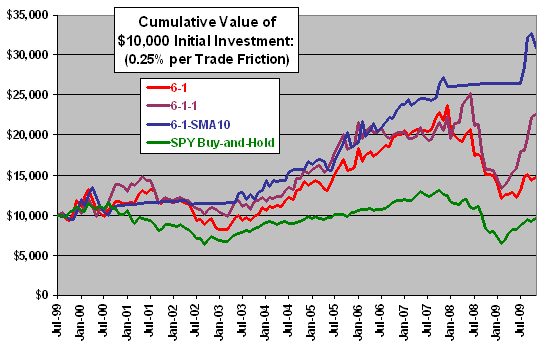
Their method was simple. They used the nine domestic sector SPDRs, held the top one based on a simple momentum ranking, and revisited the ranks monthly, switching if necessary. Three simple models were used: 1) top 6-month return, 2) top 6-month return ending 1 month ago, and 3) top 6-month return or cash if the top sector SPDR was below its 10-month moving average (a la Mebane Faber’s paper).

You can see the equity curve below, although there is better detail in the original article. (The model that can go to cash was obviously helped by two big bear markets in the last ten years; in an up market decade it might be different.)

Now, I’m not sure any compliance department would sign off on a strategy that only held one sector at a time, but it is certainly eye-opening that all three strategies outperformed the market. This finding is rampant throughout many, many academic and practitioner studies, including ones archived on our website. Systematic use of relative strength works.

Posted by:


Why Systematic Models Are Great

December 22, 2009

James Montier wrote this piece in 2006, but it is so great that I have to bring it up again! This article is a gem, worth reading over and over again.

What could baseball, wine pricing, medical diagnosis, university admissions, criminal recidivism and I have in common? They are examples of simple quant models consistently outperforming so-called experts. Why should financial markets be any different? So why aren’t there more quant funds? Hubristic self belief, self-serving bias and inertia combine to maintain the status quo.

Montier gives numerous examples of situations in which the models outperform both experts and experts using the models as additional input. Using your “expert knowledge” just makes it worse most of the time. In fact, in a study of over 130 papers comparing systematic models with human decision-making, the models won out in 122 events.

So why don’t we see more quant funds in the market? The first reason is overconfidence. We all think we can add something to a quant model. However, the quant model has the advantage of a known error rate, whilst our own error rate remains unknown. Secondly, self-serving bias kicks in, after all what a mess our industry would look if 18 out of every 20 of us were replaced by computers. Thirdly, inertia plays a part. It is hard to imagine a large fund management firm turning around and scrapping most of the process they have used for the last 20 years. Finally, quant is often a much harder sell, terms like ‘black box’ get bandied around, and consultants may question why they are employing you at all, if ‘all’ you do is turn up and crank the handle of the model. It is for reasons like these that quant investing will remain a fringe activity, no matter how successful it may be.

Lack of competition may be the best reason of all to use a systematic approach. How many investors are willing to go through a thorough and rigorous testing process to build a robust model—and are then willing to stick with the model through thick and thin? As Montier points out, it may remain a “fringe activity” no matter how successful it is.

Posted by:


Sorry, No Correlation.

December 22, 2009

How should today’s news, that the nation’s gross domestic product rose at a lower annual rate in the third quarter than previously estimated, factor into your investment decisions? Bad news for stocks?

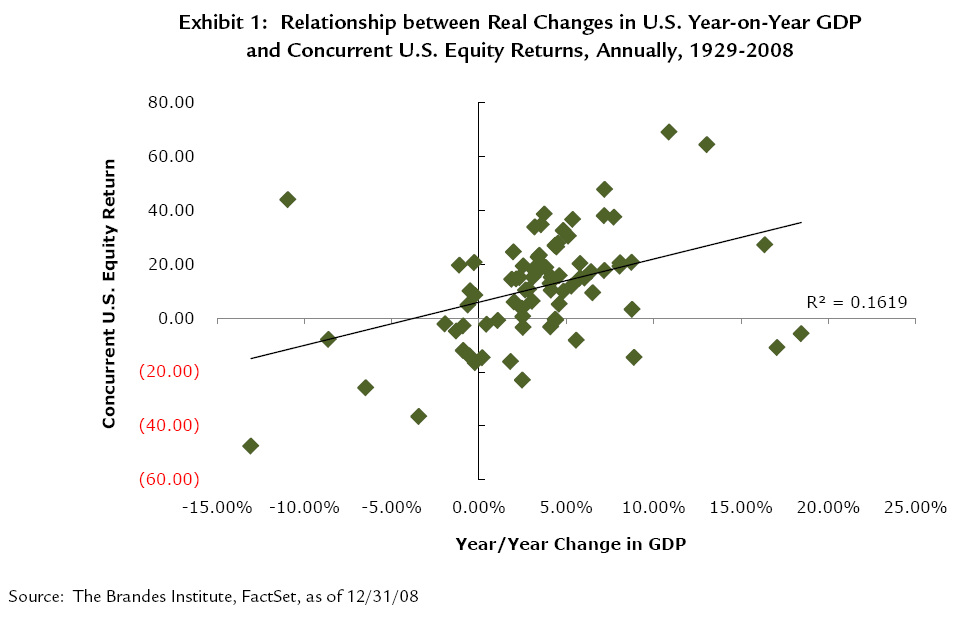
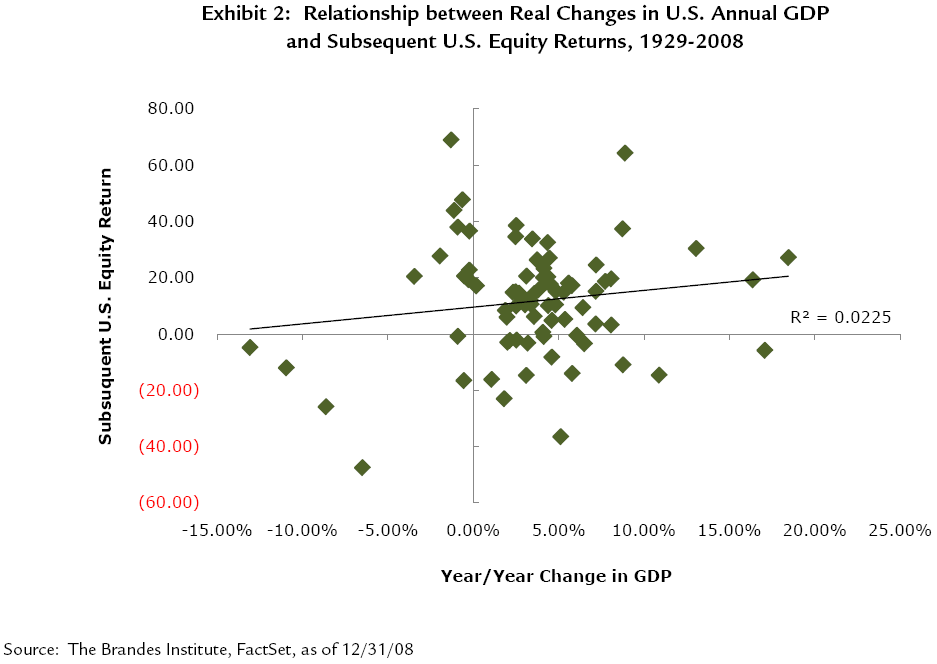
Recently, Brandes issued a report, Gross Domestic Product: A Poor Predictor of Stock Market Returns, that points out that stock market performance has not been correlated with GDP performance. Note this research covers an 80 year period of time.

Exhibit 1 shows the predictive power of changes in GDP (in explaining concurrent equity returns) was not statistically significant. The coefficient of determination, or the portion of the stock market performance, explained by GDP changes, is only 0.1619, and the regression line is a poor fit.

(Click to Enlarge)

In addition, Exhibit 2 reveals that predictive power for changes in GDP in explaining subsequent equity returns is not statistically significant. The coefficient of determination for this relationship is 0.0225, and again, the fit of the regression line is poor.

(Click to Enlarge)

It may seem logical to you to try to link GDP growth with stock market performance, but the results just don’t back that thesis up. I believe that these results confirm that investors are best served by focusing on the price movement of a security/market itself when evaluating the merits of an investment.

Posted by:


The Dollar and the Bear in the Woods

December 21, 2009

There is an old joke about two hiking buddies who inadvertently startle a bear cub deep in the woods. As the enormous, and now angry, mama bear wheels and prepares to charge, one of the hikers quickly sheds his backpack. “You’ll never be able to outrun that bear,” his buddy tells him. “I know,” he replies, “but I don’t need to outrun the bear. I just need to outrun you.”

Such is the current situation of the U.S. dollar, which is currently hitting recent highs against the yen and euro. Has the fiscal responsibility of the U.S. suddenly improved in a material way? No. Has our deficit been reduced? No—in fact, it is larger than before. So what, then, accounts for the recent strength in the dollar?

After the recent downgrade of Greece, investors became focused on the fiscal problems of Europe. In addition to Greece, Spain and Italy also have large public sector debts that are rapidly growing. And all of a sudden, the U.S. dollar doesn’t look so bad on a relative basis.

This speaks to the power of relative strength analysis in financial markets. The dollar may not be able to outrun the bear in the woods, but right now it just needs to outrun the euro. Investors everywhere always face a dilemma: where should I put my excess capital? After all, it has to go somewhere. The decision is always a relative one—what is the best choice among the options I have? Our Systematic RS accounts take advantage of this relative decision process by constantly measuring the relative performance of stocks or asset classes and attempting to focus the portfolio in assets that have been strong. Relative strength analysis allows the investor to see, from a pure supply and demand standpoint, uncluttered by rhetoric, what decisions have been made in aggregate and allows the investor to follow the trend.

Posted by:


Anti-Equity Sentiment

December 21, 2009

Time will tell whether Institutional Investor’s Julie Segal was prophetic or just susceptible to well-know behavioral finance tendencies in her article, The Equity Culture Loses Its Bloom, in which she gives a host of reasons why there is no hope for equities going forward. However, I think she has accurately captured the current fears of many investors.

As investment moves away from equities, speculation will likewise shift from stocks to other investments, including real estate, commodities and currencies. “The money supply won’t shrink, and those dollars will need a home,” says Bove. Alternatives will continue to attract money from investors’ erstwhile equity allocations.

Surely, the mindset explained in the article goes a long ways toward explaining why there has been so much demand for our Global Macro strategy this year, which can invest in U.S. equities (long & inverse), international equities (long & inverse), currencies, commodities, real estate, and fixed income. Global Macro is available as a separate account and through the Arrow DWA Tactical Fund (DWTFX). The Global Macro portfolio comes along with a systematic method for determining when and how much exposure to take in various asset classes as conditions change.

Click here to visit ArrowFunds.com for a prospectus & disclosures. Click here for disclosures from Dorsey Wright Money Management.

Posted by:


What They Were Saying 10 Years Ago

December 21, 2009

There are a lot of articles floating around right now reviewing the market forecasts of ten years ago, such as this one by Brett Arends in the WSJ.

Hands up if you had Southwestern Energy.

No? How about XTO Energy? Range Resources? Precision Castparts?

You should have. These were top stocks of the decade in the Standard & Poor’s 500-stock index. Ten years ago, the smartest thing you could have done with your money was to invest in these. Each $1,000 invested then would be worth tens of thousands today.

Now look at the stocks the experts told you to buy instead.

The most widely recommended — according to a quick survey at the time in the Washington Post — were America Online, Cisco Systems, Qualcomm, MCI WorldCom, Lucent Technology and Texas Instruments.

Ahem.

Any people who invested in that portfolio have lost about two-thirds of their money. The average stock picked at random was up 3%, including dividends

The best investments are usually the ones nobody is talking about. Ten years ago, everybody was talking about which technology stocks to buy. Almost nobody was talking about gold. The Bank of England could barely give the stuff away at $260 an ounce.

Why are people so fascinated with trying to forecast the future? I don’t get it. The track record of forecasters is utterly pathetic. Do people not know that there are more enlightened methods of investing? The data supporting trend-following, including the compilation on our website, is legion. Trend following has warts as well, but those can be relatively easily understood and should be evaluated within the context of long-term results. Those investors who accept the limitations of trend following, and commit to the process for the long-run, are in a remarkably better position that those who try to divine the impossible.

Posted by:


Weekly RS Recap

December 21, 2009

The table below shows the performance of a universe of mid and large cap U.S. equities, broken down by relative strength decile and quartile and then compared to the universe return. Those at the top of the ranks are those stocks which have the best intermediate-term relative strength. Relative strength strategies buy securities that have strong intermediate-term relative strength and hold them as long as they remain strong.

Last week’s performance (12/14/09 – 12/18/09) is as follows:

There was very little separation in performance between the different relative strength quartiles last week. This continues a trend that we have seen over the last couple months where relative strength leaders and relative strength laggards have performed very similarly. This is a big change from the dramatic outperformance seen in the relative strength laggards in the initial thrust off the March lows. I suspect that the further that we get from the March lows, the better relative strength strategies will perform.

Posted by:


Putting Inertia to Work

December 18, 2009

Ron Lieber of the NYT points out that the nation’s personal savings rate is currently at 4.4%, down from 6.4% in May, which was the highest personal savings rate since 1993. A number of the factors have led to an increased savings rate, including force, fear, and retirement planning. It is only natural for the nation’s personal savings rate to increase in the midst of adverse economic conditions.

The crucial question is what comes next. When the economy is humming along again, will people revert to their old ways of living in the moment and pretending that retirement savings can be put off for later? If there is hope for permanently boosting our nation’s personal savings rate, I doubt it will come as a result of individuals being able to maintain their current prudent-savings-mindset into the future. Rather, as pointed out by Lieber, I think it will come about as a result of translating the current recognition that personal savings must be increased into a systematic savings plan. Inertia is a powerful force and now is the time to set up some type of automatic savings plan that will continue to be executed even in an economic environment where you may be tempted to forget the lessons learned in the past 18 months. The quality of life enjoyed in your later years depends on systematic savings plans enacted now.

Posted by:


ETF Trends for the Next Decade

December 18, 2009

Interesting read by ETFdb on where the ETF industry is headed.

Ongoing product development and innovation continues to expand investor options, bringing almost every corner of the investable asset universe within reach to millions of investors.

Posted by:


The Economy is Growing Faster Than You Think

December 18, 2009

That’s the title of a must-read article on credit spreads from David Ranson, who is the chief of economic research at H.C. Wainwright. He writes:

The best market predictor I know of is the yield spread between investment grades in the industrial bond market as defined by Moody’s. The sudden widening of these spreads accurately predicted both the magnitude and timing of the downturn last year, and their equally rapid return to normalcy is now predicting an explosive recovery.

This simple market-based indicator has several advantages over the confusing plethora of theoretical arguments being tossed around by forecasters. First, its track record is pristine; during its 90-year history it has faithfully mirrored the economy’s cyclical ups and downs. Second, it has credibility; as a derivative of transaction prices, it reflects the objectivity of the financial-market system.

Moreover, it has a natural interpretation as an index of risk tolerance, in that it quantifies the changing uncertainties that influence the willingness with which capital is placed at risk and put to work.

It’s nice to see an economist that relies on market-generated data. It also matches up with the forecast from other market-generated data like the yield curve. The most powerful part of Ranson’s argument is that

The narrowing of the spread this year has been the largest since the 1930s. From the second to the third quarter the Baa/Aaa spread fell back by 108 b.p., more than twice the 40-b.p average for the four incidents that saw seven-percent growth. This suggests that a forecast of seven percent for the fourth quarter and the first quarter of next year may be conservative.

The next couple quarters should be very interesting. We’ve got economists lined up on both sides of the argument and both sides are persuasive: explosive growth based on market-generated data or sluggish growth based on all of the continuing problems with housing, banking, and unemployment. By mid-year 2010 we’ll get to see who was right, but that hardly matters. The immediate problem for investors is how to deal with their portfolios when forecasts are so widely disparate. There’s a real risk of letting our underlying emotions of pessimism or optimism creep into the investment decision-making. What’s needed is an unemotional, systematic way to navigate portfolios through what could be a tumultuous period. Our Systematic RS strategies attempt to do just that, by measuring the relative performances of securities or asset classes and keeping the strongest ones rotated to the front of the portfolios.

Posted by:


Unlikely Converts to Capitalism

December 18, 2009

Everyone in China is getting in on the new fad: capitalism. The Shaolin monks are going public. I didn’t even know they had a CEO or had bikini pageants.

Posted by: