$7 Trillion

December 9, 2009

That’s the size of the wall of money held in cash by U.S. households. According to an article on Morningstar:

Data released by the Federal Reserve show that private cash holdings by households and companies as a percentage of nominal US GDP is just shy of 72 per cent, or about $10,120bn, as of the second quarter of 2009. The US household sector currently holds about $7,760bn in liquid assets. These cash balances are higher than the previous peak in the 1980s.

With returns on money market funds still low – the interest paid has barely turned positive – there are plenty of market watchers who expect the money to keep moving out of cash and prop up buying of stocks, corporate bonds and other assets with higher returns.

“The last time we had a big money mountain was in the 1980s,” says James Paulsen, chief investment strategist at Wells Capital Management. “For the next 20 years, a little bit more went into economic activity and some went into stocks and bonds. This same pattern will be repeated next year and for a number of years to come.”

There are a couple of interesting features in the current situation. 1) there is a ton of cash on the sidelines, and 2) the return on the cash is virtually nonexistent. Clearly, some of the cash will be looking for a home. Where will that new home be? It’s impossible to predict—but money will generally go where the returns have been. Relative strength is just a systematic way to measure where the best returns have been. Often it turns out that those trends continue for some time. The wall of money has created some potential investment opportunities and a systematic application of relative strength is one useful way to hone in on them.

Posted by:


Auto Sales Up 98%

December 9, 2009

in China. And up 68% year over year in India. Phenomenal. And they apparently did not need a cash-for-clunkers program to do it. Rapid economic growth is occurring—just not in the United States or Europe.

Rapid growth in auto sales will have potential pricing consequences in world markets in oil and steel, and in local markets for aftermarket auto parts, and so on. As auto dealers and their employees do well, there may be a general trickle-down effect in consumer goods throughout their domestic economies. In other words, revenues create investment opportunities.

The U.S. market is going to continue to be important, but it’s a mistake to overlook opportunities elsewhere around the globe. To me, headlines like this are a primary reason to expand your investment horizons globally.

Posted by:


Black Swan Of Laggard Rallies

December 9, 2009

It has been a difficult year for Relative Strength strategies. RS is a “success-based” factor, and what has worked this year has been companies that have had little success. From an RS standpoint, the laggards (those stocks that declined the most heading into the market low) have outperformed the leaders (those that held up the best in the market decline) by a historically wide margin. According to research by The Leuthold Group in their December 2009 Green Book, this year has been the second best year for laggard outperformance in history. The best year for the laggards to outperform the leaders was all the way back beginning at the market low in June 1932. Their study uses Ken French’s data, and calculates the performance spread between the leaders and laggards in the first 12 months of a new bull market.

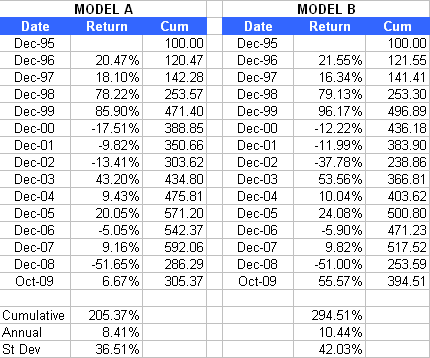
The historically high laggard outperformance presents interesting challenges for anyone who is testing and systematically applying an RS factor. Take the following two models, for example:

For purposes of this post the actual model specifications don’t matter. But for those of you who will e-mail me anyway, Model A is a simple 12-month trailing return model with 50 holdings. Very straightforward and plain vanilla. Model B is just a test I was playing around with that attempts to adapt more quickly to the market. In effect, the RS factor is a 12-month trailing return unless there is a 20% swing in the S&P; 500. If there is a 20% swing, the lookback period changes from 12 months ago to the market high or low where the swing is measured from.

If you just look at the cumulative return you would say that Model B is much better. But is it really? There are some big differences in the performance of the two models in 2002 and 2003, but look at the difference in 2009. Essentially, all of the outperformance from Model B comes in 2009. In fact, if you ran these two models as of 12/31/2008 you would have said that Model A is better (+186% for Model A versus +154% for Model B).

You can’t simply look at the return streams of any model in a vacuum. There are reasons why the returns are what they are, and those reasons need to be considered. I think hitching your wagon to an RS strategy that makes a huge percentage of its relative (to other models) gains in a year like 2009 is asking for trouble. According to Leuthold’s research, the next set of laggard rallies that were difficult for RS were off the market lows in 1990, 2002, and 1938. All three of those instances were around 40% outperformance by the laggards over 12 months. This current laggard rally is almost 2 times that (77%).

Could it be that we have just seen the proverbial Black Swan of laggard rallies? It’s certainly possible. While a laggard rally of this magnitude can certainly happen again (and probably will at some point), the data suggests that relying on this type of rally to generate returns using an RS model over long periods of time is not wise. So like most things that get tested, I would say the idea of Model B was very interesting, but will wind up in the graveyard of good ideas.

Posted by:


Bubble Prognostication

December 9, 2009

Identifying bubbles seems to be a preoccupation of more and more market participants these days. Talk about bubbles in treasuries and gold seem to be everywhere currently. They will likely be right at some point. However, it does seem that many people were shunning real estate because of the threat of a bubble years before it actually peaked. It is easy to see why there is so much fascination with trying to time bubbles. After all, think of all the money you would have if you could get in at the low and get out at the top ! Never having to worry about the aftermath of bubbles would make investing so…idyllic.

There are certain aspects of bubbles that are predictable. Namely, one can predict with a very high degree of confidence that we are going to see numerous bubbles in the future, just like there have been in the past. A bubble timer may correctly identify different phases of every bubble (Stealth Phase, Awareness Phase, Mania Phase, and finally Blow Off Phase.) However, the challenge is that every bubble is just different enough to make timing them practically impossible.

For example, you may remember the story of hedge fund manager Julian Robertson who in the 1990s very correctly and loudly pointed out the Dot.com bubble. As a result of his conviction that the technology bubble was going to burst, he refused to participate in technology in the late ’90s and his hedge fund, Tiger Management, lost 4% in 1998, and lost 19% in 1999. Tiger Management closed down in February of 2000, just before the bubble burst. He was absolutely right on the fundamental story, but the timing was off.

Capitalizing on bubbles is a major reason that relative strength strategies have the potential to deliver superior results over time. However, instead of trying to identify tops in bubbles we simply allow the market forces to dictate when we exit a trade. Invariably, we will exit the trade after the trend has declined from its peak and we will have given back some of what was gained in the often multi-year run-up to the peak. However, it is better to make money than getting caught up focusing on how the market should perform based on your fundamental position, no matter how correct that fundamental position is.

Posted by:


Good Odds for 2010

December 9, 2009

Now that it has been nine months since the bear market low, you may be wondering how much longer this bull market can go. It is important to note that there is strong historical precedent for bull markets to follow through in year two.

Sam Stovall, S&P;’s chief investment strategist, recently pointed out that all but one of the 14 previous bull markets since 1932 survived into a second year. They then averaged 12.5 percent gains during that year (AP, 12/08/09).

Good reason to be optimistic.

Posted by: