Debtor Nations

December 22, 2009

The Economist has a brief article on the debt loads of the G20 developed nations versus the emerging market countries. Because the developed countries are very dependent on their financial services sectors for economic growth, they have seen tax revenues plummet (just as the master of disaster, Harvard professor and former IMF chief economist Kenneth Rogoff, indicated had happened in all of the previous crises). At the same time, developed countries tend to have much more extensive social welfare safety nets—an expense that accelerates as the economy gets worse. The net result is that debt as a percentage of GDP has exploded as The Economist’s graphic below indicates.

The political implications of the developed world being dependent on the emerging market countries to finance them will be interesting to see unfold. The G20 nations are going to have much less leverage in global negotiations. Gone is the ability to boss everyone else around—we need their money as much as they need our expertise and technical assistance. Multi-lateralism has arrived whether we like it or not.

Posted by:


Inflation versus Deflation

December 22, 2009

Economists still have a battle raging between the slow growth and fast growth groups. The slow growth economists are basing their belief on current indications of trouble in commercial real estate, housing, and banking that will take some time to resolve. The fast growth economists are basing their argument on market-generated expectations like the steep yield curve (mentioned again today in another article in the Wall Street Journal).

Yet another market-generated indication comes from the markets for Treasury Inflation-Protected Securities (TIPS). According to an analyst quoted in this Bloomberg article:

The gap between yields on Treasuries and so-called TIPS due in 10 years, a measure of the outlook for consumer prices, closed above 2.25 percentage points four days last week, the longest stretch since August 2008. That’s the low end of the range in the five years before Lehman Brothers Holdings Inc. collapsed, and shows traders expect inflation, not deflation in coming months, said Jay Moskowitz, head of TIPS trading at CRT Capital Group LLC in Stamford, Connecticut.

The market, pretty clearly, is expecting faster growth accompanied by some inflation. Of course, market expectations are not always correct—and you can expect some turbulence in the market if expectations are thwarted and have to be readjusted. Maybe in a year or so we will know the answer, but it’s worth noting that the data generated by the market has been correct more often than the economic talking heads.

Posted by:


More on the Bond Vigilantes

December 22, 2009

…this time mentioned in an article in the Global Business section of the New York Times. It indicates to me that others are starting to notice the tendency of the bond markets to police the policy makers (although not with as much panache as our earlier post.) I’m sure the policy makers have noticed it too, which should make for an interesting 2010 as the Fed tries to wean the economy off financial life support.

Posted by:


Beating Buy-and-Hold, Again

December 22, 2009

Although it always seems counterintuitive for incredibly simple momentum strategies to be able to beat the market, yet more evidence is provided in a brief article from CXO Advisory. (Relative strength is often called “momentum” in academic literature.)

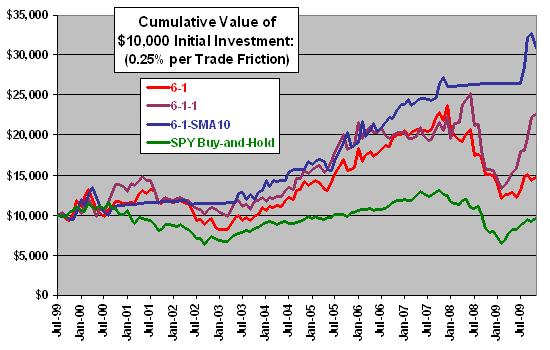
Their method was simple. They used the nine domestic sector SPDRs, held the top one based on a simple momentum ranking, and revisited the ranks monthly, switching if necessary. Three simple models were used: 1) top 6-month return, 2) top 6-month return ending 1 month ago, and 3) top 6-month return or cash if the top sector SPDR was below its 10-month moving average (a la Mebane Faber’s paper).

You can see the equity curve below, although there is better detail in the original article. (The model that can go to cash was obviously helped by two big bear markets in the last ten years; in an up market decade it might be different.)

Now, I’m not sure any compliance department would sign off on a strategy that only held one sector at a time, but it is certainly eye-opening that all three strategies outperformed the market. This finding is rampant throughout many, many academic and practitioner studies, including ones archived on our website. Systematic use of relative strength works.

Posted by:


Why Systematic Models Are Great

December 22, 2009

James Montier wrote this piece in 2006, but it is so great that I have to bring it up again! This article is a gem, worth reading over and over again.

What could baseball, wine pricing, medical diagnosis, university admissions, criminal recidivism and I have in common? They are examples of simple quant models consistently outperforming so-called experts. Why should financial markets be any different? So why aren’t there more quant funds? Hubristic self belief, self-serving bias and inertia combine to maintain the status quo.

Montier gives numerous examples of situations in which the models outperform both experts and experts using the models as additional input. Using your “expert knowledge” just makes it worse most of the time. In fact, in a study of over 130 papers comparing systematic models with human decision-making, the models won out in 122 events.

So why don’t we see more quant funds in the market? The first reason is overconfidence. We all think we can add something to a quant model. However, the quant model has the advantage of a known error rate, whilst our own error rate remains unknown. Secondly, self-serving bias kicks in, after all what a mess our industry would look if 18 out of every 20 of us were replaced by computers. Thirdly, inertia plays a part. It is hard to imagine a large fund management firm turning around and scrapping most of the process they have used for the last 20 years. Finally, quant is often a much harder sell, terms like ‘black box’ get bandied around, and consultants may question why they are employing you at all, if ‘all’ you do is turn up and crank the handle of the model. It is for reasons like these that quant investing will remain a fringe activity, no matter how successful it may be.

Lack of competition may be the best reason of all to use a systematic approach. How many investors are willing to go through a thorough and rigorous testing process to build a robust model—and are then willing to stick with the model through thick and thin? As Montier points out, it may remain a “fringe activity” no matter how successful it is.

Posted by:


Sorry, No Correlation.

December 22, 2009

How should today’s news, that the nation’s gross domestic product rose at a lower annual rate in the third quarter than previously estimated, factor into your investment decisions? Bad news for stocks?

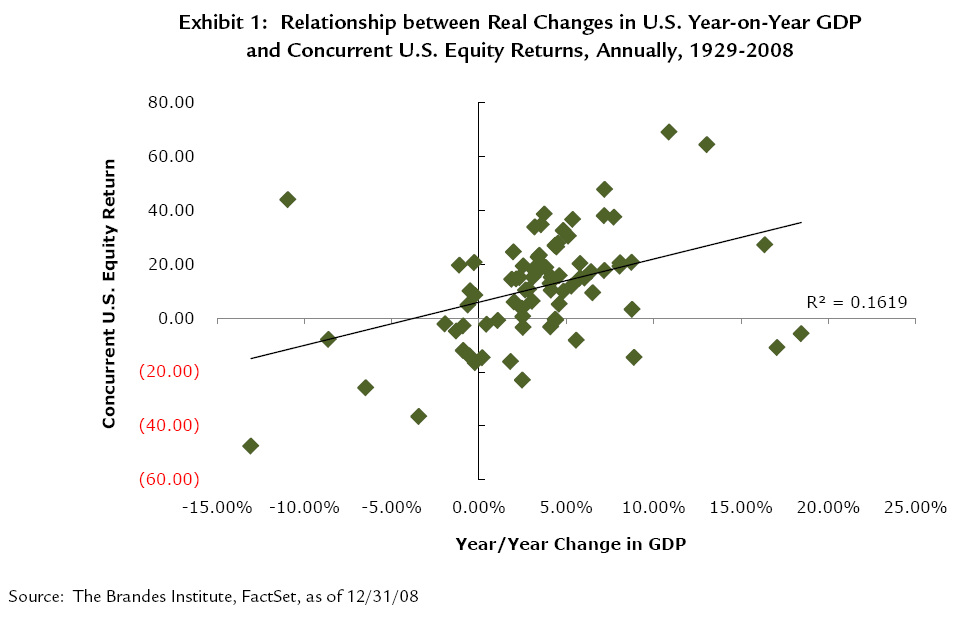
Recently, Brandes issued a report, Gross Domestic Product: A Poor Predictor of Stock Market Returns, that points out that stock market performance has not been correlated with GDP performance. Note this research covers an 80 year period of time.

Exhibit 1 shows the predictive power of changes in GDP (in explaining concurrent equity returns) was not statistically significant. The coefficient of determination, or the portion of the stock market performance, explained by GDP changes, is only 0.1619, and the regression line is a poor fit.

(Click to Enlarge)

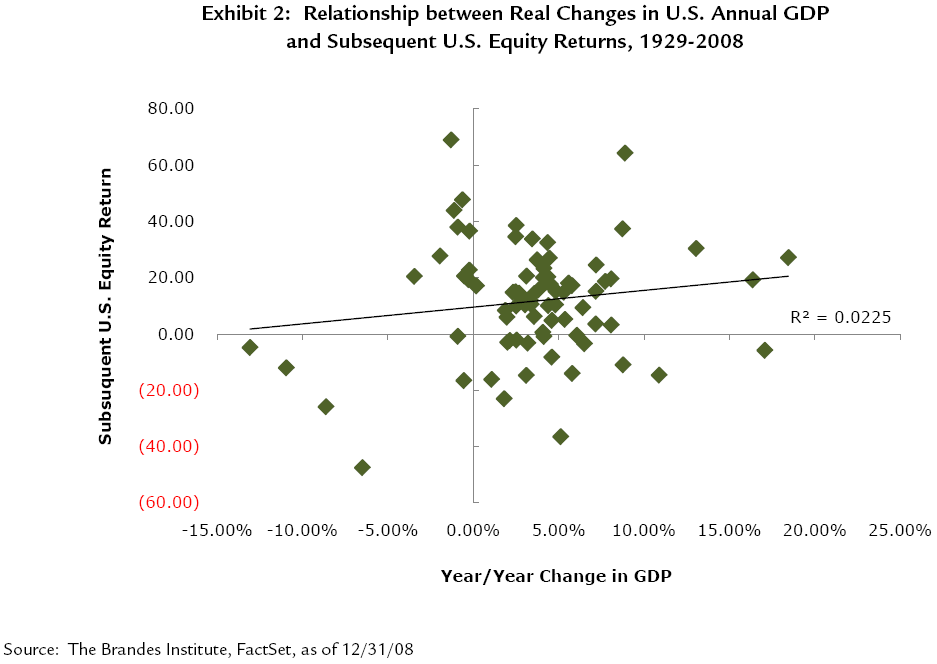
In addition, Exhibit 2 reveals that predictive power for changes in GDP in explaining subsequent equity returns is not statistically significant. The coefficient of determination for this relationship is 0.0225, and again, the fit of the regression line is poor.

(Click to Enlarge)

It may seem logical to you to try to link GDP growth with stock market performance, but the results just don’t back that thesis up. I believe that these results confirm that investors are best served by focusing on the price movement of a security/market itself when evaluating the merits of an investment.

Posted by: