Is Buy-and-Hold Dead?

January 8, 2010

The Journal of Indexes has the entire current issue devoted to articles on this topic, along with the best magazine cover ever. (Since it is, after all, the Journal of Indexes, you can probably guess how they came out on the active versus passive debate!)

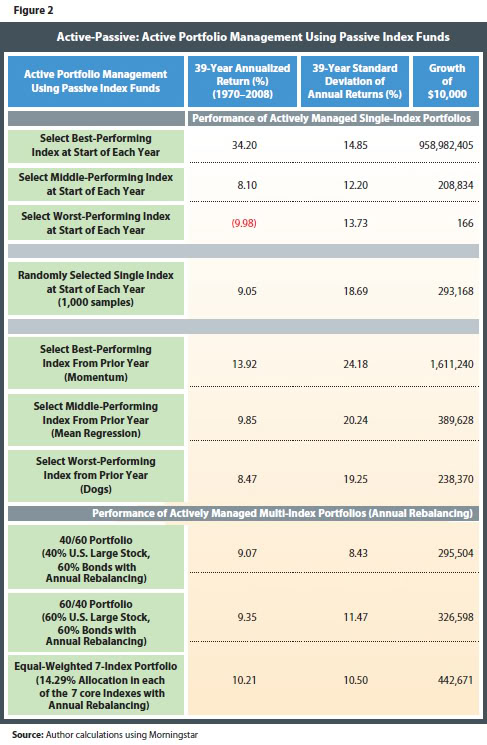
One article by Craig Israelson, a finance professor at Brigham Young University, stood out. He discussed what he called “actively passive” portfolios, where a number of passive indexes are managed in an active way. (Both of the mutual funds that we sub-advise and our Global Macro separate account are essentially done this way, as we are using ETFs as the investment vehicles.) With a mix of seven asset classes, he looks at a variety of scenarios for being actively passive: perfectly good timing, perfectly poor timing, average timing, random timing, momentum, mean reversion, buying laggards, and annual rebalancing with various portfolio blends. I’ve clipped one of the tables from the paper below so that you can see the various outcomes:
Click to enlarge

Although there is only a slight mention of it in the article, the momentum portfolio (you would know it as relative strength) swamps everything but perfect market timing, with a terminal value more than 3X the next best strategy. Obviously, when it is well-executed, a relative strength strategy can add a lot of return. (The rebalancing also seemed to help a little bit over time and reduced the volatility.) Maybe for Joe Retail Investor, who can’t control his emotions and/or his impulsive trading, asset allocation and rebalancing is the way to go, but if you have any kind of reasonable systematic process and you are after returns, the data show pretty clearly that relative strength should be the preferred strategy.


Rancid Real Estate

January 8, 2010

It’s no wonder that investors have a hard time getting things right. All of the news media is working against them. The media is simply doing their job—reporting the news. What are they reporting about real estate right now? Nothing but bad news: delinquencies on home equity loans have jumped to new highs and delinquencies on commercial mortages have spiked up and are projected to go even higher. Apartment vacancy rates have also gone to new highs. And it’s all true. I’m sure the media is reporting the current state of affairs accurately.

More evidence that the reporting is accurate comes from the commercial banks, which are heavily exposed to commercial mortgages. Commercial banks know that these bad loans are coming and are piling up cash to handle the writeoffs.

In short, it’s no secret that real estate is a disaster. There’s just one problem: while real estate prices are going down, real estate stocks are going up, as shown by this chart of the Dow Jones U.S. Real Estate Index.

Real assets might be priced on reality, but stocks are priced on expectations. Current expectations are obviously that the real estate market will get better. As long as the expectation remains the same, real estate stocks should continue to perform well. (Of course, if something causes the expectation to change, watch out!)

If you allow current news and your emotions to affect your investing, you are going to have trouble. And it’s impossible not to be affected. After all, you can see the problems in the real estate market with your own eyes every day: the For Sale signs in your own neighborhood, the vacant offices in your building at work, the real estate horror story told by your friend or neighbor. This is precisely one of the reasons that we use a systematic process for investing—so that we aren’t swayed by what we can see with our own eyes. Our systematic relative strength process responds to what is happening in the market, not to what we feel or think might happen.