Garbage In, Garbage Out

January 15, 2010

Michael J. Boskin’s recent article in the WSJ, Don’t Like The Numbers? Change ‘Em, is highly disturbing, yet I’m am guessing that it no longer will strike too many as shocking.

Politicians and scientists who don’t like what their data show lately have simply taken to changing the numbers. They believe that their end—socialism, global climate regulation, health-care legislation, repudiating debt commitments, la gloire française—justifies throwing out even minimum standards of accuracy. It appears that no numbers are immune: not GDP, not inflation, not budget, not job or cost estimates, and certainly not temperature. A CEO or CFO issuing such massaged numbers would land in jail.

Yet, surely many a CEO or CFO is taking as much liberty with the numbers as are many of the corrupt politicians. Furthermore, you don’t need to agree with all of his politics to agree with the dangerous implications of dealing with manufactured numbers:

As a society and as individuals, we need to make difficult, even wrenching choices, often with grave consequences. To base those decisions on highly misleading, biased, and even manufactured numbers is not just wrong, but dangerous.

What can be trusted? How certain can one be of the financial data generated by a firm when trying to determine valuation?

One thing that can’t be fudged is the price of a security. Supply and demand for the security determine its price and that price movement is ultimately all that matters to the bottom line of the investor. We take comfort in the fact that price is the single input into our relative strength models; this helps us avoid the “garbage in, garbage out” problem.


Q4 2009 Review

January 15, 2010

Our Q4 2009 Review covers the following topics:

  • Putting the 2009 laggard rally in context of past laggard rallies.
  • Using data from James O’Shaughnessy, we look at how relative strength strategies have rebounded from past laggard rallies over the last 84 years.
  • Possible economic implications of a steep yield curve.

Click here to read the full review.


Updated Global Macro Video

January 15, 2010

If you are a financial advisor, click here to view an updated video on our Global Macro strategy. The video has been updated to include performance through 12/31/2009.

This global tactical asset allocation strategy can invest in domestic equities (long & inverse), international equities (long & inverse), currencies, commodities, real estate, and fixed income.


Coming Soon to a State Near You

January 14, 2010

Over the course of the last year, the biggest flows have gone into fixed income, including a significant amount of municipal bonds. Now one of the largest state issuers of debt, California, has received another downgrade from Standard & Poor’s and remains on negative creditwatch. (Moody’s and Fitch downgraded the debt even earlier.)

California is facing a $20 billion budget shortfall, but it is far from the only state having fiscal problems. On the face of it, this seems like a very good reason to run for the hills.

However, paradoxically, municipal debt had a pretty good year last year because the funding crisis, although bad, was expected to be even worse. This year could turn out the same way depending on the path various states take to move back toward fiscal balance. If the gap is closed with spending cuts, the market might respond very differently than if the gap is closed by accounting gimmicks and higher taxes. At any rate, investment decisions on municipal debt should be made based on price action and relative performance, not on an emotional reaction to a negative headline.

For a different take on California’s fiscal situation, check out this article in the Wall Street Journal. The author contends that California’s debt is not overly large relative to its economy and that, in fact, California taxpayers have been subsidizing the rest of the country for decades.


Turnabout Is Fair Play?

January 14, 2010

The government unveiled a plan to cover the cost of rescuing the financial system which involves charging banks a 15 basis point fee on various covered assets. A relatively healthy commercial bank might make only a 1% return on assets, so 15 basis points could be a substantial levy, depending on exactly what assets are covered and what is excluded. The fee is expected to raise $90 billion dollars over a 10-year period.

Regardless of what you may think of this plan, it illustrates an investment risk not often discussed in finance textbooks: political risk. Usually when we talk about political risk, we are thinking about a coup in Venezuela or a sovereign debt default in Zimbabwe. We don’t necessarily think about how much a domestic industry can be affected by legislation that radically unbalances the status quo. From a fundamental point of view, such a fee could reduce bank earnings by a significant amount for the next decade, leading to lower assumed valuations by spreadsheet jockeys.

From a relative strength point of view, life goes on. If bank stock prices are affected for better or worse, relative strength will change. But actual prices will need to change before anything can be assumed. It may be that some type of fee or punitive operating restrictions were already anticipated by the market—and sometimes when the news is not as bad as expected, the stocks actually rally. Whether it’s political risk or any other exotic risk, price is the final arbiter.


Financial Crisis Inquiry Commission

January 13, 2010

The big news of the day is that the Financial Crisis Inquiry Commission kicked off proceedings in earnest today. Apparently they are planning to spank all of the CEOs of the major banks, or at least give them a timeout and take away their milk and cookies.

Both FT Alphaville and The Atlantic had interesting articles about testimony that was heard or should be heard.

The FT Alphaville article is about rethinking the incentives embedded in the system, which seems like a really good idea regardless of one’s political persuasion. The Atlantic’s article is about the amount of leverage that banks were allowed (and still are) to take on—quite eye-opening.


Serious Growth

January 13, 2010

552 ETFs are currently in registration. Pretty impressive, given that there were only a total of 680 ETFs listed in the US in May 2008, according to the Investment Company Institute.


Two Approaches to Motivating Clients

January 12, 2010

Ken Haman, a managing director at the Advisor Institute at AllianceBerstein responds to the following question posed by an advisor and published in Investement News:

Q: I’ve had some frustrating conversations with clients recently—trying to get them back in the market. Very few are taking my advice, even though they seem to know that staying on the sidelines is a mistake. What’s going on, and how can I get them “unstuck”?

A: Problems like this have to do with how people make decisions. Behavioral finance uses the term “inappropriate extrapolation”-and insights about it can help you understand your clients and respond to them more effectively.

To make any decision, human beings create a mental picture of the future. That’s what “expectations” are-the ability to take information from the past and present, and project it into the future. Unlike most animals, human beings can project far into the future; as a result, we are able to “plan ahead.” Unfortunately, we usually don’t create these future images terribly well. Instead of making a thoughtful assessment of what’s likely to happen in the future, we typically picture the future as just a continuation of the recent past.

Essentially, you want to learn how to install a positive picture of the future that the client feels is likely to happen in reality. Start by explaining the mechanisms of the market and illustrating visually how those mechanisms work. Many investors have only the vaguest understanding of the cause-effect dynamics in the markets. Instead of making thoughtful, well-informed decisions, they react to their perception of patterns and trends. Market “mechanisms” are those cause-effect relationships that equip financial professionals to invest rationally instead of speculating randomly.

By looking at how market mechanisms operated in both the recent and more distant past, you teach your clients how to think more strategically about the markets. This allows them to build a more vivid mental picture of market behaviors in the future. Make sure you explain market mechanisms visually as well as verbally: use charts and graphs that show market behaviors over time. Whenever possible, connect your investment recommendations to a clear explanation of the mechanism that is involved.

Second, provide an adequate level of detail about the mechanisms you explain. There’s a commonly held myth that clients aren’t interested in hearing about the markets. So, many financial advisors gloss over important information and rush to their proposal without creating a case the client understands. But clients are interested in understanding the mechanisms that drive their investment results-as long as your explanation is clearly illustrated and easy to understand.

Finally, you have to deliver your message with personal conviction-that you fully believe the future will look the way you anticipate. Your clients need to borrow your conviction and clarity about the future. That’s how they’ll build their sense of confidence in the decisions you’re asking them to make. Take a stand on what you believe about the future, and add the courage of your own convictions to the clarity of your explanation.

There is also an alternative approach of just being frank with the client and telling them that you don’t know exactly what the future holds, nor does anyone else. However, you adhere to a systematic relative strength process that gives you great flexibility to allocate to a wide range of asset classes depending on how the future unfolds. At times, the approach can be allocated very conservatively and at times it can be allocated quite aggressively. My experience has been that clients appreciate the honesty and are willing to embrace a trend-following approach that deals very effectively with not being able to see into the future.


Politics and the Economy-2009 Year in Review

January 11, 2010

The year in review from noted pundit Dave Barry. Well, pundit is pushing it. But it is pretty funny. There’ll be at least one thing that will make you laugh out loud.


Weekly RS Recap

January 11, 2010

The table below shows the performance of a universe of mid and large cap U.S. equities, broken down by relative strength decile and quartile and then compared to the universe return. Those at the top of the ranks are those stocks which have the best intermediate-term relative strength. Relative strength strategies buy securities that have strong intermediate-term relative strength and hold them as long as they remain strong.

Last week’s performance (1/4/10 – 1/8/10) is as follows:

The best performance last week came from those stocks with the weakest relative strength, many of which were Energy names. It seems that the leaders and laggards have taken turns having the better performance in recent weeks. This has caused the relative strength spread to flatten out, after declining strongly during the laggard rally off of the March lows.


Is Buy-and-Hold Dead?

January 8, 2010

The Journal of Indexes has the entire current issue devoted to articles on this topic, along with the best magazine cover ever. (Since it is, after all, the Journal of Indexes, you can probably guess how they came out on the active versus passive debate!)

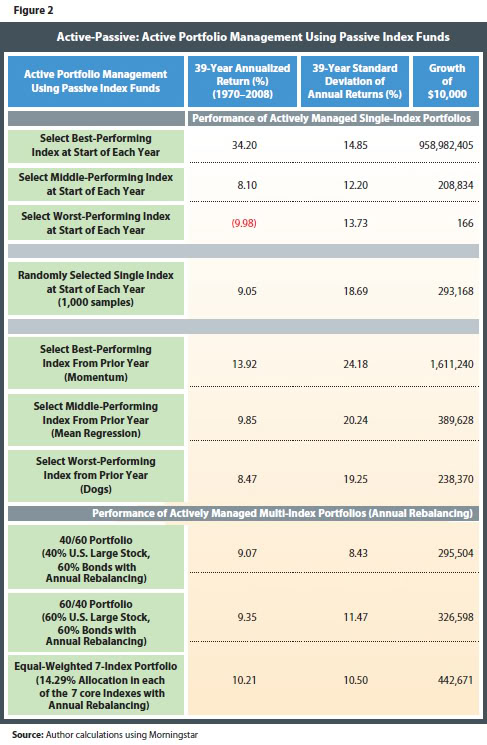
One article by Craig Israelson, a finance professor at Brigham Young University, stood out. He discussed what he called “actively passive” portfolios, where a number of passive indexes are managed in an active way. (Both of the mutual funds that we sub-advise and our Global Macro separate account are essentially done this way, as we are using ETFs as the investment vehicles.) With a mix of seven asset classes, he looks at a variety of scenarios for being actively passive: perfectly good timing, perfectly poor timing, average timing, random timing, momentum, mean reversion, buying laggards, and annual rebalancing with various portfolio blends. I’ve clipped one of the tables from the paper below so that you can see the various outcomes:

Click to enlarge

Although there is only a slight mention of it in the article, the momentum portfolio (you would know it as relative strength) swamps everything but perfect market timing, with a terminal value more than 3X the next best strategy. Obviously, when it is well-executed, a relative strength strategy can add a lot of return. (The rebalancing also seemed to help a little bit over time and reduced the volatility.) Maybe for Joe Retail Investor, who can’t control his emotions and/or his impulsive trading, asset allocation and rebalancing is the way to go, but if you have any kind of reasonable systematic process and you are after returns, the data show pretty clearly that relative strength should be the preferred strategy.


Rancid Real Estate

January 8, 2010

It’s no wonder that investors have a hard time getting things right. All of the news media is working against them. The media is simply doing their job—reporting the news. What are they reporting about real estate right now? Nothing but bad news: delinquencies on home equity loans have jumped to new highs and delinquencies on commercial mortages have spiked up and are projected to go even higher. Apartment vacancy rates have also gone to new highs. And it’s all true. I’m sure the media is reporting the current state of affairs accurately.

More evidence that the reporting is accurate comes from the commercial banks, which are heavily exposed to commercial mortgages. Commercial banks know that these bad loans are coming and are piling up cash to handle the writeoffs.

In short, it’s no secret that real estate is a disaster. There’s just one problem: while real estate prices are going down, real estate stocks are going up, as shown by this chart of the Dow Jones U.S. Real Estate Index.

Real assets might be priced on reality, but stocks are priced on expectations. Current expectations are obviously that the real estate market will get better. As long as the expectation remains the same, real estate stocks should continue to perform well. (Of course, if something causes the expectation to change, watch out!)

If you allow current news and your emotions to affect your investing, you are going to have trouble. And it’s impossible not to be affected. After all, you can see the problems in the real estate market with your own eyes every day: the For Sale signs in your own neighborhood, the vacant offices in your building at work, the real estate horror story told by your friend or neighbor. This is precisely one of the reasons that we use a systematic process for investing—so that we aren’t swayed by what we can see with our own eyes. Our systematic relative strength process responds to what is happening in the market, not to what we feel or think might happen.


Pay My Debts

January 7, 2010

Kuwait must have very constituent-friendly legislators. Apparently their populace is tired of paying off their consumer credit, so the legislature has introduced a bill to have the government reschedule everyone’s debts. On the other hand, this might be cheaper than having the government pay off the debts of the entire banking system like the U.S. did!


You Are On Your Own

January 7, 2010

Recession and bailout-weary countries are now starting to act on their own. Early on, there was talk of international coordination, but now that the worst of the crisis seems to have passed, it’s every man for himself.

The European Central Bank let Greece know in no uncertain terms—through an interview in an Italian newspaper—that if they sunk themselves with debt, no bailout would be coming.

In unrelated, and yet related, news, Japan’s finance minister decided that exports would revive their economy and declared the yen to be too high. After which it promptly dropped. The new finance minister took over the post yesterday from his predecessor, who had the exact opposite policy.

In more unrelated, and yet related, news, China’s central bank decided it needed to put the brakes on the economy and increased interest rates on treasury bills for the first time in this cycle.

Now, an international dog-eat-dog world is not really news. It’s more like the norm. Yet it will represent a sea change in the way things were handled throughout the crisis, where international cooperation and consultation was key. You can count on all sorts of crazy, unexpected things starting to happen again. Some of them may be possible to explain in hindsight, but no one will be able to consistently predict what will happen. When a finance minister in one of the world’s largest economies can do a 180 degree policy shift in his first interview, you never know what else might be coming. For some reason, this “new normal” looks a lot like the old normal.

In the absence of being able to predict what might be coming—don’t even waste your time—it might make sense to use a more tactical approach that allows you to react to the changes as they occur.


The Bucket List

January 6, 2010

UBS Wealth Management has a nice white paper on using asset buckets for retirement income. I’m not shilling for UBS—it’s just the first formal presentation I’ve seen of the bucket approach.

Essentially, there are two schools of thought when putting together a portfolio from which a retiree will draw income. The first is to put together a single balanced and diversified portfolio and then to draw a rational amount of income annually, say 3-4%. The second is to break the client assets into separate buckets, each with its own time frame and risk parameter. The first approach has the advantage of trying to put the entire portfolio at the right spot on the efficient frontier, if you believe in modern portfolio theory in the first place. The second approach allows you to use the client’s natural psychological urge to segment things—often counterproductive, by the way—to their advantage. It’s not clear right now if one approach or the other is to be preferred. There’s just so little quantitative research in the area that it’s hard to tell.

UBS’s approach in the paper is to use three buckets. Bucket 1 is composed of low-volatility, highly liquid assets and is designed to be the bucket from which income is pulled. Bucket 2 is the core bucket where most of the assets are held. Bucket 2, in fact, might look quite a bit like the single core portfolio in the alternative approach. Bucket 3 is the risk bucket where the client shoots for capital gains but doesn’t have to worry about drawing on the assets for income.

One can imagine numerous variations on this theme. More than three buckets could be used, each with slightly increasing volatility. Or the income bucket could periodically be replenished by capital gains from buckets 2 and 3 when they occurred. Relative sizes of the buckets could change depending on client’s risk parameters and needs, and so on.

I think there will be significant research done in how best to fund a retirement, primarily because the Baby Boom generation is just now starting to retire. I don’t think anyone has many answers yet, but maybe by the time the Baby Boomers are finished retiring, we will all have a better idea of what works and what doesn’t. The industry is finally starting to address retirement income issues, so this UBS paper is an interesting step.


The $ Value of Patience

January 6, 2010

The annals of investor behavior make for some pretty scary reading. Yet this story from the Wall Street Journal may take the cake. It is an article about the top-performing mutual fund of the decade and it shows with remarkable clarity how badly investors butcher their long-term returns. The article hits the premise right up front:

Meet the decade’s best-performing U.S. diversified stock mutual fund: Ken Heebner’s $3.7 billion CGM Focus Fund, which rose more than 18% annually and outpaced its closest rival by more than three percentage points.

Too bad investors weren’t around to enjoy much of those gains. The typical CGM Focus shareholder lost 11% annually in the 10 years ending Nov. 30, according to investment research firm Morningstar Inc.

It’s hard to know whether to laugh or cry. In a brutal decade, Mr. Heebner did a remarkable job, gaining 18% per year for his investors. The only investment acumen required to reap this 18% return was leaving the fund alone. Yet in the single best stock fund of the decade investors managed to misbehave and actually lose substantial amounts of money—11% annually.

Even Morningstar is not sure what to do with Mr. Heebner:

The fund, a highly concentrated portfolio typically holding fewer than 25 large-company stocks, offers “a really potent investment style, but it’s really hard for investors to use well,” says Christopher Davis, senior fund analyst at Morningstar.

I beg to differ. It’s really hard to use well?? What does that even mean? If it is, it’s only in the sense that a pet rock is really hard to care for.

Investor note: actively managed or adaptive products need to be left alone! The whole idea of an active or adaptive product is that the manager will handle things for you, instead of you having to do it yourself.

Unfortunately, there is an implicit belief among investors—and their advisors—that they can do a better job than the professionals running the funds, but every single study shows that belief to be false. There is not one study of which I am aware that shows retail investors (or retail investors assisted by advisors) outperforming professional investors. So where does that widespread belief come from?

From the biggest bogeyman in behavioral finance: overconfidence. Confidence is a wonderful trait in human beings. It gets us to attempt new things and to grow. From an evolutionary point of view, it is probably quite adaptive. In the financial arena, it’s a killer. Like high blood pressure, it’s a silent killer too, because no one ever believes they are overconfident.

At a Harvard conference on behavioral finance, I heard Nobel Prize winner Daniel Kahneman talk about the best way to combat overconfidence. He suggested intentionally taking what he called an “outside view.” Instead of placing yourself—with all of your incredible and unique talents and abilities—in the midst of the situation, he proposed using an outside individual, like your neighbor, for instance. Instead of asking, “What are the odds that I can quit my day job and open a top-performing hedge fund or play in the NBA?” ask instead, “What are the odds that my neighbor (the plumber, or the realtor, or the unemployed MBA) can quit his day job and open a top performing hedge fund or play in the NBA?” When you put things in an outside context like that, they always seem a lot less likely according to Kahneman. We all think of ourselves as special; in reality, we’re pretty much like everyone else.

Why, then, are investors so quick to bail out on everyone else? Overconfidence again. Our generally mistaken belief that we are special makes everyone else not quite as special as us. Overconfidence and belief in our own specialness makes us frame things completely differently: when we have a bad quarter, it was probably bad luck on a couple of stock picks; if Bill Miller (to choose a recent example) has a bad quarter, it’s probably because he’s lost his marbles and his investment process is irretriveably broken. We’d better bail out, fast. (A lot of people came to that conclusion over the past couple of years. In 2009, Legg Mason Value Trust was +40.6%, more than 14% ahead of its category peers.)

Think about an adaptive Dorsey, Wright Research model like DALI. As conditions change, it attempts to adapt by changing its holdings. Does it make sense to jump in and out of DALI depending on what happened last quarter or last year? Of course not. You either buy into the tactical approach or you don’t. Once you decide to buy into—presumably because you agree with the general premise—a managed mutual fund, a managed account, or an active index, for goodness sakes, leave it alone.

In financial markets, overconfidence is the enemy of patience. Overconfidence is expensive; patience with managed products can be quite rewarding. In the example of the CGM Focus Fund, Mr. Heebner grew $10,000 into $61,444 over the course of the last ten years. Investors in the fund, compounding at -11% annually, turned $10,000 into $3,118. The difference of $58,326 is the dollar value of patience in black and white.


Bureaucracy-and its Debt-Kills

January 5, 2010

Economic geniuses Carmen Reinhart and Kenneth Rogoff have authored another paper on the pile up of public debt and its effect on economic growth-based on 200 years of data. (Note to Congress: It’s so refreshing to see actual evidence for economic policy recommendations!) The Wall Street Journal has a synopsis of their argument here.

One finding: Countries with a gross public debt debt exceeding about 90% of annual economic output tended to grow a lot more slowly. For advanced countries above the 90% threshold, average annual growth was about two percentage points lower than for countries with public debt of less than 30% of GDP.

The results are particularly relevant at a time when debt levels in the U.S. and other countries at the center of the financial crisis are rapidly approaching the 90% threshold. Gross government debt in the U.S., for example, stood at 85% of GDP in 2009 and will reach 108% of GDP by 2014, according to IMF projections.

Unsurprisingly, economies engaged in paying off the cost of massive government bureaucracies and unrestrained public spending have a hard time being productive. It’s just difficult enough paying off the debt. With the U.S. projected to hit the 90% threshold shortly, it’s time to diversify your portfolio.


Your Home is a Terrible Investment

January 5, 2010

From Eddie Elfenbein’s Crossing Wall Street blog, a succinct accounting of all of the problems of home investment—and by way of elimination, a good argument for financial assets. Portfolios of financial assets have none of the problems associated with personal real estate.


Crouching Tiger, Hidden Dragon

January 5, 2010

An absolutely mind-blowing review by Joseph Kahn of Martin Jacques’ new book, When China Rules the World, can be found here. Kudos to Mr. Kahn for such a fascinating summary of the book.

Jacques has an interesting perspective. In the developed West, we tend to have Western-centric thinking. Jacques suggests that we look at things differently.

China was the wealthiest, most unified and most technologically advanced civilization until well into the 18th century, Jacques points out. It lost that position some 200 years ago as the industrial revolution got under way in Europe. Scholars once viewed China as having crippling social, cultural and political defects that underscored the superiority of the West. But given the speed and strength of China’s recent growth, those defects have begun to look more like anomalies. It is the West’s run of dominance, not China’s period of malaise, that could end up being the fluke, Jacques writes.

If we expect the status quo to be largely unchanged, we could be quite disappointed or even shocked, according to the author:

…Jacques argues that the country’s cultural core resembles ancient China far more than it does modern Europe or the United States. It is accumulating wealth much faster than it is absorbing foreign ideas. The result, he says, is that China is nearly certain to become a major power in its own mold, not the “status quo” power accepting of Western norms and institutions that many policy makers in Washington hope and expect it will be.

The boldface is my emphasis. Jacques makes a good point that China is acquiring wealth and influence much more rapidly than it is acquiring Western ideas. Chinese ideals of democracy and political economy are also radically different than in the West.

What will happen in the future? No one knows-but it could quite possibly be something entirely different from what anyone is expecting. Just as very few moderate Westerners can imagine what motivates a jihadist to perform a suicide bombing, so too may we be missing an understanding of Chinese culture. We may think they have the same motivations that we do-and they might-but we could also be completely wrong in that belief. To deal with a much less certain future, investor portfolios of tomorrow are going to need to be globally allocated across all sorts of asset classes. There are no “givens” any longer.


Memo to US Investors

January 5, 2010

Yesterday, an article in the Financial Times shed light on the global implications of President Obama’s recent trip to Copenhagen for the climate summit. President Obama arrived for a meeting on global climate change (check that debate at the door), and instead, became a spectator of the global economy at work. The FT article focuses specifically on four developing nations that are emerging as dominant global forces – India, South Africa, Brazil and Turkey.

Mr Obama must have felt something of a chump when he arrived for a last-minute meeting with Wen Jiabao, the Chinese prime minister, only to find him already deep in negotiations with the leaders of none other than Brazil, South Africa and India. Symbolically, the leaders had to squeeze up to make space for the American president around the table.

Let’s skip over the political implications of this scenario to examine what this means for US investors. As a US-based investor, we are presented with 2 options: we can participate in a global economy or we can shut ourselves off from it. Andy’s article from last week highlights exactly this point. Only 3% of assets managed by US fund managers are exposed to emerging markets.

Luckily for us, and unlike President Obama, we have no political ties that bind us. We are free to put our money to work where we want to, and this economic freedom allows us to participate in developing and emerging markets as we see fit. The Systematic Global Macro Account and the Arrow Tactical Fund both have the flexibility to invest in the global market without restraints. Don’t let yourself be shouldered off the table.

Click here to visit ArrowFunds.com for a prospectus & disclosures. Click here for disclosures from Dorsey Wright Money Management.


Markets Act Like Real People

January 5, 2010

Critics of the Efficient Market Hypothesis continue to get more press. Newsweek’s Barrett Sheridan recently wrote an article that discusses the Efficient Market Hypothesis (EMH) versus the adaptive-markets hypothesis (AMH). He mentions one of the key flaws in EMH: that market participants are rational.

He goes on to focus on MIT professor Andrew Lo and his AMH work. Lo does not share the EMH tenet that the financial markets consist of cool, calm, and rational investors. He suggests that investors will behave differently depending on their psychology at any given moment. (Some of the old brokers I knew called it the fear-greed pendulum.) It follows that any investment rule based on a fixed measurement of value for the market such as yield, P/E ratio, etc. will work only sporadically over time if the AMH is valid. Nothing is set in stone because investors continually change and adapt to the market ecosystem.

Our Systematic RS portfolios use relative measurements. We believe in an adaptive approach to investing that recognizes that since markets are controlled by real people, they act like real people.


Weekly RS Recap

January 4, 2010

The table below shows the performance of a universe of mid and large cap U.S. equities, broken down by relative strength decile and quartile and then compared to the universe return. Those at the top of the ranks are those stocks which have the best intermediate-term relative strength. Relative strength strategies buy securities that have strong intermediate-term relative strength and hold them as long as they remain strong.

Last week’s performance (12/28/09 – 12/31/09) is as follows:

There was little disparity in performance between the different relative strength quartiles last week.


Neglecting Underlying Forces

January 4, 2010

Tyler Cowen’s NYT article, discussing the rise of developing nations over the past ten years, includes the following comment:

One lesson from all of this is that steady economic growth is an underreported news story — and to our own detriment. As human beings, we are prone to focus on very dramatic, visible events, such as confrontations with political enemies or the personal qualities of leaders, whether good or bad. We turn information about politics and economics into stories of good guys versus bad guys and identify progress with the triumph of the good guys. In the process, it’s easy to neglect the underlying forces that improve life in small, hard-to-observe ways, culminating in important changes.

The comment is spot on. Without the aid of a systematic process (i.e. computer-driven) human nature will cause investors to miss much of long-term trends until they finally become convinced of the trend’s investment merits by friends, the media, etc. - which is generally very late in the game.