Rob Arnott and the Key to Better Returns

February 26, 2010

Rob Arnott is a thought leader in tactical asset allocation, currently well-known for his RAFI Fundamental Indexes. In his recent piece, Lessons from the Naughties, he discusses how investors will need to find return going forward.

The key to better returns will be to respond tactically to the shifting spectrum of opportunity, especially expanding and contracting one’s overall risk budget.

It’s a different way to view tactical asset allocation–looking at it from a risk budget point of view. The general concept is to own risk assets in good markets and safe assets in bad markets.

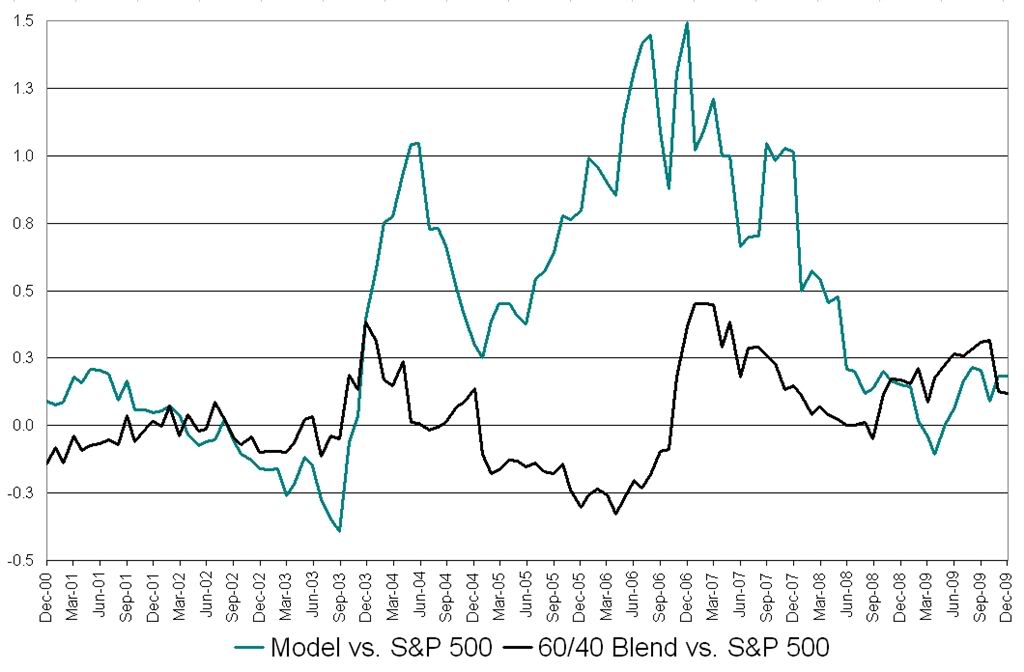
It turns out that systematic application of relative strength accomplishes this very well. The good folks at Arrow Funds recently asked us to take a look at how the beta in a tactically managed portfolio changed over time. When we examined that issue, it showed that as markets became risky, relative strength reduced the beta of the portfolio by moving toward low volatility (strong) assets. When markets were strong, allocating with relative strength pushed up the beta in the portfolio, thus taking good advantage of the market strength.
click to enlarge

Using relative strength to do tactical asset allocation, the investor was not only able to earn an acceptable rate of return over time, but was able to have some risk mitigation going on the side. That’s a pretty tasty combination in today’s markets.

Posted by:


The Upside of Financial Contagion

February 26, 2010

This article from the New York Times is pretty much in keeping with the current zeitgeist. It discusses the financial crisis and points out how inter-connected financial markets are these days.

As we all now know, mortgage woes were contained — to planet Earth. And so it may be with overleveraged nations in Europe.

Simply put, contagion is a fact of life in our interconnected global economy and financial markets. And that means investors must strap in for more gyrations in the stock and bond markets as the great and painful deleveraging that began in 2007 continues around the world.

However, this article, like most of its brethren, looks only at the negative aspect of financial contagion. In fact, contagion is just as likely to happen when things get rolling to the upside again.

Right now it is easy to be focused on gloom and doom, but market cycles don’t press on the downside forever. One can certainly make the case that the market would have gone down by now if it really and truly deserved to. Keep in mind that the stock market is typically a leading indicator. We’ve already had a nice rally from March 2009 until now.

What happens if the market stubbornly refuses to go down from here, and continues to make upside progress? Suddenly all the benefits of a positive feeback cycle are being discussed: corporate earnings rise, corporate dividends increase, national tax receipts begin to surge, and hiring starts once again. It’s quite likely that because global markets are so inter-connected that improvements in psychology and corporate results will move around the globe too. The global village may mean that your investment policy needs to be more flexible and to include more asset classes, but it doesn’t mean that we’re going to be mired in the muck forever.

Posted by:


The Price That Must Be Paid

February 26, 2010

Just like there are risks associated with trend-following (lagging at the turns) there are risks associated with forecasting (being too early or just plain wrong.) As far as forecasters go, Jeremy Grantham has been pretty good.

Jeremy Grantham warned in January 2000 that U.S. equities were “more overpriced than at any time in the last 70 years due to the massive overpricing of technology and especially dot-com stocks.” By the end of 2002, the Standard & Poor’s 500 Index had fallen 40 percent and technology shares were down 73 percent. The forecast didn’t help his firm, Grantham Mayo Van Otterloo Co., because he’d been bearish since 1997. Assets declined 45 percent in the late 1990s as customers sought out better- performing mutual funds that liked the technology stocks Grantham disdained.

He recommended avoiding Japanese stocks more than two years before they started falling at the end of 1989.

Two of Grantham’s most recent forecasts were right — and timely. In 2007, he wrote in his newsletter that all asset classes were overvalued and it was time to sell high-risk securities. In March 2009, when the S&P; 500 index bottomed out at 676, Grantham wrote that fair value for the benchmark of the largest U.S. stocks was 900, or 33 percent higher.

Looking back on more than 40 years in the investment business, Grantham summed up his career this way: “We win all the bets but we are horrifically early,” he said. [Bold is my emphasis]

It appears that his firm’s performance has been very good over time, but Grantham’s own assessment of his tendency to be “horrifically early” is just something his investors have to be aware of and accept. I am always impressed with those managers who are fully aware of the weaknesses of their strategies, but accept them as the price that must be paid in order to acheive excellent long-term results.

Posted by:


Public Service Announcement!

February 26, 2010

In light of J.P.’s recent post, I don’t want to push on this too hard, but the good folks at Morningstar are becoming concerned that investors misunderstand Treasury Inflation Protected Securities (TIPS). Their point is simply that TIPS provide inflation protection, but not price protection from rising interest rates. Worth a read.

Posted by:


How To Cope With Inflation…Or Not

February 26, 2010

Many investors are worrying about inflation these days. There is certainly a good case that can be made for inflation as an eventual consequence to the vast amounts of debt being issued by many governments. Matthew Bandyk, writing for U.S. News and World Report, looked at some investment possibilities for hedging against inflation. His article points out that about half of the economists surveyed believe the Fed will keep inflation under control, while 41% believe that there will be significant inflation. In other words, inflation does not seem to be a foregone conclusion.

Just in case, Mr. Bandyk looks at three major areas as possible inflation hedges. These would be investments whose value can resist a weakening dollar or rising consumer-good prices. He examines TIPS (Treasury inflation-protected securities), gold, and real estate and concludes that no single hedge works for all inflation situations. We agree and further suggest that rather than focusing on forecasts for a single asset class, investors utilize a strategy that has the ability to shift among a variety of asset classes as dictated by which ones are actually working.

Posted by:


Reverse Psychology

February 26, 2010

This just in: People do the opposite of what you tell them.

Researchers at the University of Indiana released the results of a study yesterday, which examined the effects of shame and guilt-inducing public service announcements. Specifically, the researchers studied ads which promoted responsible alcoholic consumption by way of illustrating the harmful consequences of over-drinking. By highlighting side effects like blackouts and car accidents, viewers of the ads were made to feel ashamed and guilty for indulging in those behaviors.

What’s the problem with that? Unwittingly, the ads caused people who are already dealing with those problems to drink even more.

Findings show such messages are too difficult to process among viewers already experiencing these emotions – for example, those who already have alcohol-related transgressions.

So not only do the ads not really work, they also exacerbate the situation for people who already have a problem.

Why do we care? Because this same kind of shame-inducing message could be leading retail investors to continue to do exactly what is hurting them in the first place. The human brain, when confronted with the horrors of reality, sets up a foiling mechanism to cope with the bright light of truth.

Advisor: You know, the research proves without a doubt that retail investors cannot time the market. You would be well-served by adopting a proven strategy and sitting tight for the long-term.

Client: Well that sure doesn’t sound like me! Hey this fund is down on the year, let’s find a new one. Next!

So not only does the client have a major problem to begin with, when you show them the error of their ways, it forces the client down a rabbit-hole of denial. It’s a vicious cycle.

We’ve talked about this type of behavior before.

Maybe we should try reverse psychology and suggest that clients churn their portfolio at every whim?

[Editor’s note: J.P. does not have teenagers, or he would already know people do the opposite of what you tell them!]

Posted by:


Sector and Capitalization Performance

February 26, 2010

The chart below shows performance of US sectors and capitalizations over the trailing 12, 6, and 1 month(s). Relative strength strategies buy securities that have strong intermediate-term relative strength and hold them as long as they remain strong. Performance updated through 2/25/2010.

Posted by:


Committing Capital Amid Uncertainty

February 25, 2010

The risks to committing new capital to investments right now may seem abnormally frightening. However, how often is it that we really feel extremely confident that now is a great time to commit new money to an investment? Aren’t there always risks lurking in the shadows? Consider the comments of Neels van Shaik on this topic (via Prieur du Plessis’ blog.)

Commentators and investment pundits have flooded the media with articles and information regarding the state of the world economy and the uncertainty the world faces regarding government debt, geopolitical instability, consumer deleveraging, and the rest of the jargon that goes with it. This is held forward as a key reason why you have to be cautious to commit new capital to the market.

Although all these concerns are valid, you will very seldom, if ever, find a period where global macro forces are in such a state of equilibrium that capital commitments to stocks can be done with any degree of certainty. We can let our minds drift back to the late 1940’s, when Europe was completely broken after World War II and capital was scarce. Looking at the world and the future at that point in time could not have inspired too much hope for investors.

Another example is the seventies which saw one of the worst periods for stock investments. Between 1970 and 1978 the S&P500; delivered a cumulative capital return of 7% and adjusted for inflation a complete annihilation of capital. By the end of 1978 any investor in stocks could have been excused for not having too much optimism on the outlook for stock returns, given the returns over the preceding eight years.

The world has become a very small place and investors and consumers are even more bombarded now with information on financial markets on a daily basis. I am not sure that all this information necessarily adds value to investment decisions though.

Investors must consider the historical pattern of bleak economic environments giving way to periods of economic abundance. Sure, some investments go bust. That is why you don’t put all of your eggs in one basket and why it makes sense to adhere to dynamic approaches that seek to identify and invest in winners and seek to keep losses to manageable levels. Once an investor has given adequate thought to asset allocation and understands the role of each piece of the overall portfolio, it is time to move forward.

Posted by:


Fund Flows

February 25, 2010

The Investment Company Institute is the national association of U.S. investment companies, including mutual funds, closed-end funds, exchange-traded funds (ETFs), and unit investment trusts (UITs). Members of ICI manage total assets of $11.82 trillion and serve nearly 90 million shareholders. Flow estimates are derived from data collected covering more than 95 percent of industry assets and are adjusted to represent industry totals.

Net fund flows are shown in the table below:

The flows into fixed income continued in the week ending February 17.

Posted by:


Consumer Confidence

February 24, 2010

Sometimes a picture is worth a thousand words. After all of the hullabaloo yesterday about consumer confidence, Bespoke Investments had a nice piece on what has happened in the past after large drops in consumer confidence. Their chart is reproduced below. (For a link to the entire article, click here.)

Source: Bespoke Investments

Suffice it to say that consumers tend to panic near the lows, not at the highs. This is a nice piece of data visualization and really makes it clear that consumer confidence is a lagging indicator, not a leading one.

Posted by:


High RS Diffusion Index

February 24, 2010

The chart below measures the percentage of high relative strength stocks that are trading above their 50-day moving average (universe of mid and large cap stocks.) As of 2/23/10.

The 10-day moving average of this indicator is 53% and the one-day reading is 59%. This oscillator has shown the tendency to remain overbought for extended periods of time, while oversold measures tend to be much more abrupt.

Posted by:


Ken Rogoff Sees Sovereign Defaults Ahead

February 23, 2010

Bloomberg carried an excellent story about Ken Rogoff and his view of how the sovereign debt problems will ultimately be worked out. As you read it, you have to keep in mind that Mr. Rogoff was the former chief economist of the International Monetary Fund and thus has had a front-row seat to numerous sovereign defaults in the past. In addition, he and Carmen Reinhart wrote what is certainly the most data-heavy treatment of the last 800 years of financial crises and their aftermath, This Time is Different.

Rogoff was speaking at a conference in Tokyo and painted a bleak picture for sovereign debt.

Following banking crises, “we usually see a bunch of sovereign defaults, say in a few years,” Rogoff, a former chief economist at the International Monetary Fund, said at a forum in Tokyo yesterday. “I predict we will again.”

The U.S. is likely to tighten monetary policy before cutting government spending, sending “shockwaves” through financial markets, Rogoff said in an interview after the speech. Fiscal policy won’t be curbed until soaring bond yields trigger “very painful” tax increases and spending cuts, he said.

On the other hand, he suggests that a little inflation might not be so bad given the alternatives.

“Most countries have reached a point where it would be much wiser to phase out fiscal stimulus,” said Rogoff, who co- wrote a history of financial crises published in 2009. It would be better “to keep monetary policy soft and start gradually tightening fiscal policy even if it meant some inflation.”

It’s hard to know how U.S. policymakers will handle the situation, but it is clear that this business cycle is perhaps unusual because of the large buildup of debt in the system. In situations like that, often things happen in an unforeseen way. In the battle for investment survival, now more than ever, it may be important to be able to tactically allocate around the globe.

Posted by:


Crowding Out

February 23, 2010

One of the consequences of overspending is the need to borrow lots of money to cover that spending. The federal government is borrowing, the state and local governments are borrowing, and the consumer is often crowded out. There’s only so much money to lend and institutions and inviduals would rather loan it to the government, for example, as opposed to small businesses. In addition, because there is a lot of borrowing and a finite amount of money to lend, interest rates often get pushed up.

An article on CNBC.com discusses the crowding out issue and its effect on interest rates.

Consumers and businesses looking to borrow and investors trying to find a way to navigate a marketplace heading toward higher interest rates will find the conditions daunting, experts say.

“Clearly the government is not the 800-pound gorilla—it’s the 8,000-pound gorilla in the credit markets nowadays,” says Mike Larson, analyst at Weiss Research in Jupiter, Fla. “These numbers are just so mind-boggling. Really what’s going on is you have intractable debt and deficit problems in the country that neither side wants to tackle in a meaningful way, so the market is doing it for them.”

I’ve added the emphasis in the quotation. It’s a good reminder that markets will not wait around for policy makers to figure out what they want to do. Markets will begin to trade on expectations of what will happen, whether those expectations turn out to be right or wrong in the long run. Markets don’t like uncertainty and they will begin to resolve uncertainties on their own by making assumptions about what might happen and pricing things in the market accordingly.

Right now the market is assuming that there is more borrowing going on than lenders are eventually going to be able to supply. Thus the yield curve is very steep and there is concern that interest rates will push higher. It could certainly work out differently, but it’s important to keep an eye on the assumptions that markets are making.

Posted by:


Relative Strength Spread

February 23, 2010

The chart below is the spread between the relative strength leaders and relative strength laggards (universe of mid and large cap stocks). When the chart is rising, relative strength leaders are performing better than relative strength laggards. As of 2/22/2010:

After being out of favor for the better part of a year, the stage is set for relative strength to re-emerge as a winning investment factor. None of us know how soon we’ll again see a sustained rising spread, but the historical tendency has been for periods of underperformance for relative strength factors to be followed by periods of strong outperformance.

Posted by:


Next Destination for Hot Money?

February 22, 2010

Even while raising assets at a breakneck pace in bond funds, mutual fund companies are trying to figure out how to keep the assets, in what they expect to be a rising interest-rate environment in the coming years.

Fearing a backlash from investors who are still piling into bond funds, mutual fund companies are rolling out sales and marketing campaigns to encourage investors to shift assets into other products.Rising interest rates are likely to cause a decline in bond fund values. But fund companies are afraid that investors will blame them for their losses.

Whatever their future problems, bond funds currently dominate all other asset classes; they attracted $28 billion in net inflows last month, according to Morningstar Inc. Fixed-income funds now represent about 30% of the mutual fund market, up from 19% at the end of 2007.

Rather that having to resell a client on a new product each time a different asset class comes into favor, wouldn’t it more effective to sell them on a single strategy that has the ability to tactically shift among all of the asset classes as dictated by relative strength?

Posted by:


Weekly RS Recap

February 22, 2010

The table below shows the performance of a universe of mid and large cap U.S. equities, broken down by relative strength decile and quartile and then compared to the universe return. Those at the top of the ranks are those stocks which have the best intermediate-term relative strength. Relative strength strategies buy securities that have strong intermediate-term relative strength and hold them as long as they remain strong.

Last week’s performance (2/15/10 – 2/19/10) is as follows:

There wasn’t much difference in performance between the relative strength ranks last week; it was an exceptional week for all.

Posted by:


Something’s Gotta Give

February 19, 2010

Andy had a nice blog piece the other day about municipal bond issuers flirting with bankruptcy. But even larger government entities like states are having trouble because of growing pension obligations. According to a February 18 Bloomberg story,

U.S. states must contend with a more than $1 trillion gap between what they have saved and what they have promised to retired workers for pension and health-care benefits, the Pew Center on the States said in a report today.

Even by congressional standards, $1 trillion is a lot of money. Some states (Illinois, Connecticut, New Jersey, California) are in more trouble than others, but this part of the story was completely shocking to me:

Twenty states have saved nothing for future obligations for health care and other benefits.

How can this happen? Very simply, governments are not held to the same accounting standards as corporations, which is more than a little scary when you contemplate how much latitude even corporations have.

Corporations are legally required to use accrual accounting. That means if you have an anticipated expense–like your corporate pension obligation–you must reserve for it. Governments are allowed to use cash accounting. They are allowed to pretend that their future contractual obligations do not exist. The only thing they have to show is how much cash came in and how much cash went out. The potential for financial chicanery is significant–and has been fully exploited by government entities large and small all over the U.S. (If you understand only this much about the debt crisis, you will know more than 90% of American taxpayers.)

As the bulge of baby boomers begins to retire, there’s going to be big pressure on budgets due to pension obligations. Something’s got to give. It’s never clear when or how the bond market will react as the budget pressure becomes apparent, but it’s something to keep in the back of your mind. Having an income portfolio focused on municipal bonds, without the flexibility to go elsewhere for income or capital gains, could end up being a problem. More assets and more options might turn out to be a necessity in the future.

Posted by:


Zut Alors!

February 19, 2010

If you need another reason to hate the French, besides envy of their excellent cuisine, it turns out that a bevy of winemakers were fined and given suspended sentences for foisting cheap, lousy wine on American consumers and charging them premium prices for it.

On the other hand, it shows that cognitive biases are everywhere. Neither the American company the wine was shipped to nor consumers drinking it ever complained! Because the wine was labeled as premium pinot noir, wine enthusiasts apparently thought it tasted great. In fact, it turns out that wine drinkers think expensive wine tastes better, even when you trick them and give them two glasses of wine from the same bottle.

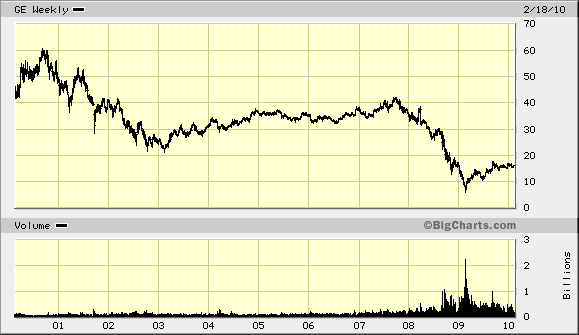
This behavior is not unknown in the stock market, where cognitive biases run unbridled down Wall Street. Ten years ago, everyone was in love with General Electic. It, too, was high-priced and tasted great. Ten years later, GE is considered cheap swill that leaves a bitter taste in the mouths of investors.

The moral of the story is that you can’t fall in love with your stocks or your wine. You have to like it on its own merits. In the case of our Systematic RS accounts, we like a stock only as long as it has high relative strength. When it becomes weaker and drops in its ranking–indicating that other, stronger stocks are available–we sell it and move on to a better class of grape. (We’ve been known to break a bottle here and there, but the idea is to adapt as tastes change.) In this way, we strive to keep our wine cellar stocked with the best vintages all the time.

Posted by:


Building a Winning Team

February 19, 2010

Our partners at Arrow Funds have just released their latest newsletter in which they have included a nice analogy on relative strength:

In a sports tournament, a team’s ultimate goal is to win. Likewise, a relative strength portfolio manager uses a tournament approach to narrow a portfolio to a group of the strongest securities. In the first round of the tournament, securities are grouped and compared by asset classes.

Relative strength of individual securities can be used to measure within their asset class to identify the top-performing representatives. In the second round, relative strength is used to compare the strength of each asset class against the asset class universe that was established by the manager.

A portfolio manager uses this process to allocate larger (strong relative strength) and smaller (weak relative strength) positions to these asset classes within the portfolio. The ultimate goal is to put together a team with exposure to the strongest asset classes and securities.

In sports, a tournament ends with a winning team as the champion. That champion will remain until the next season’s tournament. A relative strength tournament in investing also repeats. However, the manager has the ability to alter the frequency of the tournament based on the time frames being used to measure the securities.

Posted by:


Sector and Capitalization Performance

February 19, 2010

The chart below shows performance of US sectors and capitalizations over the trailing 12, 6, and 1 month(s). Relative strength strategies buy securities that have strong intermediate-term relative strength and hold them as long as they remain strong. Performance updated through 2/18/2010.

Posted by:


Diversification versus Tactical Allocation

February 18, 2010

It’s no secret that we prefer tactical asset allocation as a way to deal with the vagaries of financial markets. A very nice piece from Doug Short, entitled “Diversification Works…Until It Doesn’t” illustrates why we are leery of sit-and-take-it investing.

Markets are always changing. Sometimes taking risk is rewarded and sometimes it is punished. During the last bear cycle, bonds were the “safe” assets. Given the large buildup of public indebtedness, can anyone assume that bonds will be the safe asset the next time around? I’m not willing to make that leap of faith. That’s one of the nice things about tactical asset allocation: you don’t have to make assumptions; you can just roll with the changes. Let supply and demand determine what is strong and what is weak.

Posted by:


Municipal Bonds: Still Low Risk?

February 18, 2010

As discussed in today’s WSJ, it appears that municipal bond holders are going to become increasingly familiar with the term “Chapter 9.”

The seldom-used part of U.S. bankruptcy law gives municipalities protection from creditors while developing a plan to pay off debts. Created in the wake of the Great Depression, Chapter 9 is widely considered a last resort and filings under it are more taboo than other parts of bankruptcy code because of the resulting uncertainty for everyone from municipal employees to bondholders.

The economic slump, however, is forcing debt-laden cities, towns and smaller taxing districts throughout the U.S. to consider using Chapter 9. As their revenue declines faster than expenses, some public entities are scrambling to keep making payments on municipal bonds. And that is causing experts to worry about the safety of securities traditionally considered low risk.

Past assumptions about municipal debt need to be reevaluated:

“People believe that municipal debt is safe based on assumptions that are no longer true,” says Kenneth Buckfire, managing director and chief executive of Miller Buckfire & Co., an investment bank that has worked with corporations on restructurings and now is advising municipalities.

Once again, we can see the merit of allocating among assets based on intermediate-term relative strength as opposed to long-held assumptions.

Posted by:


Fund Flows

February 18, 2010

The Investment Company Institute is the national association of U.S. investment companies, including mutual funds, closed-end funds, exchange-traded funds (ETFs), and unit investment trusts (UITs). Members of ICI manage total assets of $11.82 trillion and serve nearly 90 million shareholders. Flow estimates are derived from data collected covering more than 95 percent of industry assets and are adjusted to represent industry totals.

Net fund flows are shown in the table below:

There were big inflows for taxable bonds and big outflows for U.S. equities for the week ending February 10.

Posted by:


Was It Really a Lost Decade?

February 17, 2010

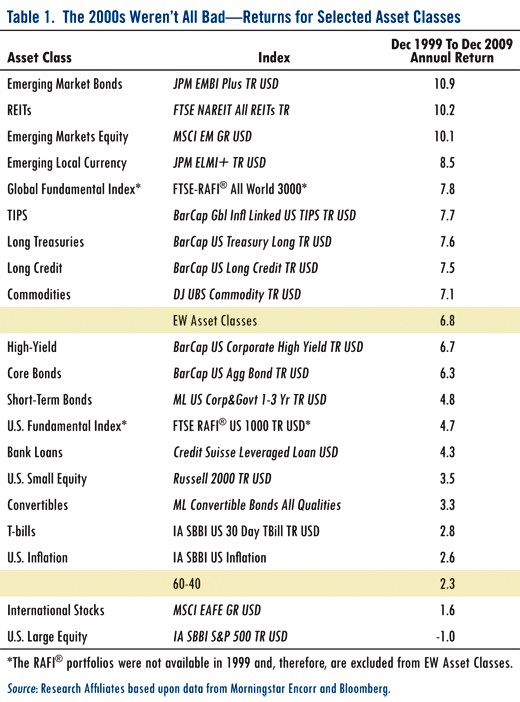
Index Universe has a provocative article by Rob Arnott and John West of Research Affiliates. Their contention is that 2000-2009 was not really a lost decade. Perhaps if your only asset was U.S. equities it would seem that way, but they point out that other, more exotic assets actually had respectable returns.

The table below shows total returns for some of the asset classes they examined.

click to enlarge

What are the commonalities of the best performing assets? 1) Lots of them are highly volatile like emerging markets equities and debt, 2) lots of them are international and thus were a play on the weaker dollar, 3) lots of them were alternative assets like commodities, TIPs, and REITs.

In other words, they were all asset classes that would tend to be marginalized in a traditional strategic asset allocation, where the typical pie would primarily consist of domestic stocks and bonds, with only small allocations to very volatile, international, or alternative assets.

In an interesting way, I think this makes a nice case for tactical asset allocation. While it is true that most investors–just from a risk and volatility perspective–would be unwilling to have a large allocation to emerging markets for an entire decade, they might find that periodic significant exposure to emerging markets during strong trends would be quite acceptable. And even assets near the bottom of the return table like U.S. Treasury bills would have been very welcome in a portfolio during parts of 2008, for example. You can cover the waterfront and just own an equal-weighted piece of everything, but I don’t know if that is the most effective way to do things.

What’s really needed is a systematic method for determining which asset classes to own, and when. Our Systematic Relative Strength process does this pretty effectively, even for asset classes that might be difficult or impossible to grade from a valuation perspective. (How do you determine whether the Euro is cheaper than energy stocks, or whether emerging market debt is cheaper than silver or agricultural commodities?) Once a systematic process is in place, the investor can be slightly more comfortable with perhaps a higher exposure to high volatility or alternative assets, knowing that in a tactical approach the exposures would be adjusted if trends change.

Posted by:


A not so Happy Valentine’s Day

February 17, 2010

What could be more appropriate on Valentine’s Day than an article about being in the red? Tom Raum of Associated Press published an alarming article Sunday on why US debt will keep growing even with recovery. It looks like there are some very difficult choices ahead for voters and their representatives. Current projections have our national debt exceeding our GDP within the next few years. In addition, the interest on that debt will be 80% of the federal budget within a decade.

Needless to say, if the government does not act on this problem, the financial markets certainly will at some point. For example, Reuters recently reported that some of China’s generals have called for using our debt as a weapon against us by having their government sell off U.S. Treasury bonds if we sell arms to Taiwan.

We do not profess to know all that is needed to solve this problem, although obviously we need to throttle back the government gravy train. As responsible voters, we need to contact our representatives to get them to take the budget problem seriously. But as investors, we need to have enough flexiblity in our investment policy to position our assets to protect them if our representatives don’t act.

Posted by: