Was It Really a Lost Decade?

February 17, 2010

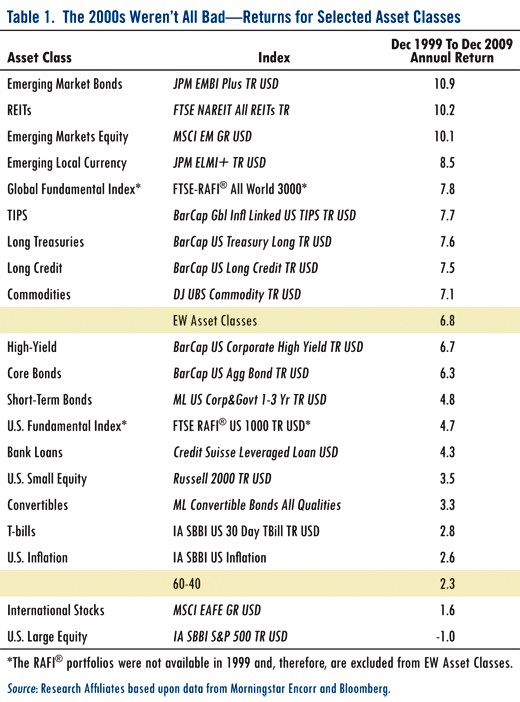
Index Universe has a provocative article by Rob Arnott and John West of Research Affiliates. Their contention is that 2000-2009 was not really a lost decade. Perhaps if your only asset was U.S. equities it would seem that way, but they point out that other, more exotic assets actually had respectable returns.

The table below shows total returns for some of the asset classes they examined.
click to enlarge

What are the commonalities of the best performing assets? 1) Lots of them are highly volatile like emerging markets equities and debt, 2) lots of them are international and thus were a play on the weaker dollar, 3) lots of them were alternative assets like commodities, TIPs, and REITs.

In other words, they were all asset classes that would tend to be marginalized in a traditional strategic asset allocation, where the typical pie would primarily consist of domestic stocks and bonds, with only small allocations to very volatile, international, or alternative assets.

In an interesting way, I think this makes a nice case for tactical asset allocation. While it is true that most investors-just from a risk and volatility perspective-would be unwilling to have a large allocation to emerging markets for an entire decade, they might find that periodic significant exposure to emerging markets during strong trends would be quite acceptable. And even assets near the bottom of the return table like U.S. Treasury bills would have been very welcome in a portfolio during parts of 2008, for example. You can cover the waterfront and just own an equal-weighted piece of everything, but I don’t know if that is the most effective way to do things.

What’s really needed is a systematic method for determining which asset classes to own, and when. Our Systematic Relative Strength process does this pretty effectively, even for asset classes that might be difficult or impossible to grade from a valuation perspective. (How do you determine whether the Euro is cheaper than energy stocks, or whether emerging market debt is cheaper than silver or agricultural commodities?) Once a systematic process is in place, the investor can be slightly more comfortable with perhaps a higher exposure to high volatility or alternative assets, knowing that in a tactical approach the exposures would be adjusted if trends change.


A not so Happy Valentine’s Day

February 17, 2010

What could be more appropriate on Valentine’s Day than an article about being in the red? Tom Raum of Associated Press published an alarming article Sunday on why US debt will keep growing even with recovery. It looks like there are some very difficult choices ahead for voters and their representatives. Current projections have our national debt exceeding our GDP within the next few years. In addition, the interest on that debt will be 80% of the federal budget within a decade.

Needless to say, if the government does not act on this problem, the financial markets certainly will at some point. For example, Reuters recently reported that some of China’s generals have called for using our debt as a weapon against us by having their government sell off U.S. Treasury bonds if we sell arms to Taiwan.

We do not profess to know all that is needed to solve this problem, although obviously we need to throttle back the government gravy train. As responsible voters, we need to contact our representatives to get them to take the budget problem seriously. But as investors, we need to have enough flexiblity in our investment policy to position our assets to protect them if our representatives don’t act.


Getting Off the Sidelines

February 17, 2010

We’re at a strange place in the market cycle. Depending on the day, investors are either fearful of a further decline or fearful of missing the recovery. No one can tell if we are in the eye of the storm and about to head into the dreaded double dip or if the nascent economic recovery has legs and is about to surprise on the upside. Despite the best year of the decade in 2009, it’s safe to say that investor confidence is still very fragile.

Amid that backdrop, investors have responded by clinging to cash. According to a recent article in Investment News, more than $9 trillion is on the sidelines. Investors need to figure out some way to get back in the game.

Of course, investor angst is understandable. Most investors diversified and tried to be patient, the very behavior they had been counseled to follow. Then 2008 came along and they got whacked when almost every asset class dropped. In other words, they did what they were told and it turned out disastrously for them. Now investors don’t know what to do or who to believe.

It’s not that investors are living in a cave. They can see the current environment and they understand that there are multiple risks they need coverage against: inflation, deflation, currency depreciation, and so on. With the yield on cash at essentially zero, they also know they can’t sit in money market funds forever and reach their investment goals.

Investors recognize that a potentially broader approach to asset classes would be helpful, but they are paralyzed with fear and have no idea how to implement that kind of investment policy. It’s not so much that they are afraid of the market as they are afraid of jumping in (or out) and getting it wrong.

Our Global Macro portfolio offers a possible solution for some of that $9 trillion sitting on the sidelines. Investors, I believe, after being beaten half to death by the proponents of sit-and-take-it investing, are now open to a tactical approach that offers great flexibility of exposure to different asset classes. They can see with their own eyes that the world has changed. They are just confused about how to handle the timing of multiple asset class exposures and reluctant to attempt it on their own.

Their problems can be addressed with something like the Global Macro portfolio because the timing and market exposure is handled for them. If conditions are harsh, the portfolio could be held in fixed income, inverse funds, and cash. If risk is being rewarded, aggressive assets such as domestic equities, emerging markets, and real estate might be held. In an inflationary environment, there might be more exposure to basic materials and commodities. If the dollar depreciates, the portfolio might be heavily laden with international equities and foreign currencies. The other significant benefit is that the systematic relative strength process used to run the accounts continues to adapt to new conditions as markets change. I think investors breathe a little easier when they recognize that there is a specific strategy that is being followed-it won’t be optimal in every environment, but it won’t be driven by fear and greed.

It’s up to each client and each advisor to figure out how to get off the bench and back into the game, but for many clients a global allocation product might smooth the transition back onto the field of play.


High RS Diffusion Index

February 17, 2010

The chart below measures the percentage of high relative strength stocks that are trading above their 50-day moving average (universe of mid and large cap stocks.) As of 2/16/10.

The 10-day moving average of this indicator is 37% and the one-day reading is 56%. After reaching a single-day low of 26% on 2/5/10, this oscillator has rebounded sharply.