Rob Arnott and the Key to Better Returns

February 26, 2010

Rob Arnott is a thought leader in tactical asset allocation, currently well-known for his RAFI Fundamental Indexes. In his recent piece, Lessons from the Naughties, he discusses how investors will need to find return going forward.

The key to better returns will be to respond tactically to the shifting spectrum of opportunity, especially expanding and contracting one’s overall risk budget.

It’s a different way to view tactical asset allocation-looking at it from a risk budget point of view. The general concept is to own risk assets in good markets and safe assets in bad markets.

It turns out that systematic application of relative strength accomplishes this very well. The good folks at Arrow Funds recently asked us to take a look at how the beta in a tactically managed portfolio changed over time. When we examined that issue, it showed that as markets became risky, relative strength reduced the beta of the portfolio by moving toward low volatility (strong) assets. When markets were strong, allocating with relative strength pushed up the beta in the portfolio, thus taking good advantage of the market strength.
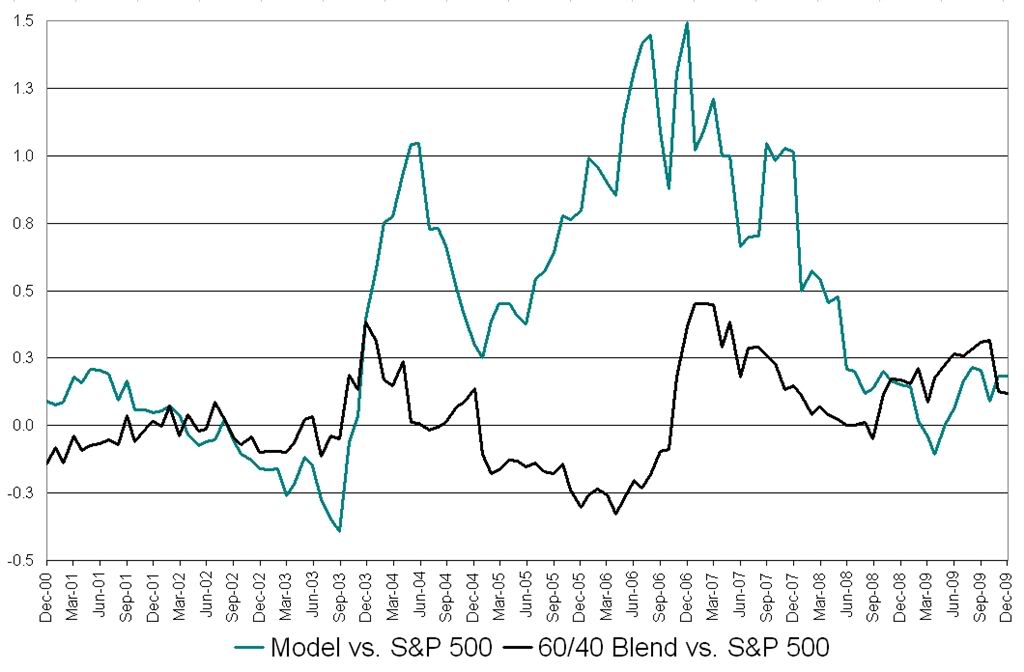
click to enlarge

Using relative strength to do tactical asset allocation, the investor was not only able to earn an acceptable rate of return over time, but was able to have some risk mitigation going on the side. That’s a pretty tasty combination in today’s markets.


The Upside of Financial Contagion

February 26, 2010

This article from the New York Times is pretty much in keeping with the current zeitgeist. It discusses the financial crisis and points out how inter-connected financial markets are these days.

As we all now know, mortgage woes were contained — to planet Earth. And so it may be with overleveraged nations in Europe.

Simply put, contagion is a fact of life in our interconnected global economy and financial markets. And that means investors must strap in for more gyrations in the stock and bond markets as the great and painful deleveraging that began in 2007 continues around the world.

However, this article, like most of its brethren, looks only at the negative aspect of financial contagion. In fact, contagion is just as likely to happen when things get rolling to the upside again.

Right now it is easy to be focused on gloom and doom, but market cycles don’t press on the downside forever. One can certainly make the case that the market would have gone down by now if it really and truly deserved to. Keep in mind that the stock market is typically a leading indicator. We’ve already had a nice rally from March 2009 until now.

What happens if the market stubbornly refuses to go down from here, and continues to make upside progress? Suddenly all the benefits of a positive feeback cycle are being discussed: corporate earnings rise, corporate dividends increase, national tax receipts begin to surge, and hiring starts once again. It’s quite likely that because global markets are so inter-connected that improvements in psychology and corporate results will move around the globe too. The global village may mean that your investment policy needs to be more flexible and to include more asset classes, but it doesn’t mean that we’re going to be mired in the muck forever.


The Price That Must Be Paid

February 26, 2010

Just like there are risks associated with trend-following (lagging at the turns) there are risks associated with forecasting (being too early or just plain wrong.) As far as forecasters go, Jeremy Grantham has been pretty good.

Jeremy Grantham warned in January 2000 that U.S. equities were “more overpriced than at any time in the last 70 years due to the massive overpricing of technology and especially dot-com stocks.” By the end of 2002, the Standard & Poor’s 500 Index had fallen 40 percent and technology shares were down 73 percent. The forecast didn’t help his firm, Grantham Mayo Van Otterloo Co., because he’d been bearish since 1997. Assets declined 45 percent in the late 1990s as customers sought out better- performing mutual funds that liked the technology stocks Grantham disdained.

He recommended avoiding Japanese stocks more than two years before they started falling at the end of 1989.

Two of Grantham’s most recent forecasts were right — and timely. In 2007, he wrote in his newsletter that all asset classes were overvalued and it was time to sell high-risk securities. In March 2009, when the S&P 500 index bottomed out at 676, Grantham wrote that fair value for the benchmark of the largest U.S. stocks was 900, or 33 percent higher.

Looking back on more than 40 years in the investment business, Grantham summed up his career this way: “We win all the bets but we are horrifically early,” he said. [Bold is my emphasis]

It appears that his firm’s performance has been very good over time, but Grantham’s own assessment of his tendency to be “horrifically early” is just something his investors have to be aware of and accept. I am always impressed with those managers who are fully aware of the weaknesses of their strategies, but accept them as the price that must be paid in order to acheive excellent long-term results.


Public Service Announcement!

February 26, 2010

In light of J.P.’s recent post, I don’t want to push on this too hard, but the good folks at Morningstar are becoming concerned that investors misunderstand Treasury Inflation Protected Securities (TIPS). Their point is simply that TIPS provide inflation protection, but not price protection from rising interest rates. Worth a read.


How To Cope With Inflation…Or Not

February 26, 2010

Many investors are worrying about inflation these days. There is certainly a good case that can be made for inflation as an eventual consequence to the vast amounts of debt being issued by many governments. Matthew Bandyk, writing for U.S. News and World Report, looked at some investment possibilities for hedging against inflation. His article points out that about half of the economists surveyed believe the Fed will keep inflation under control, while 41% believe that there will be significant inflation. In other words, inflation does not seem to be a foregone conclusion.

Just in case, Mr. Bandyk looks at three major areas as possible inflation hedges. These would be investments whose value can resist a weakening dollar or rising consumer-good prices. He examines TIPS (Treasury inflation-protected securities), gold, and real estate and concludes that no single hedge works for all inflation situations. We agree and further suggest that rather than focusing on forecasts for a single asset class, investors utilize a strategy that has the ability to shift among a variety of asset classes as dictated by which ones are actually working.


Reverse Psychology

February 26, 2010

This just in: People do the opposite of what you tell them.

Researchers at the University of Indiana released the results of a study yesterday, which examined the effects of shame and guilt-inducing public service announcements. Specifically, the researchers studied ads which promoted responsible alcoholic consumption by way of illustrating the harmful consequences of over-drinking. By highlighting side effects like blackouts and car accidents, viewers of the ads were made to feel ashamed and guilty for indulging in those behaviors.

What’s the problem with that? Unwittingly, the ads caused people who are already dealing with those problems to drink even more.

Findings show such messages are too difficult to process among viewers already experiencing these emotions – for example, those who already have alcohol-related transgressions.

So not only do the ads not really work, they also exacerbate the situation for people who already have a problem.

Why do we care? Because this same kind of shame-inducing message could be leading retail investors to continue to do exactly what is hurting them in the first place. The human brain, when confronted with the horrors of reality, sets up a foiling mechanism to cope with the bright light of truth.

Advisor: You know, the research proves without a doubt that retail investors cannot time the market. You would be well-served by adopting a proven strategy and sitting tight for the long-term.

Client: Well that sure doesn’t sound like me! Hey this fund is down on the year, let’s find a new one. Next!

So not only does the client have a major problem to begin with, when you show them the error of their ways, it forces the client down a rabbit-hole of denial. It’s a vicious cycle.

We’ve talked about this type of behavior before.

Maybe we should try reverse psychology and suggest that clients churn their portfolio at every whim?

[Editor's note: J.P. does not have teenagers, or he would already know people do the opposite of what you tell them!]


Sector and Capitalization Performance

February 26, 2010

The chart below shows performance of US sectors and capitalizations over the trailing 12, 6, and 1 month(s). Relative strength strategies buy securities that have strong intermediate-term relative strength and hold them as long as they remain strong. Performance updated through 2/25/2010.