Morningstar Buy Signal for U.S. Stocks?

March 9, 2010

Since 1994, Morningstar has been tracking a strategy of buying the asset classes that had the largest net outflows and then holding the positions for three years before rotating them out. The essential idea is just to buy an asset class when it is out of favor and hold on to it patiently, long enough to reap the gains. In effect, this is simply doing the opposite of what most investors do. The strategy produces better than market returns over both three-year and five-year time horizons.

From 1994 through 2009, the buy-the-unloved strategy produced an annualized 8.1% return, compared with 4.77% for the loved, 6.24% for the S&P 500, 6.96% for the Wilshire 5000, and 5.36% for the MSCI World. This assumes you invest in the unloved categories for three years running and then roll over the oldest group into the new unloved group starting in year four.

The strategy also produced strong results if you run it on a five-year rotation. In that version, the unloved produced an 8.08% annualized return, compared with 4.25% for the loved, 5.17% for the S&P 500, 5.76% for the Wilshire 5000, and 4.55% for the MSCI World.

While it is no shock that going opposite retail (and institutional pension funds!) investors is profitable, it may be a bigger surprise what the portfolio is buying this year.

Based on the 12-month flows through the end of January, the unloved categories to buy now are large-cap growth, large-cap value, and world stock.

Note: this would be a good time to point out that our Systematic RS Aggressive and Core portfolios fit solidly within the large-cap category! I will be pleasantly surprised if we begin to see flows into our domestic equity products by far-seeing, patient advisors. Industry practice is to wait until there is a good marketing window for retail investors-usually after a year or two of strong performance. There’s nothing wrong with that, but since the timing isn’t optimal, investors have to be prepared to weather a couple of cycles to really get maximum benefit from the strategy. If I were in advertising, I would advise you to beat the rush and buy domestic large cap stocks today!


This Is Insanity!

March 9, 2010

According to the article Public Pension Funds Are Adding Risk to Raise Returns in today’s New York Times:

States and companies have started investing very differently when it comes to the billions of dollars they are safeguarding for workers’ retirement. Companies are quietly and gradually moving their pension funds out of stocks. They want to reduce their investment risk and are buying more long-term bonds.

Besides bonds, where else are they going?

Though they generally say that their strategies are aimed at diversification and are not riskier, public pension funds are trying a wide range of investments: commodity futures, junk bonds, foreign stocks, deeply discounted mortgage-backed securities and margin investing. And some states that previously shunned hedge funds are trying them now.

What type of return do they need?

A spokeswoman for the Texas teachers’ fund said plan administrators believed that such alternative investments were the likeliest way to earn 8 percent average annual returns over time.

Why pensions don’t want to lower their return assumptions:

A growing number of experts say that governments need to lower the assumptions they make about rates of return, to reflect today’s market conditions. But plan officials say they cannot. “Nobody wants to adjust the rate, because liabilities would explode,” said Trent May, chief investment officer of Wyoming’s state pension fund.

Why not increase contributions?

Colorado cannot afford the contributions it owes, even at the current estimated rate of return. It has fallen behind by several billion dollars on its yearly contributions, and after a bruising battle the legislature recently passed a bill reducing retirees’ cost-of-living adjustment, to 2 percent, from 3.5 percent. Public employees’ unions are threatening to sue to have the law repealed.

This is insanity! It is time for public pension plans to face the music. They need a better investment approach. It’s after reading articles like this that I become even more grateful that we adhere to a dynamic approach to investing that doesn’t have any bias about where returns will come from in the future. We simply allow relative strength to dictate how we will be allocated. They have sworn off US equities because of their volatility and of their underperformance relative to other asset classes over the last ten years. However, it is entirely possible that US equities could be the very best performing asset class over the next ten years.

They need to realize that nobody is entitled to 8% per year. I think 8% a year, and even better, is very possible over time, but you have to earn it by adhering to an effective investment plan. Furthermore, there is no way to get that year in and year out unless you are one of Bernie Madoff’s clients.

They need to quit promising guaranteed benefits that are completely out of line with reality. Rather, they should pay out benefits that fluctuate according to how the pension performs. That is how the rest of us live.

Finally, funding the pension cannot be optional. It must be funded each year, regardless of the opposition.

There, I’m done.


Relative Strength Spread

March 9, 2010

The chart below is the spread between the relative strength leaders and relative strength laggards (universe of mid and large cap stocks). When the chart is rising, relative strength leaders are performing better than relative strength laggards. As of 3/8/2010:

The sharp decline in the RS Spread for much of the last 12 months has moderated considerably in recent months, and may well be setting the stage for a more favorable RS environment.


Trends Are Everywhere

March 8, 2010

Acorn Investments’ Jason Russell writes:

Trends are everywhere - weather, sports, fashion, food, entertainment, health, science and politics. Some trends are long, some are short. They come and they go as they always have and always will. Life and business both thrive on identifying, following and serving trends. Market prices for metals, currencies, energies or bonds are no different.

This is why we are never very concerned when markets are trendless for a while. New trends come and go all the time, and our Systematic RS process is designed to identify the strongest trends and to latch on to them. The trends that continue for a long period of time can be very profitable.

via www.MichaelCovel.com


Weekly RS Recap

March 8, 2010

The table below shows the performance of a universe of mid and large cap U.S. equities, broken down by relative strength decile and quartile and then compared to the universe return. Those at the top of the ranks are those stocks which have the best intermediate-term relative strength. Relative strength strategies buy securities that have strong intermediate-term relative strength and hold them as long as they remain strong.

Last week’s performance (3/1/10 – 3/5/10) is as follows:

That is my kind of week - great performance for the broad market and even better performance for high relative strength stocks! Now, if I annualized that performance…


If You Miss the 10 Best Days

March 5, 2010

We’ve all seen numerous studies that purport to show how passive investing is the way to go because you don’t want to be out of the market for the 10 best days. No one ever mentions that the “best days” most often occur during the declines!

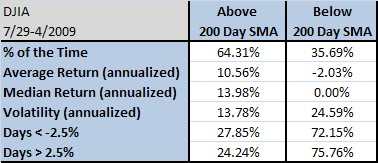
It turns out that the majority of the best days and the worst days occur near one another, during the declines. Why? Because the market is more volatile during declines. It is true that the market goes down 2-3x as fast as it goes up. (World Beta has a nice post on this topic of volatility clustering, which is where this handy-dandy table comes from.)

from World Beta

You can see how volatility increases and the number of days with daily moves greater than 2.5% really spikes when the market is in a downward trend. It would seem to be a very straightforward proposition to improve your returns simply by avoiding the market when it is in a downtrend.

However, not every strategy can be improved by going to cash. Think about the math: if your investing methodology makes enough extra money on the good days to offset the bad days, or if it can make money during a significant number of the declines, you might be better off just gritting your teeth during the declines and banking the higher returns. Although the table above suggests it should help, a simple strategy of exiting the market (i.e., going to cash) when it is below its 200-day moving average may not always live up to its theoretical billing.

click to enlarge

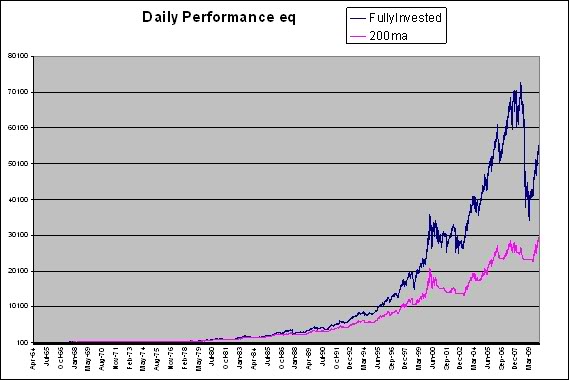
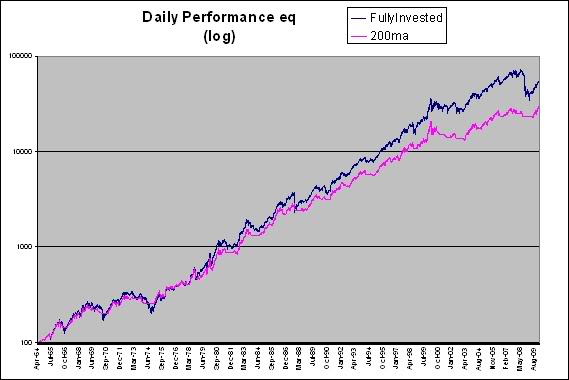
Consider the graphs above. (The first graph uses linear scaling; the second uses logarithmic scaling for the exact same data.) This test uses Ken French’s database to get a long time horizon and shows the returns of two portfolios constructed with market cap above the NYSE median and in the top 1/3 for relative strength. In other words, the two portfolios are composed of mid- and large-cap stocks with good relative strength. The only difference between the two portfolios is that one (red line) goes to cash when it is below its 200-day moving average. One portfolio (blue line) stays fully invested. The fully invested portfolio turns $100 into $49,577, while the cash-raising portfolio yields only $26,550.

If you would rather forego the extra money in return for less volatility, go right ahead and make that choice. But first stack up 93 boxes of Diamond matches so that you can burn 23,027 $1 bills, one at a time, to represent the difference-and then make your decision.

The drawdowns are less with the 200-day moving average, but it’s not like they are tame-equities will be an inherently volatile asset class as long as human emotions are involved. There are still a couple of drawdowns that are greater than 20%. If an investor is willing to sit through that, they might as well go for the gusto.

As surprising as it may seem, the annualized return over a long period of time is significantly higher if you just stay in the market and bite the bullet during train wrecks-and even two severe bear markets in the last decade have not allowed the 200-day moving average timer to catch up.

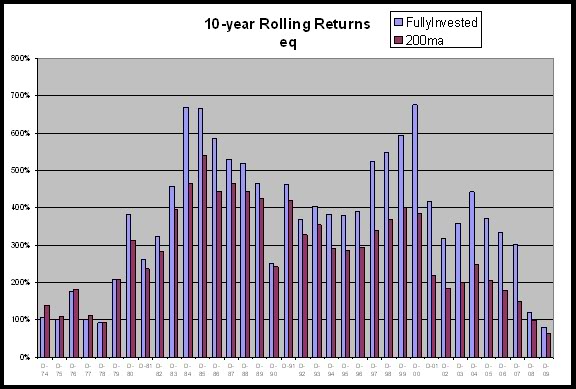
At the bottom of every bear market, of course, it certainly feels like it would have been a good idea (in hindsight) to have used the 200-day moving average to get out. In the long run, though, going to cash with a high-performing, high relative strength strategy might be counterproductive. When we looked at 10-year rolling returns, the fully invested high relative strength model has maintained an edge in returns for the last 30 years running.

click to enlarge

Surprising, isn’t it? Counterintuitive results like this are one of the reasons that we find testing so critical. It’s easy to fall in line with the accepted wisdom, but when it is actually put to the test, the accepted wisdom is often wrong. (We often find that even when shown the test data, many people refuse, on principle, to believe it! It is not in their worldview to accept that one of their cherished beliefs could be false.) Every managed portfolio in our Systematic RS lineup has been subjected to heavy testing, both for returns and-and more importantly-for robustness. We have a high degree of confidence that these portfolios will do exceedingly well in the long run.


This Recovery Can’t Get No Respect

March 5, 2010

The director of the Economic Cycle Research Institute refers to this as a Rodney Dangerfield recovery. Here’s a link to the video interview-worth watching especially if you are currently awash in pessimism. Things are coming along nicely, but no one cares. (Although if growth continues to accelerate, all the investors who just piled into bond funds might start to care a lot.) From the perspective of a practitioner who is not an economist, I’m not surprised the recovery has been pretty good. The market has been strong over the last 12 months, and the market is a leading indicator. In addition, other market-based indicators like the yield curve have suggested a strong recovery is on the way.

Mr. Achuthan is also forecasting more frequent ups and downs in the economy going forward, so he concludes that buy-and-hold investing is dead. We nominate him as a charter member of Economists For Tactical Allocation.


If “the Worst” Happens…

March 5, 2010

Fascinating analysis by Gary Alexander of Navellier regarding how the market has reacted to unexpected shocks, such as epidemics, wars, earthquakes, tsunamis, floods, and other tragedies.

There is some cold comfort in knowing that no matter how tragic the world’s events may seem, the market is one thing we don’t need to worry about when sudden tragedy strikes.

No doubt, there are many investors who dial back their risk or largely avoid risk altogether (unwisely, it turns out) because of fear of unexpected shocks.


Sector and Capitalization Performance

March 5, 2010

The chart below shows performance of US sectors and capitalizations over the trailing 12, 6, and 1 month(s). Relative strength strategies buy securities that have strong intermediate-term relative strength and hold them as long as they remain strong. Performance updated through 3/4/2010.


The Land of the Midnight Sun

March 4, 2010

Norway is now trying to figure out whether they should continue to use active managers or go to passive management. Their crisis came about in the financial meltdown when their previously successful active managers lost a slug of money. Now they are wondering whether they should just save the fees and use a passive approach.

I must confess that I’ve never completely understood this argument. Sure, an active manager can lose when the market goes down-but a passive manager is guaranteed to lose also. Fees are never pleasant, but as the old saying goes, “the bitterness of poor service lingers long after the sweetness of low cost is gone.”

The base question is: are you getting what you pay for? Clearly, it makes no sense to pay a closet indexer the full fee for active management. We’ve written about this before, and it’s true that closet indexers are a large part of the industry. No, you need to find a manager out of the mainstream with a high active share. It means you won’t track the benchmark very closely at all, but you’ve got a very decent shot at beating the market according to the research.

And despite what John Bogle and other EMH apologists say, there are plenty of strategies that do beat the market. Mark Hulbert of MarketWatch addressed this recently:

My three decades of tracking investment advisers has shown that, over long periods of time, about one out of five advisers are able to do better than simply buying and holding an index fund. While that means it isn’t impossible to outperform the market over the long term, the odds are stacked against us.

That 20% number sounds about right to me, and obviously Mr. Hulbert has the data to back it up. The 80/20 rule holds just about everywhere else; I don’t know why investment management would be any different.

If, instead of resorting to passive management, you dedicate yourself to finding that superior 20% of the industry, it could be quite rewarding, not to mention a lot less boring than settling for mediocrity.


The “Safest” Investment Around

March 4, 2010

Brideway’s John Montgomery on bonds, from their recently released semi-annual report:

If we turn back the hands of time to the period after the deepest recession of the last century, we may see in vivid terms what could be in store, or at least the risk that presents itself. Take a sixty-year old retiree in 1940. She has just lived through the Great Depression and is convinced that the stock market is for speculators only. Looking for the “safest” instrument around, she invests in 90-day U.S. Treasury Bills. As long as America is in business, these investments can’t go down…or can they? Each month over the decade of the 1940s, her monthly statement shows an increasing balance as interest is reinvested. However, putting her money in Treasury Bills over this ten year period from 1940-1950 would have yielded a dramatic, portfolio destroying, inflation-adjusted drop of 41%. Note that at no time was there a sudden decline; she may even have been lured into a false sense of security. But “waking up” in 1950 to the reality that food, rent, and other expenses have increased far faster than her account balances leaves her unable to maintain her previous standard of living. Perhaps even worse, there is no hope of such a fixed income investment ever recovering from such a major hit. Coming off the heels of the second worst recession and worst bear market since 1940, one has to wonder if investors aren’t once again taking money from stocks and positioning it into one of the most risky asset classes - fixed income - for the decade of the 2010′s. It seems extremely likely that the only way out of the mounting national debt is for the U.S. government to “inflate” its way out. Only time will tell, but we are highly concerned that investors have just moved their commitment away from stocks into fixed income at the worst possible moment.


Retail Investors: China Edition

March 4, 2010

Apparently retail investors everywhere are the same-they tend to lose money. CXO Advisory has a nice piece that highlights research showing that Chinese retail investors consistently lose relative to institutions and large investors. And they lose a lot.

The keys to successful investing in the long term are pretty simple: a good process and lots and lots of patience. Lots of reasonable investment strategies are available to investors, but the patience you have to supply yourself.


Fund Flows

March 4, 2010

The Investment Company Institute is the national association of U.S. investment companies, including mutual funds, closed-end funds, exchange-traded funds (ETFs), and unit investment trusts (UITs). Members of ICI manage total assets of $11.82 trillion and serve nearly 90 million shareholders. Flow estimates are derived from data collected covering more than 95 percent of industry assets and are adjusted to represent industry totals.

Net fund flows are shown in the table below:

Fixed income continued to attract biggest portion of new money in the week ending February 24.


Investing Lies We Grew Up With

March 3, 2010

This is the title of a nice article by Brett Arends at Marketwatch. He points out that a lot of our assumptions, especially regarding risk, are open to question.

Risk is an interesting topic for a lot of reasons, but principally (I think) because people seem to be obsessed with safety. People gravitate like crazy to anything they perceive to be “safe.” (Arnold Kling has an interesting meditation on safe assets here.)

Risk, though, is like matter-it can neither be created nor destroyed. It just exists. When you buy a safe investment, like a U.S. Treasury bill, you are not eliminating your risk; you are just switching out of the risk of losing your money into the risk of losing purchasing power. The risk hasn’t gone away; you have just substituted one risk for another. Good investing is just making sure you’re getting a reasonable return for the risk you are taking.

In general, investors-and people generally-are way too risk averse. They often get snookered in deals that are supposed to be “low risk” mainly because their risk aversion leads them to lunge at anything pretending to be safe. Psychologists, however, have documented that individuals make more errors from being too conservative than too aggressive. Investors tend to make that same mistake. For example, nothing is more revered than a steady-Eddie mutual fund. Investors scour magazines and databases to find a fund that (paradoxically) is safe and has a big return. (News flash: if such a fund existed, you wouldn’t have to look very hard.)

No one goes looking for high-volatility funds on purpose. Yet, according to an article, Risk Rewards: Roller-Coaster Funds Are Worth the Ride at TheStreet.com:

Funds that post big returns in good years but also lose scads of money in down years still tend to do better over time than funds that post slow, steady returns without ever losing much.

The tendency for volatile investments to best those with steadier returns is even more pronounced over time. When we compared volatile funds with less volatile funds over a decade, those that tended to see big performance swings emerged the clear winners. They made roughly twice as much money over a decade.

That’s a game changer. Now, clearly, risk aversion at the cost of long-term returns may be appropriate for some investors. But if blind risk aversion is killing your long-term returns, you might want to re-think. After all, eating Alpo is not very pleasant and Maalox is pretty cheap. Maybe instead of worrying exclusively about volatility, we should give some consideration to returns as well.


Psychology That Drives Bull Markets

March 3, 2010

The Leuthold Group’s Doug Ramsey on the psychology that drives bull markets:

Cashing in on bull markets is not a matter of waiting for everything to line up, anyway. There must be a set of intellectually appealing bear arguments keeping some players on the sidelines…it is these same players who will eventually drive prices even higher when “new” and intellectually appealing bull arguments belatedly appear on the scene. I have found that some of the best bull market action occurs when the “bull/bear” arguments superficially appear to be in relative balance, confounding many market players. When the balance tips too heavily to one side or the other, the odds are that most of the related market move is already in the books.


Old Habits Die Hard

March 3, 2010

The Great Recession was supposed to scar consumers for life and scare them into saving. Personally, I thought consumers might permanently change their behavior as they did after the Great Depression in the 1930s. But just as investor behavior is seemingly intractable, consumer spending behavior is hard to change. According to an article in the Washington Post:

Consumers spent more and saved less in January, according to government data released Monday, a sign that Americans feel increasingly secure about their financial situation, economists said. The growth in spending and the decline in savings were, respectively, more and less than analysts had predicted — adding weight to a growing consensus that consumers’ newfound frugality was just a fling.

Maybe consumers feel like the recession is over and they are willing to spend again. If so, most economists (again!) are going to be caught off guard.

Sectors catering to the consumer might perform more strongly than people expect. When I looked at our relative strength sector work yesterday, the biggest positive changes in RS over the last several weeks have come in healthcare, consumer staples, and consumer cyclicals. It’s impossible to know if the strength will be durable, but it’s certainly not what the consensus expected.


High RS Diffusion Index

March 3, 2010

The chart below measures the percentage of high relative strength stocks that are trading above their 50-day moving average (universe of mid and large cap stocks.) As of 3/2/10.

The 10-day moving average of this indicator is 69% and the one-day reading is 81%. This oscillator has shown the tendency to remain overbought for extended periods of time, while oversold measures tend to be much more abrupt.


John Bogle is Missing!

March 2, 2010

There is an absolutely hilarious round of letters and investment challenges going around, started by a challege from Roger Schreiner of Schreiner Capital Management to John Bogle. It’s been 193 days and John Bogle has yet to accept.

David Loeper from Wealthcare Capital Management responded in a Letter to the Editor and the accusations are flying. (There’s a link to the original challenge and Loeper’s response in the article.)

Everyone has an ax to grind and the challenges are somewhat tilted, but it’s been a great excuse for Mr. Schreiner to skewer passive investing.

Our investment strategy is to own stocks when the market is strong and sell them when the market is weak. By comparison, the investment process (if you can call it that) of the passive investor is embarrassingly simple: hope.

I’m sure this will not end the active versus passive debate, but it has been good for some entertainment.


Forecasting, Schmorecasting…

March 2, 2010

We’ve written about the uselessness of forecasting in the past and even cited James Montier’s wonderful piece, The Seven Sins of Fund Management. This citation comes from Mebane Faber’s World Beta blog. Montier writes:

The two most common biases are over-optimism and overconfidence. Overconfidence refers to a situation whereby people are surprised more often than they expect to be. Effectively people are generally much too sure about their ability to predict. This tendency is particularly pronounced amongst experts. That is to say, experts are more overconfident than lay people. This is consistent with the illusion of knowledge driving overconfidence.

Dunning and colleagues have documented that the worst performers are generally the most overconfident. They argue that such individuals suffer a double curse of being unskilled and unaware of it. Dunning et al argue that the skills needed to produce correct responses are virtually identical to those needed to self-evaluate the potential accuracy of responses. Hence the problem.

This is irony in action. Knowledge drives overconfidence, so people who actually know something about a topic are more prone to think they can forecast, and they probably even sound more believable. And finally, the worst performers are the most overconfident!

This may be one of the few instances in which ignorance is bliss. If you have the Zen “beginner’s mind” and don’t make any assumptions about what might happen, you’re going to be better off than if you are knowledgeable and try to guess.

Systematic trend-following eliminates the need to forecast (although apparently not the desire, since we have clients constantly asking us what we think is going to happen). We use relative strength to drive our trend-following; it is able to pick out the strongest trends, and those are the trends we are interested in following. We stay with an asset as long as it remains strong. When it weakens, we kick it out of the portfolio and replace it with something stronger. This kind of casting-out method allows the portfolio to adapt to the market environment, as it is constantly refreshed with new, strong assets.

Despite having a logical and simple method that performs well over time and eliminates the need to forecast, soothsayers will probably always be with us-but your best bet is to ignore them.


Relative Strength Spread

March 2, 2010

The chart below is the spread between the relative strength leaders and relative strength laggards (universe of mid and large cap stocks). When the chart is rising, relative strength leaders are performing better than relative strength laggards. As of 3/1/2010:

After being out of favor for the better part of a year, the stage is set for relative strength to re-emerge as a winning investment factor. The RS Spread has just broken above its 50 Day Moving Average.


Life Expectancy at Retirement

March 1, 2010

Source: The Economist, via Greg Mankiw.

Americans, as well as citizens of many other advanced nations, now spend about twice as many years in retirement as they did a generation or two ago. Aggressive saving and adherence to a well-thought-out investment plan are more important today than they have ever been. It is a big mistake for today’s 65-year olds to no longer consider themselves to be “long-term investors.”


Strategic Asset Allocators Finally Cave

March 1, 2010

According to Investment News, the hot new trend in target date funds is…tactical asset allocation!

AllianceBernstein LP, Van Kampen Funds Inc., Invesco Ltd. and Putnam Investments have all announced changes to their target date portfolios that will enable managers to provide more active management.

In some cases, the funds now will allow managers to move in and out of different asset classes more quickly during market fluctuations. Others are adding funds to their target date portfolios that are meant to protect investors from market downturns.

These fund companies are not bit players-they are large and they have a lot of industry influence. They have discovered that their original premise of using strategic asset allocation did not work very well during the last downturn. Additionally, they may be concerned that piling more bonds into target date portfolios as investors age might not be a great idea in this interest rate environment.

Maybe it is something else entirely that is making them nervous. Whatever the reason, it is interesting to see that they have suddenly gotten religion, thrown strategic asset allocation overboard, and gone tactical.


On This Day Three Years Ago

March 1, 2010

On 3/1/2007, Dorsey Wright and our partners PowerShares rang the bell at the NYSE and The PowerShares DWA Technical Leaders Portfolio (PDP) began trading. In the three years since its inception, PDP has outperformed the S&P 500 by 0.54%. It is up 55.01% over the last twelve months, which is ahead of the S&P 500 by 4.76% over that time.

Click here for the fact sheet on PDP.


Weekly RS Recap

March 1, 2010

The table below shows the performance of a universe of mid and large cap U.S. equities, broken down by relative strength decile and quartile and then compared to the universe return. Those at the top of the ranks are those stocks which have the best intermediate-term relative strength. Relative strength strategies buy securities that have strong intermediate-term relative strength and hold them as long as they remain strong.

Last week’s performance (2/22/10 – 2/26/10) is as follows:

The top quartile percentile performed a little better than the universe last week.