Core-and-Satellite

May 3, 2010

Quite a number of the financial advisors we work with adhere to a core-and-satellite portfolio system. But what should be the core and what should be the satellite? Often funds with broad market exposure, usually indexes, are considered to be the core exposure and anything else is part of the satellite. However, I have often argued that tactical allocation funds (like our Global Macro separate account, or DWAFX and DWTFX), because of their ability to adapt to numerous investing environments, really should be considered part of the core allocation.

Morningstar’s Christine Benz, in her article What’s a Core Holding, Anyway? addresses the definitional issue of what constitutes a core holding. According to her thinking:

One commonly held definition of a core holding is that the investment provides broad exposure to a large part of the market and gives you a lot of diversification in a single shot.

This is pretty much the textbook definition. She goes on to say that a statistic like r-squared can be used to differentiate core from non-core funds. Steve Raymond in Dorsey, Wright’s Richmond office, for example, has regularly pointed out that most large-cap funds have r-squares near 0.9, indicating a similar profile to the broad market index like the S&P 500.

But then Ms. Benz gets to the heart of the matter:

However, there’s a big problem with strictly defining what’s core by its level of market correlation. Many great investors-in fact, I’d argue, most great investors-couldn’t give a hoot about whether their portfolio or performance tracks that of a broad market benchmark. Instead, they go where the opportunities beckon, regardless of whether they end up heavily skewed toward a single market segment or not. Such investors’ performance may veer significantly from that of broad market indexes at various points in time-sometimes for better, sometimes for worse. They know that getting ahead of the market over the long haul is what matters, and most would probably argue that concepts like R-squared and “tracking error” are the domain of money managers, not real investors.

This is so great that I wish I had written it! I added the boldface type, because I think what she said is ridiculously important. Most great investors don’t care about tracking a benchmark. They care only about long-term performance and they will go wherever they need to go to get it. That is the essence of a systematic approach to global tactical asset allocation, and exactly why I would argue that it should be classified as part of a portfolio’s core.


Don’t Wait!

May 3, 2010

Time ran a series of pithy articles with retirement advice. Although I don’t agree with every single bit of advice, most of it is quite sound. One important piece of advice:

You’re pretty much on your own when it comes to earning, saving and investing. So make a plan early and check in often. Those who have a realistic plan are far more likely to achieve their financial goals.

According to AARP, more than 50% of people closing in on retirement do not have any kind of plan! Get started. In my experience, clients who commit to even the simple act of setting up a spreadsheet to tally their net worth each quarter take a huge step toward getting on the right track.


Recognition is a Long Time Coming

May 3, 2010

Relative strength is no longer the Rodney Dangerfield of investing.

In a watershed event for relative strength investing, Morningstar will begin to consider “momentum” as a return factor. This nugget was disclosed in a Portfolio Strategy article that appeared in today’s Wall Street Journal.

For many years, academic researchers believed a stock’s performance could be explained by three primary factors: the market where the stock traded, the size of the company, and the stock’s style, along a continuum from shares of fast-expanding “growth” companies to seemingly cheap value stocks.

But now, the academic community has “coalesced” around recognition of momentum as the “fourth factor,” says Mr. Rekenthaler, a sentiment echoed in recent research.

Momentum, as you may recall, is the name academics use for relative strength. Academic research began appearing on momentum in the 1990s, although market technicians have been writing about-and using-relative strength at least since the 1930s. (My theory is that academics and value investors can’t stand to admit that technical analysis has tremendous value.)

Morningstar didn’t stop with just the recognition of relative strength as a return factor. They’re going to measure it:

In a sign of just how popular this idea is becoming, Morningstar Inc. this summer will roll out a new gauge: The research firm will assign U.S. and international stocks a score between 1 and 100 for momentum and take the mean momentum score of a mutual fund’s holdings to give the fund an overall momentum ranking. If funds that consistently score highly on momentum perform similarly, Morningstar might eventually create a new category of momentum-oriented funds, says John Rekenthaler, vice president of research at the firm.

The other salient point that the Wall Street Journal article makes is something that we have emphasized often on this blog. Relative strength strategies and deep value strategies are often complementary. The article references the work of Clifford Asness at AQR:

Mr. Asness co-authored a 2009 study entitled “Value and Momentum Everywhere,” which suggested that investors can hedge themselves and boost returns with a simple combination of momentum and value strategies—in stocks and all other asset classes.

In the past, many investors looked to hold a mix of value-oriented and growth-oriented stocks or funds, since the two were thought to take turns in favor. Now AQR suggests that momentum, rather than growth, is the right foil for value strategies.

There’s one area where I take issue with the article. It suggests that relative strength has no fundamental underpinning; that it is purely a psychological phenomenon, or somehow related to group-think:

These momentum trends in markets have more to do with the faddishness of human behavior than the fundamentals of economics and balance sheets. In essence, investors often flock to the stocks that have been going up, which tends to propel them further.

That is a very incomplete description of how relative strength works. A number of academic studies have shown that part of the push behind relative strength is that new information sifts into the market gradually and that the time-release effect is one of the drivers of relative performance. Fundamental analysts often comment that a positive earnings revision is frequently followed by another-the so-called “cockroach effect.” Analysts tend to adjust their earnings estimates more slowly than they should and relative strength is often just recognition of improved prospects in the market running ahead of the analysts’ conservative thinking.

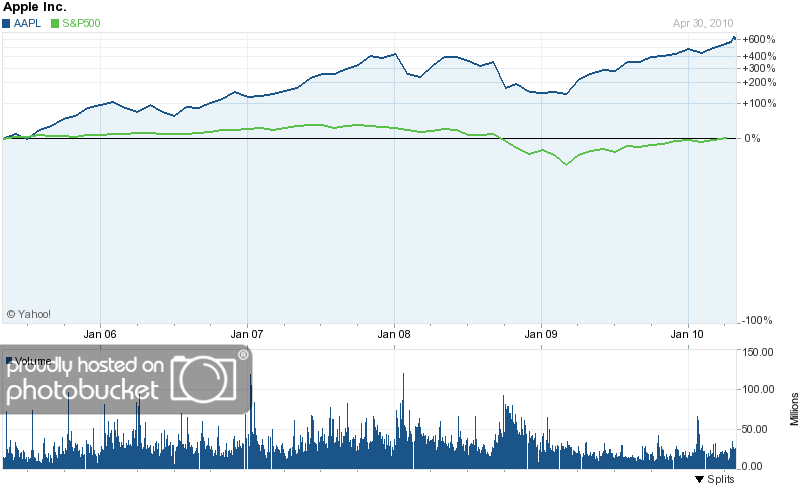
Indeed, relative strength is typically driven by fundamentals. For example, the largest weight in the PowerShares DWA Technical Leaders Index (PDP) is Apple Computer (AAPL). If you look at a chart, you can see that it has vastly outperformed the S&P 500 index over the past few years.

click to enlarge

Is that because investors are blindly flocking to it because it has been going up, or is it in recognition of the earnings per share going from $2.27 (9/2006) to $6.29 (9/2009), with a consensus estimate of $13.08 for this fiscal year? In our view, it’s simple math. Earnings going from $2 to $13 merits an increase in the stock price. Value investors can debate if Apple is cheap or expensive, but the market has already voted. In other words, if a stock is outperforming the market and its peer group, it’s typically because the fundamentals are superior.

That caveat aside, I would like to tip my cap to Morningstar and the Wall Street Journal. It’s about time that relative strength gets the respect it deserves.


We Made Barron’s

May 3, 2010

Our blog received a nice recommendation from Michael Santoli in his May 3rd Barron’s article, The Provisional Pullback:

MOST OF US, IN THIS ONLINE AGE, are hummingbirds of media consumption, flitting from flower to flower for the promise of a little nourishment, expending much energy to travel not very far. So it’s no surprise that the requests come constantly for recommendations for sites worth reading on market-relevant matters. The quick and easy answer is that everything is worth reading if one approaches it in the proper context, but time constraints require shortcuts and edited research itineraries.

An excellent gateway to the daily bounty (or burden) of economic and financial writing is www.RealClearMarkets.com. There’s a barely perceptible pessimistic bias in the arrayed daily links, but on the whole it’s a fine way to get current on the chatter animating the market.

Passionate, cogent and opinionated periodic commentary on financial and related policy matters can be found at www.StumblingOnTruth.com, a blog by Cliff Asness, who runs the quantitative asset manager AQR Capital Management. If there is a cleverer phrasemaker or clearer thinker among finance Ph.D.s than Asness, he or she is a stranger to my Web browser. Be sure to check out his latest riff on the Goldman/credit crisis inquest, “Keep the Casinos Open.”

For worthwhile color commentary on the day-to-day market action, featuring links to more eclectic research as well, close market watchers should check out http://systematicrelativestrength.com, run by the folks at the technical-analysis firm Dorsey Wright & Associates, and www.tradersnarrative.com.

Finally, the quarterly letters of Jeremy Grantham of asset manager GMO are a fun and thought-provoking read. The latest, at www.gmo.com, is noteworthy mainly for a non-consensus view of what would be the gravest long-term risk to markets and the economy. Grantham makes the case that a halting, uncertain economic recovery that would embolden the Federal Reserve to keep monetary policy hyper-easy could produce another bubble in risk assets, driving stocks toward the old highs and then ultimately collapsing, at a time when governments would lack the wherewithal to mute the effects.

For balance, note that Laszlo Birinyi of Birinyi Associates offers a dismissive take on Grantham’s thinking in his own highly readable and caustically contrary monthly newsletter (offered by subscription only, but alluded to on his firm’s blog, www.tickersense.typepad.com).

(Emphasis Added)


Dorsey, Wright Sentiment Survey Results - 4/23/2010

May 3, 2010

Our sentiment survey was open from 4/23/2010 through 4/30. The response rate was not much better this week–we had 127 responses. Your input is for a good cause! If you believe, as we do, that markets are driven by supply and demand, client behavior is important. We’re not asking what you think of the market—since most of our blog readers are financial advisors, we’re asking instead about the behavior of your clients. Then we’re aggregating responses exclusively for our readership. Your privacy will not be compromised in any way.

After the first 30 or so responses, the established pattern was simply magnified, so we are comfortable about the statistical validity of our sample. Most of the responses were from the U.S., but we also had multiple advisors respond from at least two other countries. Let’s get down to an analysis of the data! Note: You can click on any of the charts to enlarge them.

Question 1. Based on their behavior, are your clients currently more afraid of: a) getting caught in a stock market downdraft, or b) missing a stock market upturn?

Chart 1: Greatest Fear. 69.3% of clients were fearful of a downturn, down somewhat from last survey’s 71.4%. Only 30.7% were afraid of missing an upturn, again higher than last survey’s 28.6%. As you can see in the chart, client fear is slowly abating as the stock market continues to push higher.

Chart 2. Greatest Fear Spread. Another way to look at this data is to examine the spread between the two groups. That spread has narrowed to 39% from 43% last survey. Clients are still cautious, but clearly less so than a few surveys ago. Chart 2 is constructed by subtracting the percentage of respondents reporting clients fearful of missing an upturn from the clients reported as fearful of a market downdraft.

Question 2. Based on their behavior, how would you rate your clients’ current appetite for risk?

Chart 3: Average Risk Appetite. The average risk appetite this week was 2.85, somewhat higher than last survey’s 2.69. This number, too, is creeping upward with the market. This question is designed to validate the first question, but also to gain more precision and insight about the reported risk appetite of clients.

Chart 4: Risk Appetite Bell Curve. This chart uses a bell curve to break out the percentage of respondents at each risk appetite level. Right now the bell curve is biased to the low-risk side.

Chart 5: Risk Appetite Bell Curve by Group. The next three charts use cross-sectional data. This chart plots the reported client risk appetite separately for the fear of downdraft and for the fear of missing upturn groups. We would expect that the fear of downdraft group would have a lower risk appetite than the fear of missing upturn group and that is what we see here.

Chart 6: Average Risk Appetite by Group. A plot of the average risk appetite score by group is shown in this chart. The fear of missing downdraft group had an average risk appetite of 2.56, while the fear of missing upturn group had an average risk appetite of 3.51. Theoretically, this is what we would expect to see. It’s also interesting to note that, while risk appetites for both groups are going higher, there is more rapid movement in the missing upturn group.

Chart 7: Risk Appetite Spread. This is a spread chart constructed from the data in Chart 6, where the average risk appetite of the downdraft group is subtracted from the average risk appetite of the missing upturn group. The spread is currently 0.96, slightly up from last survey’s 0.63.

This sentiment data is going to get more interesting as time goes on, especially now with the S&P 500 level added in the background. We think it will be a unique sample because, unlike most of the existing sentiment surveys, it employs a third-party rating system, where advisors rate client behavior. As a result, it has the potential to be more accurate than sentiment surveys that rely on self reports. Thank you for participating!


Four Alpha-Seeking ETFs Crushing SPY

May 3, 2010

And one one of them is our very own PDP. ETFdb writes:

One of the hottest topics in the industry at present is the future of actively-managed ETFs. The issue is also a very divisive one; some expect that widespread adoption of active ETFs is only a matter of time, while others believe mutual funds will continue to be the vehicle of choice for those interested in active management. So far, the flows into active ETFs have been little more than a trickle, although a few funds have seen spikes in assets in recent weeks (see Three Active ETF Gamechangers).

The steady surge in popularity of “enhanced” or “intelligent” ETFs has received far less publicity, but has been an interesting development in the ETF industry over the last year. While the majority of ETF assets are found in products that replicate traditional cap-weighted benchmarks (such as the S&P 500, Russell 1000, or MSCI EAFE Index), alternative indexing strategies have become increasingly popular (see Nine Twists On S&P 500 ETFs). In addition to methodologies that use other fundamental metrics–such as revenue, earnings, and dividends–to determine weightings, a number of ETFs seek to deliver superior investment returns by tracking indexes that employ various quantitative screens and analysis.

Of PDP, ETFdb writes:

PowerShares DWA Technical Leaders (PDP): This ETF tracks the Dorsey Wright Technical Leaders Index, a benchmark that includes companies with strong relative strength characteristics. This list is constructed by analyzing the performance of each of the largest U.S.-listed companies compared to a benchmark index, as well as the relative performance of industry sectors and sub-sectors. According to PDP’s market cap breakdown, more than 70% of the underlying holdings are mid-cap stocks. PDP is up almost 80% since March 2009; SPY has gained 67% over that same period.

(Click to Enlarge)

Source: StockCharts.com

PDP Fact Sheet available here.


Fighting the Last Battle

May 3, 2010

Unprecedented numbers of retail investors have fled the stock market in the past year and have sought stability in fixed income funds. Bloomberg Businessweek puts the flows in context:

According to TrimTabs Investment Research, investors poured $467.2 billion into bond mutual funds in 2009 and a further $115.8 billion so far this year. By contrast, an average of $43 billion flowed annually into bond funds from 2003 to 2008.

According to TrimTabs, $11.9 billion has been pulled from U.S. equity funds in the last 12 months, even as the S&P 500, the broad stock market index, rose 76 percent since Mar. 9, 2009.

Obviously, the meager returns for US equity index investors over the last decade, coupled with wild volatility, has resulted in many retail investors swearing off stocks and seeking stability. However, I wonder how many of these investors who have fled to fixed-income have given adequate consideration to the interest rate risk involved in their investment. Bond fund investors are playing a very different game than individual bond investors. Individual bond investors can hold the bond until maturity and can therefore avoid losing principal. That is not the case for bond fund investors. They absolutely can lose principal if interest rates rise from their current depressed levels, and, ironically, end up in the very predicament that they were seeking to avoid.

Clearly, this migration among retail mutual fund investors from equity funds to bond funds speaks to the emotional beating that investors have taken in the past decade. They need a different solution than what they had before. Yet, the solution of forsaking one asset class for another based on emotion is highly unlikely to be a good long-term solution.

A much more enlightened alternative is to adopt a global tactical asset allocation approach that broadens the investment universe to stocks, bonds, currencies, commodities, real estate, fixed income, and even inverse equities. In a global tactical asset allocation strategy, driven by relative strength, asset allocation changes adapt to new leadership. Changes to the portfolio are made in a systematic fashion based on data rather than emotion. Perhaps the biggest advantage of this type of approach is the flexibility to seek to capitalize on current opportunities rather than seeking to constantly fight the last battle.


Weekly RS Recap

May 3, 2010

The table below shows the performance of a universe of mid and large cap U.S. equities, broken down by relative strength decile and quartile and then compared to the universe return. Those at the top of the ranks are those stocks which have the best intermediate-term relative strength. Relative strength strategies buy securities that have strong intermediate-term relative strength and hold them as long as they remain strong.

Last week’s performance (4/26/10 – 4/30/10) is as follows:

High RS stocks underperformed the universe in what was a pretty rough week for the overall market.