Most of us learn to ride a bicycle when we are young. The process, despite the well-meaning frantic coaching of our parents running alongside us, is basically trial and error-including lots of crashes. As children, we have a “beginner’s mind.” We are willing to listen to anyone who has a plausible theory about riding a bike because, after all, we know nothing about it. When we fall down, we are told to immediately get back up and to get back on the bike. And we do, since most all of us can ride a bike. But what happens when an experienced rider-who expects to be successful-has a crash?
Today I read an article in the New York Times about horrific cycling crashes, and how professional cyclists get over their fear and get back on the road. I noticed a number of parallels between the article and how the capital markets operate.
Click here to read the NYT article, “Crashes Can Make Even the Best Cyclists Uneasy.”
The article focuses mostly on Jens Voigt, who is one of the older and more experienced riders on the professional circuit. In the Tour de France of 2009, Voigt crashed so badly that he couldn’t finish the race. Plenty of people worried he would never race again.
He had a concussion, a litany of bruises and several broken bones in his face. His orbital bone was broken in two places, his jaw in one. The wall of one of his sinuses had been punctured and was filling with blood, causing equilibrium problems, Voigt said. That injury later required the insertion of a titanium plate to hasten healing.
Sound familiar? If you were invested in the stock market during 2008, the description of Voigt’s wounds should ring a bell…that’s probably how you felt by the end of the year. Broken down, beaten up, your face literally smashed in.
A lot of people quit the market after the 2008 meltdown (see this post about money on the sidelines), just like some cyclists never recover from these types of epic crashes. It’s just human nature – some people just can’t get over that fear of defeat, especially after tasting asphalt.
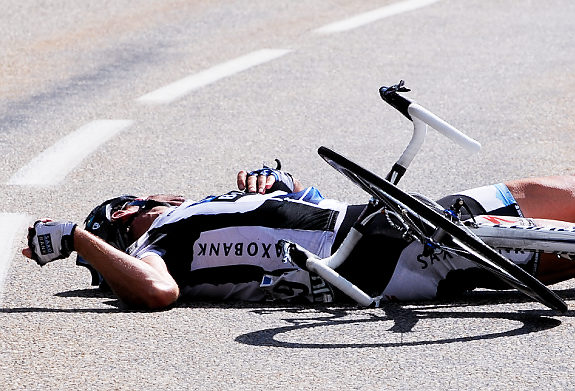
Jens Voigt on the ground after his crash. Source: NYDailyNews
What separates those who can get back on the bike, and those who just walk away? The answer is probably different for every person, but I’m going to tie it directly to one of the skills required for success in the capital markets- DISCIPLINE. The type of person who can get up after a bicycle crash is the same type of person who can recover from a setback in the market. The determination and willpower necessary to recover and excel professionally after this type of crash is not superhuman-we all do it when we are first learning to ride a bike. This type of behavior is not to be confused with blind faith or sheer stupidity. Each time you get back on the bike you try to do things a little better than last time, but you have a strong underlying belief that you can learn to ride successfully because you see others who have learned how to ride.
Now consider a time-tested investment strategy like relative strength that has outperformed for decades – do you just walk away from your strategy after hitting the pavement? Or do you shake yourself off, collect your senses, and get back on the road? The drive to succeed is a matter of temperament and must come from within. A systematic process can only do so much to help you with this decision…anyone can just quit and go home.
If we’re working on being smart while operating within the capital markets, discipline alone will not carry you to finish line. It’s the whole package – knowledge, discipline, and patience – that are going to guide you successfully. Crashes are always just around the corner. Crashes happen. It’s your job as an advisor to be ready to deal with them.
Final Thought: One of the more interesting bits in the article highlights how Voigt went back over the tapes again and again to try to figure out “what he did wrong.” In the end, his tire slipped on road paint and he was face-first on the ground within half a second. There was literally nothing he could have done to prevent the crash. That’s often the case in markets as well. You can’t always prevent it, so you’ve got to be prepared to deal with it and get back on the bike.


