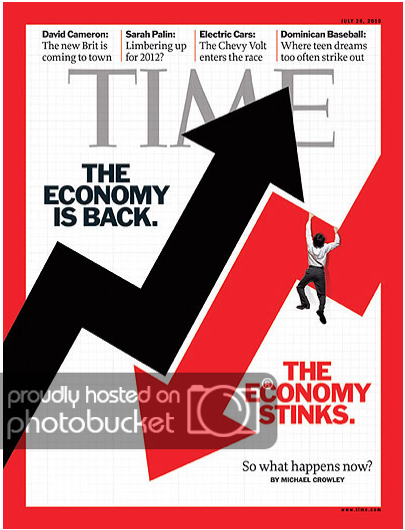
The current cover of Time magazine does a nice job of capturing the level of uncertainty that currently exists about the direction of the economy. The same cover would be just as timely if the word “economy” were replaced with “stock market.” So what happens now?
Every time that there seems to be an unusually large degree of uncertainty about the direction of the economy or stock market, the natural reaction for many is to seek “expert” opinion. Richard Ferri’s recent article in Forbes should make you think twice before getting too excited about what the “experts” think is in store for the economy or stock market in the months and years to come.
Truth be told, market predictions aren’t about the markets; they’re about marketing. By predicting markets, the gurus provide the illusion of skill and knowledge, and that brings attention to whatever service they’re selling. This is especially true if a guru makes an outrageous market prediction that actually comes true. People tend to remember the one big call and overlook a guru’s dismal long-term track record. Is there hope of finding a guru that actually has market timing skill? Sure there is. Anything’s possible. It’s possible that some guru someplace has forecasting powers, just like it’s possible that space aliens will send giant cockroaches to eat the Earth. It’s just not probable.
A behavioral economist could very easily explain why my plea to pay no attention to investment gurus will fall on deaf ears (it’s emotionally satisfying for an investor to rely on expert opinion so that it is no longer their fault if things don’t work out). Another explanation, could simply be that many are unaware of the poor track record of forecasters.
For those of us who employ trend-following strategies, the name of the game is to always maintain the flexibility to adapt to new trends. Furthermore, the question isn’t whether “it” is going to go up or down because there are generally some asset classes going up, some stagnating, and some going down. Trend followers focus not on forecasting, but on execution. A behavioral economist would probably also point out that one reason someone like us may prefer to rely on systematic trend-following models is because that it is also emotionally satisfying (I can attest to the fact that it is much less stressful to manage money by strict adherence to models than by my current judgement/emotions). If reliance on guru opinion and reliance on systematic trend-following models are BOTH emotionally satisfying ways of dealing with uncertainty, doesn’t it make sense to choose the one that gives you the best probability of investment success? To help you evaluate the probabilities and performance associated with trend-following models, click here to read the white paper Relative Strength and Asset Class Rotation, written by one of our portfolio managers, John Lewis.


 Posted by Andy Hyer

