CXO Advisory has a nice review of a study of the German stock market, which looked for universal factors that served as a source of return. Here is their summary:
“The Cross-Section of German Stock Returns: New Data and New Evidence” informs beliefs as follows:
- There is no basis for belief that stock beta or firm size predict future returns.
- There is some basis for belief that book-to-market ratio predicts future returns.
- There is strong basis for belief that momentum predicts future returns.
Not surprisingly, relative strength (known to academics as momentum) was the strongest return factor, outperforming value. (Book-to-market ratio is a value factor and that seemed to have some predictive ability as well. The best mix was stocks with good momentum that were also inexpensive.) Below you can see the returns of each factor by decile.
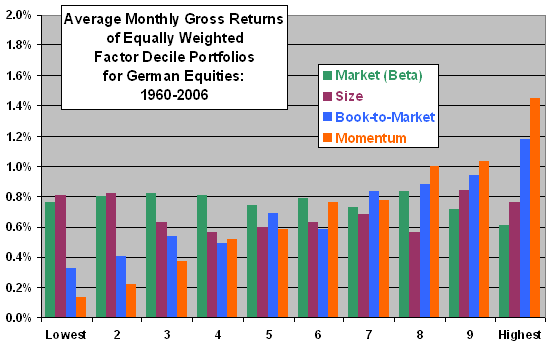
Source: CXO Advisory (click to enlarge)
The picture shows very graphically what we find over and over–most of the excess returns in every factor come from the top couple of deciles. In other words, most of the returns come at the extremes. If you try to buy middle-of-the-road value stocks, it is likely not going to work. The same thing is true of relative strength. It’s important to hold assets with powerful relative strength characteristics. The biggest benefit of a systematic approach is that it forces our portfolios to hold these outliers, however uncomfortable it may feel.
One of the reasons that it is difficult for investors to outperform indexes is the psychological discomfort entailed by holding stocks at the extremes. No one wants to own stocks that have already gone up a lot (high relative strength) or stocks that are financially impaired or teetering on the edge of bankruptcy (deep value stocks). Instead, they prefer to own something that seems safer. Hence, the premium returns of stocks in the top couple of deciles persist. Dozens of studies show exactly where the excess returns are–investors are just unwilling, for the most part, to do what is necessary to take advantage of them.








[…] two types of investors make money over time…value investors and momentum investors. Why? Because they’re willing to act when most aren’t. Their success […]
[…] our plan take its course. This is SO much harder to do than to say, which is why the edges of momentum and deep value […]
[…] to trend. There is a reason deep value and momentum, despite totally different tactics, remain consistent sources of alpha. var wordpress_toolbar_urls = […]
[…] doubt is the best recipe for profits, and is the bridge to all successful styles. Value and relative strength have proven to be the two most consistent ingredients to market success, because the psychology […]