Trend Following: Conceptually Simple, but Effective

September 20, 2010

Strong trends seem to always be surrounded by controversy. The current debate about the strength of the Japanese yen is no exception. The debate has become even more interesting over the past week as Japan has intervened in the currency markets in an attempt to halt the rise of the yen, which is causing problems for their export-reliant economy.

As shown in the chart below, the CurrencyShares Japanese Yen Trust (FXY) is currently +8.19% so far in 2010.

Many of the arguments on both sides of the debate were summarized in a recent Wall Street Journal article, “Bank of Japan’s Maverick Move Not a Sure Bet” on 9/16/2010.

It was noted that on Wednesday, 9/15, there was a wave of foreign-exchange market intervention by Japan estimated at $20 billion which sent the dollar sharply higher against the yen. However, it was also noted that currency trading is now a daily $4 trillion affair and that the daily trading in the dollar-yen market alone is now $568 billion. So, how much effect is the intervention of the Japanese government going to have in reversing the trend of their currency?

Among the arguments for why the yen will continue to appreciate is the fact that China is now buying Japanese bonds. Furthermore, last time Japan intervened in the currency markets in 2004 it pumped 35 trillion yen into the markets, or about $320 billion in exchange rates at the time. In the end, intervention changed little, with the yen trading roughly where it did at the start of the operation. However, in 1995 when the yen hit a high of 79.75 against the dollar, Japan also intervened. Within a month the yen had weakened 8% and by the end of 1995 it had weakened 23%. Hmm, so there have been times when Japanese intervention seems to have been effective and times when it seemed to have little effect. Which will it be this time? There are many other factors at play, including the political pressure that Japan may receive from other members of the Group of Seven richest economies, of which Japan is a member, to refrain from currency intervention since nobody seems to want a strong currency.

This is just the another example of the complexity of issues surrounding strong trends. Trying to trade them as if you were judging a debate is likely to result in total frustration. There are so many influences on the supply and demand relationship that it is nearly impossible to give adequate weight to each of the factors at play and then to properly manage the trade.

Trend followers take a much more pragmatic approach: Stay with strong trends as long as they remain strong and exit the trade when the trend sufficiently reverses. Conceptually simple, but effective.


Emerging Markets

September 20, 2010

While the dominant form of indexing remains cap-weighted-indexing (for now), companies like PowerShares have revolutionized the concept of indexing by bringing to market a number of ETFs based on alternatively-weighted Indexes. Among those ETFs currently in the market that offer an alternative approach to weighting an index is our own line-up of relative strength-weighted Technical Leaders ETFs (PDP, PIE, and PIZ).

All of our Technical Leaders ETFs are having a very good 2010. In particular, the PowerShares DWA Emerging Markets Technical Leaders ETF (PIE) is well ahead of its benchmark this year.

A review of the top country allocations for PIE provides insight into how it has been able to stand apart from its benchmark (large overweights in Malaysia, and Indonesia, while being underweight China).

More information about PIE can be found at www.powershares.com. Past performance is no guarantee of future returns.

*FXI, EIDO, EWM, EWY are used for reference.


What’s Your Retirement Number?

September 17, 2010

Once in a while, I think it is important to revisit our touchstone in the financial advisory business-what is the point of investment management in the first place? I’ve always looked at it as a way to make our clients’ dreams come true, not necessarily in the fantasy sense, but in terms of being financially comfortable and having the freedom not to worry about money constantly. Surveys indicate that the main reason investors save is to meet their retirement goals. Of course, there are often other goals along the way, like buying a house or getting the kids through college, but retirement is the Big Kahuna.

How paradoxical is it, then, that Americans do such a lousy job saving for retirement? According to a recent article on MarketWatch, the current gap between what Americans will need to retire and what they have actually saved is a staggering $6.6 trillion dollars. Yes, trillion with a T. Suddenly saving and getting good investment advice seems a lot more important!

Part of the reason the gap is so big is that most investors never bother to calculate how much money they might actually need to retire! According to Retirement Investigator:

…if you are like 58% of active workers, you haven’t. That’s right, 58% of workers have NEVER tried to calculate what they need to save for a comfortable retirement…

And “only 42% of active workers have ever tried to calculate how much they need… and 8% of those admitted they arrived at their answer by guessing,” reported National Underwriter on April 24, 2006.

For whatever reason, trying to figure out a retirement number must be either baffling or terrifying to investors. (Or maybe they just find it amusing. ING has developed an entire advertising campaign around “the number,” with individuals walking around with bright orange numerical plaques.)

Source: Adrant

I will de-mystify the process and show a couple of simple calculations to arrive at your retirement number, depending on whether you want to be conservative or minimalist in your estimate. First, let’s define our terms. When I am talking about a conservative approach to a retirement number, I am talking about the pool of capital that would be required to support your required spending on a sustainable basis, while attempting to leave the original capital intact. A minimalist approach simply assumes, as the study in the MarketWatch article did, that you convert all of your savings to an immediate annuity.

Sustainable spending is a tricky concept. Dozens of studies have been performed on historical data that suggest that the proper spending rate is 3 to 5%. A lot of endowments use 4%, for example. In reality, I think the sustainable spending level depends quite heavily on financial conditions at the time. A stock market with a 6% dividend yield is going to support more spending than a market yielding 3%. In other words, I tilt toward a relative calculation first developed by James Garland. He shows that you can generally spend more than just your dividend and interest income, but far less than your total earnings yield. His rule of thumb is that sustainable spending is about 130% of the yield on the major stock indexes. (You can use this link to find the current dividend yield on the major stock indexes.) The current yield on the S&P 500, for example, is now 2.02%, so 130% of that number would be 2.626% (2.02 x 1.3 = 2.626). Garland’s sustainable spending rule will form the basis for our conservative estimate.

The basis of every retirement number is income. The easiest way to calculate a retirement number is to determine what income you need in retirement and work backward from there. Let’s say that you would like to have an income of $50,000 in retirement, in today’s dollars. The calculation of the conservative retirement number is straightforward. First, find your multiplier by dividing your sustainable spending level into 100. At the current time, that would be about 38 (100 / 2.626 = 38.080731). Your retirement number is simply your desired income times the multiplier, which in the example would amount to $1.9 million ($50,000 x 38). This calculation gives you the amount in today’s dollars. You can either adjust it upward for inflation to get a future dollar number, or you can use real returns (nominal returns minus inflation) to determine if you are on track on not. Morningstar’s savings calculator is easy to use. There are literally hundreds of others on the web.

The minimalist approach is a little different. It assumes that you will take all of your savings and convert it to an immediate annuity. In this approach, you aren’t worried about dipping into principal-in fact, you’re liquidating it. On the plus side, it allows you generate more income with the same amount of capital. Again, the easiest way to do this is to back into the number. I used one of the popular annuity websites to do this calculation, assuming a 62-year-old couple in Richmond, Virginia. The desired monthly income would be $4,167 , which is equivalent to our earlier annual income of $50,000. The day I ran it, annuity rates were such that I got a quote for a single-life annuity with no payments to beneficiaries for $707,351 at the low end, all the way up to a joint life annuity with a minimum 20-year payment period for $888,741 at the top end. (Every annuity company will have different rates and some have different income options, including income that grows with inflation.)

What did we learn from this little exercise?

1) Retirement requires a lot of money! We determined that supporting $50,000 of spending requires a capital pool of $700,000 to $1.9 million. If you fiddle around with one of the many retirement calculators for a while, you will quickly realize that…

2) You need a high savings rate to get to your retirement number. Putting a 3% contribution into your 401k isn’t going to do it. Think about 15% as a starting number. Without savings to work with, no amount of investment management can help you.

3) Compounding makes a big difference too. The earlier you start, the more years you have to compound. And your assets will compound much faster when your investment return is high. As you play around with a retirement calculator, it becomes clear that you have to…

4) Invest for growth. Here, we finally get back around to why investment management is important. Low rates of return that barely offset inflation, sustained over long periods of time, will not allow you to reach your retirement number. Nope-you’re going to have to figure out how to intelligently expose your portfolio to return factors (and risk) that will allow you to compound at rates far above inflation, at least for an accumulation portfolio. (Perhaps your risk exposure will need to be reduced when you transition to a distribution portfolio, but that’s another discussion.)

Any proven return factor, rigorously executed, will give you a decent chance of reaching your goals, but we tilt toward a relative strength approach. It has been shown to work within markets-and also across markets and asset classes. That flexibility may prove to be critical in a world where many of the best investment opportunities may not be in the U.S., or maybe not even in equities at all. Relative strength is possibly the most adaptable tool in the investment toolkit.


Sector and Capitalization Performance

September 17, 2010

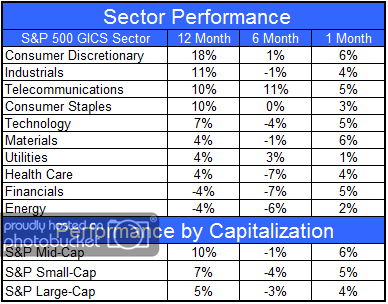
The chart below shows performance of US sectors and capitalizations over the trailing 12, 6, and 1 month(s). Relative strength strategies buy securities that have strong intermediate-term relative strength and hold them as long as they remain strong. Performance updated through 9/16/2010.


Fund Flows

September 16, 2010

The Investment Company Institute is the national association of U.S. investment companies, including mutual funds, closed-end funds, exchange-traded funds (ETFs), and unit investment trusts (UITs). Members of ICI manage total assets of $11.82 trillion and serve nearly 90 million shareholders. Flow estimates are derived from data collected covering more than 95 percent of industry assets and are adjusted to represent industry totals.

Taxable bond funds have now had inflows of over $189 billion for the year– dwarfing the flows into municipal bonds, hybrids, and foreign equity funds. Domestic equities continued to lose money last week, but the size of the withdrawals were cut by more than half on a weekly basis.


High RS Diffusion Index

September 15, 2010

The chart below measures the percentage of high relative strength stocks that are trading above their 50-day moving average (universe of mid and large cap stocks.) As of 9/14/10.

The 10-day moving average of this indicator is 83% and the one-day reading is 92%. This oscillator has shown the tendency to remain overbought for extended periods of time, while oversold measures tend to be much more abrupt.


Conflicting Ideas and Confused Investors

September 14, 2010

One of the big stories in today’s news cycle is a major poll conducted by AP and CNBC which purports to show that a majority of US stock investors are wary of the stock market, market participants, and government regulators. In short, all market participants get a bad rap, which is why Joe Investor has been piling into bonds over the last two to three years.

The poll focused on stock, mutual fund, and bond owners in the US, and not surprisingly, “more than 60 percent of those surveyed said they had paid attention to news reports about swings the stock market.” What could this lead to?

Perhaps as a result, investors have been moving their money away from stocks and into bonds, which are generally more conservative investments and less volatile.

One participant interviewed explained, “It’s just a gut feeling.” And so it goes! The poll data highlights a broad market sentiment dominated by fear, which we’ve gone over in our own Dorsey Wright Client Sentiment Survey series.

So, we have a situation where regular investors are reading the news and jumping ship into the perceived safety of bonds. However, by digging deeper into this poll we’ll see a more complicated situation: a confused investor who is out of touch with the facts, and acting upon conflicting impulses and advice.

Let’s get to the meat.

Nearly 80 percent of those surveyed said the best way to make money in the stock market is to buy stocks and hold them for a long time before selling.

Eighty percent of regular market participants *know* that the best bet is to sit tight…yet everyone is piling into bonds based on gut feelings! I’ve written about this phenomenon before – when someone does something that they know is bad for them, yet continue to do so. What’s even more problematic is that the mere act of informing someone that their behavior has negative consequences can lead to reinforcement of the offending behavior. It’s a dirty game!

What are the big takeaways of the poll results?

  • Average investors are extremely distrustful of the market and market participants (including regulators)
  • Net worth plays a big role in shaping an individual’s market perception
  • Emotions trump data

It’s the last point that needs to be hammered home again and again. On the one hand, investors know the facts – they know emotional decisions hurt long-term performance because 80% have accepted the data. And on the other hand, these same investors keep making the same mistake over and over again. The bond flows paint a gruesome picture: investors are afraid of losing their money and are jumping into bonds as a result of how they feel (fear and pain), not what the data shows (don’t make decisions based on fear and pain).

It’s up to you, the client’s financial advisor, to remain above the fray and to keep your client’s emotional proclivities in check. Good luck!


Relative Strength Spread

September 14, 2010

The chart below is the spread between the relative strength leaders and relative strength laggards (universe of mid and large cap stocks). When the chart is rising, relative strength leaders are performing better than relative strength laggards. As of 9/13/2010:

For an indicator that has at times shown quite a bit of volatility, the RS Spread hasn’t hardly budged in over a year. What does it mean? I don’t know for sure, but it could simply be a reflection of high degree of uncertainty that persists in the financial markets. The last two years have been crammed full of regulatory changes, uncertainty over future tax policy, and healing from the credit crisis of 2008. It is quite possible that the pace of regulatory changes will slow in the coming years, tax policy will be resolved, and business will have a better idea of the rules that they will need to play by-all of which bode well for more sustainable market leadership.


Weekly RS Recap

September 13, 2010

The table below shows the performance of a universe of mid and large cap U.S. equities, broken down by relative strength decile and quartile and then compared to the universe return. Those at the top of the ranks are those stocks which have the best intermediate-term relative strength. Relative strength strategies buy securities that have strong intermediate-term relative strength and hold them as long as they remain strong.

Last week’s performance (9/6/10 – 9/10/10) is as follows:

Performance for the universe of U.S. mid and large cap stocks was essentially flat for the week with little distinction in performance between each of the relative strength deciles and quartiles.


Dorsey, Wright Client Sentiment Survey - 9/10/10

September 10, 2010

Here we have the next round of the Dorsey, Wright Sentiment Survey, the first third-party sentiment poll.

As you know, when individuals self-report, they are always taller and more beautiful than when outside observers report their perceptions! Instead of asking individual investors to self-report whether they are bullish or bearish, we’d like financial advisors to weigh in and report on the actual behavior of clients. It’s two simple questions and will take no more than 20 seconds of your time. We’ll construct indicators from the data and report the results regularly on our blog–but we need your help to get a large statistical sample!

Click here to take Dorsey, Wright’s Client Sentiment Survey.

Contribute to the greater good! It’s painless, we promise.


Sector and Capitalization Performance

September 10, 2010

The chart below shows performance of US sectors and capitalizations over the trailing 12, 6, and 1 month(s). Relative strength strategies buy securities that have strong intermediate-term relative strength and hold them as long as they remain strong. Performance updated through 9/9/2010.


Economist Food Fight

September 9, 2010

There is a fierce, ongoing debate about the prospects for inflation or deflation. This article in the New York Times discusses the economic divide that still persists between Morgan Stanley and Goldman Sachs on this issue. (They could both be right, depending on the time frame.)

According to the deflationistas, as they are nicknamed, a new round of stimulus spending by Washington is urgently required to stave off a Depression-like cycle of falling prices and wages that is difficult to reverse once it is set in motion.

Inflationistas, by contrast, worry more about the effect that additional government borrowing could have on the recovery. With the budget deficit expected to hover around $1 trillion a year for the next decade, they say, interest rates could eventually surge, making borrowing — and goods — more expensive. A double dip, they say, is highly unlikely.

Regardless of how things eventually turn out, guidance from major firms often influences the investment policies of their clients and the broader constituency across Wall Street. The market is unsettled right now in part because these two views could lead to very different portfolios to cope with the expected environments.

The beautiful thing about relative strength is that it does not have to take philosophical sides-it will simply go with the assets that are strongest. Right now, our Global Macro portfolios actually have a bizarre mix of traditional inflation and deflation assets. Eventually one side of the argument will overwhelm the other, but it’s good to know that relative strength will always lean to the winning side.


Investors Behaving Badly

September 9, 2010

Great articles on investor behavior never get old! Carl Richards discusses the seemingly intractable problem in the New York Times. His first prescription is to notice the behavior in ourselves-always good advice.

When it comes to investing, the tendency to behave badly is not going away.

So what do we do about it?

1. Admit it. Like any destructive behavior that first step to fixing it is to admit that there is a problem in the first place. Being honest with yourself and reviewing past decisions will help:

  • Did you get caught up in the tech bubble in 1999?
  • Real estate in 2006?
  • Did you sell in 2002, late 2007, or early 2008?

The reality is that most of the money is made during the implementation and execution of a systematic plan to exploit a known return factor like relative strength. Finding the return factor is just the first step. Execution is what is crucial-and key to good execution is not letting one’s emotions undermine the whole enterprise.


Understanding Financial Markets

September 9, 2010

Judging from their investment results, retail investors do not understand financial markets. In part this may be because financial markets do not operate exactly like markets for consumer goods, with which they may be more familiar. A recent article in The Economist discusses this difference:

Financial markets do not operate in the same way as those for other goods and services. When the price of a television set or software package goes up, demand for it generally falls. When the price of a financial asset rises, demand generally increases.

Why the difference? The reason is surely that goods and services are bought with a specific use in mind. Our desire for them may be driven by fashion or a desire to enhance our status. But those potential qualities are inherent in the goods themselves—the sports car, the designer sunglasses, the fitted kitchen. Such goods may be means to an end but the nature of the means is still important.

Financial assets appeal for one reason only: their ability to enhance, or conserve, the buyer’s wealth.

I’ve added the bold type, because I think this is generally something that is difficult for novice investors to grasp. Supply and demand is still in effect, of course, but financial markets operate differently in terms of inducing the demand. The practical implication is that it is useful in financial markets to think in terms of “strong” and “weak” assets, which is exactly what relative strength quantifies.


Fund Flows

September 9, 2010

The Investment Company Institute is the national association of U.S. investment companies, including mutual funds, closed-end funds, exchange-traded funds (ETFs), and unit investment trusts (UITs). Members of ICI manage total assets of $11.82 trillion and serve nearly 90 million shareholders. Flow estimates are derived from data collected covering more than 95 percent of industry assets and are adjusted to represent industry totals.

Taxable bond funds have now had inflows of over $189 billion for the year- dwarfing the flows into municipal bonds, hybrids, and foreign equity funds. On the losing end has been domestic equity funds with redemptions of over $50 billion for the year.


Bank of England Endorses Trend Following!

September 8, 2010

I confess to drastically overstating the case to get your attention. But Andrew Haldane is an economist at the Bank of England. He recently gave a speech on Patience and Finance, which was commented on by Gavyn Davies in the Financial Times. Mr. Haldane made some comments about the puzzling success of trend following strategies versus using value, summarized by Mr. Davies:

Andy Haldane conducts the following experiment. He estimates the results of an investment strategy in US equities which is based entirely on the past direction of the stockmarket. If the market rises in the period just ended, the strategy buys stocks for the next period, and vice versa. In other words, the strategy simply extrapolates the recent trend in the market. The result? According to Andy, if you had been wise enough to start this procedure with $1 in 1880, you would have consistently shifted in and out of stocks at the right times, and you would now possess over $50,000. Not bad for a strategy which could have been designed in a kindergarten.

Next, Andy tries an alternative strategy based on value. This calculates whether the stockmarket is fundamentally over or undervalued, and buys the market only when value gives a positive signal. The criterion for measuring value is the dividend discount model, first devised by Robert Shiller. If you had been clever enough to devise this measure of value investing in 1880, and had invested $1 at the time, the procedure would have left you with a portfolio now worth the princely sum of 11 cents.

I am sure that fundamentalists will argue that this particular value strategy is far too simple, and that other ways of using the Shiller p/e or alternative measures of value would produce much better results. That may be the case, but it does not detract from the fact that a very basic momentum-based technique seems to work very well indeed. And that should not be true if you believe in the efficiency of capital markets.

I’m not too surprised by the good performance of the trend following strategy (but I am shocked by the terrible, terrible performance of the dividend discount model). Clearly, there is some universal characteristic that is being captured in the momentum factor. Maybe it is something psychological like investor confidence, or perhaps it is closely related to the underlying fundamentals and the business cycle.

As Mr. Davies points out, this observation is very problematic for efficient markets and Modern Portfolio Theory. The whole rise of passive investing-using index funds and giving up on picking stocks-is based on the assumption that markets are efficient. I see this indexing approach extolled for individual investors all the time now. However, if markets are not efficient, for whatever reason, passive investing is bunk.

I have to come down on the bunk side of the ledger. The momentum anomaly is far too well-established for claims that passive investing is the only thing that makes sense. Whatever the underlying process is, it has worked since 1880-and continues to work today. (Some of our published research shows that models written about almost 40 years ago still generate a similar level of excess return in today’s markets, so it’s not simply a case of the anomaly being unknown.)

Instead, why not act to take advantage of relative strength as a return factor? Maybe trend following powered by relative strength is finally coming into its own.


“Time To Grab A Piece Of PIE?”

September 8, 2010

Benzinga takes a closer look at PIE today:

For all the fanfare that emerging markets ETFs get, there are still a few that fly under the radar. One such example is an interesting play, the PowerShares DWA Emerging Markets Technical Leaders ETF (NYSE: PIE).

Nearly three years old, PIE tracks the Dorsey Wright Emerging Markets Technical Leaders Index, which follows about 100 stocks.

About half of PIE’s allocation is to large-caps and mid-caps gets about 40% of the ETF’s weight with the rest going to small-caps.

Explaining why PIE doesn’t grab a lot of press is difficult. After all, the volume (over 241,000 shares per day average) and the assets under management (almost $144 million) are sufficient and certainly don’t put the ETF in danger of disappearing.

The ETF is a fine idea for the investor that can’t decided on a country-specific ETF because PIE devotes double-digit allocations to Malaysia, South Korea and Indonesia and will give you decent exposure to China and Mexico, among others.

At over 18%, financials lead the way in terms of sector allocation, followed by consumer staples (16.4%), industrials (14.4%) and consumer discretionary (12%).

PIE isn’t all that volatile compared to other emerging markets fare, but to be really bullish, you’ll want to see the ETF string together several closes above $16. If you’re willing to hold PIE for a year, you could rip another 20% out of it from here.

Click here for more information about the PowerShares DWA Technical Leaders ETF (PIE).


Emerging Markets: “Poised To Account For An Ever-Larger Cut”

September 8, 2010

If Goldman Sachs’ predictions about the future growth of emerging markets are remotely right, PIE could be an increasingly useful way to access this market (see Taking Stock: Equity Will Survive This Tiring Bout, Dow Jones Newswire, 9/8/2010).

Goldman suggests total world equity market capitalization could stagger up to $83 trillion dollars by 2020 and on to $146 trillion by 2030. That’s from the comparative bagatelle of $43 trillion now.

Unsurprisingly, the total is going to get bigger largely thanks to the emerging markets, which are also of course poised to account for an ever-larger cut. Emerging-market equity cap could increase from $14 trillion now to $37 trillion in 2020 and $80 trillion in 2030, the bank says.

Goldman thinks funds could purchase $4 trillion of emerging-market equities over the next 20 years, and this figure could be twice as large with only moderately higher underlying assumptions.

Click here for more information about the PowerShares DWA Emerging Markets Technical Leaders ETF (PIE).


High RS Diffusion Index

September 8, 2010

The chart below measures the percentage of high relative strength stocks that are trading above their 50-day moving average (universe of mid and large cap stocks.) As of 9/7/10.

The 10-day moving average of this indicator is 64% and the one-day reading is 84%. This index has rebounded sharply from the oversold levels of May-July of this year.


Using Momentum To Help Mitigate Risk

September 7, 2010

Writing in Pensions & Investments magazine, Khalid Ghayur summarizes the merits of combining momentum and value strategies:

While research has shown that value stocks outperform the market over the long run, value strategies can underperform significantly during shorter periods. Capturing the full extent of value returns requires a long-term commitment on the investor’s part. However, periods of pronounced underperformance often negatively affect investors’ ability to “stay the course.”

Our research documents that a highly diversified strategy that combines value stocks with high price-momentum stocks (i.e., stocks with a high trailing 12-month total return) offers important risk reduction benefits to investors. It allows investors to stay invested for the long term by significantly mitigating potential underperformance in the short term.

Academic research has documented that value and momentum have provided significant market outperformance, or active returns, over the long run. Value and momentum are powerful and persistent sources of active returns, as depicted in the chart below.

My emphasis added. We’ve written a lot in the past about what a good portfolio mix relative strength and momentum make together. This article just makes the same point. There’s another important issue embedded in his article that ought to be of interest to advisors still using style boxes. He mentions that “momentum serves as a better diversifier to value than growth.” In terms of portfolio construction, you may be better off with value and relative strength than with value and growth. This viewpoint is likely to become more widespread, because as Mr. Ghayur points out:

Not surprisingly, Morningstar Inc. recently announced it soon will begin giving stocks a momentum score and then use it to give mutual funds a momentum ranking. This may ultimately lead to a new momentum investment style category for mutual funds.

Why wait for a mutual fund? You can be the first advisor on your block to use our already-available Systematic Relative Strength portfolios, which are separate accounts designed to capture momentum returns. Alternatively, there are three PowerShares Technical Leaders indexes designed to capture momentum returns. I must admit, though, that it’s nice to see industry leaders like Morningstar coming around to our point of view!

To receive the brochure for our Separately Managed Account strategies, click here. More information about PDP can be found at www.powershares.com.

Click here for disclosures. Past performance is no guarantee of future returns.

Click here to read the entire article, including the results of combining a value and momentum strategy from 1940-2009.


Dorsey, Wright Sentiment Survey Results - 8/27/10

September 7, 2010

Our latest sentiment survey was open from 8/27/10 to 9/3/10. We saw a solid uptick in the response rate, with 159 readers participating. Your input is for a good cause! If you believe, as we do, that markets are driven by supply and demand, client behavior is important. We’re not asking what you think of the market—since most of our blog readers are financial advisors, we’re asking instead about the behavior of your clients. Then we’re aggregating responses exclusively for our readership. Your privacy will not be compromised in any way.

After the first 30 or so responses, the established pattern was simply magnified, so we are comfortable about the statistical validity of our sample. Most of the responses were from the U.S., but we also had multiple advisors respond from at least two other countries. Let’s get down to an analysis of the data! Note: You can click on any of the charts to enlarge them.

Question 1. Based on their behavior, are your clients currently more afraid of: a) getting caught in a stock market downdraft, or b) missing a stock market upturn?

Chart 1: Greatest Fear. Despite this week’s rally, client fear continues to dominate our broad sentiment index. 94% of clients were fearful of a downdraft, nudging higher from last survey’s 93%. In the previous survey, fear nudged up by the same amount; we remain just off the all-time highs of fear sentiment. The market has staged a respectable bounce over the week the survey was out. It will be interesting to see if the market can hold up, and what, if any, the effect will be on client sentiment.

Chart 2. Greatest Fear Spread. Another way to look at this data is to examine the spread between the two groups. The spread remains significantly skewed towards fear of losing money this round. This survey’s reading was 89%, a step higher than last week’s reading of 86%. It seems like the spread is inching higher and higher as the market fumbles around. Eventually this trend will have to pull back, and it’s just a matter of time before that happens.

Question 2. Based on their behavior, how would you rate your clients’ current appetite for risk?

Chart 3: Average Risk Appetite. Average risk appetite has been trading within a fairly steady range since the end of May, pointing to a long-term patten of low-risk tolerance during times of heightened market uncertainty. Right now the average risk appetite for all participants is 2.03, just down from last week’s reading of 2.10. The average risk appetite slow-march towards zero risk is highlighted here.

Chart 4: Risk Appetite Bell Curve. This chart uses a bell curve to break out the percentage of respondents at each risk appetite level. Right now the bell curve is biased to the low-risk side, as it has been for the few months. What we see in the bell curve is more evidence that clients are afraid of losing money in the market. This week we had zero respondents whose clients would be considered a 5, which is “Take Risk.”

Chart 5: Risk Appetite Bell Curve by Group. The next three charts use cross-sectional data. This chart plots the reported client risk appetite separately for the fear of downdraft and for the fear of missing upturn groups. We would expect that the fear of downdraft group would have a lower risk appetite than the fear of missing upturn group and that is what we see here.

Chart 6: Average Risk Appetite by Group. A plot of the average risk appetite score by group is shown in this chart. These readings come exactly into line with what we’ve noticed before. The downturn group’s average risk appetite clocked in at 1.99, while the upturn group’s came in at 2.67. In both instances, the average risk appetite moved lower from last survey to this one. It seems like across the board, all of our sentiment indicators are creeping towards fear and reducing risk. It’s just a question of how low it can go, and how long it will stay there.

Chart 7: Risk Appetite Spread. This is a spread chart constructed from the data in Chart 6, where the average risk appetite of the downdraft group is subtracted from the average risk appetite of the missing upturn group. The spread is currently .67, down from last week’s .85. We see here again that the upturn group has a more volatile risk appetite, while the fearful clients have been staying around an average of 2.0 for nearly the entire summer.

This survey’s responses sync up nicely with our previous data. As the market continues to chop and grind lower, clients edge closer to being fully risk-averse. The market rallied big in the middle of the week to start September, which could lead to some discrepancy in the reading. Most of our respondents came early in the week, so this round really doesn’t incorporate the rally. However, who’s to say that a bounce would get anyone back in the market? In our last two surveys we’ve discussed how much of a rally it’s going to take to get Joe Investor back in the market…it’s likely to take a lot more than a solid bounce that has lasted half a week thus far. Hopefully the market will make a move out of its tight range in the latter half of the year, and we’ll get to see how that move affects our sentiment numbers.

No one can predict the future, as we all know, so instead of prognosticating, we will sit back and enjoy the ride. A rigorously tested, systematic investment process provides a great deal of comfort for clients during these types of fearful, highly uncertain market environments. Until next time, good trading and thank you for participating!


The New 800-Pound Gorilla in the Room

September 7, 2010

Somewhat mysteriously, the yen has been incredibly strong. Often a strong currency is the result of powerful economic growth, resulting in high interest yields for investors. That’s not the case with Japan right now-their economy is still slogging along in what seems like a never-ending alternation between recession and very slow growth that’s been going on since 1989 or so.

But as you can see for yourself in this chart of FXY, the yen is rocketing.

Source: Yahoo! Finance

So where is all the demand coming from? China, according to this article on Reuters. China has $2.4 trillion in foreign reserves and they’re using some of it to buy Japanese bonds. China is now the supplier of capital to the world-it’s the 800-pound gorilla in the room now, not the U.S. The U.S. doesn’t have $2.4 trillion in reserves-in fact, it has no reserves at all. If the U.S. government wants to spend, it has to borrow the money. The world has changed and your investment policy needs to keep up.

Capital flows matter. It’s often more important to pay attention to price action than to macro-economic factors. If the forecaster is lucky or good, the macro factors might have the predicted effect; price is an established fact.

Systematic application of relative strength relies completely on price-no guessing involved. Price isn’t perfect, but it’s often a lot less flawed than the alternatives.


Relative Strength Spread

September 7, 2010

The chart below is the spread between the relative strength leaders and relative strength laggards (universe of mid and large cap stocks). When the chart is rising, relative strength leaders are performing better than relative strength laggards. As of 9/3/2010:

The RS Spread remains fairly flat for now. However, the RS Spread is currently above its 50 day moving average.


Weekly RS Recap

September 7, 2010

The table below shows the performance of a universe of mid and large cap U.S. equities, broken down by relative strength decile and quartile and then compared to the universe return. Those at the top of the ranks are those stocks which have the best intermediate-term relative strength. Relative strength strategies buy securities that have strong intermediate-term relative strength and hold them as long as they remain strong.

Last week’s performance (8/30/10 – 9/3/10) is as follows:

Stocks had a very strong week last week with the universe benchmark gaining 4.29%; even better performance came from those stocks with the weakest relative strength characteristics.


Who Makes Money In The Markets?

September 3, 2010

Derek Hernquist on who makes money in the markets:

Who makes money in the markets? Sometimes it’s the guy with the opinion, and he gets books written about him like John Paulson. Good for him…I think it was more about the low risk/high reward purchase he made on those credit default swaps, but his prediction paid off.

Generally two types of investors make money over time…value investors and momentum investors. Why? Because they’re willing to act when most aren’t. Their success doesn’t hinge on predicting an outcome…it hinges on someone later paying a much higher price than you pay now. The value investor scours the balance sheet, develops a thesis on what “fair value” is, and if it’s well enough below, buys the stock and waits. If fundamentals improve, it’s a home run instead of a double…but the payoff is not contingent on that outcome.

On the other spectrum, the momentum investor looks at rising price or explosive growth and joins in…seems silly, but since most are afraid to pay up there’s actually only a small % of participants aboard. He’s not making a prediction, he’s making an observation…this thing is going up, and I’m going to be involved until it stops going up. Simple, but often effective as most are too worried they missed the boat already…how many people do you know that have actually owned NFLX or CRM or BIDU for more than a week?

Full disclosure: Dorsey Wright owns NFLX, CRM, and BIDU.