Thousands of New Manufacturing Jobs Created by Intel

October 29, 2010

Of course, the jobs just aren’t in the U.S. Interestingly, they aren’t even in China. According to Forbes:

Intel Corp. inaugurated its largest chip assembly and testing factory Friday, part of a $1 billion investment in Vietnam that the company says will create several thousand skilled manufacturing jobs.

Yes, Vietnam. In Ho Chi Minh City, no less. Thirty five years ago, it was called Saigon and military helicopters were landing on the rooftop of the U.S. embassy to evacuate as many people as possible before the capital fell. Now, the chip in your next computer may be manufactured there.

Why Vietnam. Because, of course, China is too expensive!

Fast-growing Vietnam is seen by multinational corporations as an alternative to China as a base for low-cost manufacturing though it still grapples with frequent strikes, bouts of high inflation and low education standards.

Markets are global, even if your portfolio isn’t. Globalization is here and your portfolio needs to adapt.

Posted by:


Warning: Retirement Disaster Ahead

October 29, 2010

That’s the catchy title of an article in Smart Money that details the problems facing long-term investors at the present time. It draws upon calculations of long-term expected returns made by Rob Arnott of Research Affiliates. (There’s a link to the paper in the Smart Money article.) Those expected returns, in his estimation, are low, only about 2.1% per year after inflation for a 60/40 balanced portfolio. That’s too low for most pensions and individual investors to reach their goals. Arnott and his co-author, John West, point out that returns:

can only come from four things: Dividends, earnings growth, inflation and changes in valuation.

This all sounds very bleak. You can argue with their assessment of inflation, long-term earnings growth, or valuation, but that really isn’t the point. They are mathematically correct about the sources of return. However, they have slipped in another assumption without mentioning it. It is assumed that the investor will be passive.

If low returns are all that is available to a passive investor, maybe a change in approach is in order. An individual investor has no control over inflation, so that return component will be the same for everyone. Shooting for higher earnings growth makes sense-Arnott and West suggest emerging markets-but there are also dozens of excellent growth stocks in the U.S. market. Any company that is rapidly growing revenues and earnings, either on a cyclical or a secular basis, is worth a look. High relative strength, by the way, tends to identify those companies quite effectively. Another thing that may work well is a more tactical approach that rotates across global asset classes. With a strategic asset allocation, returns are always capped at the level of the best performing asset. With a relative strength-driven tactical approach, it is quite possible to perform better than the best-performing asset over time, as the investor is holding assets only during periods of strength.

There is no good reason to passively accept low returns when other approaches may be much more effective.

Posted by:


Sector and Capitalization Performance

October 29, 2010

The chart below shows performance of US sectors and capitalizations over the trailing 12, 6, and 1 month(s). Relative strength strategies buy securities that have strong intermediate-term relative strength and hold them as long as they remain strong. Performance updated through 10/28/2010.


Posted by:


Why Do We Trade Systematically?

October 28, 2010

One of the most common protests I hear while talking to advisors and clients is this:

But you’re buying stocks at the top. I want to get in at a good price.

This isn’t just a one-off either. I hear this ALL THE TIME. It feels like a comfortable argument. Why would anyone buy a stock that is extended, at the top of its range, or way above its moving averages? It takes a high degree of psychological resilience to buy stocks (and asset classes) that are making new highs all the time.

As an example, let’s take a look at a stock that we’ve owned in our SRS Aggressive portfolios since the last month of 2009. We bought FFIV at the time because it had exhibited earlier strength and was therefore ranked highly. Fast forward to the beginning of October 2010. The stock’s well up on the year, everything looks great…and then all hell breaks loose. Another company from the same “Cloud Computing” group revises its revenue downwards by a relatively small amount (click here for that day’s MarketWatch reporting).

And just like that, FFIV falls over 12% in one day! When this happens, we’ll get a few calls over the next few days which often go something like this:

Advisor: So when are we selling FFIV?

Dorsey, Wright MM: When the portfolio rules call for a sell. It still has a strong relative strength rank.

Advisor: But the stock lost 12% in a single day! How can you own the stock? I thought you only bought stocks that went up!

And so on. We continued to hold the stock, as it fell in price over the next few weeks. The stock’s relative strength ranking declinded, but not enough to eliminate it from the portfolio. All in all, FFIV fell a grand total of 20% before it hits a short-term low. How many advisors out there are willing to sit through a -20% drawdown without breaking a sweat? Not many. It’s hard for us, too.

Fortunately, our systematic process prevents us from making emotional decisions based on fear and pain. Even though the stock fell -20%, our model did not call for a sell. Did it hurt? Yes. Was it fun? No.

Click to enlarge. Source: YahooFinance

After reporting earnings on Wednesday, the stock is now hitting new highs, having recovered all of that 20% and then some. High relative strength stocks are some of the most volatile stocks on the market, and with price volatility usually comes emotional volatility. To answer the original question, we use a rigorously tested systematic process because it relieves the emotional pressure of making a painful decision.

P.S. from Mike: What J.P. is getting at here is important-the willingness to tolerate psychological discomfort. I spoke at a Morgan Stanley Smith Barney conference this week and suggested that the primary reason that excess returns from value and momentum do not get arbitraged away is because they are psychologically uncomfortable to capture. It is extremely uncomfortable to buy something that is very strong (relative strength) or very weak (value/mean reversion). It is even more uncomfortable to continue holding those positions if they are performing poorly but have not yet triggered your sell discipline. But if you want the returns from a relative strength or value strategy, you have to deal with that discomfort. (Of course, in this case, it’s nice that FFIV has worked out so far. Lots of positions don’t work out so nicely!)

Disclosure: Dorsey Wright Money Management owns FFIV in some of our portfolios & managed products. For a complete list of trades in the SRS Aggressive portfolio over the past 12 months, please direct your request to us at [email protected].

Posted by:


Fund Flows

October 28, 2010

The Investment Company Institute is the national association of U.S. investment companies, including mutual funds, closed-end funds, exchange-traded funds (ETFs), and unit investment trusts (UITs). Members of ICI manage total assets of $11.82 trillion and serve nearly 90 million shareholders. Flow estimates are derived from data collected covering more than 95 percent of industry assets and are adjusted to represent industry totals.

The pressure to pull money out of domestic equities seems to be waning in recent weeks. However, taxable bond funds continue to be the biggest recipient of new money.

Posted by:


High RS Diffusion Index

October 27, 2010

The chart below measures the percentage of high relative strength stocks that are trading above their 50-day moving average (universe of mid and large cap stocks.) As of 10/26/10.

After pulling back to the middle of the distribution in August, high relative strength stocks have moved sharply higher over the last 7 weeks and over 90% continue to trade above their 50 day moving average.

Posted by:


Relative Strength Spread

October 26, 2010

The chart below is the spread between the relative strength leaders and relative strength laggards (universe of mid and large cap stocks). When the chart is rising, relative strength leaders are performing better than relative strength laggards. As of 10/25/2010:

The RS Spread has remained relatively flat over the last year as a result of RS leaders and laggards generating similar performance. This transitional period was preceded by a sharply declining spread during the initial months of the new bull market-a time in which there were major changes in leadership. Stay tuned for what I expect will be a rising spread in the coming years.

Posted by:


Weekly RS Recap

October 25, 2010

The table below shows the performance of a universe of mid and large cap U.S. equities, broken down by relative strength decile and quartile and then compared to the universe return. Those at the top of the ranks are those stocks which have the best intermediate-term relative strength. Relative strength strategies buy securities that have strong intermediate-term relative strength and hold them as long as they remain strong.

Last week’s performance (10/18/10 – 10/22/10) is as follows:

Another strong week for high relative strength stocks with the top quartile outperforming the universe by 42 basis points and outperforming the bottom quartile by 123 basis points.


Posted by:


What’s Hot…and Not

October 25, 2010

How different investments have done over the past 12 months, 6 months, and month.

1PowerShares DB Gold, 2iShares MSCI Emerging Markets ETF, 3iShares DJ U.S. Real Estate Index, 4iShares S&P Europe 350 Index, 5Green Haven Continuous Commodity Index, 6iBoxx High Yield Corporate Bond Fund, 7JP Morgan Emerging Markets Bond Fund, 8PowerShares DB US Dollar Index, 9iBoxx Investment Grade Corporate Bond Fund, 10PowerShares DB Oil

Posted by:


DWA Poll

October 25, 2010

We recently polled users of the Dorsey Wright research database to find out how many users of the research are also using Dorsey Wright managed products. The question was:

Do you use Dorsey Wright managed products in your business? This would include any of the following: Arrow DWA Balanced Fund (DWAFX), Arrow DWA Tactical Fund (DWTFX), PowerShares Technical Leaders ETFs (PDP, PIE, PIZ), Rydex Variable Insurance Trusts (Sector Rotation or Flexible Allocation), or Dorsey Wright separately managed accounts.

There were 256 responses to this poll.

For more information:

Arrow Funds: www.arrowfunds.com

PowerShares: www.powershares.com

Rydex SGI: www.rydex-sgi.com

Separately Managed Accounts: www.dorseywrightmm.com

Posted by:


Gold: Is It Too Late to Buy?

October 22, 2010

No one really knows the answer to that question, of course. It’s easy to find articulate analysts with intelligent arguments on both sides of the current debate. And really, it’s less about gold than it is about any asset that has had a good run of recent performance.

Whenever performance has been good, the question is always asked, “Is it too late to buy? Has the easy money already been made? Has the smart money already gotten out and moved on to the next big thing? If I buy here, am I going to be a sucker and a bag-holder?”

You can drive yourself crazy worrying about it because there really isn’t a good answer to the question. It all depends on human behavior-and good luck predicting the madness of crowds. For our part, we simply follow the trend. We hold assets that are strong and sell them when they begin to become weak. Sometimes trends flame out quickly, but often they go on much longer than investors expect.

I did see a stunning chart contained in a Paul Kedrosky post that reminded why trends can go on longer than anyone expects.

We all have very short memories. Relative to some past time frames-in this case, 1982-gold is not heavily owned in investor portfolios at all! Something to keep in the back of your mind.

Disclosure: some of our managed accounts currently have positions in DGL, GLD, and IAU.

Posted by:


Dorsey, Wright Client Sentiment Survey - 10/22/10

October 22, 2010

Here we have the next round of the Dorsey, Wright Sentiment Survey, the first third-party sentiment poll.

As you know, when individuals self-report, they are always taller and more beautiful than when outside observers report their perceptions! Instead of asking individual investors to self-report whether they are bullish or bearish, we’d like financial advisors to weigh in and report on the actual behavior of clients. It’s two simple questions and will take no more than 20 seconds of your time. We’ll construct indicators from the data and report the results regularly on our blog–but we need your help to get a large statistical sample!

Click here to take Dorsey, Wright’s Client Sentiment Survey.

Contribute to the greater good! It’s painless, we promise.


Posted by:


Sector and Capitalization Performance

October 22, 2010

The chart below shows performance of US sectors and capitalizations over the trailing 12, 6, and 1 month(s). Relative strength strategies buy securities that have strong intermediate-term relative strength and hold them as long as they remain strong. Performance updated through 10/21/2010.


Posted by:


What Do Clients Really Want?

October 21, 2010

David D’Amico ponders this very question in a recent article in FA Magazine. According to D’Amico, clients are disenchanted with their recent market experience and are after something different, which he believes is a tactical solution:

After the past decade of bubbles, followed by corrections, in technology, commodities, real estate, and most recently banking, investors are questioning the traditional asset-allocation, buy-and-hold approach. It simply has failed to produce consistent returns and diversification has not controlled downside risk…

…The answer lies with tactical investment strategies, which are emerging as a viable option for risk control in a prudently diversified total portfolio.

His conclusion is that clients are now ready to embrace a more tactical element in their portfolio design.

Advisors can consider active, tactical investing as a permanent component of a well-diversified total portfolio by segregating 20-30% of a client’s portfolio to invest in tactical strategies available from Separate Account Managers or through pooled vehicles. Advisors need to do due diligence and seek managers with real long term track records, proven tactical formulas, strong reputations and competitive fees.

I can vouch for this on an anecdotal basis, because we see this more and more in our own money management business. Whereas before something like our Global Macro strategy might be a 10% allocation for a client portfolio, more and more frequently we are seeing large core allocations on the order of 35%. Over the last decade, clients have become much more aware of globalization and alternative asset classes. Some of it is no doubt driven simply by poor returns in the U.S. markets in the last ten years, but I think there is also a strong element of openness to additional asset classes in portfolio construction.

D’Amico thinks that the (increasingly few) holdouts from tactical asset allocation misunderstand its true nature and offers a way to reframe its benefits to clients:

Many advisors have been slow to adapt this tactical investing approach because they have been trained to believe that market timing does not work. To change this mindset, advisors need to view these tactical investment strategies not as market timing but as proactive and systematic buy and sell disciplines made possible due to the major technological advancements over the past 20 years. Active investment strategies that tactically allocate assets to areas of the markets that are trending well (including cash) while avoiding declining areas is a sophisticated quantitative investment solution.

Today, tactical strategies utilizing quantitative computer models are more of a science and less of an art. These are data-driven strategies whereby computer models analyze asset class trends and momentum factors to determine where to invest. In broadly declining markets, these computer models are built to stop losses as soon as a downtrend is confirmed and reinvest in a stable asset class or cash to protect wealth. These are not emotional decisions but rather systematic buy-and-sell disciplines based on a wide array of technical and momentum factors.

The key here, I think, is that most tactical allocation processes available today (like our, for example) are data-driven, unemotional, and systematic. Just removing emotion from the decision-making process has significant benefits; using a systematic model that can be rigorously tested is also very important. Global tactical asset allocation strategies have tremendous appeal to clients right now because traditional strategic asset allocation methods have been quite disappointing, especially during the turmoil of 2008. Clients are ready to move on from sit-and-take-it investing.

Source: Michael Covel

To receive the brochure for our Separately Managed Acccounts, click here. For information about the Arrow DWA Tactical Fund (DWTFX) or Arrow DWA Balanced Fund (DWAFX), click here.

Click here for disclosures. Past performance is no guarantee of future returns.

Posted by:


Fund Flows

October 21, 2010

The Investment Company Institute is the national association of U.S. investment companies, including mutual funds, closed-end funds, exchange-traded funds (ETFs), and unit investment trusts (UITs). Members of ICI manage total assets of $11.82 trillion and serve nearly 90 million shareholders. Flow estimates are derived from data collected covering more than 95 percent of industry assets and are adjusted to represent industry totals.

This week we saw a sizable decrease in domestic equity outflows from week to week, while taxable bond funds continue to set the pace for inflows. Foreign Equities are also now seeing some pretty steady inflows and are now up to $30 billion in new money for the year.


Posted by:


High RS Diffusion Index

October 20, 2010

The chart below measures the percentage of high relative strength stocks that are trading above their 50-day moving average (universe of mid and large cap stocks.) As of 10/19/10.

After pulling back to the middle of the distribution in August, high relative strength stocks have moved sharply higher over the last 6 weeks and over 90% continue to trade above their 50 day moving average.


Posted by:


What if the U.S. Really Is Like Japan?

October 19, 2010

There are lots of reasons to assume that the U.S. will not turn out like Japan after their market peak in 1989. There are vast cultural differences and many significant differences in the economic systems. Most often, when the Japan-U.S. analogy is brought up by bearish commentators, it is quickly dismissed by those who are more bullish. However, one important way in which the U.S. might not be very different from Japan, or anywhere else, is human psychology. Even across cultures, people tend to have similar cognitive biases. What if it turns out that the U.S. really is on the cusp of a Japan-like experience? What might that be like for investors?

The view on the market side is not encouraging. As a recent article in the New York Times points out:

The decline has been painful for the Japanese, with companies and individuals like Masato having lost the equivalent of trillions of dollars in the stock market, which is now just a quarter of its value in 1989, and in real estate, where the average price of a home is the same as it was in 1983. And the future looks even bleaker, as Japan faces the world’s largest government debt — around 200 percent of gross domestic product — a shrinking population and rising rates of poverty and suicide.

Perhaps even more surprising-and concerning-has been the impact of the slow-motion financial crisis on the psychology of the public:

But perhaps the most noticeable impact here has been Japan’s crisis of confidence. Just two decades ago, this was a vibrant nation filled with energy and ambition, proud to the point of arrogance and eager to create a new economic order in Asia based on the yen. Today, those high-flying ambitions have been shelved, replaced by weariness and fear of the future, and an almost stifling air of resignation. Japan seems to have pulled into a shell, content to accept its slow fade from the global stage.

Animal spirits are important. The willingness to take a risk for the prospect of future gain is a requirement for the proper functioning of an entrepreneurial capitalist economy or a strong financial market. Struggling through a difficult economy is one thing, but losing all hope is another thing entirely. When hope disappears, so does the willingness to take risk.

When asked in dozens of interviews about their nation’s decline, Japanese, from policy makers and corporate chieftains to shoppers on the street, repeatedly mention this startling loss of vitality. While Japan suffers from many problems, most prominently the rapid graying of its society, it is this decline of a once wealthy and dynamic nation into a deep social and cultural rut that is perhaps Japan’s most ominous lesson for the world today.

The classic explanation of the evils of deflation is that it makes individuals and businesses less willing to use money, because the rational way to act when prices are falling is to hold onto cash, which gains in value. But in Japan, nearly a generation of deflation has had a much deeper effect, subconsciously coloring how the Japanese view the world. It has bred a deep pessimism about the future and a fear of taking risks that make people instinctively reluctant to spend or invest, driving down demand — and prices — even further.

I think this article is an important read, not so much for the debate about whether the U.S. is economically like Japan or not, but more for the sentiment aspect. Pessimism has economic and financial market consequences. Although I’m concerned about our current national mood, I don’t think Americans have succumbed to permanent pessimism at this point. Given the current low spirits, however, what makes sense from an investment point of view? I think there might be a few right answers.

1) Companies that innovate and grow. Although the broad indexes in Japan are down over the trailing 12 months, a cursory search on the Dorsey, Wright research website reveals many companies with 25%+ returns for that same time frame. Just because the market is dead doesn’t mean every company has thrown in the towel. In many cases, companies in good industries or with new, exciting products will continue to perform well. (In the U.S., Apple would be an apt current example.) Relative strength, incidentally, is a good way to identify strong companies.

2) Global tactical asset allocation. There is usually a bull market somewhere. Lots of countries and asset classes have had phenomenal growth over the last 20 years while Japan has been stagnating. A global approach allows an investor to commit to areas where animal spirits are still powerful, wherever they may be. Maybe Japan has suffered a loss of confidence, but perhaps Brazil is just starting on the way up. There could also be opportunities in alternative asset classes like commodities and currencies. Having a wide-angle view of global business and politics might be very helpful. Here, too, relative strength can be an excellent guide.

If the “PIMCO New Normal” turns out to be the case, then perhaps sovereigns of lightly-indebted nations and canned goods will be the way to go. In a New Normal scenario, a traditional value buyer may end up with a higher-than-normal percentage of value traps-assets that are persistently cheap for a good reason, one that becomes apparent only after you’ve saddled the dog. There’s no telling how events will unfold, but keeping a global perspective and an eye on the mood of the citizenry may prove important.

Posted by:


Dorsey, Wright Client Sentiment Survey Results - 10/8/10

October 19, 2010

Our latest sentiment survey was open from 10/8/10 to 10/15/10. We had nearly the same response rate as last survey, with 93 readers participating. Your input is for a good cause! If you believe, as we do, that markets are driven by supply and demand, client behavior is important. We’re not asking what you think of the market—since most of our blog readers are financial advisors, we’re asking instead about the behavior of your clients. Then we’re aggregating responses exclusively for our readership. Your privacy will not be compromised in any way.

After the first 30 or so responses, the established pattern was simply magnified, so we are comfortable about the statistical validity of our sample. Most of the responses were from the U.S., but we also had multiple advisors respond from at least two other countries. Let’s get down to an analysis of the data! Note: You can click on any of the charts to enlarge them.

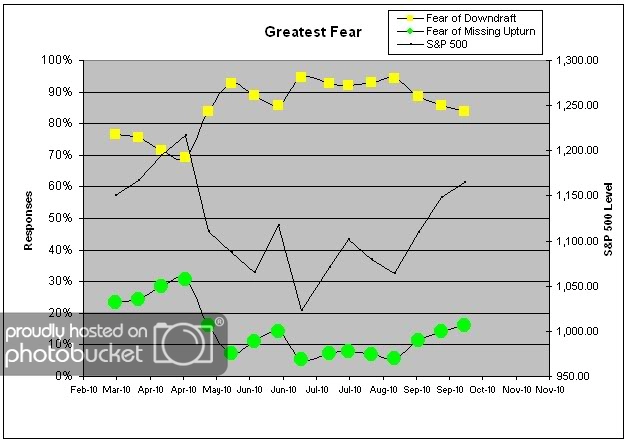
Question 1. Based on their behavior, are your clients currently more afraid of: a) getting caught in a stock market downdraft, or b) missing a stock market upturn?
 Dorsey, Wright Client Sentiment Survey Results   10/8/10

Chart 1: Greatest Fear. After a few weeks of solid rallying, the market inched slightly higher for this round of survey, up about 1.5% using the survey data points. As expected, client fear levels ticked slightly lower, down to 84% from 86%. Again, we have a roughly 2% market move which correlates almost exactly with the lower client fear levels. The opposite is true of the fear of missing an upturn group, with 16% up from last survey’s reading of 14%. The question here is whether it will take a 40% move from here to get client fear levels at the 50/50 mark.
 Dorsey, Wright Client Sentiment Survey Results   10/8/10

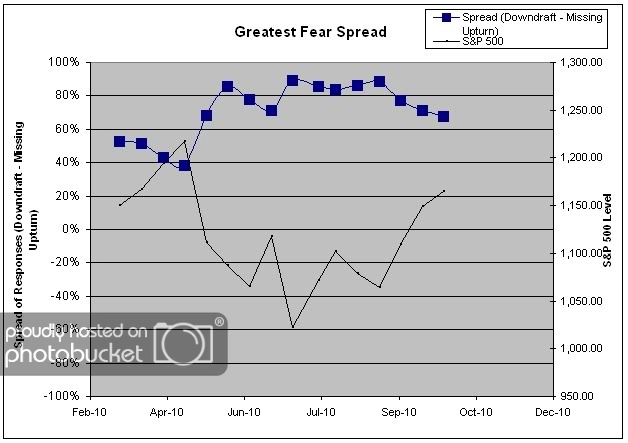
Chart 2. Greatest Fear Spread. Another way to look at this data is to examine the spread between the two groups. The spread remains skewed towards fear of losing money this round. Again, we see the spread moving towards parity as the market rallies, and the extreme fear levels abate.

Question 2. Based on their behavior, how would you rate your clients’ current appetite for risk?
 Dorsey, Wright Client Sentiment Survey Results   10/8/10

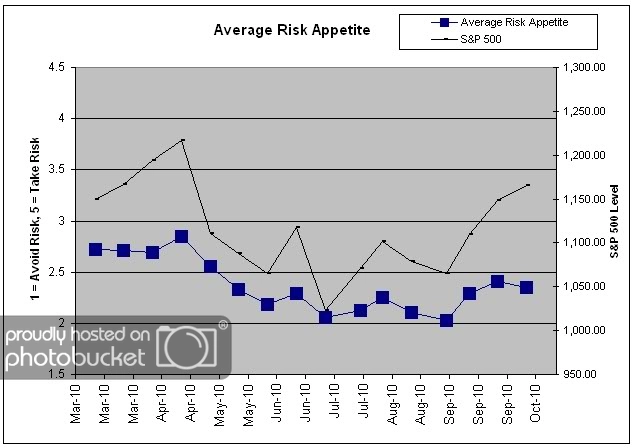
Chart 3: Average Risk Appetite. After breaking out of the tight summer range, risk appetite crept backwards a few basis points to 2.35, down from 2.40. This reading is so close to last survey’s, we would consider it a flat reading. Keeping in mind that the market was up just over 1% from survey to survey, this round’s number fits nicely with our expectations.
 Dorsey, Wright Client Sentiment Survey Results   10/8/10

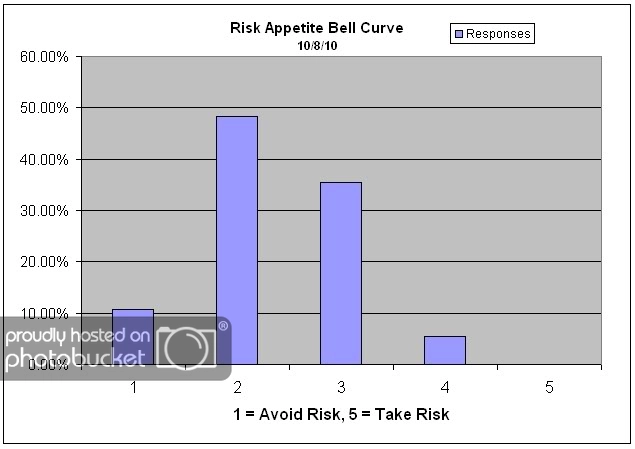
Chart 4: Risk Appetite Bell Curve. This chart uses a bell curve to break out the percentage of respondents at each risk appetite level. Even with the modest rally and the shift towards more risk, clients are definitely not taking many chances in this market. With this indicator, we would expect the bell curve to shift towards more risk if the market continues to rally into the fall. This round, we had a grand total of zero respondents with a risk tolerance of 5 (Take Risk).
 Dorsey, Wright Client Sentiment Survey Results   10/8/10

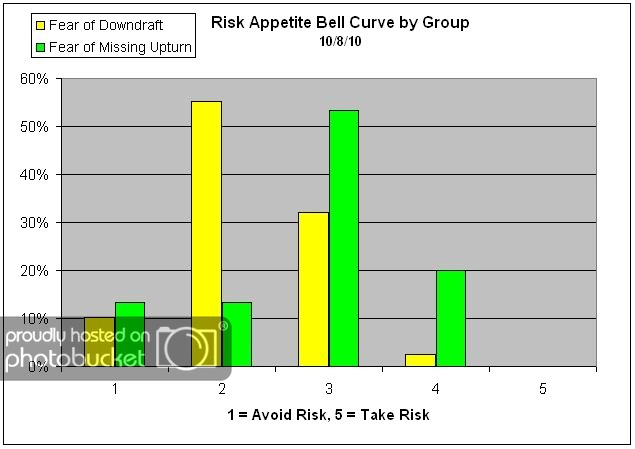
Chart 5: Risk Appetite Bell Curve by Group. The next three charts use cross-sectional data. This chart plots the reported client risk appetite separately for the fear of downdraft and for the fear of missing upturn groups. We would expect that the fear of downdraft group would have a lower risk appetite than the fear of missing upturn group and that is what we see here. Again, zero 5′s out of all our respondents.
 Dorsey, Wright Client Sentiment Survey Results   10/8/10

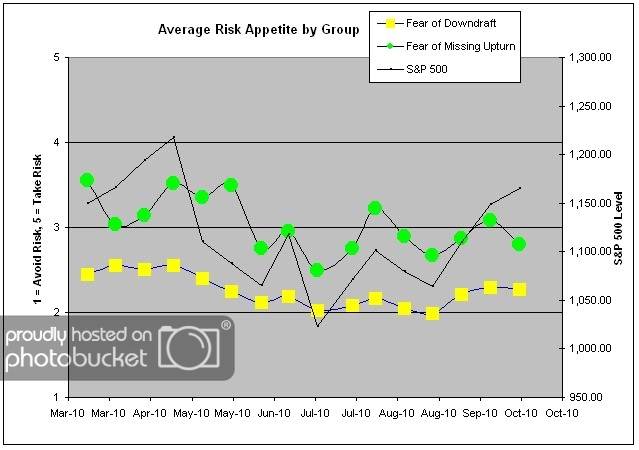
Chart 6: Average Risk Appetite by Group. A plot of the average risk appetite score by group is shown in this chart. Here we see that the average risk appetite for the fear of losing money group is significantly lower than the risk appetite for the fear of missing the rally group — perfect. Interestingly, this round the upturn group’s risk appetite actually dropped as the market rallied. Have we stumbled upon a new contrarian indicator? We’ve noticed before that the upturn’s group risk appetite is significantly more volatile than the downturn’s group, and this is what we see here again. This round, the upturn group’s risk appetite was 2.8 and the downturn group’s risk appetite was 2.3.
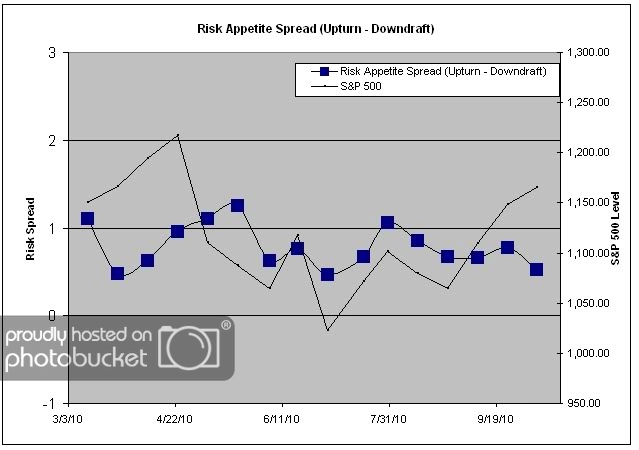
 Dorsey, Wright Client Sentiment Survey Results   10/8/10

Chart 7: Risk Appetite Spread. This is a spread chart constructed from the data in Chart 6, where the average risk appetite of the downdraft group is subtracted from the average risk appetite of the missing upturn group. The spread dropped by a fairly signifcant margin this round, moving from .78 to .53. This move can be entirely attributed to the upturn’s group lower risk appetite. We’ve noted before that the volatility of the spread is linked directly with the upturn group’s volatile risk tolerance.

This round, we saw a muted market move coupled with a muted client sentiment move. The market rallied modestly, and client fear levels fell by about as much. Again, we are seeing short-term market performance closely tied to long-term investor sentiment, which usually leads to emotional decisions based on relatively irrelevant market performance. The upturn group’s risk appetite actually fell this week, despite the small market rally. Contrarian indicator, anyone? Only time will tell!

No one can predict the future, as we all know, so instead of prognosticating, we will sit back and enjoy the ride. A rigorously tested, systematic investment process provides a great deal of comfort for clients during these types of fearful, highly uncertain market environments. Until next time, good trading and thank you for participating!

Posted by:


Weekly RS Recap

October 18, 2010

The table below shows the performance of a universe of mid and large cap U.S. equities, broken down by relative strength decile and quartile and then compared to the universe return. Those at the top of the ranks are those stocks which have the best intermediate-term relative strength. Relative strength strategies buy securities that have strong intermediate-term relative strength and hold them as long as they remain strong.

Last week’s performance (10/11/10 – 10/15/10) is as follows:

Last week was excellent for high relative strength stocks-the top quartile outperformed the universe by 54 basis points and outperformed the bottom quartile by 133 basis points.


Posted by:


Dear Pension Funds: We Have A Suggestion

October 15, 2010

Katy Burne of Dow Jones Newswires reports that pension funds have a bit of a problem. They are falling further and further behind on their obligations. They don’t want the volatility of stocks and they don’t like the yields offered by bonds. The ugly details are summarized below:

The median expected return on assets in U.S. pension plans:

Last year’s median expected return on assets among U.S. pension plans of the Standard & Poor’s 1,500 index was around 8%, according to consultancy Mercer.

The problem:

Pension funds are in a bind over how to achieve the sorts of returns they have been used to, given the pummeling stocks suffered during the financial crisis and expectations that interest rates will languish near zero for a protracted period.

Their solution:

Companies that recently set about de-risking their portfolios include retailer J.C. Penney Co. (JCP) and technology company NCR Corp. (NCR). In April, NCR announced it would change its 40% allocation into bonds to 100% by the end of 2012.

This makes perfect sense, right? After all, there is no risk in longer-duration bonds…

Milliman’s annual pensions study shows the average equity allocation has fallen more than 15% over the past three years. “This represents the movement into longer-duration bonds and hedging instruments to de-risk their investment portfolios,” explained John Ehrhardt, principal and consulting actuary at Milliman.

Let me suggest another option that has a much higher chance of succeeding: expand your investment universe beyond U.S. stocks and bonds to include international stocks and bonds, currencies, commodities, real estate, and inverse equities and embrace a tactical asset allocation approach that shifts exposure to those asset classes that have the best relative strength. We have thoroughly tested it, and it works. Even better for investors, we have made such strategies available as turn-key solutions through the Arrow DWA Balanced Fund (DWAFX), the Arrow DWA Tactical Fund (DWTFX), and our Global Macro separate account strategy.

To receive the brochure for our Separately Managed Acccounts, click here. For information about the Arrow DWA Tactical Fund (DWTFX) or Arrow DWA Balanced Fund (DWAFX), click here.

Click here for disclosures. Past performance is no guarantee of future returns.

Posted by:


Sector and Capitalization Performance

October 15, 2010

The chart below shows performance of US sectors and capitalizations over the trailing 12, 6, and 1 month(s). Relative strength strategies buy securities that have strong intermediate-term relative strength and hold them as long as they remain strong. Performance updated through 10/14/2010.


Posted by:


Primer in Supply and Demand

October 14, 2010

Ryan Krueger of Minyanville offers a nice reminder that both supply and demand are variable forces.

When IBM (IBM) recently borrowed money for three years at 1%, temporarily setting a record low interest rate at that maturity, it turned right around and bought back more of its own shares from the public, which was stuck wondering when stock prices would ever go up again. No different than any other asset, the price of a stock will go up only when there’s demand for one more unit than there is supply available. Consider the following chart and overwhelmingly bullish facts for share prices that most investors never even glance at before considering a purchase or sale.

We aren’t looking at speculative buying here with its last nickel either. IBM had $3.6 billion in cash in 2000. Ten years later it has $12.2 billion in cash after buying back all those shares with many more buybacks to come, already authorized by the board. Ten years ago IBM’s operating profit was $9 billion and the stock was at $140. This year it will make close to $20 billion and yet almost half as many shares are trading at $140.

Krueger’s point bears repeating: the price of a stock will go up only when there’s demand for one more unit than there is supply available. Furthermore, price can still rise with demand falling if supply is falling even more.

Posted by:


Fund Flows

October 14, 2010

The Investment Company Institute is the national association of U.S. investment companies, including mutual funds, closed-end funds, exchange-traded funds (ETFs), and unit investment trusts (UITs). Members of ICI manage total assets of $11.82 trillion and serve nearly 90 million shareholders. Flow estimates are derived from data collected covering more than 95 percent of industry assets and are adjusted to represent industry totals.

The stampede to bond funds continues. Foreign Equities are also now seeing some pretty steady inflows and are now up to $30 billion in new money for the year.


Posted by:


Worried About Market Manipulation?

October 13, 2010

Charles Kirk, of the Kirk Report, was recently asked about how concerned investors should be about “market manipulation.” This is also a question that I receive from time to time and I think that Kirk’s response was spot on:

For me, I remember as a little guy that life wasn’t fair. After all, there were people who were better looking, much smarter, had far less strict parents and had much nicer and many more toys than I did as a child. However, I soon learned that if I did good things and was a good person, I would be rewarded and that what inequities existed, didn’t really matter!

I think this lesson is one that many traders need to relearn and remember. Take for example this email I received in my inbox this morning….

“While I greatly respect your technical trading skills, I think it would beneficial to you to realize the government is manipulating the markets. To deny this fact is pointless. They have wanted the DOW above 10,000 since March 2009. They manage news flow via Leesman on CNBC and use buy programs via JPM, MS and GS. I have been trading stocks for more than 10 years and I know the difference in a free market and a manipulated one. I realize you do not like to mix these thoughts with your trading but reading your comments on the web site, I feel you are in denial. I feel an occasional comment on the subject is needed.” – George C.

I have one simple question – how does having me talk endlessly about how “unfair” or “manipulated” the markets are make more money for you? Those who know me know that I am a doer, not a whiner. My #1 job as a trader is to profit, no matter what – not to sit here complaining to the cows come home how unfair or not I think the market is to the average individual investor!

Second, it is sad but true, in my experience those who complain the most are also those who tend to underperform the most. All of us unfortunately and far too frequently look for others to blame for our mistakes and losses and frankly right now there’s no better excuse than to blame widespread market manipulation. However, at the end of the day, how does that make you more money or, even more importantly, put you on the right track to improve yourself in the future?

Let me tell you a secret – the market has ALWAYS been manipulated to some extent AND always will. You can either choose to play and find ways to profit from the market or just go home and do other things with your money. Those who make money in this market don’t have time or energy to complain about how the markets are unfair unless they’re selling services and advice that pray on the fears of others. In my humble opinion, we have too much of that already and I’m not going to be part of that group!

Once again, we come back to Econ 101 and the law of supply and demand. Rather than trying to find out the exact motivation of buyers and sellers (an impossible task) it is much more profitable to accept that the market place is made up of investors with differing motives and that are currently taking action based on differing factors. The advantage of a relative strength approach to money management is the lack of emotion required to simply trade the strongest trends. Who cares about the “why” and the “who” behind every price move. It is much more profitable to focus on executing a proven investment approach (i.e. focus on what you can actually control).

Manipulation or no manipulation, there are strong trends to trade.

Posted by:


High RS Diffusion Index

October 13, 2010

The chart below measures the percentage of high relative strength stocks that are trading above their 50-day moving average (universe of mid and large cap stocks.) As of 10/12/10.

The 10-day moving average of this indicator is 93% and the one-day reading is 94%. This oscillator has risen sharply over the last month and a half and is now holding above 90%.


Posted by: