Dorsey, Wright Client Sentiment Survey Results - 9/24/10

October 4, 2010

Our latest sentiment survey was open from 9/24/10 to 10/1/10. We saw a decrease in the response rate, with 91 readers participating. Your input is for a good cause! If you believe, as we do, that markets are driven by supply and demand, client behavior is important. We’re not asking what you think of the market—since most of our blog readers are financial advisors, we’re asking instead about the behavior of your clients. Then we’re aggregating responses exclusively for our readership. Your privacy will not be compromised in any way.

After the first 30 or so responses, the established pattern was simply magnified, so we are comfortable about the statistical validity of our sample. Most of the responses were from the U.S., but we also had multiple advisors respond from at least two other countries. Let’s get down to an analysis of the data! Note: You can click on any of the charts to enlarge them.

Question 1. Based on their behavior, are your clients currently more afraid of: a) getting caught in a stock market downdraft, or b) missing a stock market upturn?
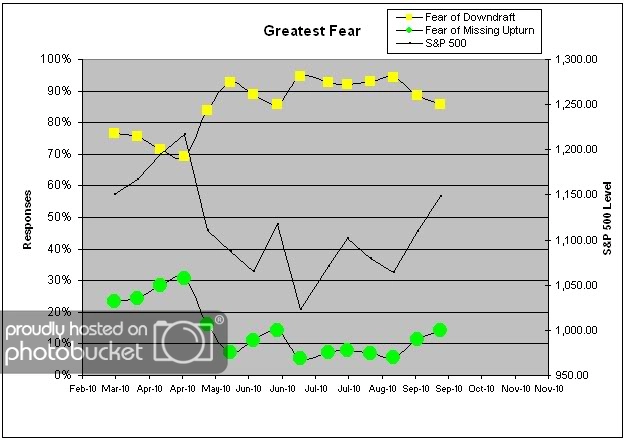
Chart 1: Greatest Fear. Now we got a rally going! And guess what…client fear levels are moving in-line, as predicted. Using only the survey data points, the market has rallied around 8% since August. 86% of clients were afraid of losing money this round, versus 14% of clients who were afraid of losing out on a rally. Contrast this with the most recent August lows, where 94% of clients were fearful of losing money. Let’s do some simple math: An 8% market rally corresponds to an 8% client fear level move! The two are moving lock-step with each other. The only question is whether it’s going to take a 40% market move to get client fear levels to a 50/50 split. Only time will tell.
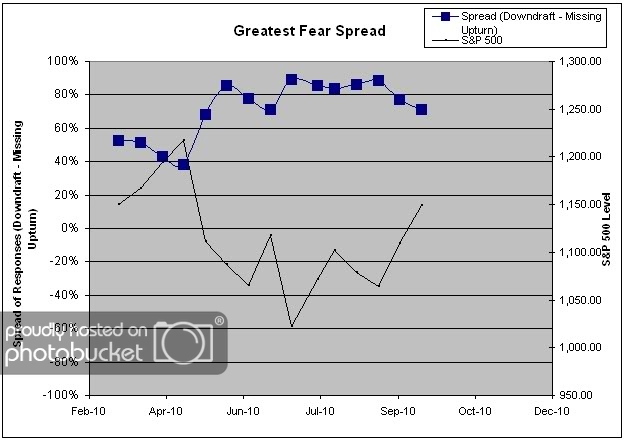
Chart 2. Greatest Fear Spread. Another way to look at this data is to examine the spread between the two groups. The spread remains skewed towards fear of losing money this round. Same as with the general fear numbers, the market move has corresponded exactly with a move in the spread between the two groups. Right now the spread is at 71%.

Question 2. Based on their behavior, how would you rate your clients’ current appetite for risk?
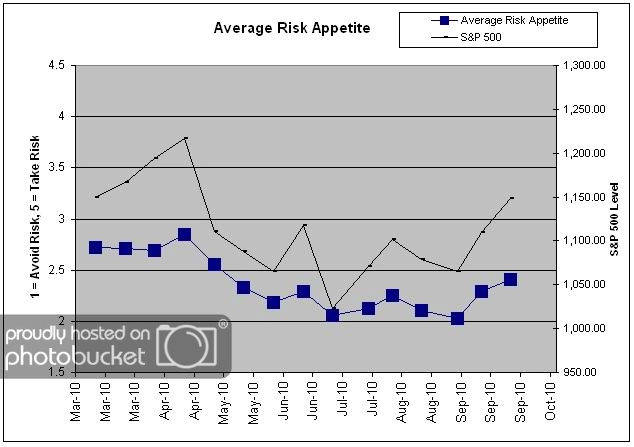
Chart 3: Average Risk Appetite. The market move has led to the average risk appetite scoring the highest number since May! That’s a big breakout after holding a pretty tight range for the entire summer. Right now average risk appetite is 2.4, up from last week’s 2.3, and well off the most recent lows of 2.0. It’s great to see all of our indicators working exactly as we thought they would.
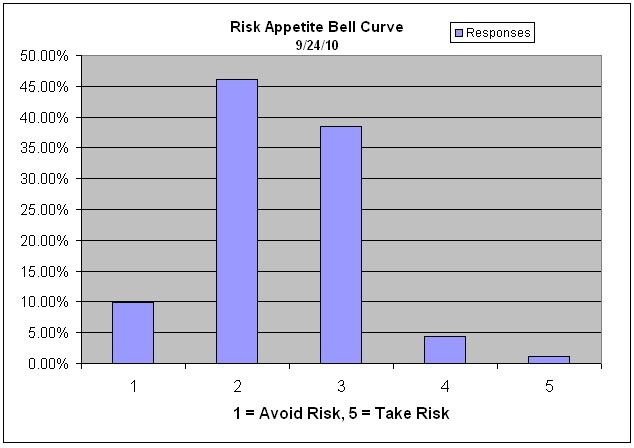
Chart 4: Risk Appetite Bell Curve. This chart uses a bell curve to break out the percentage of respondents at each risk appetite level. Even with the modest rally and the shift towards more risk, clients are definitely not taking many chances in this market. With this indicator, we would expect the bell curve to shift towards more risk if the market continues to rally into the fall.
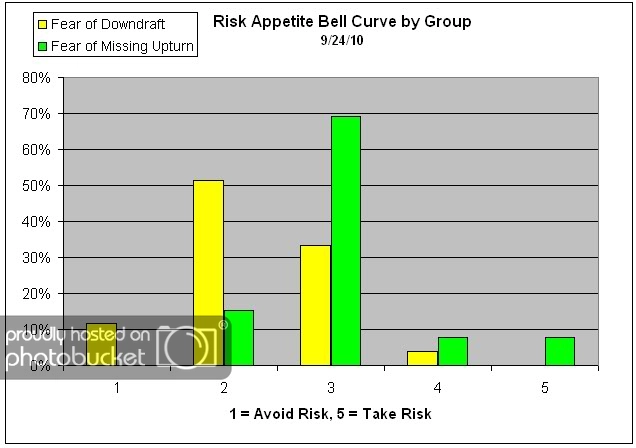
Chart 5: Risk Appetite Bell Curve by Group. The next three charts use cross-sectional data. This chart plots the reported client risk appetite separately for the fear of downdraft and for the fear of missing upturn groups. We would expect that the fear of downdraft group would have a lower risk appetite than the fear of missing upturn group and that is what we see here.
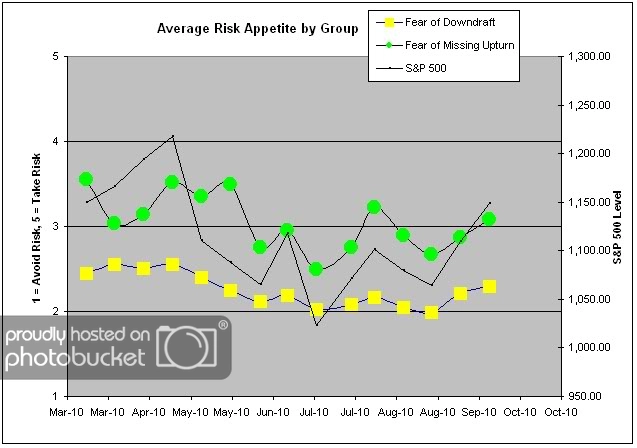
Chart 6: Average Risk Appetite by Group. A plot of the average risk appetite score by group is shown in this chart. Here we see that the average risk appetite for the fear of losing money group is significantly lower than the risk appetite for the fear of missing the rally group — perfect. Both averages have spiked in-line with the market, which is also reflected in the general average risk appetite chart. This time, we saw the upturn group have a little bit more volatility, but not as significantly as we’ve seen before. Currently the average risk appetite of the downturn group is 2.3 and the risk appetite of the upturn group is 3.1.
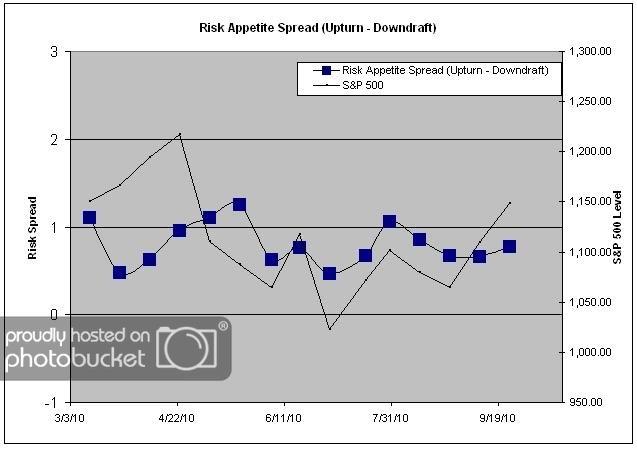
Chart 7: Risk Appetite Spread. This is a spread chart constructed from the data in Chart 6, where the average risk appetite of the downdraft group is subtracted from the average risk appetite of the missing upturn group. The spread has become a little bit more stable during the rally, as both groups react to market performance at around the same pace. Right now the spread is .78, up about 10 basis points from last week’s .66. It’s not that large of a move considering that we’ve seen moves of close to 50 basis points in just two weeks before.

The current survey numbers show just how consistently client sentiment is linked to short-term market performance. We see an 8% market move, we get an 8% fear level move. Is it really that simple? One would hope not, but unfortunately, all signs point to “Yes” at the moment. Short term market performance should not be closely tied to long-term market outlook!! But it is. Advisors, it’s clearly a tough job to keep your clients’ emotions in check.

No one can predict the future, as we all know, so instead of prognosticating, we will sit back and enjoy the ride. A rigorously tested, systematic investment process provides a great deal of comfort for clients during these types of fearful, highly uncertain market environments. Until next time, good trading and thank you for participating!


Getting Exposure to Indonesia and Thailand

October 4, 2010

Minyanville profiles 4 ETFs today, including our own PIE, as a way to get exposure to some of the best performing emerging markets this year- Indonesia and Thailand:

Editor’s Note: This content was originally published on Benzinga.com by The ETF Professor.

Unless you’ve been living in a cave, you know that the iShares MSCI Thailand Investable Market Index Fund (THD) and the Market Vectors Indonesia ETF (IDX) have sizzled in 2010. And with good reason. After all, those two markets are the only Asian markets officially in bull-market territory.

But what’s an investor who may want exposure to both markets or several other emerging markets along with Indonesia and Thailand in a single ETF to do?

Given how well Indonesia and Thailand have performed and how many emerging marketsETFs represent plays on multiple markets, there aren’t a ton of options capturing Indonesia and Thailand in a single fund, but there are few.

Here’s a quartet of ETFs that offer exposure to both Indonesia and Thailand.

1. SPDR S&P Emerging Asia Pacific ETF (GMF):
Don’t get too excited if you’re hunting for Indonesia or Thailand exposure here because GMF allocates more than 35% of its weight to China. Indonesia checks in at 4.45% and Thailand gets almost 3.6% of this fund’s weight.

2. SPDR S&P Emerging Markets Small Cap ETF (EWX):
Same goes for EWX, which is a great fund, but its weights to Indonesia and Thailand disappoint at 3.05% and 2.75%, respectively. Taiwan represents almost one-third of EWX’s weight.

3. PowerShares DWA Emerging Markets Technical Leaders ETF (PIE):
Alright, now we’re getting somewhere. Indonesia and Thailand combine for almost 21% of PIE’s weight. The fund is a solid performer in its own right, though it hasn’t grabbed many headlines this year.

See also, Time to Grab a Piece of This PIE ETF?

4. WisdomTree Emerging Markets SmallCap Dividend ETF (DGS):
While short on Indonesia exposure (just about 2.6%), DGS does allocate almost 10.5% of its weight to Thailand, making it an interesting option for the investor that’s long IDX, but doesn’t have any Thai exposure in his portfolio.

See www.powershares.com for more information.


Updated Global Macro Video

October 4, 2010

We have just posted an updated video presentation on our Global Macro strategy (click here) which describes the strategy and discusses our current allocations. This global tactical asset allocation strategy can invest in domestic equities (long & inverse), international equities (long & inverse), currencies, commodities, real estate, and fixed income.

To receive the brochure for our Global Macro strategy, click here. For information about the Arrow DWA Tactical Fund (DWTFX), click here.

Click here and here for disclosures. Past performance is no guarantee of future returns.


PIE In The News

October 4, 2010

ETF Channel profiled PIE on 10/1/10:

The DWA Emerging Markets Technical Leaders Portfolio (PIE) has been soaring. This ETF has had a total return of almost 25% over the last three months, and over 28% in the trailing twelve months. One of the ETF’s holdings, Vivo Participacoes S/A Ads (VIV), is up nearly 5% in the last three months, and 16% in the last year. Another holding, Creditcorp(BAP) is up over 25% in the last three months, and nearly 52% in the last year. And Wimm-Bill-Dann Foods OJSC (WBD) is higher by 27% in three months, and 35.5% in the last year.

The Fund will normally invest at least 80% of its total assets in securities of emerging economies within Dorsey Wright & Associates’ classification definition, excluding companies listed on a U.S. stock exchange.

The underlying index includes approximately 100 companies that possess powerful relative strength characteristics and are domiciled in emerging market countries including, but not limited to Argentina, Brazil, Chile, China, Colombia, Czech Republic, Egypt, Hungary, India, Indonesia, Israel, Malaysia, Mexico, Morocco, Pakistan, Peru, Philippines, Poland, Russia, South Africa, Taiwan, Thailand and Turkey.

See www.powershares.com for more information.


Not All 30-Year Periods Are The Same For Bonds

October 4, 2010

Not all 30-year periods are quite as spectacular for bonds as have been the last 30. From Ben Levishohn’s Oct. 2nd WSJ article, “How To Play Rising Rates”:

Bond yields have fallen for most of the past three decades. A $1,000 investment in the U.S. government debt in 1980 would be worth about $12,970 today, according to the Ryan Labs Treasury Composite Index. Treasury prices, which move in the opposite direction of yields, have surged 9.3% this year alone.

Now consider a different era: 1949 through 1979. Over that 30-year span, a $1,000 initial investment in Treasurys would have turned into a far humbler $2,950. That’s because yields soared during the period; by 1980 the yield on the 10-year Treasury had reached a record high of nearly 16%.

Given that Treasury yields have since plunged back down to 2.5% or so, how much further can they fall?

It wouldn’t take much of a rise in rates to pose problems for investors. A one-point jump in Treasury yields would translate to a 5% loss for the 10-year Treasury note and a 12% drop for a 30-year Treasury. Many strategists are predicting 10-year Treasury rates above 3% over the next year.

From a relative strength perspective, bonds continue to have pretty good relative strength (although real estate and commodities have better relative strength). However, now is the time for investors to make sure that their asset allocation has the flexibility to handle a rising-rate environment.


Weekly RS Recap

October 4, 2010

The table below shows the performance of a universe of mid and large cap U.S. equities, broken down by relative strength decile and quartile and then compared to the universe return. Those at the top of the ranks are those stocks which have the best intermediate-term relative strength. Relative strength strategies buy securities that have strong intermediate-term relative strength and hold them as long as they remain strong.

Last week’s performance (9/27/10 – 10/1/10) is as follows:

The best performance last week came from the stocks with the weakest relative strength.