Avoiding Value Traps

November 22, 2010

In the U.S. at least, value investing seems to be the approved mode of thought. It could be nothing more than historical accident, but since Graham and Dodd’s Security Analysis is now enshrined in many business and finance programs, it seems likely to continue that way. (It always surprises people to learn that John Bogle’s survey of mutual funds concluded that growth funds had virtually identical performance to value funds.)

The bugaboo of value investing is the so-called “value trap.” It’s a stock that looks cheap, but turns out to be cheap for a good reason and continues to go down or perform poorly. The reason that value investors refer to such stocks as value traps is because they are difficult to identify. After all, if you are buying something because it is cheap relative to various metrics, dropping in price often makes it theoretically more attractive.

Clay Allen of Market Dynamics thinks he knows why many portfolio managers underperform common benchmarks over time: the value traps sneak up on them. In his weekly essay of October 29, he writes:

The record of market performance shown by a large number of stocks indicates that as many as 25% to 30% of all stocks show a history of market performance that is worse than the market but not bad enough to force the portfolio manager to face up to the problem. As a result, the long-term investor whose approach is strictly fundamental will not be able to see the persistence of poor performance by many stocks. The long-standing record of poor relative performance shown by 80% of professionally managed portfolios may, in fact, be attributed to value-trap stocks.

The portfolio process that we use for our Systematic Relative Strength accounts is called “casting out.” The casting-out process is tailor-made for relative strength investing. It requires that we remove an asset from the portfolio when it is no longer highly ranked and replace it with an asset that is stronger. It’s impossible not to face up to a problem stock. The casting out process ensures that the portfolio is always exposed to strong assets, and thus, always exposed to the relative strength return factor. Relative strength is a potent source of returns and by keeping the portfolio focused in strong names, we have a good chance of outperforming market benchmarks over time.

Consider the difficulties of using a casting-out process for value investing. (In fact, many value managers talk about this when they discuss selling a stock to replace it with a better value.) First, you rank everything by value and then buy the items that are cheapest. The items that rise in price often no longer qualify as inexpensive, so they are sold and replaced with better values. The stocks that drop in price, the aforementioned value traps, are retained in the portfolio because they often continue to be very attractive from a valuation standpoint. Think about what happens to the portfolio over a period of time: you sell all of the winners and hold on to the losers! Which, of course, is the exact opposite of what you would like to do. Ouch! Managing a value portfolio well thus generally requires a great deal of discretion. It’s difficult to do systematically. Even good value managers aren’t going to be right about every judgement, and of course there is always inherent market volatility and the periodic investor preference rotation from value to growth and back again to deal with. Research shows that deep value provides excess returns, but the return is tough to capture because of those tricky value traps.

Relative strength investing has an equally aggravating problem: occasionally getting into a trend just as it is ending. Investors get to pick their poison. No method is perfect, but we think because systematic application of relative strength avoids value traps, it might also, just through a happy marriage of the casting-out process with the relative strength return factor, make it a little bit easier to capture the available excess return.


Value or Growth: Which is Better?

November 22, 2010

This isn’t exactly the topic of my post, but it’s an inquiry along those lines, and it probably got your attention. My occasion for thinking about this was a comment in the Prudent Speculator newsletter, published by Al Frank Asset Management through Forbes. John Buckingham is the chief investment officer, one of the most respected deep value investors around, and has the track record to prove it. In addition, he is a super nice guy and a friend of mine. John cited data from the Ibbotson Yearbook, compiled by Eugene Fama and Ken French, that indicated that value stocks had higher returns than growth stocks:

Certainly there have been periods (the 30s and 90s) during which value stocks have lagged growth, but data compiled by Eugene Fama and Ken French show that from 1928-2009, large value stocks had an 11.0% geometric return, compared to 8.7% for large growth, while small value stocks have outperformed by a wider margin (13.9% to 9.0%).

It is untrue that value outperforms growth, contradicted by both experience and statistics, but it is a popular misconception. The misconception stems from the way in which value and growth are defined. The Ibbotson Yearbook in question uses the book-to-market ratio as their metric. This is probably the most common definition in the academic literature as well. Value is virtuously defined as having high book-to-market values. Growth is defined in opposition as those stocks with low book-to-market values. In other words, growth is defined rather perversely as bad value! If growth is defined as bad value, it’s not too surprising that bad value performs worse than good value!

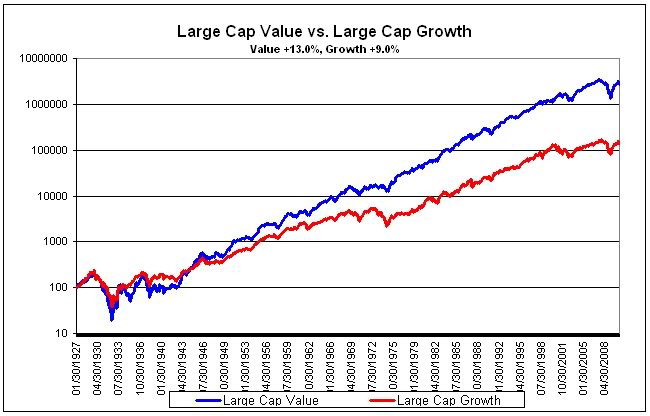
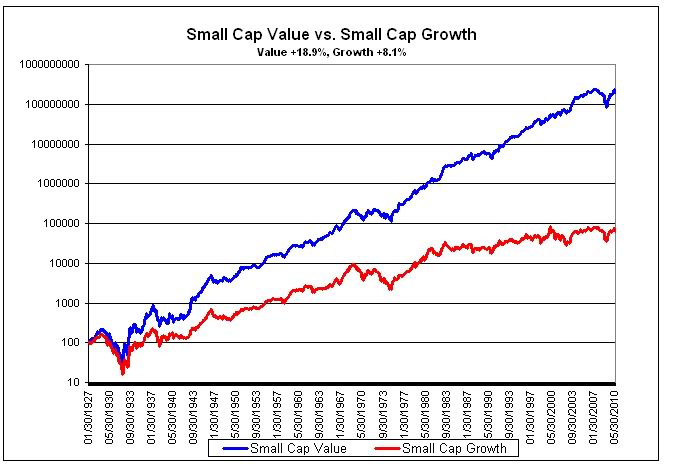
Our research assistant, J.P. Lee, went to the Ken French data library and looked at portfolios formed by market capitalization and book value. The relationships are just as Ibbotson reported, although the numbers are slightly different because of different time periods and a slightly different methodology. For the period from 1/30/1927 to 6/30/2010, large cap value (high book-to-market) stocks had a 13.0% compounded return, compared to 9.0% for large growth (low book-to-market/bad value). Small value stocks outperformed by a wider margin (18.9% to 8.1%). The charts below show the relationships. (Click all charts to enlarge)

source: Ken French Data Library

Of course, growth investors don’t actually busy themselves trying to find overpriced stocks! John Brush has written a very important paper about this, Value and Growth, Theory and Practice, (archived on our website) which was published in 2007 in The Journal of Portfolio Management. He points out that all the conventional academic definition shows is that good value beats bad value. He proposes, instead, a list of ten selection factors to define the value and growth styles.

VALUE FACTORS GROWTH FACTORS
Dividend-to-price Short-term change in earnings-to-price
Earnings-to-price Long-term change in earnings-to-price
Cash flow-to-price Estimate revisions
Expected future earnings-to-price Earnings surprise
Book value-to-price Price momentum

source: John Brush, Journal of Portfolio Management

Note that the value factors are static, while the growth factors are dynamic. As Brush puts it:

Most value managers will agree that the static factors describe their style. Most growth managers will perhaps more reluctantly recognize the dynamic measures as the basis of their style.

Brush shows that annualized excess returns for un-rebalanced portfolios formed monthly for the period from 1971-2004 are higher for growth stocks over holding periods up to a year, then shift slightly in favor of value stocks for longer holding periods. Of course, in real life, portfolios are not left unchanged for years at a time. Evidence from actual mutual fund portfolios shows that growth stock returns are very similar to value stock returns, if not slightly ahead. For example, John Bogle of Vanguard fame, in his 2003 book, Common Sense on Mutual Funds, writes:

In recent years, the conventional wisdom has been to give the value philosophy accolades for superiority over the growth philosophy. Perhaps this belief predominates because so few observers have examined the full historical record…For the full 60-year period, the compound total returns were: growth, 11.7 percent; value, 11.5 percent - a tiny difference.

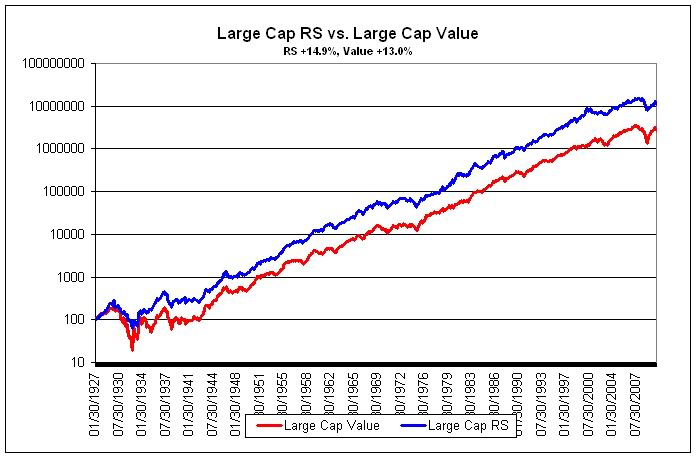
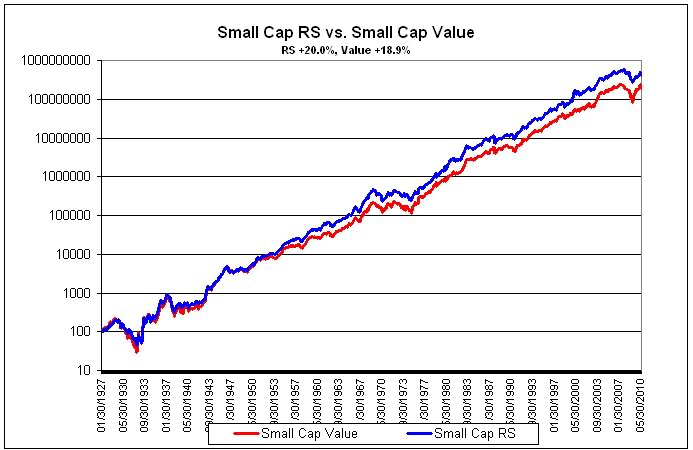
Relative strength is a growth factor. Academics refer to it as price momentum, which is how you will find it listed in the table above. We think it is the most powerful growth factor, and also the most adaptable. Because of its incredible adaptibility, we use relative strength exclusively to manage portfolios. When you compare high relative strength to value, suddenly the tables are turned. Keep in mind that the charts below are generated from the exact same Ken French data library. Value is still defined as high book-to-market, the same data definition that made growth/bad value look like such a nebbish in the last set of charts. But this go round, growth/bad value has been replaced with a worthier opponent, high relative strength.

source: Ken French data library

When it is a fair fight, it’s pretty clear that relative strength is not inferior to value at all. Large cap high RS stocks had a 14.9% compounded return, compared to 13.0% for large cap value. Relative strength also outperformed in the small cap arena, with compounded returns of 20.0%, compared to 18.9% for small cap value.

And, as it turns out, relative strength and value are quite complementary. Their excess returns tend to be uncorrelated, a fact that is remarked on both in Bogle’s book and Brush’s article. Any advisor that has been in the business for a while has seen this effect-both value and growth go through pronounced cycles. Now that we know that both relative strength and value are powerful return factors, and that their excess returns are uncorrelated, what are the practical implications for an advisor?

1) If relative strength is the premier growth factor, it might make sense to replace the growth managers in your stable with managers that use relative strength.

2) Since the excess returns from relative strength and value are uncorrelated, it might make sense to expose clients to both return factors. Brush’s article suggests that a 50/50 mix is the best combination.

So which is better, value or growth? The truth is none of the above. Both are valuable return factors for a portfolio-and because they tend to offset one another, they are even better in combination. If you like, think of the client’s portfolio as a Milky Way bar. Chocolate is good; so is caramel. And together, mmm!

source: Skiptomylou.org


Put Aside the Focus on the Economy

November 22, 2010

Time provides a great overview of why “It’s Not The Economy” that investors should focus on:

A recent story on the daily peregrinations of the stock market concluded that, at least for the day, “U.S. stocks erased their losses to finish in positive territory, as investors weighed an improving domestic economy against heightened global concerns.” That seems an innocuous enough statement. The markets did well because investor concerns about the economy were allayed by some data or shift in sentiment. Pretty simple, right? Yes, but also pretty wrong.

Reading markets in light of economic data is common, but it is using a deeply flawed lens. Not only can markets rise when the economy is weak and fall when the economy is strong, but the fate of an increasingly large number of companies has little to do with the fate of their home countries. Using national economic data as a barometer of companies and stocks may have once made sense — when firms were intimately tethered to their homelands — but no longer. In fact, using national economic data as a guide to how companies will perform is almost certain to lead to the wrong conclusions.

In part, this is because companies have become increasingly global in their business, especially publicly listed companies that trade on the world’s stock exchanges. Nearly 50% of the earnings of the S&P 500 companies came from outside the U.S. last year, and if you take out companies that are closely tied to the American economy such as utilities and health care services, that percentage is almost certainly above 50%. Even some prominent, dynamic U.S. consumer companies like Nike are seeing their most dramatic growth by selling to China and its rapidly emerging middle class, along with a host of other emerging countries. The swoosh is as familiar in Guangdong province as it is in Galveston, Texas.

So while there remain industries like health care that are inextricably linked to the domestic economy, those are the exceptions. The new rule for investing should be to put aside the quaint notion that getting the economy right helps you get stocks right. Once, what was good for GM might have been good for America, but that was another time, another age, one that should be remembered as history. And only as history.

This is a pretty good argument for allowing price trends to dictate allocations as opposed to obsessing about the growth of “the economy.” As pointed out in the article, the U.S. economy will be fortunate if it ekes out 2% to 3% growth this year, while S&P 500 third quarter earnings grew by an astonishing 31% (year over year).


What’s Hot…and Not

November 22, 2010

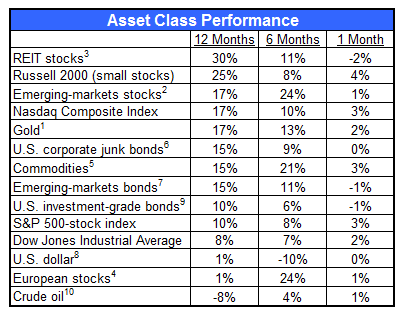
How different investments have done over the past 12 months, 6 months, and month.


1PowerShares DB Gold, 2iShares MSCI Emerging Markets ETF, 3iShares DJ U.S. Real Estate Index, 4iShares S&P Europe 350 Index, 5Green Haven Continuous Commodity Index, 6iBoxx High Yield Corporate Bond Fund, 7JP Morgan Emerging Markets Bond Fund, 8PowerShares DB US Dollar Index, 9iBoxx Investment Grade Corporate Bond Fund, 10PowerShares DB Oil


Weekly RS Recap

November 22, 2010

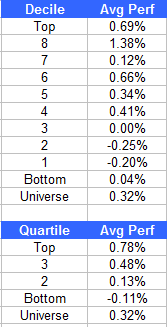
The table below shows the performance of a universe of mid and large cap U.S. equities, broken down by relative strength decile and quartile and then compared to the universe return. Those at the top of the ranks are those stocks which have the best intermediate-term relative strength. Relative strength strategies buy securities that have strong intermediate-term relative strength and hold them as long as they remain strong.

Last week’s performance (11/15/10 – 11/19/10) is as follows:

Last week was another strong week for high relative strength stocks; the top quartile outperformed the universe by 46 basis points and it outperformed the bottom quartile by 89 basis points.