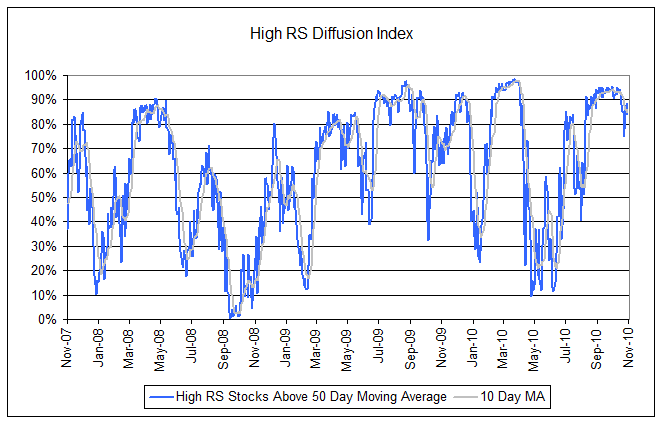
Bill Miller of Legg Mason Capital Management, in his November 2010 issue of Perspectives, discusses the market situation. I think he correctly points out that economic conditions are pretty good, but what is really lacking is confidence and optimism. Pessimism has infected the masses-and people are always more comfortable doing what is being done by the crowd. The crowd is driven by emotions, and emotions are driven by price action.
One of the most remarkable things about the investing world is how (correctly) venerated Warren Buffett is and how completely people ignore his investing advice. Since Mr. Buffett has made more money than anyone in the history of the planet solely through investing, one would think that when he says quite clearly what to invest in, people would pay attention. I guess they do pay attention, they just do the opposite. In 1974, near the bottom of the market, he said stocks were so cheap he felt like an over-sexed guy in a harem. In 1999, near the top, he opined that stocks would see returns way below those experienced in the bull market up to that time. From the time of his comments in November 1999 to the end of October 2008, stocks fell over 2% per year. In October 2008, again near the bottom, Buffett published an op-ed in The New York Times entitled, “Buy American. I Am.” telling people to buy American stocks. They promptly accelerated their selling. On October 5th of this year, he said the following: “It is quite clear stocks are cheaper than bonds. I can’t imagine anybody having bonds in their portfolio when they can own equities.” The result: people pour their money into bond funds in record amounts, and sell their holdings in funds that invest in U.S. stocks. Why investors persist in doing the opposite of what the greatest investor of all time does, is a greater mystery than the problem of consciousness, or the origin of life, or free will and determinism. Those at least are hard problems.
What will bring the public back to stocks? The same thing that always does: higher prices. People like bonds not because they have carefully considered the risks and rewards of owning them, but because they have gone up so much over the past several decades. Stocks are the long duration asset, and their level reflects people’s optimism about the future and their attitude toward risk.
The bold is my emphasis, I suppose because I find his commentary accurate, funny, and sad, all at the same time. Investors have memories and the freshest memory right now is the beating the stock market took in 2008-2009. Investors want nothing to do with stocks right now, even though some return factors have performed pretty well this year. [As an aside, investors are generally stunned to learn that the PowerShares DWA Technical Leaders Index is up more than 20% year-to-date. It's just not in their mental framework that things could be going well.] Will they ever come back to equities? Of course-when they feel comfortable. Unfortunately, they will likely miss a great deal of the recovery by relying on their emotions.
Going against the crowd is difficult for people. Maybe we just need to figure out a way to form a new crowd that is more productive for investors. Perhaps snazzy banners saying “100% of successful investors go against the crowd. Join us!” would do the trick. Clearly, I will never be a slogan writer, but you get the idea.


 Posted by Mike Moody