Look Ma, No Risk!

November 29, 2010

In a recent article in Pensions & Investments, Robert Pozen took the industry to task for recent changes in the allocation of pension plans:

As corporate pension plans have shifted away from equities, they have substantially increased their allocations to high-quality bonds after the financial crisis. Most of this increase was concentrated in U.S. Treasuries with maturities of one to 10 years. In making this move to high-quality bonds, the trustees of corporate pensions were trying to “de-risk” their portfolios. In their view, more bonds would mean lower annual volatility for their portfolios, which would in turn minimize future corporate contributions to the plans.

Yet this reduction in annual portfolio volatility comes with a price — lower long-term returns. The expected returns of U.S. corporate pension plans now are around 8% per year. The average corporate pension plan was 82% funded in 2009, and that will reportedly fall to 75% by the end of 2010.

Risk is like matter in physics-it cannot be created or destroyed. Like matter, it just changes form. Pension funds have not actually “de-risked.” They have reduced volatility and simultaneously increased their risk of long-term underperformance, not to mention drastically increasing their interest rate risk. As Pozen points out, this is a big problem because of the terribly underfunded state of pensions today:

Like their corporate counterparts, public pension plans are facing large funding deficits. These plans were on average about 80% funded in mid-2009, and at least eight state plans were less than 65% funded. Even these estimates are overstated because of the unique accounting rules applicable to public pension plans. If public plans were subject to standard pension accounting, their funding deficits would be 20% to 30% larger.

Up to now, public pension plans have been allowed to compute their deficits based on the returns they expect from their portfolios, rather than relevant current interest rates. The Governmental Accounting Standards Board has proposed that public plans begin to use current interest rates of high-quality municipal bonds. However, this proposal would be confined to calculating cash flows needed to eliminate a plan’s current deficit. It would still allow expected returns to be used for valuing existing plan assets.

Given these accounting rules, it is not surprising to see that public pension plans have set expected returns of 8% per year for their investment portfolios.

Wow! I’d like to be able to report my performance based on my expected return too! (I added the italics, just because it is so mind-boggling.) Why stop at 8%? Public pension plans could eliminate their funding issues simply by assuming that would earn 20% per year! Besides the bogus accounting for funding deficits, Pozen points out the other flaw in “de-risking:”

To achieve these returns, public pension plans have decreased their equity allocations and instead allocated much more to alternative investments. In other words, public pension plans have not “de-risked” their portfolios by replacing stocks with bonds. Instead, public plans have “up-risked” their portfolios by replacing stocks with hedge funds and private equity funds.
Geez! Apparently stocks are so risky that pensions would rather own high-fee leveraged hedge funds and high-fee private equity funds! With the lack of transparency of many of these funds, it simply makes it more likely that some state pension will end up the victim of a mini-Madoff at some point.
This is classic investor behavior—emotional asset allocation. After you’ve been burned, run away. Unfortunately, the decisions made by public pension plans affect all of us, either as beneficiaries or as the taxpayers doing the funding. The urge to reduce risk has led to greater risk. And it’s prevented many pension plans from earning good returns in relative strength strategies this year.

Dorsey, Wright Client Sentiment Survey Results - 11/19/10

November 29, 2010

Our latest sentiment survey was open from 11/19/10 to 11/26/10. We had one more respondent than last survey, with 110 readers participating. Your input is for a good cause! If you believe, as we do, that markets are driven by supply and demand, client behavior is important. We’re not asking what you think of the market—since most of our blog readers are financial advisors, we’re asking instead about the behavior of your clients. Then we’re aggregating responses exclusively for our readership. Your privacy will not be compromised in any way.

After the first 30 or so responses, the established pattern was simply magnified, so we are comfortable about the statistical validity of our sample. Most of the responses were from the U.S., but we also had multiple advisors respond from at least two other countries. Let’s get down to an analysis of the data! Note: You can click on any of the charts to enlarge them.

Question 1. Based on their behavior, are your clients currently more afraid of: a) getting caught in a stock market downdraft, or b) missing a stock market upturn?

Chart 1: Greatest Fear. From survey to survey, the S&P 500 fell around 2%, and client fear levels spiked by a large degree. 86% of clients were afraid of losing money in the market this round, up big from last survey’s reading of 71%. On the other side, we saw the missed opportunity levels fall from 29% to 14%. This is clear evidence that despite a major summer rally (+17% since June lows), market participants are still on edge, ready to jump at first notice. When we see client fear levels go from 71% to 86% on a 2% market drop, that points to overwhelmingly negative, fearful sentiment.

Chart 2. Greatest Fear Spread. Another way to look at this data is to examine the spread between the two groups. The spread remains skewed towards fear of losing money this round. We can see the same move in the spread as we saw in the overall fear levels, as the spread jumped from 41% to 73%. The technical breakout we discussed last survey could not withstand the market pullback.

Question 2. Based on their behavior, how would you rate your clients’ current appetite for risk?

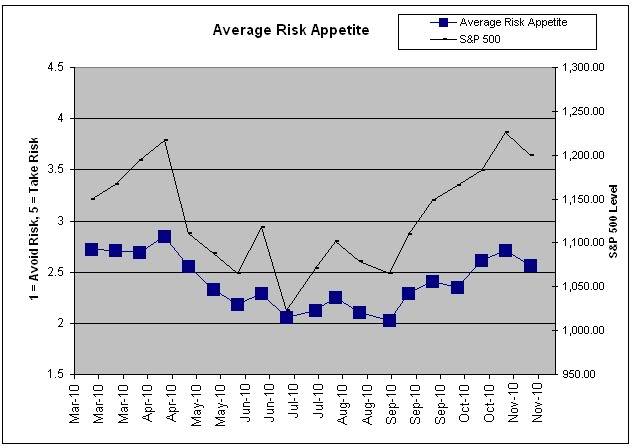
Chart 3: Average Risk Appetite. Risk appetite levels pulled back *slightly* from their recent highs. Average risk appetite fell from 2.72 to 2.56, and the word “slightly” is important here because of the relative size of the move compared to the basic fear level indicator. Looking at the raw Client Fear levels, we would expect a much larger drop in client risk appetites to go along with the rise in fear levels. We could consider this a divergence pattern, as the risk appetite held up relatively well while the fear levels caved easily on a -2% move.

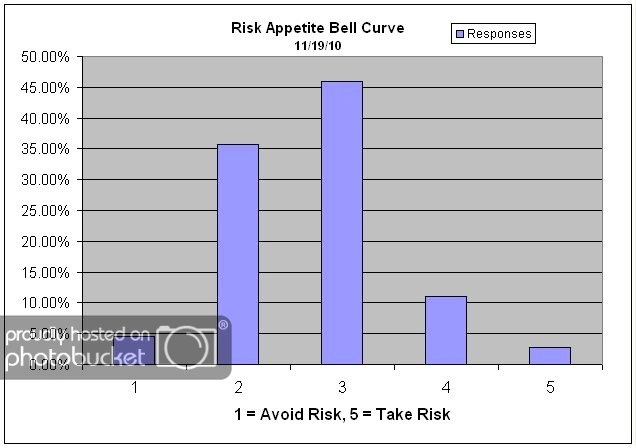
Chart 4: Risk Appetite Bell Curve. This chart uses a bell curve to break out the percentage of respondents at each risk appetite level. This week we saw the same basic pattern as the previous survey, with the majority of respondents looking for risk levels of 2 to 3.

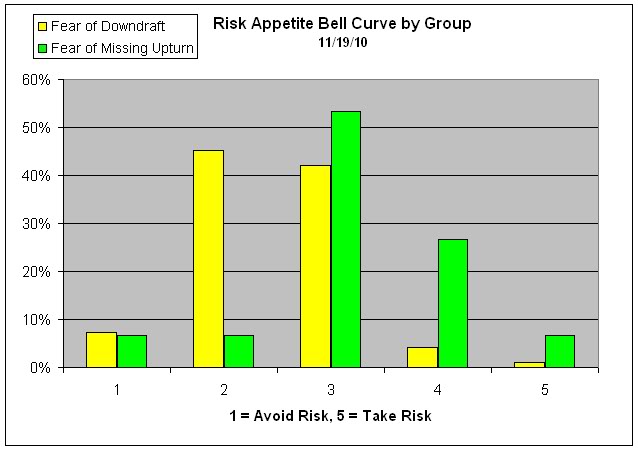
Chart 5: Risk Appetite Bell Curve by Group. The next three charts use cross-sectional data. This chart plots the reported client risk appetite separately for the fear of downdraft and for the fear of missing upturn groups. We would expect that the fear of downdraft group would have a lower risk appetite than the fear of missing upturn group and that is what we see here.

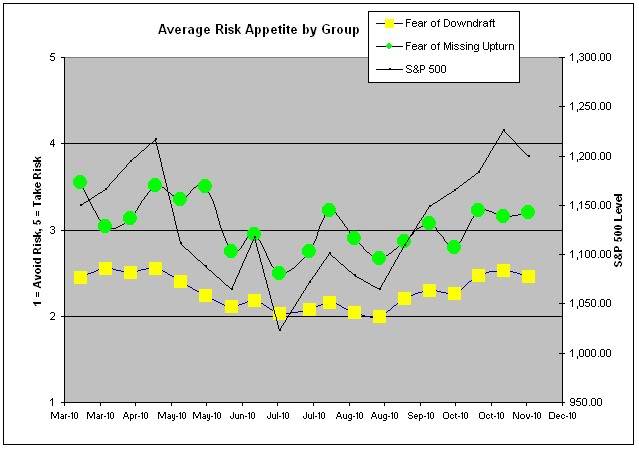
Chart 6: Average Risk Appetite by Group. A plot of the average risk appetite score by group is shown in this chart. Here again, we see more evidence of a muted move in the risk appetite of the respondents, compared to the overall fear levels. We would expect average risk appetite to move dramatically lower, in-line with the general fear levels. However, we see in this chart that client fear levels didn’t fall by that much, and in the case of the missing upturn group, average risk appetite actually moved higher.

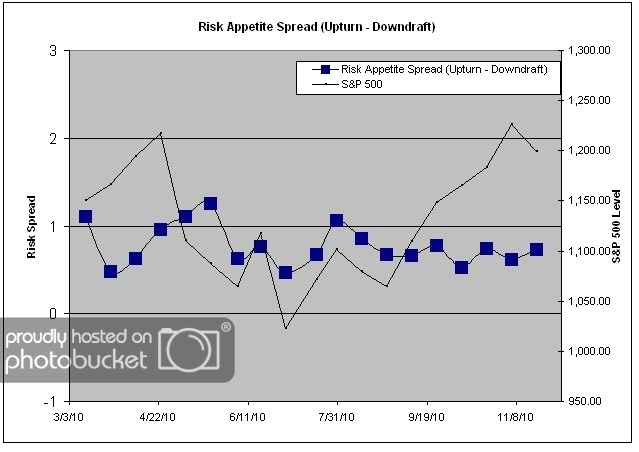
Chart 7: Risk Appetite Spread. This is a spread chart constructed from the data in Chart 6, where the average risk appetite of the downdraft group is subtracted from the average risk appetite of the missing upturn group. The spread this week rose by around .10 points this round.

The story of the survey this round would be the massive shift in client sentiment towards the fear of losing money. Right now the S&P 500 is up around 17% from the lows of the summer — that’s a big summer rally. Client fear levels have been inching lower as the rally managed to hold up, but after a -2% pullback, client fear levels have shot right back up. Clearly, market participants are NOT willing to jump into the rally with full faith. The second big story would be the muted move in average risk appetite. Client fear levels and average risk appetite have moved pretty much in-line with each other as expected, but not so on this round. Average risk appetite fell by a much smaller percentage compared with client fear levels — we’d expect to see a major shift towards lowering risk as fear levels grew. However, we saw only a minor shift towards less risk.

No one can predict the future, as we all know, so instead of prognosticating, we will sit back and enjoy the ride. A rigorously tested, systematic investment process provides a great deal of comfort for clients during these types of fearful, highly uncertain market environments. Until next time, good trading and thank you for participating!


What’s Hot…And Not

November 29, 2010

How different investments have done over the past 12 months, 6 months, and month.

1PowerShares DB Gold, 2iShares MSCI Emerging Markets ETF, 3iShares DJ U.S. Real Estate Index, 4iShares S&P Europe 350 Index, 5Green Haven Continuous Commodity Index, 6iBoxx High Yield Corporate Bond Fund, 7JP Morgan Emerging Markets Bond Fund, 8PowerShares DB US Dollar Index, 9iBoxx Investment Grade Corporate Bond Fund, 10PowerShares DB Oil


Weekly RS Recap

November 29, 2010

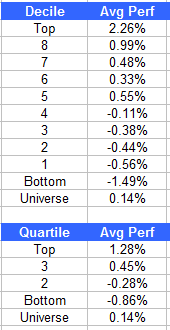
The table below shows the performance of a universe of mid and large cap U.S. equities, broken down by relative strength decile and quartile and then compared to the universe return. Those at the top of the ranks are those stocks which have the best intermediate-term relative strength. Relative strength strategies buy securities that have strong intermediate-term relative strength and hold them as long as they remain strong.

Last week’s performance (11/22/10 – 11/26/10) is as follows:

High RS stocks had another good week last week, with the top quartile outperforming the universe by 114 basis points. The Consumer Cyclical and Technology sectors (two sectors that have been market leaders for well over a year now) were again among the market leaders.