Dorsey, Wright Client Sentiment Survey - 12/31/10

December 31, 2010

Here we have the next round (and final of the year!) of the Dorsey, Wright Sentiment Survey, the first third-party sentiment poll.

As you know, when individuals self-report, they are always taller and more beautiful than when outside observers report their perceptions! Instead of asking individual investors to self-report whether they are bullish or bearish, we’d like financial advisors to weigh in and report on the actual behavior of clients. It’s two simple questions and will take no more than 20 seconds of your time. We’ll construct indicators from the data and report the results regularly on our blog–but we need your help to get a large statistical sample!

Click here to take Dorsey, Wright’s Client Sentiment Survey.

Contribute to the greater good! It’s painless, we promise.

Posted by:


Bringing About Great Good

December 31, 2010

Last night I had an opportunity to get to know a person of a quality that I have never before known. This woman, who must have been in her eighties, left me in awe and in deep thought. The world has many impressive volunteers who give of their time, talents, and resources for countless worthy causes. However, I’m not sure how many people there are in the world that would fall into the category of this woman who I sat with for several hours.

Last night, my wife and I volunteered to serve at a homeless shelter. This particular homeless shelter provided dinner, medical care, clothing, hair cuts, and showers to nearly 200 homeless in our area. The majority of the homeless had attended such shelters before and knew the flow to the evening. They knew when to sit at the tables, when to line up for the clothing, where to go for the medical care, when to quietly listen to the “message of hope” from that evening’s speaker, and when to set up a cot to sleep on. However, there were others who were there for the first time. It was our responsibility to sit with the unfortunate newcomers to help them get oriented and to give them the information about what resources they could access from the shelter. I met many people who had fallen on hard times. Some had mental challenges, some had physical ailments, and some had recently lost their jobs and had run out of options. Several seemed very bright and capable and I could sense their embarrassment for finding themselves in such a situation.

This eighty-year old volunteer who I found myself sitting next to was completely at ease. She knew and warmly embraced a number of the homeless. She whispered in their ears. I learned that she had spent the last 25 years providing nearly constant service to those in need. She was a regular at the homeless shelters. She is a nurse and volunteers on a regular basis to fly to Mexico with a team of medical doctors who provide free medical care for four days each month to long lines of people in need. Two weeks ago she was serving in an orphanage in Bolivia. She was leaving at 8 in the morning for another medical trip to Mexico. Medical service missions have taken her to India, Armenia, and many countries throughout the world. She spoke of the doctors and pilots who volunteer their services and resources. This woman seemed happy to give detailed answers to our questions. I couldn’t help but think that she probably knew that part of her role was to inspire others to join the cause. However, there was nothing pretentious about her answers. It became crystal clear that this woman devoted her life to this type of service solely for the purpose of making a positive difference in the lives of those who suffer. Did I mention this woman must have been in her eighties?

Among the questions that I had for this woman were questions about the funding for the shelters and the medical missions. I learned enough to know that there is need far greater than the level of current funding. Money truly is power. It is not everything, because money without anything else is nothing.

Being in the wealth management business, by definition, means that we serve a fortunate clientele who control great wealth. That wealth can be used for many purposes, some of which are very noble. After my experiences last night, I don’t know that I have ever felt better about what I do for a living. Our team (and all other successful money managers) have honed a skill set that has earned us the opportunity to manage large amounts of wealth that have been entrusted to us and to seek to help this money grow to much larger sums of wealth, with the knowledge that much of this money may be put to some very noble uses over time. Money truly is power, and great wealth can potentially bring about great good.

Posted by:


MPT Headache

December 31, 2010

Modern Portfolio Theory has had a rough go lately, but its apologists are still trying to find a way to make it sound plausible. There’s a lot of emotional investment in MPT because so many firms have endorsed it and so many assets are invested according to its principles. Consider, for example, the following two statements taken from the same article written by a financial advisor:

Modern portfolio theory can be a useful guide for financial advisers, but it’s just a theory. It doesn’t take into account the current economic context.

And then, a couple of paragraphs later:

MPT is only successful if it takes current economic conditions into consideration.

So, it doesn’t take current conditions into account, but it can only be successful if it takes current conditions into account? What?

That’s why I get a headache when I read this stuff.

I think I understand what he is getting at in his article-that asset allocation can’t be done mechanically through portfolio optimization. Yet, isn’t that the exact premise of Modern Portfolio Theory? Once you start actively tweaking the asset allocation based on your judgement, that’s tactical asset allocation-not a bad thing, but not MPT. When MPT advocates write articles, it seems that more often than not they backpedal into an endorsement of what everyone else calls tactical asset allocation!

Here’s one section of his article that I agree with:

…MPT assumes certain asset classes have reverse correlations — that they’re “natural hedges” for each other. But in 2008 many of those natural hedges crashed at the same time, and many investors who had put all their eggs in the MPT basket faced economic ruin.

Somehow, to me, “economic ruin” sounds slightly worse than the not-really-comforting explanation that MPT is “not that good at dealing with statistical anomalies.” Tactical asset allocation using relative strength does not make any assumptions about the correlations between asset classes and focuses entirely on current conditions, which might be a little safer bet.

Posted by:


Sector and Capitalization Performance

December 31, 2010

The chart below shows performance of US sectors and capitalizations over the trailing 12, 6, and 1 month(s). Relative strength strategies buy securities that have strong intermediate-term relative strength and hold them as long as they remain strong. Performance updated through 12/30/2010.


Posted by:


The Coming Double Dip

December 30, 2010

…probably isn’t coming anytime soon. This will no doubt be horribly disappointing to the whining prophets of doom, but according to Bloomberg today:

Businesses in the U.S. expanded in December at the fastest pace in two decades, adding to evidence the world’s largest economy is accelerating heading into 2011.

The Institute for Supply Management-Chicago Inc. said today its business barometer rose to 68.6 this month, exceeding the most optimistic forecast of economists surveyed by Bloomberg News and the highest level since July 1988.

Economists expected the number to fall; instead it hit the highest level in twenty years! Here’s an important point to keep in mind: just because the economy is doing great says nothing about where the stock market will go. It works the other way around-the strong stock market over the past 18 months was a pretty good indicator of what might happen with the economy. Right now, the wall of worry is still in place, but as it dissipates, the broad indexes could lose their fizz.

The great thing about using relative strength to drive a portfolio process is this: in order to outperform, we just need some groups to trend more strongly than others. As long as there is pretty good dispersion, we can usually cling to the strong areas and avoid the weak ones. Below, I broke out the price returns for the Vanguard domestic sector ETFs. The S&P 500 Index return is near the bottom of the list, but lackluster index returns are not necessarily an impediment to great portfolio returns. If the stock market follows the pattern following some other recession bear markets, 2011 could be another good year for relative strength.

Symbol Name Performance %
VCR Vanguard Consumer Discretionary ETF 29.61
VIS Vanguard Industrials ETF 25.71
VNQ Vanguard REIT Index ETF 23.67
VAW Vanguard Materials ETF 21.75
VDE Vanguard Energy ETF 19.47
NASD Nasdaq Composite 17.53
VOX Vanguard Telecommunication Services 16.14
VFH Vanguard Financials ETF 13.44
VGT Vanguard Information Technology ETF 12.61
VOO Vanguard S&P 500 ETF 12.59
VDC Vanguard Consumer Staples ETF 11.77
VHT Vanguard Health Care ETF 4.45
VPU Vanguard Utilities ETF 3.27

Source: www.dorseywright.com

Posted by:


Banner Year For DWAFX

December 30, 2010

2010 has been a good year for the Arrow DWA Balanced Fund (DWAFX). It is up 15.84% through 12/29/10 and is outperforming 96% of its peers in the Morningstar Moderate Allocation Category.

(Click to Enlarge)

To learn more about why this fund should be part of your business, click the links below:

What is a Balanced Fund, and Why Should You Care?

What Do Clients Really Want?

The Arrow DWA Balanced Fund (DWAFX)

The Endowment Portfolio Rides Again

Click here for disclosures.

Posted by:


Rethink Your Weighting Methodology

December 30, 2010

ETFdb has a good article on Ten New Years’ Resolutions for ETF Investors. One of their suggestions is to consider other weighting methodogies. Although it may seem like a very technical topic, weighting can make a difference:

If you achieve equity exposure through an ETF, chances are at least one of the funds you own is linked to a market capitalization-weighted index. Most equity ETFs are, simply because many of the best-known equity benchmarks are cap-weighted–meaning that weightings to individual securities are determined based on the value of components’ equity (market capitalization is equal to shares outstanding multiplied by price per share). But some investors have expressed concerns over the methodology used to construct and maintain cap-weighted indexes. Because there is a direct link between stock price and the allocation an individual security receives, there is a tendency to overweight overvalued stocks and underweight undervalued stocks.

There are a number of equity ETFs linked to indexes constructed using various other weighting methodologies, including equal-weighted and dividend weighted funds. Generally, there will be considerably overlap between these funds, with the weighting strategy being the primary difference. And while this may sound like a relatively minor twist, the impact on bottom line returns can be material.

It is true that the difference in returns can be material. They demonstrated some of the options in the following table from the article, with returns through 12/21:

ETF Weighting YTD Gain
S&P Equal Weight ETF (RSP) Equal 21.0%
FTSE RAFI U.S. 1000 (PRF) RAFI 19.0%
RevenueShares Large Cap ETF (RWL) Revenue 16.2%
WisdomTree Large Cap Dividend (DLN) Dividend 14.3%
S&P 500 SPDR (SPY) RSP 14.1%
WisdomTree Earnings 500 Fund (EPS) Earnings 12.7%

A range from 12.7% to 21.0% is certainly significant. Unfortunately, ETFdb neglected to consider another weighting methodology: relative strength weighting. The PowerShares DWA Technical Leaders Index takes the same basic universe as the ETFs in the table, but it plucks out the strongest ones and weights them by relative strength. Through 12/21, the return for the index portfolio ETF, PDP, was up 27.2%, outstripping everything listed in the table. Something to keep in mind.

Posted by:


Fund Flows

December 30, 2010

The Investment Company Institute is the national association of U.S. investment companies, including mutual funds, closed-end funds, exchange-traded funds (ETFs), and unit investment trusts (UITs). Members of ICI manage total assets of $11.82 trillion and serve nearly 90 million shareholders. Flow estimates are derived from data collected covering more than 95 percent of industry assets and are adjusted to represent industry totals.

Foreign equities have attracted the most new money for four straight weeks now. Taxable bond funds have had outflows for three straight weeks and municipal bond funds have had outflows for seven straight weeks. Change is in the air! Could it be that we are finally seeing the bond bubble burst?

Posted by:


Podcast #9 Relative Strength in 2009 and 2010

December 29, 2010

Podcast #9 Relative Strength in 2009 and 2010

John Lewis and Andy Hyer

Posted by:


Haters Gonna Hate

December 29, 2010

Earlier this year I highlighted an article by Mr. Brett Arends of the WSJ who thrashed Apple, calling for investors to take profits, or at the minimum, buy some puts to cover the risk. Apple stock is up around 100% since Arends was calling to short Apple back in 2009.

Earlier this week, I read another article by Mr. Arends on the WSJ website, Is This The Peak for Netflix? You can guess what he thinks about a stock that’s up over 250% in 2010 alone…that’s right, you should take profits!

But the game is different, and getting harder.

To me, it looks like Mr. Arends is playing the same game as always. He recommends shorting stocks that are up double digits…and continuing to short them if they become triple digit gainers. I cannot make this stuff up. If Brett Arends tells you to GET OUT or BUY PUTS, you might consider doing the opposite! Look-sooner or later, he will be right-he might even be right about Netflix. I have no better likelihood of guessing correctly than he does. It’s his job to make predictions, I suppose, but we all know predictions are unreliable.

You know what really grinds my gears about Mr. Arends? His articles are consistently at the top of the most-read and most-emailed links on the entire WSJ website! He is obviously getting paid good money to have his apocalyptic work published. Clearly, people love to hate on a winner.

Today, Mr. Arends came out with a new article, this one called, Why I Don’t Believe In This Santa Rally. With the stock market up around 10% this quarter, here’s what Mr. Arends has to say:

Two words: Bah, humbug.

The market doesn’t care what any commentator thinks should happen. Neither should you! If you’re going to read predictions, do it strictly for entertainment purposes.

Disclosure: Dorsey Wright Money Management owns Apple and Netflix in some of our portfolios.

haters gonna hate Haters Gonna Hate

.GIF credit to thisisallido.com

Posted by:


The Failure of Prediction

December 29, 2010

Bloomberg has an article today about the predictions of a number of managers that haven’t panned out. I don’t think it is useful to pan the managers for not being right all the time-after all, these managers all have good long-term track records. To me, it simply points out that even very smart people can be completely wrong when they try to guess about the future. As an example, here is one excerpt from the article:

Jeremy Grantham, Bill Miller and Donald Yacktman told mutual-fund investors that 2010 was the year to buy the biggest stocks. They’re sticking with the prediction even after getting drubbed by most of their peers.

Small and mid-size stocks almost doubled the return in 2010 of the Standard & Poor’s 500 Index, the benchmark for U.S. large-capitalization equities. Still, Yacktman and the others are making the same case for the new year as they did for the last: big companies are undervalued compared with smaller stocks, and their earnings will benefit more from faster economic growth outside the U.S.

I just don’t see the point. Whether their predictions will be right this year or not is immaterial. They have a belief that large stocks are “undervalued” relative to small companies and they choose to stick with it, whether that belief is useful or not.

Here’s the thing about beliefs: maybe you should stop thinking in terms of right or wrong, and think instead about whether the belief is useful or not. Maybe they are right that large stocks are undervalued, but that belief may or may not help them make any money. Last year it cost them money-and it cost their shareholders money. We believe simply in adapting to whatever the market gives us. That is a useful belief.

Posted by:


Job Creation and the Global Investor

December 29, 2010

Wake up, America! The world has changed. According to an AP article I saw on Yahoo!, lots of job creation is going on-just not in the U.S.:

The Economic Policy Institute, a Washington think tank, says American companies have created 1.4 million jobs overseas this year, compared with less than 1 million in the U.S.

…many American companies are [hiring] — just maybe not in your town. They’re hiring overseas, where sales are surging and the pipeline of orders is fat.

More than half of the 15,000 people that Caterpillar Inc. has hired this year were outside the U.S. UPS is also hiring at a faster clip overseas. For both companies, sales in international markets are growing at least twice as fast as domestically.

Think about that. Caterpillar has hired 15,000 new employees. Demand must be reasonably good. Business is booming. And the stock hasn’t been too bad lately either.

Source: Yahoo! Finance

Fascinating. American companies are growing like crazy, but a lot of that growth is going on outside the U.S. The value of the company’s shares is rising in the stock market, but American investors aren’t playing because the economy is still pretty tepid here.

Think about it from a different perspective. Let’s say you were a wealthy investor in Botswana, or Honduras, or Turkmenistan. Are you only going to pay attention to the local economy when making investment decisions? Of course not! If you are a citizen of a small country with a lousy economy, you look elsewhere for growth. We just happen to be citizens of a large country with a lousy economy.

Get with the program-you’ve got to look for successful companies wherever they are located (and plenty of them are in the U.S.) and wherever their growth is coming from. You need to think globally.

Disclosure: We own CAT in some of our portfolios.

Posted by:


High RS Diffusion Index

December 29, 2010

The chart below measures the percentage of high relative strength stocks that are trading above their 50-day moving average (universe of mid and large cap stocks.) As of 12/28/10.

The 10-day moving average of this indicator is 94% and the one-day reading is 92%. Nearly all high relative strength stocks continue to trade above their 50-day moving average, reflecting the breadth and persistence of this market move.


Posted by:


From the Archives: 4 Investment Rules to Ignore

December 28, 2010

Christine Benz, the personal finance expert at Morningstar, has an excellent article about the four investment rules to ignore. These “rules” are in wide practice throughout the industry, but they don’t hold up under close inspection. In fact, they will destroy your long-term returns if you let them.

1. Consistency of returns is important in investment selection.

2. If an investment has been a laggard over the past three or five years, cut it loose.

3. Your risk tolerance should determine your asset allocation.

4. It’s ok to go to cash when you are nervous about the market.

This article is a must-read.

—-this article originally ran 6/25/2009. As is the case with all timeless investment wisdom, it’s still true. Ignoring them or pretending they are false doesn’t make them any less true! There are a lot of things in the investment industry that people wish were true, but that doesn’t make it so. Read this article carefully again and get a good start on 2011.

Posted by:


Another Reason Your Portfolio Needs to Adapt

December 28, 2010

The securities market itself is adapting all the time. You’ve got to adapt to keep up. Fortune Magazine interviewed Richard Bookstaber, who is now consulting for the SEC. He discusses the difficulty of regulating markets:

What is the hardest part of securities regulation?

If you find a valve in a nuclear power plant that isn’t working right and replace it, the valve is not going to try to fool you into thinking it’s on when it’s really off. In the market, traders will try to fool you. In other words, there’s a realm of feedback and gaming that can occur in the financial markets that doesn’t occur in an engineering system. That makes developing rules much more difficult for Wall Street than for safety in engineering.

When you observe the market, the very fact that you are observing it as a regulator almost guarantees that the people in the market will react as a military adversary and develop the best defense against it. They will try to find ways around it.

The market is a feedback system. And the most accurate feedback you’re going to find is price. Price isn’t perfect, but it’s probably better than anything else.

Posted by:


What’s Hot…and Not

December 28, 2010

How different investments have done over the past 12 months, 6 months, and month.

1PowerShares DB Gold, 2iShares MSCI Emerging Markets ETF, 3iShares DJ U.S. Real Estate Index, 4iShares S&P Europe 350 Index, 5Green Haven Continuous Commodity Index, 6iBoxx High Yield Corporate Bond Fund, 7JP Morgan Emerging Markets Bond Fund, 8PowerShares DB US Dollar Index, 9iBoxx Investment Grade Corporate Bond Fund, 10PowerShares DB Oil, 11iShares Barclays 20+ Year Treasury Bond

Posted by:


Dorsey, Wright Client Sentiment Survey - 12/17/10

December 27, 2010

Our latest sentiment survey was open from 12/17/10 to 12/24/10. The survey continues to experience a “holiday malaise,” with only 72 particpants responding. Things will surely pick up once the new year gets rolling. Your input is for a good cause! If you believe, as we do, that markets are driven by supply and demand, client behavior is important. We’re not asking what you think of the market—since most of our blog readers are financial advisors, we’re asking instead about the behavior of your clients. Then we’re aggregating responses exclusively for our readership. Your privacy will not be compromised in any way.

After the first 30 or so responses, the established pattern was simply magnified, so we are comfortable about the statistical validity of our sample. Most of the responses were from the U.S., but we also had multiple advisors respond from at least two other countries. Let’s get down to an analysis of the data! Note: You can click on any of the charts to enlarge them.

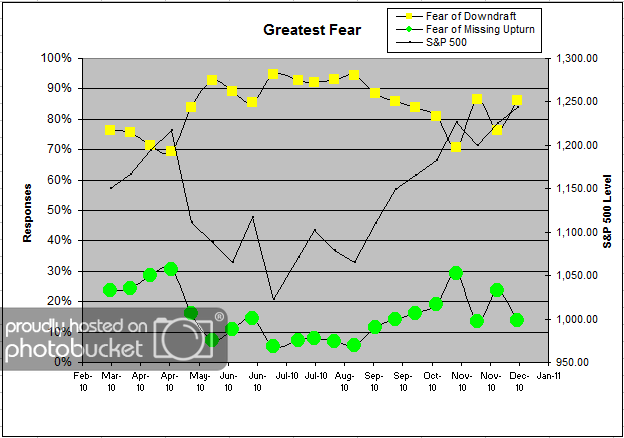
Question 1. Based on their behavior, are your clients currently more afraid of: a) getting caught in a stock market downdraft, or b) missing a stock market upturn?
 Dorsey, Wright Client Sentiment Survey   12/17/10

Chart 1: Greatest Fear. From survey to survey, the S&P 500 gained just over 1%. Surprisingly, client fear levels actually moved higher, where we would expect a drop-off in fear levels due to a rising market. We’ll accept the data as is, and partially attribute the unexpected move to the holiday season and lower participation rate. Or, we could also view it as a technical divergence (we would expect falling fear levels with rising prices). This round, 86% of respondents were fearful of a downdraft, up slightly from last round’s reading of 76%. On the flip side, only 14% of respondents were worried about missing an upturn, versus last survey’s reading of 24%.
 Dorsey, Wright Client Sentiment Survey   12/17/10

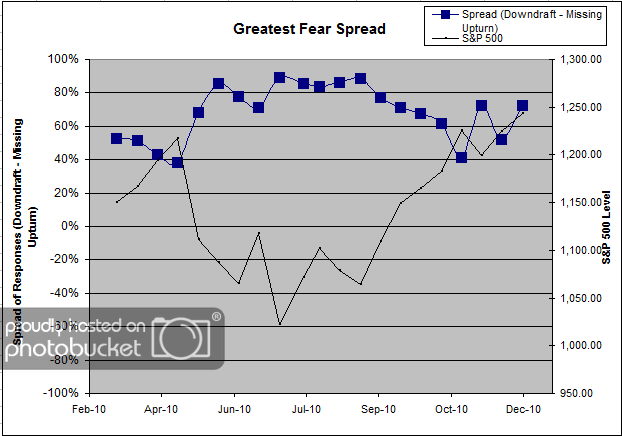
Chart 2. Greatest Fear Spread. Another way to look at this data is to examine the spread between the two groups. The spread remains skewed towards fear of losing money this round. This round, the spread rose from 52% to 72%, on account of rising fear levels.

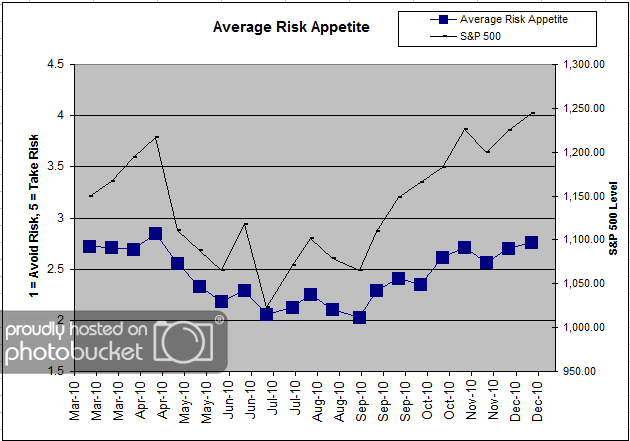
Question 2. Based on their behavior, how would you rate your clients’ current appetite for risk?
 Dorsey, Wright Client Sentiment Survey   12/17/10

Chart 3: Average Risk Appetite. Unlike the general client fear levels, the average risk appetite moved higher with market, as we would expect it to do. Average risk appetite moved to the highest levels since April, at 2.76. Keep in mind that three surveys ago (11/5), average risk appetite hit 2.71, so we would not consider this a massive breakout. Rather, we’re seeing that client risk appetite is finding the top-level of its current range and barely testing it. It’s good to see this indicator working as we hypothesize, unlike the overall client fear levels this round.
 Dorsey, Wright Client Sentiment Survey   12/17/10

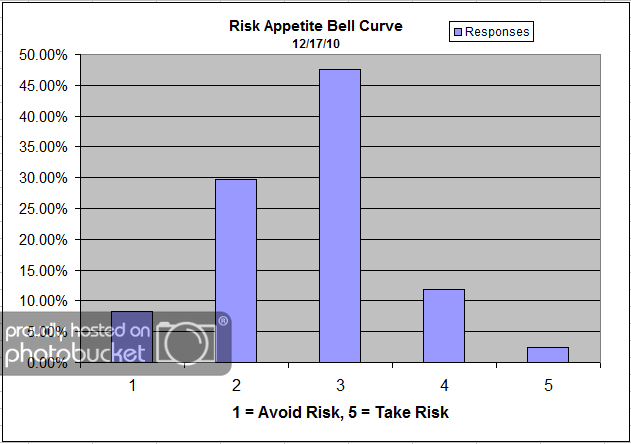
Chart 4: Risk Appetite Bell Curve. This chart uses a bell curve to break out the percentage of respondents at each risk appetite level. The most common risk appetite was 3 this round, with nearly half of all survey respondents.
 Dorsey, Wright Client Sentiment Survey   12/17/10

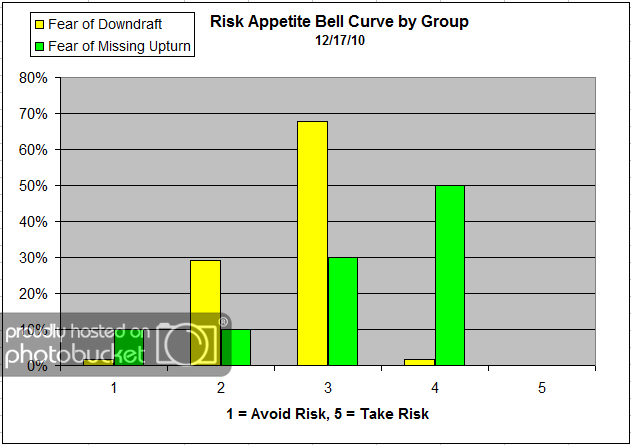
Chart 5: Risk Appetite Bell Curve by Group. The next three charts use cross-sectional data. This chart plots the reported client risk appetite separately for the fear of downdraft and for the fear of missing upturn groups. We would expect that the fear of downdraft group would have a lower risk appetite than the fear of missing upturn group and that is what we see here.
 Dorsey, Wright Client Sentiment Survey   12/17/10

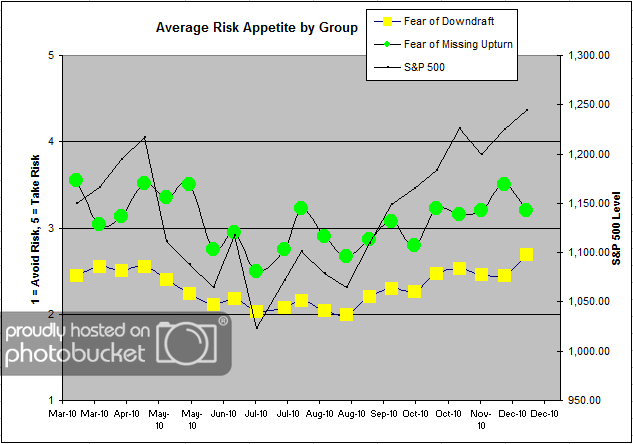
Chart 6: Average Risk Appetite by Group. We’re seeing more deviant behavior from our respondents in this chart. With a rising market, we would expect that both groups have a rising risk appetite (also consider that the overall average did move higher this round). However, the fear of missing upturn group, which has historically shown more volatility in this area, actually moved lower with a rising market. The fear of downdraft group’s average, on the other hand, moved to all-time survey highs. No matter how you slice it, the fear of downdraft’s group move higher is a statistically significant breakout. This round, the fear of downdraft group’s average risk appetite clocked in at 2.69, up from 2.45, while the missing upturn group’s appetite fell from 3.5 to 3.2. The real question is if these anomalies are due to the holiday season (tryptophan is a dangerous drug, we hear), or are they statistically valid occurences?
 Dorsey, Wright Client Sentiment Survey   12/17/10

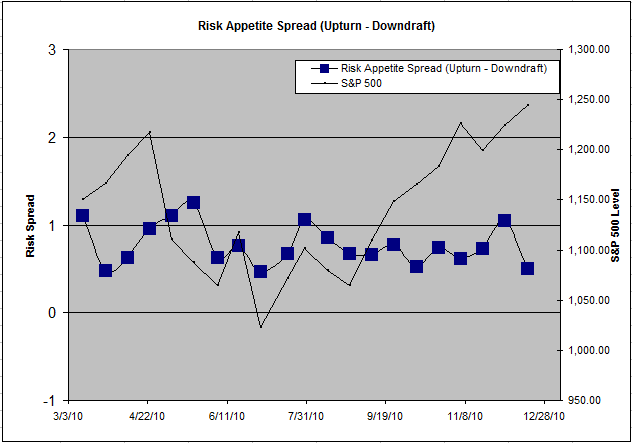
Chart 7: Risk Appetite Spread. This is a spread chart constructed from the data in Chart 6, where the average risk appetite of the downdraft group is subtracted from the average risk appetite of the missing upturn group. The spread fell dramatically this round, from around 1.0 to .50. This is due to the sharp moves in risk appetites in both groups’ averages.

We had some interesting moves in some of the indicators this round, and the floor is open to interpretation. Firstly, we saw moderately rising fear levels in a rising market. This flies in the face of what we would expect to see, in addition to what we have consistently seen in the indicator since we started the survey nearly a year ago. Instead of falling fear levels in a rising market, we have rising fear levels in a rising market. Is this just an anomaly, due to anemic holiday response? Or, could this be a technical divergence with investor sentiment forecasting a market drop (Accurate predictions? Ha Ha!)? Either way, it’s nice to have something to think about with our indicators. Usually, they do exactly what they are supposed to, and it’s fun to watch these things play out in real time.

The other story this round would be the fear of downdraft group’s average risk appetite hitting all-time survey highs. What’s doubly interesting about that reading is the fear of missed opportunity group’s risk appetite actually moved lower this round, which we would not expect. All in all, this survey had a couple of interesting nuances, but we’re probably going to see things shake out one way or the other in the first month or two of the new year.

No one can predict the future, as we all know, so instead of prognosticating, we will sit back and enjoy the ride. A rigorously tested, systematic investment process provides a great deal of comfort for clients during these types of fearful, highly uncertain market environments. Until next time, good trading and thank you for participating!

Posted by:


Paradigm Shift

December 27, 2010

Following the adage that the stock market was overvalued if the dividend yield fell below 3% worked for over 100 years, as shown in the chart below. However, imagine if you had sold all of your stocks when the S&P yield went below 3% in the early 1990s.

(Click to Enlarge)

Source: www.multpl.com

From 1990 until Dec 23, 2010, the S&P 500 Total Return Index is up 457% for an annualized return of 8.52%. Stubbornly holding to old paradigms can be costly.

Market history is full of paradigms that held…until they didn’t. This is perhaps the biggest reason to use an adaptive approach to investing.


Posted by:


Weekly RS Recap

December 27, 2010

The table below shows the performance of a universe of mid and large cap U.S. equities, broken down by relative strength decile and quartile and then compared to the universe return. Those at the top of the ranks are those stocks which have the best intermediate-term relative strength. Relative strength strategies buy securities that have strong intermediate-term relative strength and hold them as long as they remain strong.

Last week’s performance (12/20/10 – 12/23/10) is as follows:

The laggards generated better performance than the leaders last week. As shown below, Energy, Financial, and Telecomm led the way last week.


Posted by:


Early New Year’s Resolutions for 2011

December 23, 2010

Money is not the most important thing in life, but it’s right up there with oxygen.—-Dennis Miller

For those of you who like to get an early start on your resolutions, I have a list of things that might positively impact your financial well-being. Admittedly, this is the season when most Americans are preoccupied with spending money, but maybe it’s not a bad idea to also think about preserving and growing it.

1. Hire a good financial advisor. You might know a little more about what is going on, and you could end up with a lot more money. At least that was the conclusion from a recent study of 14,000 adults by ING Retirement Research.

According to the data, those who spent some time with an advisor reported saving, on average, more than twice as much for retirement as those who spent no time at all with an advisor. The number jumped even higher – over three times as much – for those who spent a lot of time with an advisor.

And yet the usage rate of advisors for this sample was a significant minority, only 31%.

2. Save more. You’re going to need it, because you are probably going to live a lot longer than you think. You’ve seen all of the statistics about how little Americans have saved or stashed into their 401ks. Do something about it. Bump your 401k savings rate up a couple of percentage points for next year. If you’re already maxing it out, start an automatic investment plan with a good mutual fund. (I am biased toward the Arrow DWA Balanced Fund!) Yes, you! Do it now before you forget about it.

3. Identify a good return factor and exploit it. Mercilessly. Relative strength and value are the most prominent return factors that have proven themselves over time. Better yet, create a portfolio that uses them both, because they mesh together very nicely.

4. Persist. Markets are going to be uncomfortable at times. You’ve got to stick with a strategy through thick and thin to reap the best returns. It’s most important not to abandon a sound strategy when it is really uncomfortable-that’s what causes investors to perform poorly.

5. If you must listen to the financial media at all, consider going opposite the accepted wisdom. A market is only news when it’s at an extreme-and that’s usually the time to consider going against the grain.

If you decide to get into shape and lose a few pounds also, great. Here’s a link to a Wall Street Journal article about how to stick to your resolutions. It’s all worthwhile.

Posted by:


Asset Allocation: Is Yours Static or Dynamic?

December 23, 2010

If your approach to providing asset allocation advice to clients is heavily influenced by mean-variance optimization, the following commentary from BNY Mellon Asset Management will probably make you a little weak in the knees.

Investors who fail to adjust their asset allocations to changing market conditions are likely to achieve disappointing returns, according to a recent report by Mellon Capital Management Corporation, part of BNY Mellon Asset Management.

“We believe the inability of a static asset allocation mix to accept new information was the main culprit behind the unrealized return expectations for many institutional investors,” said Jonathan Xiong, director, global asset allocation, for Mellon Capital. ”Investment managers need to dynamically change their asset allocations within a portfolio to reflect the most recent changes in expectations.”

Most public, corporate and endowment portfolios over the last decade have adhered to a static asset allocation, with the only changes in asset class exposures driven by market movement, according to the paper.

“A fallacy of the static allocation approach is that it assumes return expectations will not change, regardless of capital market or macro economic conditions,” said Xiong. ”Credit spreads and equity risk premiums can be volatile, and our studies indicate that changes in these factors have affected returns. Our research concludes that a five percent change in expected equity returns has the potential to shift the optimal asset allocation by more than 80 percent.”

The reality is that mean-variance optimization lacks the flexibility to deal with paradigm shifts. So asset X has generated an annualized return of Y over the past 80 years. What guarantee do you have that its annualized return over the next 10+ years won’t be +/- five percent from its long-term average? As pointed out by the research cited above, if it is +/- five percent from its long-term average then your asset allocation could be wildly off the mark. For example, if your strategic asset allocation model assumed a ten percent annualized return for U.S. equities as of the year 2000, then you ended up being off by roughly ten percent for that input over the past decade (and your portfolio suffered greatly as a result). And yet oddly enough, confidence in strategic asset allocation remains high throughout much of the industry. Is having confidence in strategic asset allocation really all that much different than having confidence in your ability to correctly predict the next four presidents of the United States?

The alternative to strategic asset allocation is tactical asset allocation which attempts to better deal with the dynamic nature of the financial markets. Furthermore, our preferred method of tactical asset allocation is strict adherence to a relative strength model. Research demonstrates that relative strength can be an effective method of asset allocation over time. It is a pragmatist’s dream because it keeps a very open mind about which asset classes are going to deliver the best returns going forward and simply keeps the portfolio fresh with those asset classes that have the best intermediate-term relative strength.

When clients have a choice between entrusting their retirement savings to the promise of an elegant, but unproven, theory of strategic asset allocation or to go with pragmatism and long-term research, I believe they will choose the latter.

Posted by:


Fund Flows

December 23, 2010

The Investment Company Institute is the national association of U.S. investment companies, including mutual funds, closed-end funds, exchange-traded funds (ETFs), and unit investment trusts (UITs). Members of ICI manage total assets of $11.82 trillion and serve nearly 90 million shareholders. Flow estimates are derived from data collected covering more than 95 percent of industry assets and are adjusted to represent industry totals.

After pouring over $240 billion in new money into taxable bond funds this year, the tide has turned in recent weeks with another $3.8 billion redeemed last week. Foreign equity funds seems to be the asset class that has gained the most attention for new money.


Posted by:


Motives Are Less Important Than Actions

December 22, 2010

Quote of the day:

The challenge of economics and to journalism is to remind us that motives are less important than actions. People lie about their motives. Look at what they do, not what they say. (Cafe Hayek via Abnormal Returns)

Which is why our investment models are based solely on following market prices-which aggregate the actions of all market participants.

Posted by:


High RS Diffusion Index

December 22, 2010

The chart below measures the percentage of high relative strength stocks that are trading above their 50-day moving average (universe of mid and large cap stocks.) As of 12/21/10.

The 10-day moving average of this indicator is 95% and the one-day reading is also 95%. Nearly all high relative strength stocks continue to trend higher.


Posted by:


Thanks a Trillion!

December 21, 2010

There have been a few articles over the last few days about the ETF marketplace gathering its first $1 trillion in assets, like this one from Index Universe. A trillion dollars is a lot even for a Congressman, and really speaks to the product acceptance in the marketplace. And while we are at it, Thank You! We would like to thank all of the Dorsey, Wright clients that have made our Technical Leaders Indexes so successful-more than $800 million in assets at the end of last week. We think it is a great way to get exposure to the high RS equity universe, but we couldn’t do it without you. You’ve made Wall Street take notice-now several other firms are coming out with products that target high relative strength stocks as well.

Best of all for investors is that relative strength has been a good return factor over the last year. Below are charts comparing PDP with the S&P 500, PIZ with EAFE, and PIE with MSCI Emerging Markets—don’t I wish every single year would be like 2010!

PDP vs SP 500

PIZ vs EFA

PIE vs EEM

Source: Yahoo! Finance

Posted by: