Who Shrunk My Kraft American Cheese?

January 5, 2011

CNBC.com has an interesting article about consumer product inflation. CNBC remarks:

According to research from Consumer Reports, many companies have been shrinking the size of the products you buy, while charging the same amount for the product.

Check out the table below from the article. Shrinking the product while maintaining the price is just a hidden price increase—and those are not small price increases! It’s kind of hard to square with the official inflation reports, which indicate there is no inflation.

Product Old Size New Size Difference
PepsiCo’s Tropicana orange juice 64 oz. 59 oz -7.8%
Procter & Gamble’s Ivory Dish Detergent 30 oz. 24 oz. -20%
Kraft American cheese 24 slices 22 slices -8.3%
Kirkland Signature (Costco) paper towels 96.2 sq. ft. 85 sq. ft. -11.6%
General Mills’ Haagen Dazs ice cream 16 oz. 14 oz. -12.5%
Kimberly-Clark’s Scott toilet tissue 115.2 sq. ft. 104.8 sq. ft. -9%
Combe’s Lanacane 113 grams 99 grams -12.4%
Chicken of the Sea Salmon 3 oz. 2.6 oz. -13.3%
Heinz’s Classico Pesto 10 oz. 8.1 oz -19%
ConAgra’s Hebrew National Franks 12 oz. 11 oz. -8.3%

Source: CNBC, Consumer Reports

The financial markets are rarely fooled as easily as government statisticians. Keep an eye on relative strength, which will likely be able to sort out the inflation winners and losers.

Posted by:


S&P 500: Broad-Based Index?

January 5, 2011

From The Reformed Broker comes a reminder about the supposedly broad-based S&P 500 index…

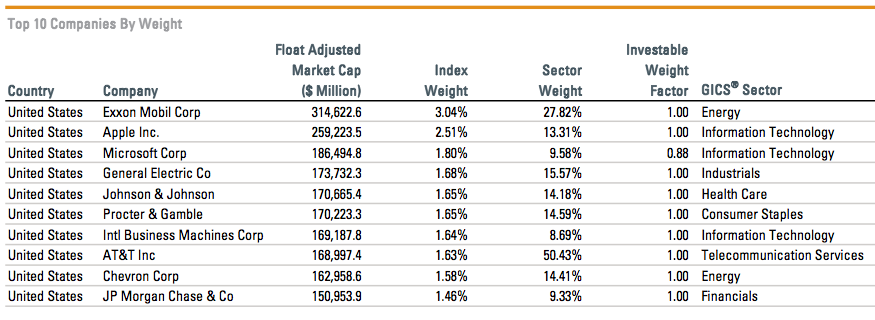
The 10 largest stocks in the S&P 500 made up 19% of the total stock market capitalization of the index as of 12/31/10. Thus, 2% of the stocks in the index (i.e., 10 out of 500) had 19% of the total value of the index. The S&P 500 is a market-cap weighted index.

spy top weightings S&P 500: Broad Based Index?

(Click to Enlarge)

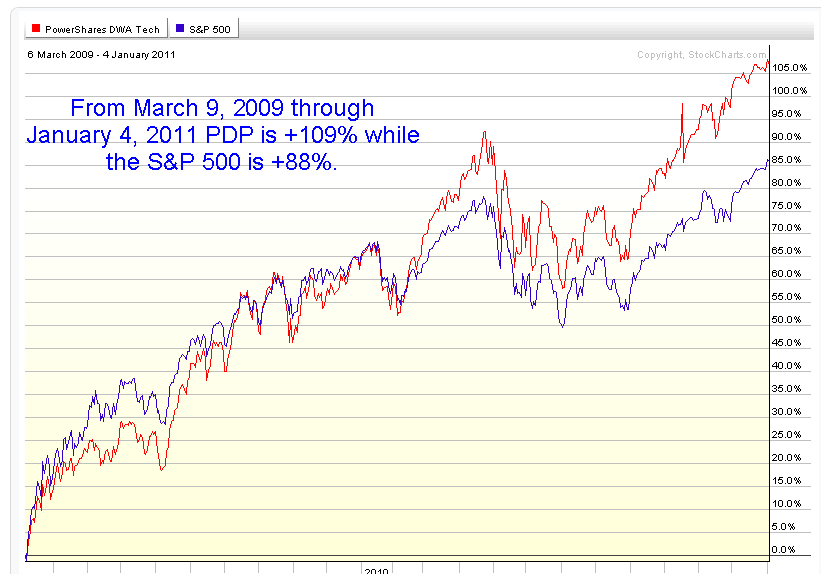
As we have previously discussed, the index-weighting methodology can make a big difference. Consider the chart below showing the difference in performance in this bull market between the PowerShares DWA Technical Leaders Index (PDP), which is relative strength-weighted, and the S&P 500, which is capitalization-weighted. The reality is that both a cap-weighted index and a relative strength-weighted index are driven by a sub-set of securities that meet a certain criteria (i.e. market capitalization or relative strength). Neither is a broad-based index. Now, it is just a question of which methodology you are more comfortable with over time.

PDP 3 S&P 500: Broad Based Index?

(Click to Enlarge), Source: StockCharts.com

See disclosures here. Past performance is no guarantee of future results.

Posted by:


Dividend Danger

January 5, 2011

Dividends are nice. Lately, they have become downright popular with the investing masses. So here is Geoff Considine, writing in Advisor Perspectives, to remind us:

The financial crisis showed that traditional metrics, such as a stock’s dividend history and its payout ratio, failed to warn investors of impending dividend cuts.

Standard and Poors’ Dividend Aristocrats index provides a well-known list of companies that have at least a 25-year track record of raising dividends every year. Even among these firms, however, there is a real risk that dividends may fall. Pfizer (PFE) and General Electric (GE), two firms that had previously been on the list of Dividend Aristocrats prior to 2009, dramatically reduced their dividends in that year, as did several other firms on the list. In all, ten of the Dividend Aristocrats were removed from the list at the end of 2009, 20% of the total.

Is nothing sacred? Apparently not-even Dividend Aristocrats can go to the dark side. Mr. Considine proposes using volatility to warn of impending problems, but I think the real key is paying attention to price. Stocks that cut their dividends almost always have poor price performance leading up to the cut because the market tends to anticipate the event. Paying attention to relative strength is usually a great way to avoid dividend danger.

RESEARCH NOTE: For example, three companies were deleted from the Dividend Aristocrats list at the end of December 2010: LLY, SVU, and TEG. All were on RS sell signals. Notably, LLY has been on a point & figure RS sell signal since 4/19/1999; SVU has had the same status since 11/14/2002. JP Lee tracked down the deletions from 2009 and 2008 for me, and when I examined them I discovered that all of them spent much or all of the deletion year on an RS sell signal. Some of the long-standing RS sell signals were in titans of American industry like GE (RS sell 9/20/2001) and PFE (RS sell 7/12/2001). Some, like 2009 deletion GCI, had a complete RS collapse while the stock went from $62 to $4. We use a much more sophisticated measurement of relative strength for our managed accounts, but even a blunt instrument like buy and sell signals on a point & figure RS chart may have promise in identifying potential dividend problems.

Posted by:


High RS Diffusion Index

January 5, 2011

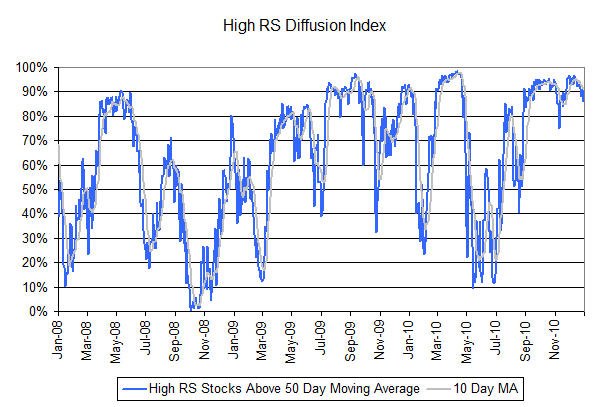
The chart below measures the percentage of high relative strength stocks that are trading above their 50-day moving average (universe of mid and large cap stocks.) As of 1/4/11.

diffusion1510 High RS Diffusion Index

The 10-day moving average of this indicator is 91% and the one-day reading is 86%. Nearly all high relative strength stocks continue to trade above their 50-day moving average.

Posted by: