Our latest sentiment survey was open from 12/31/10 to 1/7/11. We had a decent holiday bounce for participants, with 91 responses. Things will surely pick up once the new year gets rolling. Your input is for a good cause! If you believe, as we do, that markets are driven by supply and demand, client behavior is important. We’re not asking what you think of the market—since most of our blog readers are financial advisors, we’re asking instead about the behavior of your clients. Then we’re aggregating responses exclusively for our readership. Your privacy will not be compromised in any way.
After the first 30 or so responses, the established pattern was simply magnified, so we are comfortable about the statistical validity of our sample. Most of the responses were from the U.S., but we also had multiple advisors respond from at least two other countries. Let’s get down to an analysis of the data! Note: You can click on any of the charts to enlarge them.
Question 1. Based on their behavior, are your clients currently more afraid of: a) getting caught in a stock market downdraft, or b) missing a stock market upturn?
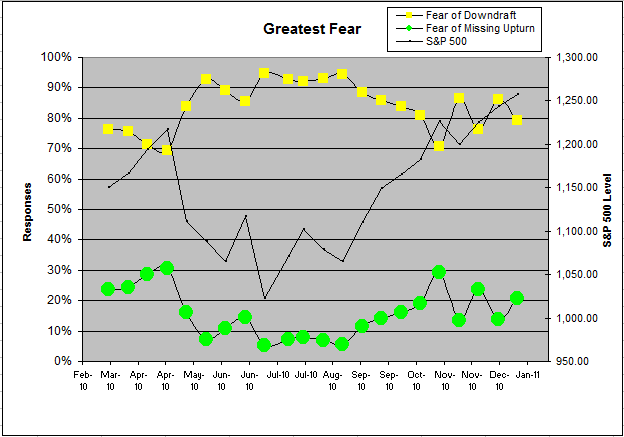
Chart 1: Greatest Fear. Same as last round, the S&P 500 gained just over 1% from survey to survey. This time, we saw a predictable drop in client fear levels, as the fear of downdraft numbers went from 86% to 79%. Since the lows of March in 2009, the S&P 500 has risen around +65%. Yet, client fear levels remain close to 80%. On the flip side, only 21% of clients are worried about missing out on a rally. What’s interesting about the fear chart patterns since November, is that the market has steadily risen, but the fear levels have been mostly choppy. What’s it going to take to get retail investors back into the market?
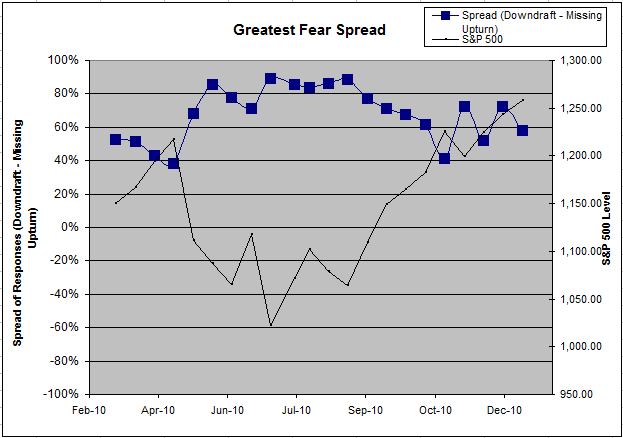
Chart 2. Greatest Fear Spread. Another way to look at this data is to examine the spread between the two groups. The spread remains skewed towards fear of losing money this round. This round, the spread fell from 72% to 58%.
Question 2. Based on their behavior, how would you rate your clients’ current appetite for risk?
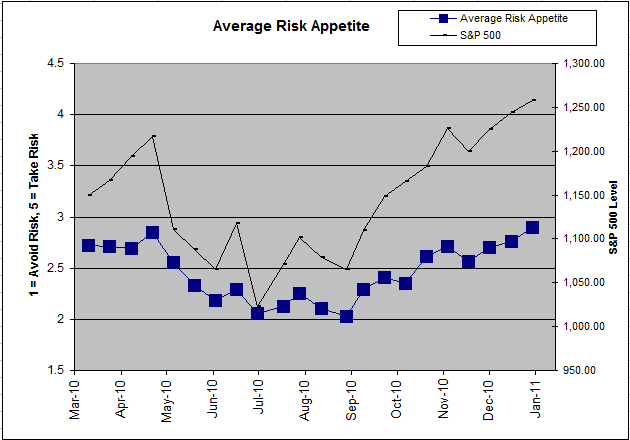
Chart 3: Average Risk Appetite. For two weeks in a row, the average risk appetite has performed exactly as expected, moving in-line with a rising market. Unlike the general fear levels, which have been choppy in a rising market, the average risk appetite is hitting all-time survey highs, just as the S&P is. This week, the overall average risk appetite was 2.90, up from last round’s reading of 2.76. There’s a couple of things to consider when taking this reading into account. First, the average risk reading is working as expected, but the general fear indicator isn’t. This could mean that clients are admitting to themselves that they are willing to take more risk in one question, but they can’t admit it in the other survey question. Again, how long can the market be up double digits year over year before clients jump in?
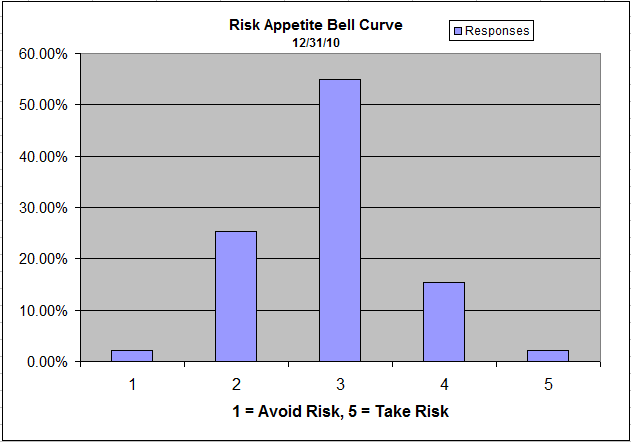
Chart 4: Risk Appetite Bell Curve. This chart uses a bell curve to break out the percentage of respondents at each risk appetite level. The most common risk appetite was 3 this round, with over half of all survey respondents.
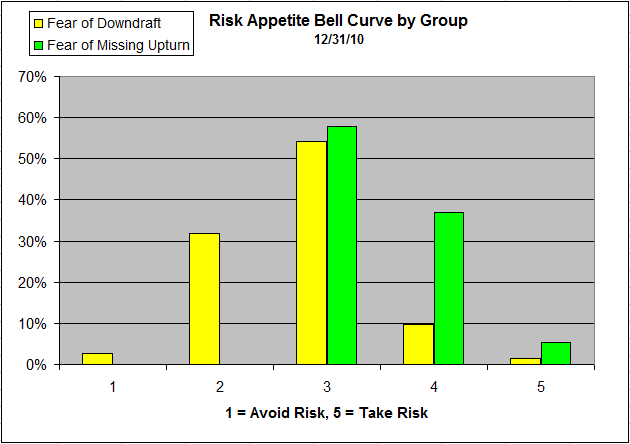
Chart 5: Risk Appetite Bell Curve by Group. The next three charts use cross-sectional data. This chart plots the reported client risk appetite separately for the fear of downdraft and for the fear of missing upturn groups. We would expect that the fear of downdraft group would have a lower risk appetite than the fear of missing upturn group and that is what we see here. Another interesting tidbit which ties along nicely with this round’s narrative is the smattering of 4′s and 5′s that the fear of downdraft group have. These are the people who are both afraid of losing money in the market, and yet are willing to add risk. There may come a time when this sub-group goes “all in” in either direction — complete safety or complete risk. At the moment, it looks like there are those who are still trying to decide what they want.
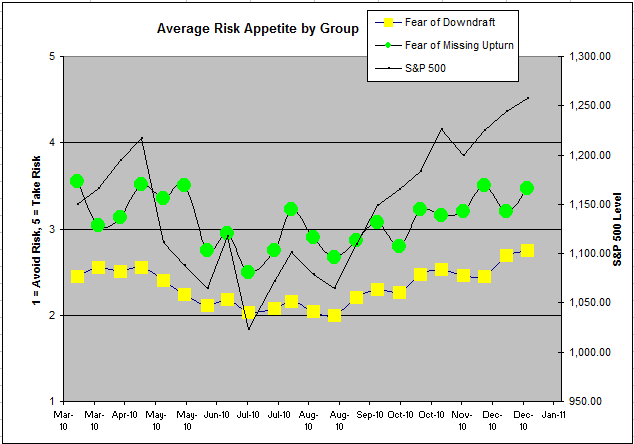
Chart 6: Average Risk Appetite by Group. Here we have a bit of a mish-mash, with the missed opportunity group piling on the risk, and the fear of losing money group barely inching higher. Keep in mind that the overall risk appetite is at all-time survey highs, so it seems like that move can be attributed to the upturn group. Last round, if you recall, we saw the upturn group risk actually fall in a rising market (not what we expect), while the downturn group moved to new highs. I was worried that the downdraft group’s risk would fall back after hitting new highs, but as you can see, it seems like the fear group is working to establish a new risk appetite base of operations.
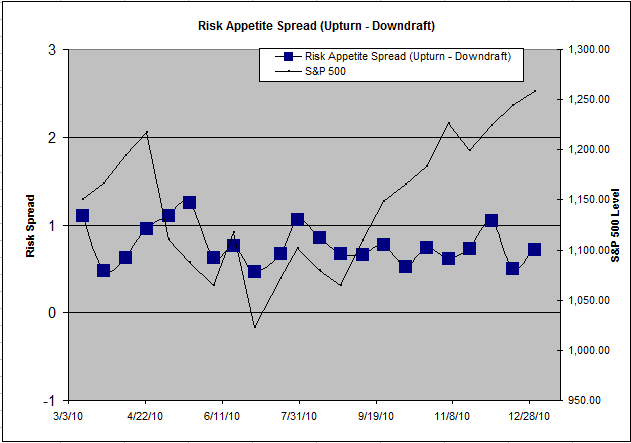
Chart 7: Risk Appetite Spread. This is a spread chart constructed from the data in Chart 6, where the average risk appetite of the downdraft group is subtracted from the average risk appetite of the missing upturn group. The spread bounced back after a nice fall last round, and seems to be working within a fairly well-defined range.
Unlike last survey, most indicators performed as expected this round. The market went up, fear levels went down, and risk appetite rose to all-time highs. Fear levels seem stuck around the 70-80% range, which seems a bit high considering the stock market’s performance over the last year and a half…it’s gone strongly higher, but clients remain scared. Fear levels are guaranteed to fall at some point if the market keeps rising; it’s just a matter of when. The overall risk appetite levels are hinting towards a broad sentiment swing, as the indicator is hitting all-time survey highs with the market. It seems like in one question, advisors see their clients acting one way (fear levels are high), and on the other, advisors see their clients acting another way (it may be time to start adding risk). Whatever happens, it’s clearly established that short-term market performance is affecting long-term outlook and sentiment, and that’s never a good thing. It’s the first survey of the year, and there’s literally no telling where we’ll be in twelve months. Hopefully our readership and participation rate will continue to grow; with more and more survey data points, we will hopefully be able to glean more information and insight from these two simple questions.
No one can predict the future, as we all know, so instead of prognosticating, we will sit back and enjoy the ride. A rigorously tested, systematic investment process provides a great deal of comfort for clients during these types of fearful, highly uncertain market environments. Until next time, good trading and thank you for participating!