Dorsey, Wright Client Sentiment Survey - 1/14/11

January 14, 2011

Here we have the next round (and first of 2011!) of the Dorsey, Wright Sentiment Survey, the first third-party sentiment poll.

As you know, when individuals self-report, they are always taller and more beautiful than when outside observers report their perceptions! Instead of asking individual investors to self-report whether they are bullish or bearish, we’d like financial advisors to weigh in and report on the actual behavior of clients. It’s two simple questions and will take no more than 20 seconds of your time. We’ll construct indicators from the data and report the results regularly on our blog–but we need your help to get a large statistical sample!

Click here to take Dorsey, Wright’s Client Sentiment Survey.

Contribute to the greater good! It’s painless, we promise.

Posted by:


RS and Value: Enlightened Asset Allocation

January 14, 2011

Several months ago, Mike made the case for replacing your traditional growth strategies with relative strength. For anyone in this business who is looking to add value through asset allocation, that post is a must read.

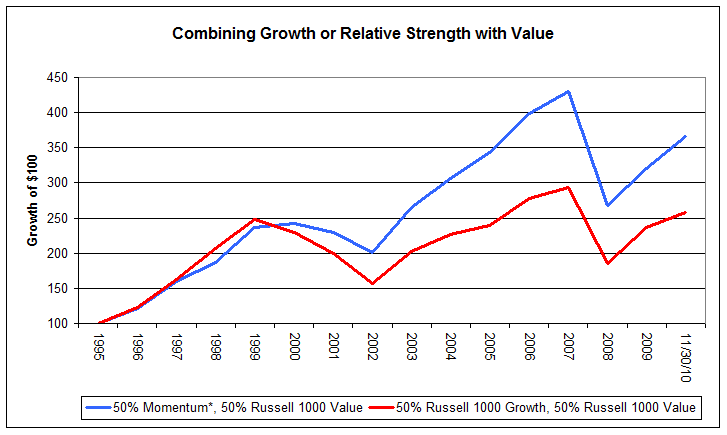
See the chart below for an example of this concept in action.

RSandValue RS and Value: Enlightened Asset Allocation

(Click to Enlarge)

Source: Ken French Data Library and Russell Investments

The red line is a 50/50 mix of the Russell 1000 Growth Index and the Russell 1000 Value Index. Combining growth and value has been industry practice for decades and chances are that most advisors follow this approach to asset allocation. However, a more enlightened approach would be to combine relative strength and value. The blue line is a 50/50 mix of a Ken French momentum index and the Russell 1000 Value Index. The data for the Ken French momentum index is taken from his online data library. That particular momentum index consists of stocks from the top half of market cap from his universe and the top third of relative strength. His index is rebalanced monthly. As shown in the chart, much higher returns were earned by mixing relative strength and value rather than the traditional approach of mixing growth and value.

Past performance is no guarantee of future returns.

Posted by:


Sector and Capitalization Performance

January 14, 2011

The chart below shows performance of US sectors and capitalizations over the trailing 12, 6, and 1 month(s). Relative strength strategies buy securities that have strong intermediate-term relative strength and hold them as long as they remain strong. Performance updated through 1/13/2011.


Posted by: