Our latest sentiment survey (and first of the year) was open from 1/14/11 to 1/21/11. We had a slight drop off in advisor respones, with 83 participants. Your input is for a good cause! If you believe, as we do, that markets are driven by supply and demand, client behavior is important. We’re not asking what you think of the market—since most of our blog readers are financial advisors, we’re asking instead about the behavior of your clients. Then we’re aggregating responses exclusively for our readership. Your privacy will not be compromised in any way.
After the first 30 or so responses, the established pattern was simply magnified, so we are comfortable about the statistical validity of our sample. Most of the responses were from the U.S., but we also had multiple advisors respond from at least two other countries. Let’s get down to an analysis of the data! Note: You can click on any of the charts to enlarge them.
Question 1. Based on their behavior, are your clients currently more afraid of: a) getting caught in a stock market downdraft, or b) missing a stock market upturn?
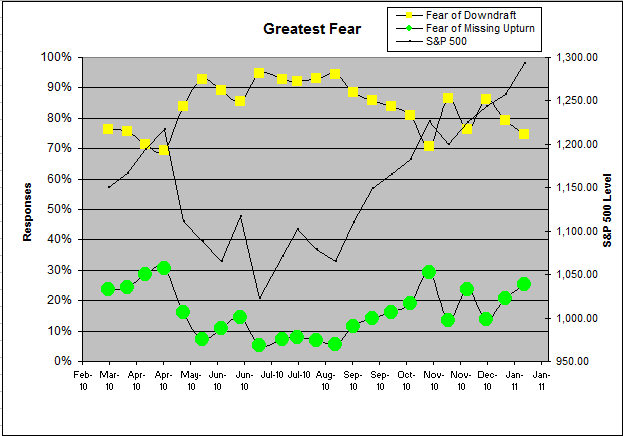
Chart 1: Greatest Fear. From survey to survey, the S&P 500 gained around +2.8%, a great start to the year. Most of the responses of this survey round came BEFORE the mid-week market correction, so keep in mind that we are analyzing data points based on when the survey was published. So, we had a great start to the year, and client fear levels dropped as expected. This survey, 75% of clients were afraid of losing money, versus 79% from last round. On the flip side, 25% of clients were afraid of missing a market rally, up moderately from the last reading of 21%. Client fear levels have been basically stuck in the 90-75% range since late October, and those support/resistance levels seem to be fairly entrenched in client behavior.
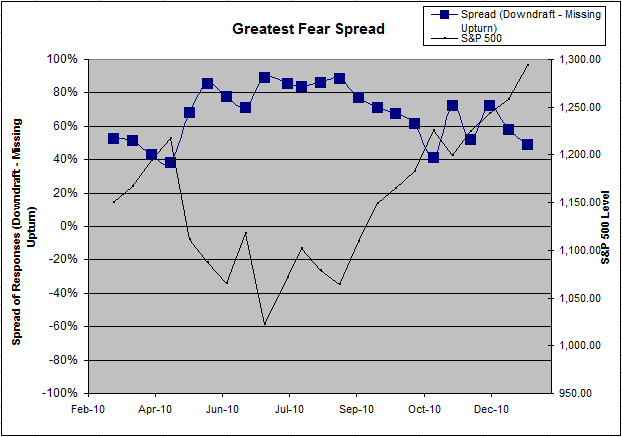
Chart 2. Greatest Fear Spread. Another way to look at this data is to examine the spread between the two groups. The spread remains skewed towards fear of losing money this round. The spread dropped slightly to 49% from the previous survey’s reading of 58%.
Question 2. Based on their behavior, how would you rate your clients’ current appetite for risk?
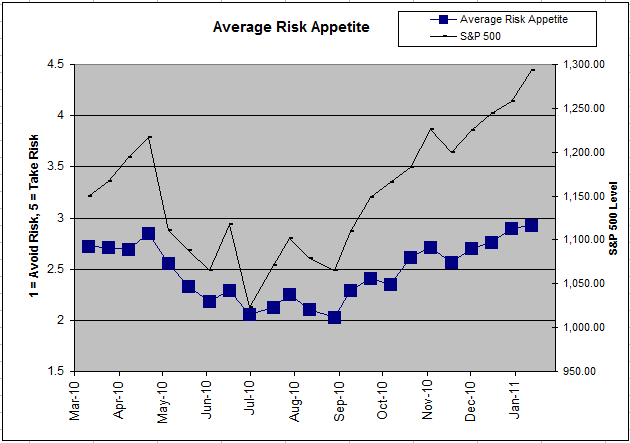
Chart 3: Average Risk Appetite. The average risk appetite number nudged its way to new highs this round, at 2.92 over last round’s 2.90. It’s great to see an indicator working exactly as we would expect it to — average risk appetite falls in a down market and rises in an up market. Some of the other indicators have been a little spotty in the recent surveys (click here), but not so for average risk appetite. As we now know, the market has taken a bit of a hit since most respondents chimed in, so we would expect to see a drop in this reading if the market continues to move lower.
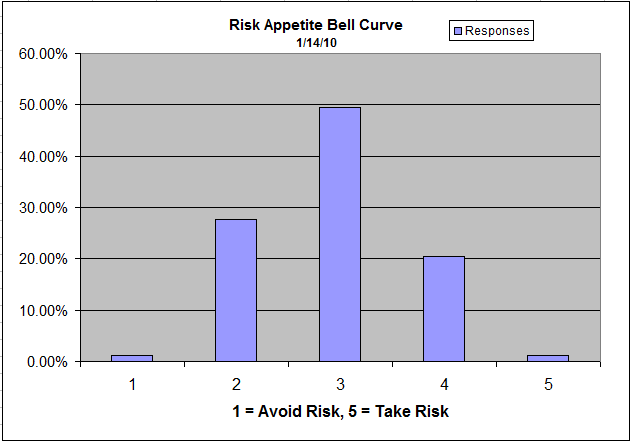
Chart 4: Risk Appetite Bell Curve. This chart uses a bell curve to break out the percentage of respondents at each risk appetite level. The most common risk appetite was 3 this round, with nearly half of all survey respondents. If you consider that the overall average was 2.92, this isn’t a surprising breakdown.
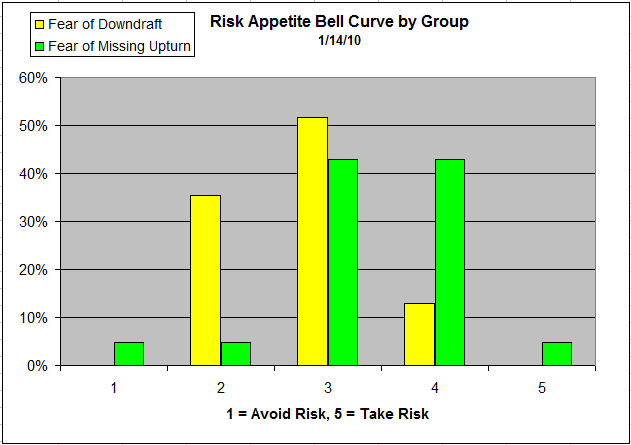
Chart 5: Risk Appetite Bell Curve by Group. The next three charts use cross-sectional data. This chart plots the reported client risk appetite separately for the fear of downdraft and for the fear of missing upturn groups. We would expect that the fear of downdraft group would have a lower risk appetite than the fear of missing upturn group and that is what we see here. The fear of downdraft group sticks close together, with only 2′s, 3′s and 4′s. On the flip side, the missing upturn group has a wide variety of responses, with a single 1 and a single 5. Again we see the fear of missing upturn group representing a wide variety of risk appetites (more volatility) while the downturn group is a more tight-knit group across the board (less volatility).
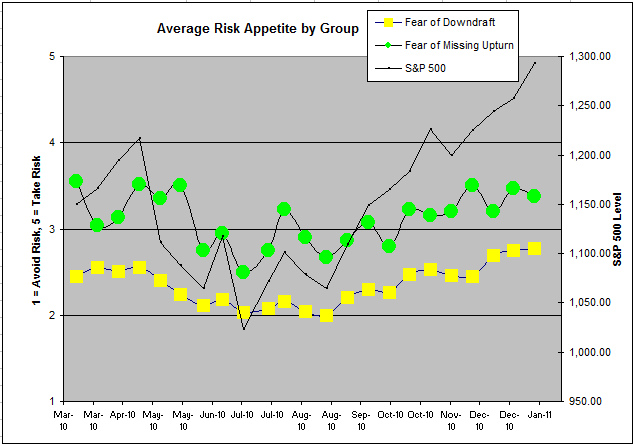
Chart 6: Average Risk Appetite by Group. We’ve noticed that this particular indicator is usually the one which performs differently than we would expect. For instance, with the market up from survey to survey, we expect both groups to have a higher risk appetite than before. It turns out that the upturn group’s risk appetite actually fell during this period, while the downturn’s group inched higher. The upturn group has historically been the more volatile of the two groups, and we see that again here. Is that extra volatility a function of the smaller sample size? Or, is that group by definition a more volatile bunch, in that the first question determines their broad risk profile (fear of losing money vs. fear of missing the rally)?
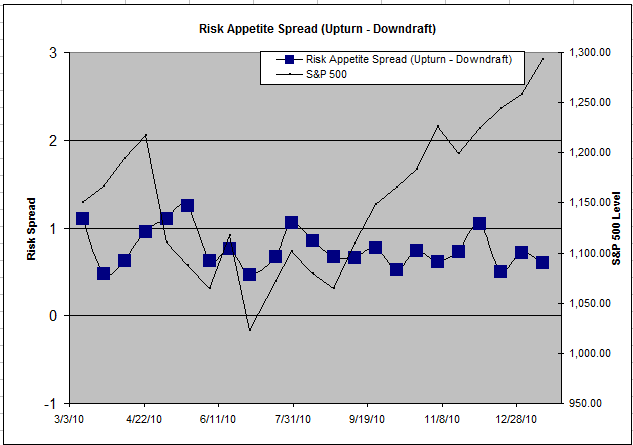
Chart 7: Risk Appetite Spread. This is a spread chart constructed from the data in Chart 6, where the average risk appetite of the downdraft group is subtracted from the average risk appetite of the missing upturn group. The spread is one of the less volatile indicators found in the survey, and seems to be trading within a fairly stable range.
This round we saw more of the same, with most of the indicators performing as expected. The market went higher, and fear levels receded a bit. Along with falling fear levels, we saw rising average risk appetite as people on the sidelines feel the need to participate in the rally. Because of the mid-week pullback, it’s important to remember that these analyses are from survey to survey, and publishing dates might not perfectly sync up with market moves. At any rate, we are still seeing short-term market performance affect long-term risk appetites, which should not be the case.
2011 is only beginning, and our indicators are performing mostly as expected. Any type of short-term anomalies are usually sorted out over the next few weeks, as we saw a month ago with rising fear in a falling market (this round was back to normal). No one can predict the future, as we all know, so instead of prognosticating, we will sit back and enjoy the ride. A rigorously tested, systematic investment process provides a great deal of comfort for clients during these types of fearful, highly uncertain market environments. Until next time, good trading and thank you for participating!

