Ignore the Extremists

January 25, 2011

From the Boston Globe comes a reminder that the forecaster who was correct about an outlier event is probably a terrible forecaster. From a study by an economist at Oxford they note:

…Denrell and Fang took predictions from July 2002 to July 2005, and calculated which economists had the best record of correctly predicting “extreme” outcomes, defined for the study as either 20 percent higher or 20 percent lower than the average prediction. They compared those to figures on the economists’ overall accuracy. What they found was striking. Economists who had a better record at calling extreme events had a worse record in general. “The analyst with the largest number as well as the highest proportion of accurate and extreme forecasts,” they wrote, “had, by far, the worst forecasting record.”

In other words, the extreme forecast gets your attention when it is correct-but you might not notice all of the other, incorrect forecasts that the pundit is making. More productive than making forecasts, we think, is to go where the market has identified leadership. Counting on a lucky forecaster-well, what are the odds of lightning striking twice?

Posted by:


Winning the Super Bowl

January 25, 2011

Every NFL team competes every week with one goal in mind: to get to the Super Bowl. No team wins every year, but every team tries to win every year. Like NFL teams, investment managers are a competitive bunch. Each year, about this time, firms wrap up their year-end performance data. We always look to see how we stack up against our direct competitors-some years great, other years not so well.

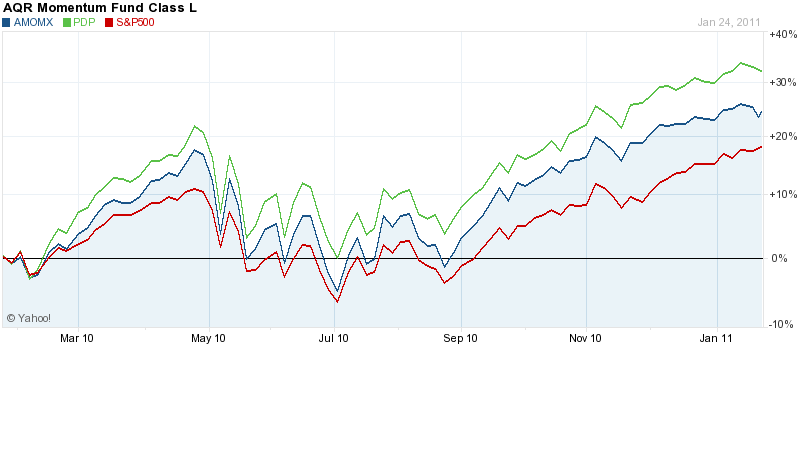
Last year, 2010, turned out to be a very good year for relative strength generally, and especially our relative strength process. The grand-daddy of relative strength indexes, the Technical Leaders Index, performed admirably against both the market and other momentum indexes. While that is unlikely to be the case every year, perhaps we should take the opportunity to do a touchdown dance now!

2010 S&P 500 total return +15.06%

AQR Momentum Index +18.60%

Technical Leaders Index +26.59%

There are some differences between the indexes, of course. The S&P 500 is the de-facto market, containing 500 companies weighted by capitalization. The AQR Momentum Index (AMOMX) contains the top third (about 300 companies) of the largest 1000 by market value. It is ranked by 12-month return and is capitalization weighted. The Technical Leaders Index (PDP) contains 100 companies from the Russell 1000, ranked by Dorsey Wright’s proprietary relative strength measure. The 100 stocks are weighted by relative strength also.

 Winning the Super Bowl

Click to enlarge. Source: Yahoo! Finance

Posted by:


Jim Simons’ “Slavish Use of Models”

January 25, 2011

Jim Simons, founder of one of the world’s most successful hedge funds-Renaissance Technologies, recently spoke at MIT about his career as a mathematician, as a hugely successful hedge fund manager, and now as a philanthropist.

Starting at the 29 minute mark (click here to view), Simons talks about how he transitioned from fundamental trading to “slavish use of models” in 1988 and how “it turned out to be a wonderful decision.” Furthermore, he stated that fundamental trading “is not a way to live your life” as a result of constantly vacillating between feeling like a genius one day and an idiot the next.

HT: Infectious Greed

Posted by:


What’s Hot…and Not

January 25, 2011

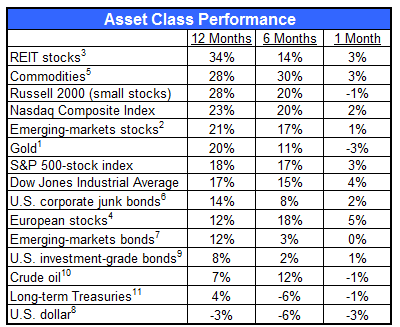
How different investments have done over the past 12 months, 6 months, and month.

assetclass12511 Whats Hot...and Not

1PowerShares DB Gold, 2iShares MSCI Emerging Markets ETF, 3iShares DJ U.S. Real Estate Index, 4iShares S&P Europe 350 Index, 5Green Haven Continuous Commodity Index, 6iBoxx High Yield Corporate Bond Fund, 7JP Morgan Emerging Markets Bond Fund, 8PowerShares DB US Dollar Index, 9iBoxx Investment Grade Corporate Bond Fund, 10PowerShares DB Oil, 11iShares Barclays 20+ Year Treasury Bond

Posted by: