DWAFX: #3 In Category In 2010

January 27, 2011

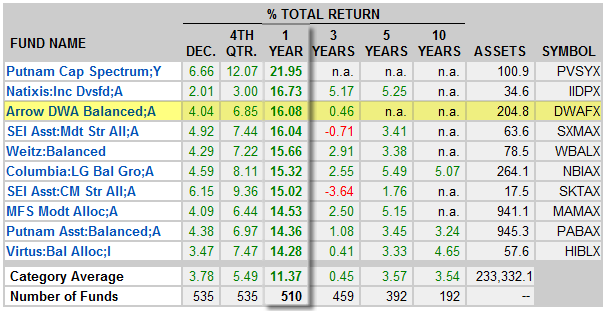
The numbers are in and The Arrow DWA Balanced Fund (DWAFX) finished 2010 +16.08% and #3 out of 510 funds in the Mixed-Asset Target Allocation Funds category for one-year performance as of Dec. 31.

dwafx 7 DWAFX: #3 In Category In 2010

(Click to Enlarge)

Source: WSJ

For more information, see www.arrowfunds.com.

Posted by:


Netflix Target Price TBD

January 27, 2011

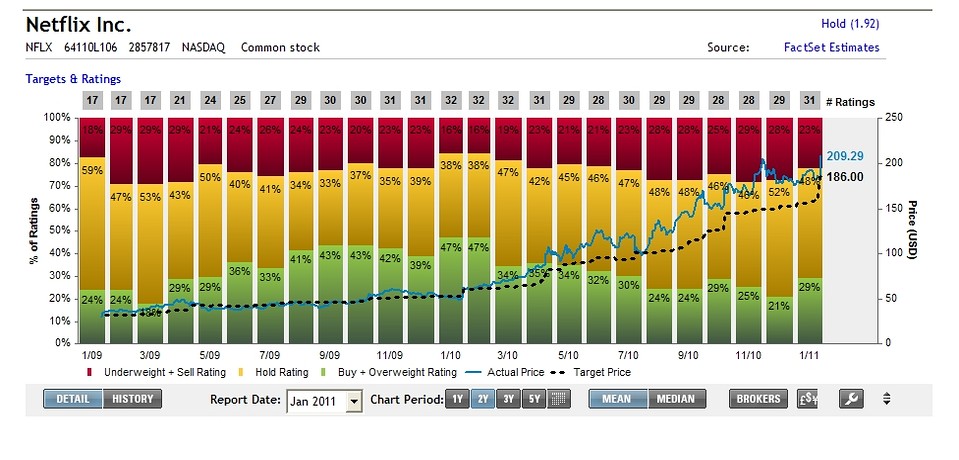
Here is a cool chart from MarketBeat. It’s from an article on Netflix in which they discussed how analysts are still playing catch-up on the stock price target. Currently, the analysts’ consensus price target is $186, but the stock is currently trading at about $210.

 Netflix Target Price TBD

Click to enlarge. Source: MarketBeat, FactSet

It’s a tough business, estimating a target price, especially when the darn stock won’t cooperate. It looks like the stock price and the consensus target were pretty aligned in 2009. In 2010, the stock charged higher and the analysts are still trying to make sense of the move. (On the other hand, the 18% of analysts that carried NFLX as a buy in March 2009 are looking pretty good.)

No doubt Netflix will top out at some point in the future-but that price is still to be determined.

Disclosure: Dorsey, Wright Money Management owns NFLX in some account styles.

Posted by:


Jeremy Grantham of GMO on Momentum

January 27, 2011

Art Cashin, the market guru at UBS, quoted Jeremy Grantham of GMO in his newsletter this morning. Am I the only one that finds it ironic that Grantham was speaking at the annual Graham & Dodd breakfast? This is Grantham discussing the economist John Maynard Keynes:

Remember, when it comes to the workings of the market, Keynes really got it. Career risk drives the institutional world. Basically, everyone behaves as if their job description is “keep it.” Keynes explains perfectly how to keep your job: never, ever be wrong on your own. You can be wrong in company; that’s okay. For example, every single CEO of, say, the 30 largest financial companies failed to see the housing bust coming and the inevitable crisis that would follow it. Naturally enough, “Nobody saw it coming!” was their cry, although we knew 30 or so strategists, economists, letter writers, and so on who all saw it coming. But in general, those who danced off the cliff had enough company that, if they didn’t commit other large errors, they were safe; missing the pending crisis was far from a sufficient reason for getting fired, apparently. Keynes had it right: “A sound banker, alas, is not one who foresees danger and avoids it, but one who, when he is ruined, is ruined in a conventional and orthodox way along with his fellows, so that no one can really blame him.”

So, what you have to do is look around and see what the other guy is doing and, if you want to be successful, just beat him to the draw. Be quicker and slicker. And if everyone is looking at everybody else to see what’s going on to minimize their career risk, then we are going to have herding. We are all going to surge in one direction, and then we are all going to surge in the other direction. We are going to generate substantial momentum, which is measurable in every financial asset class, and has been so forever. Sometimes the periodicity of the momentum shifts, but it’s always there. It’s the single largest inefficiency in the market. There are plenty of inefficiencies, probably hundreds. But the overwhelmingly biggest one is momentum…

Brilliant. I put the really good parts in bold so you wouldn’t miss it. This is an interesting explanation for momentum and might partially explain why it is always present in markets: it’s part of human nature. We just try to measure it and use it.

HT to GA.

Posted by:


Fund Flows

January 27, 2011

The Investment Company Institute is the national association of U.S. investment companies, including mutual funds, closed-end funds, exchange-traded funds (ETFs), and unit investment trusts (UITs). Members of ICI manage total assets of $11.82 trillion and serve nearly 90 million shareholders. Flow estimates are derived from data collected covering more than 95 percent of industry assets and are adjusted to represent industry totals.

ici12711 Fund Flows

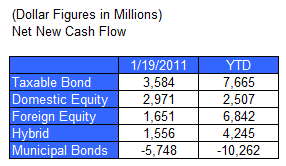
Taxable bond funds again attracting the most new money, picking up another $3.5 billion last week. However, domestic equity, foreign equity, and hybrid funds also had a nice week of inflows. Municipal bond funds continue to bleed.


Posted by:


Small Caps Forever?

January 27, 2011

Maybe Jeff Reeves is right about small caps versus large caps, maybe he isn’t. All I know is that it is quite hazardous to make any kind of claim based on three years of data. In a commentary in Marketwatch, “Investors Should Never Buy Large Cap Stocks,” this is his thesis statement:

I calculated the returns of both the S&P 500 and Russell 2000 index across the last three years. And for 33 of the past 36 months, an investor putting money into an index fund would have been better served by purchasing the small cap Russell index instead of the S&P.

After a discussion of some of the ups and downs of the last three years, he concludes:

In short, whether the market is about to take a historic flop like it did in 2008, or if it’s poised for a historic run like it saw in 2009, over the long term you are better off buying into small-cap stocks.

Take that advice at your own risk! I’m not sure that three years qualifies as the “long term.” As far as investment horizons go, that’s pretty short. There is some Ibbotson data that suggests that small caps may do better than large caps over the very long term, but that conclusion has always been in dispute. And what’s not in dispute is that markets also go through long cycles of large cap dominance.

Right now, yes, small caps are great. It’s the strongest area in the style box and our relative strength rankings like it too. But this too shall pass, and at some point another asset class or style will be dominant.

Interestingly enough, Long Term Capital Management, according to Roger Lowenstein’s book When Genius Failed, also based their convergence trades on a three-year database! They thought they had plenty of data because they had actual tick data. Their three-year database didn’t work out too well. This testing process could not contrast more with the testing process used by Dorsey, Wright Money Management. The relative strength factor has an 80+ year record of success and our unique Monte Carlo testing process makes the portfolio results repeatable and robust.

Maybe small caps will outperform from here to infinity and beyond. But I wouldn’t bet on it based on three years of selective data.
Posted by: