Dorsey, Wright Client Sentiment Survey - 1/28/11

January 28, 2011

Here we have the next round of the Dorsey, Wright Sentiment Survey, the first third-party sentiment poll.

As you know, when individuals self-report, they are always taller and more beautiful than when outside observers report their perceptions! Instead of asking individual investors to self-report whether they are bullish or bearish, we’d like financial advisors to weigh in and report on the actual behavior of clients. It’s two simple questions and will take no more than 20 seconds of your time. We’ll construct indicators from the data and report the results regularly on our blog–but we need your help to get a large statistical sample!

Click here to take Dorsey, Wright’s Client Sentiment Survey.

Contribute to the greater good! It’s painless, we promise.

Posted by:


From the Archives: Sink That Putt!

January 28, 2011

This is a fascinating piece about how golfers, consciously or unconsciously, behave more conservatively on birdie putts than on par putts, costing themselves—on average—a full stroke over 72 holes, and for a top golfer, more than $1 million in annual prize money. The reason for their conservatism is loss aversion, a psychological phenomenon noted by Nobel Prize winner Daniel Kahneman and his collaborator, Amos Tversky. In short, people try harder to avoid perceived losses than they pursue gains. Kahneman realized loss aversion is in full bloom in the financial markets, which is why (among other related investor irrationalities) he was awarded the Nobel Prize.

Articles like this point out why it is so important to have a systematic, rules-based approach to the markets. By doing so, we are able to treat every putt the same way, so to speak. A systematic approach does not vary depending on whether our last transaction was a success or a failure, or whether we’ve recently been outperforming or underperforming. We just keep pounding away at a strategy that has been shown to add value over time. By not pulling any psychological punches, we are more likely to capture whatever excess returns are available in the strategy.

—-this was originally published July 7,2009. Loss aversion reared its ugly head last year when investors became inordinately attracted to low bond yields. Now that yields are rising-and bond prices are dropping, with an assist from Meredith Whitney-the cost of loss aversion is becoming clear. To win, you have to play to win. You’re in trouble if you play to not lose.

Posted by:


Relative Strength Goes Dutch

January 28, 2011

Two very clever investment strategists at Robeco, an investment firm in the Netherlands, recently published a paper on global tactical sector allocation. They tested relative strength (i.e., momentum in academia) and several other factors to see what worked-and what continued to work after publication. Here’s what they found:

We document significant returns for momentum (1-month and 12-1 month) and the Sell in May seasonal. Interestingly, the predictive power of these factors remains after their publication dates. Although not previously tested for sectors we provide evidence which shows that sectors with positive earnings revisions outperform sectors with negative earnings revisions. We confirm the US findings of Capaul (1999) that valuation, measured as mean-reversion and dividend yield, does not work for global sector allocation. Furthermore, monetary policy fails to predict global sector returns, especially after publication date.

Although it is no surprise to us, relative strength worked in a couple of different formulations, and continued to work after the factors were published. Valuation using mean-reversion and dividend yield did not work, nor did monetary policy. Why does relative strength continue to work when other factors fail? I believe that it is because relative strength is adaptive and does not have catastrophic failures when there is a paradigm shift.

One of the nice things about relative strength is that the factor is so robust it works when measured in many different ways. Our own proprietary RS calculation is the engine behind the Global Macro strategy and the the two Arrow mutual funds that we subadvise.

HT to CXO Advisory.

To receive a brochure for our Systematic RS portfolios, please click here.

Click here to visit www.arrowfunds.com for a prospectus & disclosures. Click here for disclosures from Dorsey Wright Money Management. Past performance is no guarantee of future results.

Posted by:


New Relative Strength White Paper

January 28, 2011

A year ago, we released a white paper on our unique, Monte Carlo-based testing process which detailed the exceptional returns delivered by systematic relative strength models over time. That paper applied our testing process to a universe of mid and large cap US stocks.

We are now re-releasing Bringing Real-World Testing To Relative Strength, updated with data through 2010 (Click here to access). Additionally, the paper now includes an appendix which provides supplemental information about different relative strength factors.

Testing, such as is detailed in this white paper, has provided the insights needed to develop our family of Systematic Relative Strength portfolios. Click here to receive our brochure.

whitepaper New Relative Strength White Paper

Posted by:


Performance by Sector and Capitalization

January 28, 2011

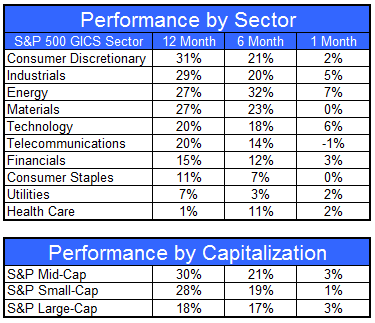
The chart below shows performance of US sectors and capitalizations over the trailing 12, 6, and 1 month(s). Relative strength strategies buy securities that have strong intermediate-term relative strength and hold them as long as they remain strong. Performance updated through 1/27/2011.

gics012811 Performance by Sector and Capitalization


Posted by: