New Technical Leaders Indexes

March 31, 2011

The Technical Leaders Indexes are indexes created by Dorsey Wright Money Management and are constituted with high relative strength securities from a given universe. We currently run three indexes: Domestic mid to large cap equity, Foreign Developed Markets Equity, and Emerging Markets Equity. These three indexes are licensed by PowerShares and can be purchased in an ETF format (Tickers: PDP, PIZ, PIE).

We are expanding the number of indexes we create. We are adding two more indexes to the Technical Leaders family. (Please note that these indexes are not licensed by any ETF sponsor so there is no vehicle to purchase them directly.)

One of the new Technical Leaders indexes will cover the Domestic Small Cap space. All of our other indexes are constituted with 100 securities, but the Small Cap Technical Leaders Index will have 200. This will still allow us to select the top decile from a small cap index like the Russell 2000, while keeping liquidity constraints in mind. To see a list of the current constituents you can click here:
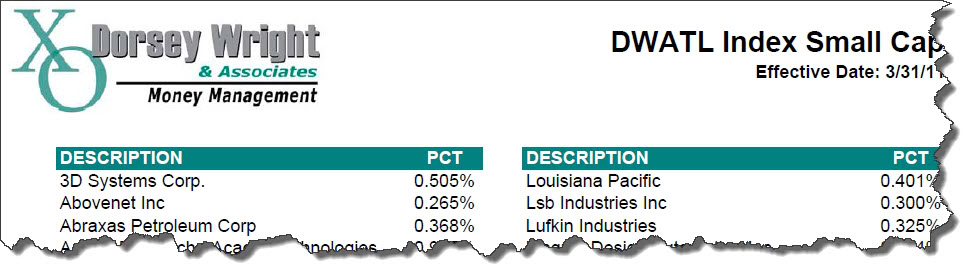
TLSmallCap New Technical Leaders Indexes(Click To Enlarge)

The second index we are beginning to publish tracks 100 high RS securities traded on the NASDAQ exchange. As you can imagine, the selection process will pull out a lot of emerging growth companies so we think this index will be very interesting to follow. For a list of the current constituents you can click here:
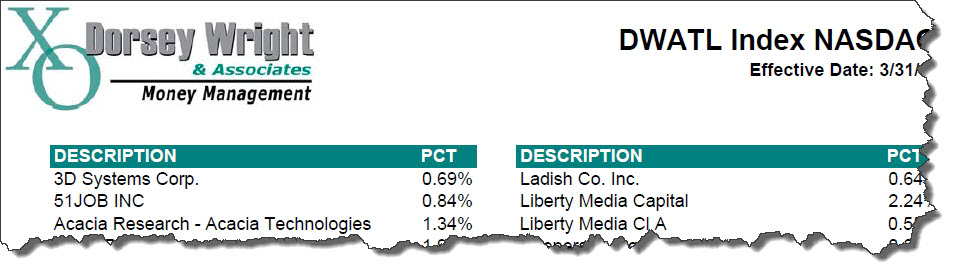
TLNASDAQ New Technical Leaders Indexes(Click To Enlarge)

Over the next couple of days I’ll post some more information about what is in the indexes. If you have any questions feel free to post them in the comments section and I’ll try to respond to them.


Investors Behaving Badly

March 31, 2011

Another reminder to stay the course comes from the article at Yahoo! Finance. It mentions a study of mutual fund returns and flows performed at Baird:

Baird looked at top-performing funds, a group that had outdone the benchmarks during the past 10 years while recording less volatility. Of the top funds, 85% had at least one three-year period when they lagged the benchmark…

It’s always good to be reminded that even the top funds go through periods when they struggle, but what tends to compound the problem is investor behavior.

Baird concluded that to succeed over the long term, investors must patiently hold funds through good times and bad. But all too often shareholders follow a self-defeating pattern. The investors buy after a fund has recorded a hot streak. When the inevitable slump occurs, the shareholders lose patience and sell at the wrong time. Consider Yacktman, which returned 12.5% annually during the past 10 years, outdoing 99% of large value peers.

Portfolio manager Donald Yacktman buys undervalued stocks with strong balance sheets and rich cash flows. During the market downturn that began in 2000, Yacktman excelled. But with stocks rallying in 2004, he slipped into the bottom quarter of the standings and stayed there for three consecutive years. Figuring that the manager had lost his touch, angry shareholders dumped the fund. Assets in the portfolio dropped from $441 million in 2005 to $293 million in 2007.

Never wavering from his style, Yacktman roared back. The fund outdid 98% of competitors in 2008 and 99% in 2009. Since then, investors have been pouring into the fund, which now has $4.2 billion in assets.

This is a very typical issue. After a year or two of subpar performance, investors often assume that a manager’s process is broken. Usually it is not. I put the key takeaway in bold: you must be patient to get outstanding results, even with excellent managers. A recent presentation I made on Ten Ways to Radically Improve Your Investment Results at a Broker Institute in Richmond counted down factors that in my estimation had the most impact on investment results. #1 was patience.

Patience is easy when things are going well. Patience is difficult when results are temporarily poor. Here’s a radical suggestion that may end up being very profitable: when you are considering dumping a strategy, turn the tables and add money instead. You’ll probably be adding somewhere near the low-exactly when investor patience is frayed-and you may have a chance of capturing both the inherent returns in the strategy and the extra bounce from a rebound.


“Dangerous Game of Probability Chicken”

March 31, 2011

We’re all aware that the US stock market has gone through numerous bear markets and has rebounded in each case. In fact, from 1802-2010 U.S. stocks generated a 7.9% annual return despite periodic set-backs (Research Affiliates, 2011.) What probably doesn’t get enough attention is a point that Rob Arnott makes in his March 2011 Newsletter:

The United States and its equity markets enjoyed good fortune. It was not invaded and occupied by a foreign power. It did not suffer a government overthrow… just ask Russian investors their return on capital after the Bolshevik Revolution! As Ben Graham might caution, beware the difference between the loss on capital (a drop in price, from which we can recover) and a loss of capital (100% loss, from which we cannot). Russia’s stock market wasn’t alone in the 20th century as three additional top 15 markets in 1900—Egypt, Argentina, and China—suffered a 100% loss of capital while Germany (twice) and Japan (once) came very close.

One of the points that Harold, John, and I discussed on our recent podcast on “Under-appreciated Risks” was the risk of having too narrow of an investment universe. Arnott makes much the same point by stating the following:

Concentrating the majority of one’s investment portfolio in one investment category, based on an unknowable and fickle long-term equity premium, is a dangerous game of “probability chicken.”

The ability to adapt and seek out the strongest trends, regardless of their geographical location or asset class, is the primary reason that I believe that our Global Macro portfolio makes so much sense to be used as a core piece of a client’s portfolio. Click here to access a 14-minute video presentation on this global tactical asset allocation strategy (financial professional only).

To receive the brochure for our Global Macro strategy, click here. For information about the Arrow DWA Tactical Fund (DWTFX), click here.

Click here and here for disclosures. Past performance is no guarantee of future returns.


Fund Flows

March 31, 2011

The Investment Company Institute is the national association of U.S. investment companies, including mutual funds, closed-end funds, exchange-traded funds (ETFs), and unit investment trusts (UITs). Members of ICI manage total assets of $11.82 trillion and serve nearly 90 million shareholders. Flow estimates are derived from data collected covering more than 95 percent of industry assets and are adjusted to represent industry totals.

Taxable bond funds again pulled in the most new money last week, bringing its YTD total to $37 billion. Hybrid and foreign equity funds had another week of steady inflows. Municipal bonds continue to bleed. And the aversion to domestic equity funds continued last week with $2.5 billion in redemptions.






