Sorry, Growth…Momentum Is Just a Better Fit

April 29, 2011

For decades the investment industry has embraced the concept of mixing growth and value. This is based on the idea that because the two styles are not perfectly correlated there are diversification benefits possible by mixing the two.

However, we frequently make the case that investors are likely to achieve better results by replacing their growth exposure with momentum. Others have also made this case. In fact, click here for an excellent white paper by AQR Capital on the topic.

As an illustration, consider the chart below which compares the performance of a momentum/value combination and a growth/value combination.

(Click to Enlarge)

Source: Ken French Data Library*, Russell Investments

The momentum index is based on an index maintained at the Ken French Data Library and is composed of US stocks from the top half of capitalization and top third of momentum in his universe. As shown above, $100 in the momentum/value combination turned into $423 while $100 in the growth/value combination turned into only $292.

Sorry, growth…momentum is just a better fit.

Posted by:


Superman Opens Global Macro Account

April 29, 2011

I think the paperwork came from an office in Smallville, Kansas. Well, not exactly. But it might not be out of the realm of possibility. In a sign that even popular culture is embracing globalization, Superman renounces his US citizenship in his most recent comic. According to a CNBC story:

Superman has started a stir with a declaration in the new issue of “Action Comics” that he intends to renounce his U.S. citizenship…The Man of Steel, who emigrated to earth as a child from Krypton and was adopted by the Kents in Smallville, Kan., comes to the conclusion that he’s better off serving the world at large…

“‘Truth, justice and the American way’ — it’s not enough anymore,” he says. “The world’s too small, too connected.”

At least that’s his story. I think he’s just upset about the declining dollar.

Citizen of the World

Source: www.theunexplainedmysteries.com

Posted by:


Lottery Winners Go Bust

April 29, 2011

I have sometimes jokingly contended that if you took all of the money in the world and divided it equally, ten years later the people who have the money now would have it again. Based on a study done by three academics at Kentucky, Pittsburgh, and Vanderbilt, there may be some support for my thesis!

Source: www.flalottery.com

Specifically, they studied lottery winners that received small to midsize jackpots ranging from $600 to $150,000 in the Florida lottery between 1993 and 2002. Then they compared bankruptcy filings for small winners (< $10,000) to big winners (> $50,000). Five years out, people who win $150,000 are just as likely to declare bankruptcy as those who win less than $10,000. There’s a lesson in the results:

“I’ve always been interested in whether you could solve people’s problems to some extent by giving them additional cash,” says Mark Hoekstra, assistant economics professor at Pittsburgh, who co-authored the paper with Kentucky’s Scott Hankins and Vanderbilt’s Paige Marta Skiba.

The study has policy implications for governments deciding how to help heavily indebted people who are struggling during economic downturns, Hoekstra says. It appears the simplest solution — giving them cash — doesn’t enhance longer-term financial stability, and only postpones, rather than avoids, bankruptcy. The lottery findings are consistent with a 2007 research paper that showed consumers initially used their 2001 federal rebate checks to reduce debt, but eventually debt returned to its pre-rebate level.

“Our research suggests that perhaps there is something more systematic about the types of people who get themselves into financial trouble — and the appropriate policy prescription for helping them out is going to be considerably more complex than giving them additional resources,” says Hoekstra.

“Winning the lottery undid any negative shock (that previously occurred) for the large winners, and they still ended up filing for bankruptcy,” Hoekstra says. “That is inconsistent with the idea that the only people who file for bankruptcy are those with negative shocks such as divorce, job loss or health issues.”

Unless people learn the basics of saving and investing, handing them a chunk of money does not seem to solve their financial problems. Advisors have a big role to play in creating financial literacy for a wider population—and apparently there is no shortage of work to be done.

Appropriate Lottery Winner Apparel

Source: www.urshirts.com

Posted by:


Sector and Capitalization Performance

April 29, 2011

The chart below shows performance of US sectors and capitalizations over the trailing 12, 6, and 1 month(s). Performance updated through 4/28/2011.

Posted by:


Technical Leaders Performance

April 28, 2011

As Mike pointed out in an earlier post, this bull market is in the middle of the pack as far as magnitude and duration. It seems like a good place to stand back and see how our Technical Leaders Portfolios have performed since the March 9th, 2009 bear market lows.

(Click to Enlarge)

We like what we see!

See www.powershares.com for more information. Past performance is no guarantee of future returns.

Posted by:


PDP: Case Study in Adaptability

April 28, 2011

The goal of any relative strength strategy is to have exposure to those securities in the investment universe that are performing relatively well while seeking to minimize exposure to those that are performing relatively poorly. Our first Technical Leaders Portfolios to begin trading is PDP, which is an index of 100 high relative strength securities. This ETF began trading on March 1, 2007 and we are pleased that it has outperformed the S&P; 500 since inception.

To illustrate this ETF’s ability to adapt and overweight strong areas of the market, see the chart below which shows the percentage of the index that has been allocated to Industrials (one of the stronger sectors over the last couple of years) and the percentage allocated to Financials (one of the weaker sectors over the last couple of years).

(Click to Enlarge)

As shown in the table below, there has been large dispersion in performance between Industrials and Financials over this period of time.

IYJ is used as a proxy for Industrials and IYF is used as a proxy for Financials.

At some point in the future, there will be another group that rises to the top and PDP will then seek to adapt to those changes. By the way, ETFdb reports that PDP is the 3rd best performing quant-based ETF year-to-date, as well as the largest.

(Click to Enlarge)

See www.powershares.com for more information about PDP.

Posted by:


Dead Economist Throwdown

April 28, 2011

From FT Alphaville, an incredibly well-produced and entertaining piece on the economic theories of Keynes and Hayek. Trust me, you’ve never seen anything like it!

Posted by:


Confirmation Bias

April 28, 2011

For every one of our failures, we had spreadsheets that looked awesome—-Scott Cook, founder of Intuit

One of the real bugaboos in finance is confirmation bias. Confirmation bias is the tendency to look for what you want to see. Coupled with cognitive dissonance—the desire to reconcile your actions and beliefs—it causes all manner of terrible decision-making.

The naive view is that we all have certain firm beliefs and we endeavor to act appropriately, so that our beliefs and actions are aligned. Lots of psychological research shows otherwise. In fact, we make decisions (act) and then construct our beliefs so as to rationalize those decisions! Confirmation bias comes in handy here, because it allows us to see what we want to see, thus making rationalization much easier.

Like Scott Cook said, anyone can construct an awesome spreadsheet, but does it actually conform to reality?

If you are a researcher into systematic investment processes, it is easy to fall into this trap. You have a great idea that should work theoretically—and when you test it, it is fantastic. Yet when you try to implement it, somehow all sorts of problems crop up. You, my friend, have just become a victim of confirmation bias.

An appropriate testing process proceeds by using the scientific method—by trying to disprove your hypothesis. You want to make sure that the phenomenon is real by testing it lots of different ways, to see if you can make it break. If the process is robust and resistant to all of your attempts to beat it up, you might have something beyond an awesome spreadsheet.

The best thing about our testing process is that it has survived and thrived in the real world—repeatedly. The reason that the Arrow DWA Balanced Fund (DWAFX), the Global Macro strategy, the Arrow DWA Tactical Fund (DWTFX), not to mention the Systematic RS separate accounts and the old Rydex Dynamic Advantage program before them, have performed well in the real world is due to a realistic and robust strategy test. The next best thing about our testing process is that all of our investment processes are designed to be adaptive. This is not to suggest they will never have losses or periods of underperformance—they can and do, like any other strategy. But when the environment changes they are designed to change along with it and conform to the new trends. Rapid trend changes always create uncomfortable adjustment periods, but investors are typically rewarded for their patience with relative strength as a return factor.

For more information on our robust testing process, you may read our whitepapers here and here. If you are interested in third-party research on relative strength, you may find resources here.

For information about the Arrow DWA Tactical Fund (DWTFX) and the Arrow DWA Balanced Fund (DWAFX), click here.

Click here and here for disclosures. Past performance is no guarantee of future returns.

Posted by:


Even the Lone Ranger Had Tonto

April 28, 2011

When you came into this world, you had nothing. And when you leave this world, you’ll take nothing with you. So don’t hate your stockbroker… He’s just doing God’s work.—-attributed to Ian McAvity

Unfortunately, many consumers seem to subscribe to Mr. McAvity’s tongue-in-cheek description of advisors. It is, however, to their detriment. Financial markets can be difficult and it’s not a good idea to go it alone. At least that is the conclusion of a 2010 study by Hewitt Associates and Financial Engines. Hewitt is one of the largest 401k custodians, so they had good access to a participant database. They looked at 400,000 401k participants between 2006 and 2008, some particularly difficult years for the market, to see how they performed and how they handled their investments. Here’s what they found:

401(k) participants who use target-date funds, managed accounts, or online advice get better returns on their retirement investments than those who do not, according to a Hewitt Associates and Financial Engines study released Monday. The median annual return for 401(k) account holders using any of these forms of investing assistance was 1.86 percent higher than among investors who choose their own investments with no guidance…

According to the study, it didn’t matter what kind of help the investors received, but the type of help tended to vary to investor type. Target-date funds tended to be used most by younger and newer employees with smaller balances. Managed accounts were the choice for older employees with the largest balances. The users of online help tended to fall in between.

Here’s the bad news: only 25% of the participants availed themselves of help! 75% chose to go it alone and suffered lower returns as a result. As Hewitt pointed out in the article, a nearly 2% gap in annual returns compounded over a working lifetime means thousands and thousands of additional dollars for retirement.

I suppose people look at the advice business with a jaundiced eye, but Hewitt’s study shows it really can make a big difference. Part of the problem may also be that retail investors have been encouraged to think that financial markets are easy and that they can handle it themselves without any problem. The E-Trade baby makes it look so simple! As an advertising gimmick it’s very effective, but the reality as shown by the Hewitt study is far different. (Click here to see what happens when the E-Trade baby gets in over his head.)

Americans have a rugged independent streak and don’t like to admit there’s anything they can’t handle, but frankly, it is ridiculous not to take advantage of help if it is available. Even the Lone Ranger had Tonto.

Posted by:


The Middle of the Pack

April 28, 2011

Although many investors are reluctant to enter the market because they feel it is tremendously overextended, Bespoke Investments shows that this bull market is in the middle of the pack as far as magnitude and duration. It’s never clear when, if, or how a bull market will end, but their data shows this one has been merely average so far!

Posted by:


The #1 Threat to US Stocks

April 28, 2011

The debt crisis spreading across parts of Europe is seen as the biggest threat to the performance of the U.S. stock market over the next 12 months, according to a survey of professional money managers.

In its latest quarterly survey of investment professionals by Russell Investments, respondents ranked European economic issues above all other major threats, with a top ranking of 73%.

Here’s the catch: this is from an article in Investment News from June 23, 2010! At the moment, the European debt crisis was big news. Now look at it, less than a year later. Besides Greece, both Ireland and Portugal have blown up and agreed to bailouts—and no one cares. Most Americans probably couldn’t find Greece on a map now.

How soon we forget that the burning problems of today are completely forgotten tomorrow! Keep your perspective about the news of the day and don’t get emotionally sucked in. Headline risk is only risk if you are making goofy decisions because of the news environment. To paraphrase G.K. Chesterton’s quip about exercise, if you have an urge to trade on news, lie down until it passes.

Source: www.wembleymattersblogspot.com

Posted by:


Fund Flows

April 28, 2011

The Investment Company Institute is the national association of U.S. investment companies, including mutual funds, closed-end funds, exchange-traded funds (ETFs), and unit investment trusts (UITs). Members of ICI manage total assets of $11.82 trillion and serve nearly 90 million shareholders. Flow estimates are derived from data collected covering more than 95 percent of industry assets and are adjusted to represent industry totals.

Investors must have serious fears of municipal bond defaults as they continue to pull money out of that asset class. The other asset classes all had strong flows, led again by taxable bond funds which have now racked up $53 billion for the year.

Posted by:


Go Active or Go Home!

April 27, 2011

That’s the reminder from this Morningstar article of the same name. Active share is a measurement of how different a portfolio is from its benchmark index. Portfolios with high active share have some worthwhile attributes, one of which tends to be long-term outperformance:

They’re not afraid to look different from their peers and the index even if it means short-term periods of underperformance, which they’ve all experienced or will almost certainly experience.

But funds with high active share scores stand a better chance of outperforming over longer periods of time than funds with only a modicum of active share. Funds with high active share scores outperform by so much that they even tend to overcome the bad effects of high expenses in the cases of funds that are burdened by them.

I put the good parts in bold. Good funds with high active share tend to perform well regardless of expenses. It’s so tiring to hear the indexing argument that low-expense funds are the only way to go. Low-expense index funds may be fine compared to full-fee closet index funds, but that’s not the whole truth.

However, to get that good performance, you need to deviate from the index in an intelligent way—and the investment organization needs to be tolerant of periodic underperformance.

Many investment organizations are not performance-driven, they’re AUM-driven. If you care only about assets under management, you can’t tolerate periods of underperformance for a year or two because retail investors tend to bail out. To keep the bulk of the retail investors around, some organizations try to hug the benchmark closely, figuring that they might never have big outperformance—but they won’t have big underperformance either—and they’ll make it up in marketing.

Over a number of years, the tendency of many firms to closet-index has led to a bad rap for active management: active managers can’t beat the index. The research on active share shows that to be completely false. Yet, when researchers look at a broad sample of “active” funds, they tend to have index performance less expenses. Why? Because a lot of “active” funds are not truly active. The retail investor is being charged fees for active management, yet is receiving a closet index fund. No wonder retail investors are confused!

Morningstar has some advice at the end of their article:

…investors need to be more vigilant, given the massive proliferation of index-hugging funds since 1980.

In the end, if you’re going to choose to pay up for active management, you may as well get it.

In other words, know what you own and make sure that you are actually getting active management if you are paying for it!

[If you had any doubt, relative strength is a proven long-term return factor that typically results in a portfolio with high active share. For example, our Systematic RS Core portfolio has an active share of 93.9%; the active share for the Systematic RS Aggressive style is typically even higher. Even our Technical Leaders Index (PDP) has an active share of 91.5%, proving that even an index fund of relative strength leaders may look very little like the S&P; 500! We think that bodes very well for their long-term performance prospects.]

See PowerShares for more information about PDP.

Click here for disclosures from Dorsey Wright Money Management. Past performance is no guarantee of future results.

Posted by:


The Plight of the Dollar

April 27, 2011

Source: www.michaelcovel.com, www.garyvarvel.com

Even budding entrepreneurs are wise to US fiscal and monetary policy!

Posted by:


Are We Seeing a Creeping Devaluation of the US Dollar?

April 27, 2011

According to Bloomberg, the creeping devaluation of the dollar may not be over:

The dollar fell to a 16-month low versus the euro on speculation the Federal Reserve will consider further easing measures to support the U.S. economy after its bond-buying program expires in June.

My emphasis. But further easing measures, with interest rates already at zero? Wow! I have no idea if this will really happen, but you might want to rethink things if you are loaded into domestic bonds. So far, commodity prices have continued to crank up as the dollar has fallen. Commodities are a reasonable inflation hedge, but most strategically allocated portfolios typically have commodities as an afterthought. Tactical portfolios (like Global Macro or DWTFX), on the other hand, often have significant commodity exposure when those assets are strong.

Click image to enlarge. Source: Yahoo! Finance

Posted by:


Looking Beneath the Veil

April 27, 2011

International investing is all the rage these days, at least in the equity business. For what little equity they’ve been buying at all, investors recentlyhave been dumping domestic stock funds and buying international stock funds. Often, this is based on an assumption like “the dollar has been going down, therefore international funds should do better than domestic funds.” This might not be having the desired effect at all. You shouldn’t avoid domestic stock portfolios on principle. The reason is that many of them have significant indirect foreign exposure. According to a Morningstar article, even the indexes have big international exposure:

Gauged according to underlying sales, after all, the S&P; 500 isn’t a domestic-stock index. It’s an international benchmark, one whose companies streamed in 46.6% of their revenue from foreign shores last year, according to S&P;’s estimates. Approximately a third of that sum, moreover, was rung up in emerging markets.

The upshot: Seen through a revenue-focused lens, Vanguard 500 and SPDR S&P; 500 aren’t plain-vanilla domestic-market trackers, and your portfolio likely tilts further in the direction of foreign fare than you might have imagined…

In other words, a plain-vanilla domestic equity account has much more ability to tilt toward international investing than commonly realized.

Posted by:


High RS Diffusion Index

April 27, 2011

The chart below measures the percentage of high relative strength stocks that are trading above their 50-day moving average (universe of mid and large cap stocks.) As of 4/26/11.

The vast majority of high relative strength stocks continue to trend higher. The 10-day moving average of this indicator is 69% and the one-day reading is 84%.

Posted by:


Thought of the Day

April 26, 2011

We can’t solve problems by using the same kind of thinking we used when we created them—-Albert Einstein

For some reason, this is the quote that keeps coming to mind when I hear the talking heads of both parties screaming about the budget deficit.

Posted by:


What is Prosperity?

April 26, 2011

Most economists are fond of measuring prosperity in terms of GDP. But according to Rob Arnott of Research Affiliates as cited in Fortune, that may not present a true picture of economic growth:

GDP that stems from new debt — mainly deficit spending — is phony: it is debt-financed consumption, not prosperity,” Arnott writes. “Net of deficit spending, our prosperity is nearly unchanged from 1998, 13 years ago.

The whole article is worth a read–and some serious thought. (It is perhaps of interest to note that the Value Line Geometric Index had a peak around 1998 also.)

Source: Yahoo! Finance

The implications for investment markets may be profound. If real prosperity is not to be found in the US at the moment, it may be necessary to broaden your investment horizons, both overseas and to different asset classes. Strategic asset allocation with a US core may need to be cast aside in favor of a more flexible tactical asset allocation approach. Relative strength, of course, is one good way to determine where returns are being made.

Posted by:


Cash is Trash

April 26, 2011

This is not new, but is perhaps interesting in relationship to our recent podcast on the US dollar. From the Los Angeles Times, here is the Fed’s contention:

The jump in oil and other commodity prices so far isn’t enough to make the Federal Reserve want to tighten credit, the central bank’s vice chairwoman said Monday.

In a speech in New York, Janet Yellen hewed to Chairman Ben S. Bernanke’s line that inflation pressures from higher commodity prices will be “transitory.”

“These developments seem unlikely to have persistent effects on consumer inflation or to derail the economic recovery and hence do not, in my view, warrant any substantial shift in the stance of monetary policy,” Yellen said.

Commodity prices have been surging, but the Fed’s current position is that it will be transitory and that they don’t plan to change monetary policy. In other words, they are not planning to raise interest rates. You have probably noticed that China, Brazil, and the European Central Bank have been raising interest rates. Those interest rate differentials are part of what is driving the US dollar lower.

Right now, cash is trash. Money market interest rates are below the level of inflation, and the declining dollar is adding to your loss in purchasing power. Cash is getting hosed in real terms right now. You can twiddle your fingers and hope the Fed is right, or you can modify your investment policy to seek out returns wherever they may be.

Posted by:


Relative Strength Spread

April 26, 2011

The chart below is the spread between the relative strength leaders and relative strength laggards (universe of mid and large cap stocks). When the chart is rising, relative strength leaders are performing better than relative strength laggards. As of 4/26/2011:

(Click to Enlarge)

After suffering through a sharply declining relative strength spread during the first half of 2009, the RS Spread has flattened out as the leaders and the laggards have generated similar performance. However, this does not mean that relative strength strategies have not outperformed the broad market since 2009. See PDP, for example. Rather, it means that the leaders have not yet pulled away from the laggards.

(Click to Enlarge)

A longer-term view shows a strongly rising, albeit uneven, RS Spread reflecting the superior performance of the strong relative strength stocks over time. It will be interesting to see if this current lull in the spread follows the pattern of 2003-2008 where relative strength really kicked in the more that the bull market aged.

See PowerShares for more information about PDP.

Posted by:


Weekly RS Recap

April 25, 2011

The table below shows the performance of a universe of mid and large cap U.S. equities, broken down by relative strength decile and quartile and then compared to the universe return. Those at the top of the ranks are those stocks which have the best intermediate-term relative strength. Relative strength strategies buy securities that have strong intermediate-term relative strength and hold them as long as they remain strong.

Last week’s performance (4/18/11 – 4/21/11) is as follows:

High RS stocks had excellent performance last week as the top quartile outperformed the universe by 0.93%. Particularly strong performance came from the Materials, Technology, and Energy sectors, as shown in the table below.

Posted by:


Dorsey, Wright Client Sentiment Survey - 4/25/11

April 25, 2011

Here we have the next round of the Dorsey, Wright Sentiment Survey, the first third-party sentiment poll. We’re also featuring a Dorsey, Wright Polo Shirt Giveaway Contest for the next few months. Participate to learn more.

As you know, when individuals self-report, they are always taller and more beautiful than when outside observers report their perceptions! Instead of asking individual investors to self-report whether they are bullish or bearish, we’d like financial advisors to weigh in and report on the actual behavior of clients. It’s two simple questions and will take no more than 20 seconds of your time. We’ll construct indicators from the data and report the results regularly on our blog–but we need your help to get a large statistical sample!

Click here to take Dorsey, Wright’s Client Sentiment Survey.

Contribute to the greater good! It’s painless, we promise.

Posted by:


Podcast #14: US Dollar Risks and Opportunities

April 21, 2011

Podcast #14 US Dollar Risks and Opportunities

Mike Moody, Harold Parker, Andy Hyer

Posted by:


Only Idiots Buy Dips

April 21, 2011

Maybe I’m overstating the case slightly, but I will note that buying the dips is a favorite strategy of retail investors. They feel like sophisticated contrarians going against the grain. How better to get street cred as a value investor?

Professionals, on the other hand, have other names for this strategy, replete with terms like knife catching, javelin catching, and catching the falling safe.

Morningstar puts to rest, hopefully for good, the dubious wisdom of trying to be a knee-jerk contrarian. The results were decidedly negative. Sorry, all you javelin-catchers:

As you can see in the table below, buying the dips hurt returns in stocks, real estate, and currencies, but not long-term U.S. government bonds. The losses are big and exceedingly unlikely to be random events. An investor who bought the S&P; 500 on dips and sold into rallies would have lagged the benchmark by 2.3% annualized since 1926. The chance of suffering such underperformance by randomly selecting months to buy the index is less than 1%.
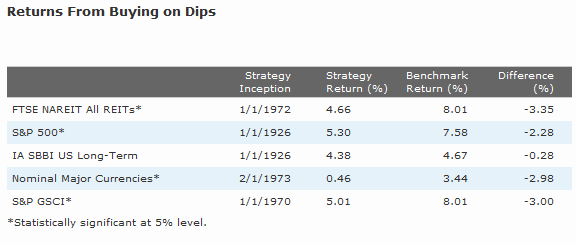
Source: Morningstar (click to enlarge)

A Suffering Retail Investor

Source: www.writers-free-reference.com

Ouch. So how does that happen? If something is a value, isn’t it supposed to be better when it falls in price? Yes—if you’ve worked up the proper valuation—which is a tricky thing not easily done. And bear in mind:

It’s possible for an asset to shed dollars and still be overpriced.

This isn’t surprising in light of momentum (aka relative strength), according to Morningstar:

The pervasive underperformance of our short-term dip-buying strategy isn’t surprising to those familiar with price momentum (sometimes abbreviated MOM in academia). The tendency for prices to trend can be tremendous. In 1993, Narasimhan Jegadeesh and Sheridan Titman published a study showing that holding the top 10% of U.S. stocks ranked by trailing 12-month returns and shorting the bottom 10%, rebalanced and reconstituted monthly, earned excess returns of 1% a month from 1965 to 1989, or more than 12% annually. The study spurred a frenzy of research that documented momentum in virtually all stock markets and asset classes, including the Victorian-era British stock market. Thanks to this rich body of research, we have a decent idea of why momentum exists and how it behaves.

To be fair, professional investors who are building valuation models often get it right, especially over a long time frame. But I’ve yet to see a retail investor work up a valuation spreadsheet. And without one, you’re probably going to get nailed:

If you’ve done the hard work of calculating an asset’s intrinsic value, and dips bring the price below intrinsic value, the strategy is a rational exercise in value investing. However, without that legwork, dip-buying is a remarkably bad technical trading rule.

I added the bold. If you are a retail investor without a valuation spreadsheet it seems a little dangerous to compete with the professionals by trying to buy the dips.

The point is, if you are going to try to trade technically, it seems far more rational to focus on relative strength. Relative strength works across virtually all markets and asset classes and has done so for a remarkably long period of time. The trend is your friend, until it ends.

Posted by: