Austerity Watch

July 19, 2011

When you find yourself in a deep hole, it is generally a good idea to stop digging. Many countries around the world have already had their ability to repay their debt called into question. As a result, they have made steep cuts in their level of debt issuance, as you can see in the chart from Clusterstock below:

Digging a deeper hole

(click to enlarge) Source: Clusterstock

Whoops! In fact, the chart show exactly the opposite. Asset-backed issuance has decreased—fewer mortgages these days—but corporate issuance has increased and sovereign issuance has exploded. Austerity has not been embraced on a global scale at all. Governments are still spending money they do not have available and covering the deficit with borrowed money.

Markets know that such spending is unsustainable, but don’t know exactly when any particular borrower will hit the wall. When lenders eventually refuse to extend credit out of concern the debt will never be paid back in full, austerity will be imposed externally. Sovereigns will have to cut back because no one will lend to them, or will lend only at unrealistic rates. Greece clearly can’t pay 30% rates; the price of the debt is simply indicating that someone is going to take a haircut. Stay tuned to see who gets shaved and how badly—and watch market pricing for the clues.

Posted by:


What’s Hot…and Not

July 19, 2011

How different investments have done over the past 12 months, 6 months, and month.

1PowerShares DB Gold, 2iShares MSCI Emerging Markets ETF, 3iShares DJ U.S. Real Estate Index, 4iShares S&P Europe 350 Index, 5Green Haven Continuous Commodity Index, 6iBoxx High Yield Corporate Bond Fund, 7JP Morgan Emerging Markets Bond Fund, 8PowerShares DB US Dollar Index, 9iBoxx Investment Grade Corporate Bond Fund, 10PowerShares DB Oil, 11iShares Barclays 20+ Year Treasury Bond

Posted by:


But, It’s Already Run Up So Much…

July 19, 2011

One of the main reasons that price momentum (aka relative strength) strategies have not been arbitraged away is because most of us are naturally born and bred contrarians. It’s just not in our psychological make-up to want to buy something that has already gone up in price, despite the fact that that is exactly what research tells us we should do. Therefore, those managers who are able to execute a relative strength strategy in a systematic fashion are in a position to do something that would likely otherwise be impossible.

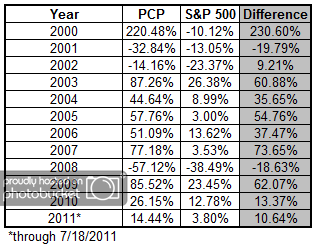
As an example, consider the performance of Precision Castparts (PCP) from 12/31/1999 - 7/18/2011. With a cumulative performance of 2,390% (compared to -11.15% for the S&P 500), PCP is among the best performing stocks in the S&P 900 over this time.

pcp But, Its Already Run Up So Much...

Honestly, without a systematic process in place, wouldn’t it have been psychologically difficult to buy PCP after many of the blowout years over this period? After all, it had already run up so much…

Disclosure: Precision Castparts is currently a holding in the PowerShares DWA Technical Leaders Index (PDP)

Posted by: