Simple. Boring. Solid savings advice from Carl Richards in What to Do If You Haven’t Saved Anything Yet.
(Even if you are actively saving and investing, the article is good motivation to keep it up.)
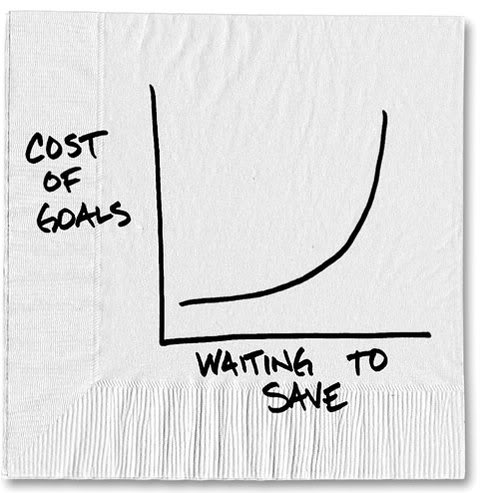
Source: Carl Richards
Simple. Boring. Solid savings advice from Carl Richards in What to Do If You Haven’t Saved Anything Yet.
(Even if you are actively saving and investing, the article is good motivation to keep it up.)
Source: Carl Richards
 Leave a Comment » |
  Retirement/Saving |
  Permalink

Posted by: Andy Hyer
Our latest sentiment survey was open from 7/15/11 to 7/22/11. The Dorsey, Wright Polo Shirt Raffle continues to drive advisor participation, and we greatly appreciate your support! This round, we had 97 advisors participate in the survey. If you believe, as we do, that markets are driven by supply and demand, client behavior is important. We’re not asking what you think of the market—since most of our blog readers are financial advisors, we’re asking instead about the behavior of your clients. Then we’re aggregating responses exclusively for our readership. Your privacy will not be compromised in any way.
After the first 30 or so responses, the established pattern was simply magnified, so we are comfortable about the statistical validity of our sample. Most of the responses were from the U.S., but we also had multiple advisors respond from at least four other countries. Let’s get down to an analysis of the data! Note: You can click on any of the charts to enlarge them.
Question 1. Based on their behavior, are your clients currently more afraid of: a) getting caught in a stock market downdraft, or b) missing a stock market upturn?

Chart 1: Greatest Fear. From survey to survey, the S&P fell -1.7%, but client fear levels managed to inch lower. Usually on any down move, we’ll see an uptick in client fear. It seems like the rally from two surveys ago (+5%) has left most clients with enough positivity to push fear levels lower.

Chart 2. Greatest Fear Spread. Another way to look at this data is to examine the spread between the two groups. Like the overall fear numbers, the spread nudged lower this round from 63% to 56%.
Question 2. Based on their behavior, how would you rate your clients’ current appetite for risk?

Chart 3: Average Risk Appetite. Unlike the overall fear numbers, the average risk appetite fell in-line with the market, from 2.68 to 2.42. If I had to pick just one indicator to gauge client sentiment real-time, it would have to be the overall average risk appetite number. For some reason, the overall number seems to follow our expectations nearly every survey. Following an up move, average risk goes up, and vice versa.

Chart 4: Risk Appetite Bell Curve. This chart uses a bell curve to break out the percentage of respondents at each risk appetite level. Fear is slowly moderating, but still in command. 2′s were the most common response this around (49%), trailed by 3′s (37%).

Chart 5: Risk Appetite Bell Curve by Group. The next three charts use cross-sectional data. This chart plots the reported client risk appetite separately for the fear of downdraft and for the fear of missing upturn groups. This chart also sorts out pretty much as expected, with the fear group wanting less risk and the opportunity group wanting more. Note there are zero responses with a risk appetite of 5.

Chart 6: Average Risk Appetite by Group. A typical result this week (and the exact opposite of last week): investors fearful of a downturn had a lower risk appetite, while investors fearing missing an upturn increased their risk appetite. The opportunity investors seem ready to add risk despite a minor pullback.

Chart 7: Risk Appetite Spread. This is a spread chart constructed from the data in Chart 6, where the average risk appetite of the downdraft group is subtracted from the average risk appetite of the missing upturn group. The spread shot right back up on the market downswing, after falling last round.
This survey round presents a few anomalies. First, the overall fear numbers did the opposite of what we would expect in a falling market. We saw a continued drop in fear levels, despite a market pullback. I’d guess that move could be explained as a follow-through from the survey before, when we saw fear levels plummet on a +5% market move. On the other hand, we saw average risk appetite move in-line with the market, falling as the market dropped. The overall average risk appetite numbers continue to perform the most consistently through the week-to-week market noise.
No one can predict the future, as we all know, so instead of prognosticating, we will sit back and enjoy the ride. A rigorously tested, systematic investment process provides a great deal of comfort for clients during these types of fearful, highly uncertain market environments. Until next time, good trading and thank you for participating.
Leave a Comment » | Investor Behavior, Markets, Sentiment | Permalink
Posted by: JP Lee
Investment News on the role of proper due diligence:
Looking at a portfolio manager’s track record is one thing, but understanding how he or she achieved it, and whether it can be repeated, is another story and something that financial advisers should consider when selecting funds for their clients, according to those who study investor behavioral trends.
We agree — which is why we have released two white papers that, we believe, will help anyone become comfortable with relative strength strategies:
Relative Strength and Asset Class Rotation, John Lewis, CMT
Bringing Real-World Testing To Relative Strength, John Lewis, CMT
Leave a Comment » | Relative Strength Research | Permalink
Posted by: Andy Hyer
According to John Tamny’s piece at Real Clear Markets, the US has already defaulted on its debt. He uses Rogoff and Reinhart’s discussion of US finances in the 1930s:
In their 2009 book, This Time Is Different, economists Carmen Reinhart and Kenneth Rogoff singled out Australia, Canada, New Zealand and the United States as countries that have never defaulted, or more specifically, have “never outright failed to meet their external debt repayment obligations or rescheduled on even one occasion.” Of course, as they later acknowledged on the same page, there are other ways to default.
There is traditional default whereby creditors experience a “haircut” or a delay in payments, and then there’s a stealth default. Looked at in terms of stealth defaults, all those countries, including the U.S., have most definitely stiffed creditors over the years.
Reinhart and Rogoff in particular pointed to a U.S. default in the 1930s. As they wrote, “the abrogation of the gold clause in the United States in 1933, which meant that public debts would be repaid in fiat currency rather than gold, constitutes a restricting of nearly all the government’s domestic debt.”
In short, the U.S. defaulted in 1933, and as evidenced by the dollar’s stupendous decline in value from 1/35th of an ounce of gold in 1971 (in private markets a dollar bought roughly 1/45th of an ounce of gold at the time in question) to 1/1550th today, the U.S. has been in default for most of the last 40 years.
Source: US Presswire
The important point here is that their are lots of ways to get a haircut. (I added the bold above.) It can be explicit, as in “we’re not giving you all of your money back,” or it can be disguised, as in “here’s your dollar back, but it’s only worth 50 cents.” Just because someone tells you you’re getting your money back doesn’t mean you’re not taking a haircut!
Don’t be naive about financial markets. You can’t fake reality, and if someone can’t afford to pay you back, you’re going to take a haircut somehow. This has been obvious in Greece for a while now, apparently to everyone but the European finance ministers. Greece has had five sovereign defaults in the past—why would they stop now?
Instead of taking a haircut, perhaps you should consider taking your money where it has a chance to appreciate. Relative strength might help you identify some of the likely candidates.
Leave a Comment » | Markets, Thought Process | Permalink
Posted by: Mike Moody
The table below shows the performance of a universe of mid and large cap U.S.equities, broken down by relative strength decile and quartile and then compared to the universe return. Those at the top of the ranks are those stocks which have the best intermediate-term relative strength. Relative strength strategies buy securities that have strong intermediate-term relative strength and hold them as long as they remain strong.
Last week’s performance (7/18/11 – 7/22/11) is as follows:
It was an up week for all relative strength quartiles last week, but the strongest performance came from the relative strength laggards.
Leave a Comment » | Markets | Permalink
Posted by: Andy Hyer
You are currently browsing the Systematic Relative Strength blog archives for the day Monday, July 25th, 2011.








