Global Macro Video

August 3, 2011

When a manager is given the flexibility to seek out the strongest trends from a global investment universe the probability of finding good investment opportunities increase significantly. Effectively allocating among a broad range of asset classes (US equities, international equities, currencies, commodities, real estate, fixed income, and inverse equities) is precisely the goal of our Global Macro portfolio.

Please click here to view a 14 minute video about this portfolio

To receive the brochure for our Global Macro strategy, click here. For information about the Arrow DWA Tactical Fund (DWTFX), click here.

Click here and here for disclosures. Past performance is no guarantee of future returns.


“The Italian Finance and Banking System is Solid”

August 3, 2011

The Wall Street Journal carried a denial from Italy this morning:

Economy Minister Giulio Tremonti convened a meeting of top Italian officials, who later released a statement noting that Italy has been hit by “tensions stemming from international uncertainty.” It added, “The Italian finance and banking system is solid.”

Of course, in the usual topsy-turvy world of politics, a denial is often a form of confirmation. Portugal, Ireland, and Greece all made official statements of denial before eventually taking bailouts as well.

What may be more telling is the price action—that’s the story behind the story. Judging from the price action in Italy and Spain, they may be the next to have problems. The same Wall Street Journal article included a nice graphic showing stock and bond market performance of the two countries.

If you have a choice between believing the market or believing the finance minister, I’d go with the market every time. You may still be wrong occasionally, but the odds are in your favor.

If you’re an investor, you can try to keep up with the news and all of the subsequent revisions or you can just watch how the market is handicapping things. Since relative strength models run on relative price performance, they use the market data exclusively. It allows the portfolio to adapt as market expectations change-or don’t change, as the case may be. That’s why tactical asset allocation makes sense.

Of course, in many cases, the day-to-day news is just noise and the underlying trend persists.

2 Years of Underlying Trend

Source: Yahoo! Finance

This chart is pretty clear, I think. Let’s put it in the form of an easy multiple choice question. Which is more reliable: a) your own two eyes, or b) a politician? If what you can see—the price action—is ultimately more reliable that what is said, why are you listening to the news?


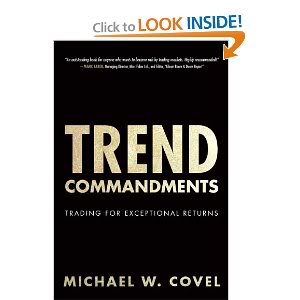
Book Review: Trend Commandments

August 3, 2011

Like all of Michael Covel’s prior books, Trend Commandments is well-written. The first time through, I read it in one sitting. However, it is quite different in style and intent from Trend Following and The Complete Turtle Trader. Trend Following introduced an unfamiliar approach to trading, to many people for the first time. This book is about more than the tenets and background of trend following. Trend Commandments is an inspirational piece and exhorts the reader to stop making excuses and go out and do something about it. This book is also about mindset and motivation.

Trend following is not complicated. Mr. Covel points out that you need answers to only five questions: 1) what market do you buy or sell at any time? 2) how much of a market do you buy or sell at any time? 3) when do you buy or sell a market? 4) when do you get out of a losing position? and 5) when do you get out of a winning position?

The tough part of trend following is in the doing. Mr. Covel discusses the discipline required and the psychological mindset needed in a very entertaining and systematic way. In approximately 60 short chapters, he hits on nearly every trend following topic imaginable—from many different angles. There’s tremendous throughness here, which may bother some readers, but it’s mostly because so many parts of the trend following mindset are interrelated. When you see something and you think to yourself ”didn’t he just say that a couple of chapters ago?” you’ll find that it wasn’t quite the same and that he is simply exploring a closely related topic from another angle.

When I say it is both thorough and entertaining, you still might not have the right idea. The bibliography ranges from Bill James to Seth Godin to Ludwig von Mises. There are citations ranging from the movie The Matrix to the Greek philosopher Epictetus to the Smashing Pumpkins—and that’s just in the first two chapters. That might give you a better flavor for how much fun this book is to read.

Beyond just a discussion of risk and reward and the tenets behind trend following, Covel’s argument is essentially a moral one about initiative, self-reliance, and accountability—things that are sorely lacking in our culture today. Without a strong moral core, you’re not going to succeed in anything, least of all investing.

In short, the book covers the waterfront on trend following and Covel makes his points well. If you don’t understand trend following as an investment approach after reading this book, well, maybe the light is never going to come on for you.

In a world awash in fundamental forecasts, self-appointed gurus, false prophets, efficient marketeers, modern portfolio theorists, high-volume gong-ringing market commentators, and a public (along with much of the investment industry) striving for safety in the middle of the herd, going it alone as a trend follower is certainly the road less taken. And that may make all the difference.

High RS Diffusion Index

August 3, 2011

The chart below measures the percentage of high relative strength stocks that are trading above their 50-day moving average (universe of mid and large cap stocks.) As of 8/2/11.

In under a month, this index has fallen from over 90% to yesterday’s measure of 26%. Dips in this index have often provided good opportunities to add to relative strength strategies.






