Dorsey, Wright Client Sentiment Survey - 9/23/11

October 3, 2011

Our latest sentiment survey was open from 9/23/11 to 9/30/11. The Dorsey, Wright Polo Shirt Raffle continues to drive advisor participation, and we greatly appreciate your support! This round, we had 87 advisors participate in the survey. If you believe, as we do, that markets are driven by supply and demand, client behavior is important. We’re not asking what you think of the market—since most of our blog readers are financial advisors, we’re asking instead about the behavior of your clients. Then we’re aggregating responses exclusively for our readership. Your privacy will not be compromised in any way.

After the first 30 or so responses, the established pattern was simply magnified, so we are comfortable about the statistical validity of our sample. Most of the responses were from the U.S., but we also had multiple advisors respond from at least two other countries. Let’s get down to an analysis of the data! Note: You can click on any of the charts to enlarge them.

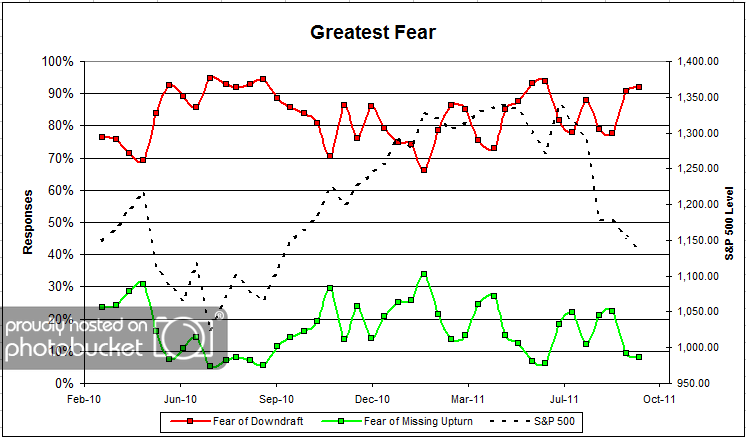
Question 1. Based on their behavior, are your clients currently more afraid of: a) getting caught in a stock market downdraft, or b) missing a stock market upturn?
greatestfear 39 Dorsey, Wright Client Sentiment Survey   9/23/11

Chart 1: Greatest Fear. From survey to survey, the S&P fell around -1.5%, and client fear levels nudged only slightly higher after a major move last round. This round, client fear levels rose from 91% to 92%, while the opportunity group fell from 9% to 8%. Client sentiment remains in the pits as the stock market continues to suffer the effects from an overall dreadful summer.
greatestfearspread 40 Dorsey, Wright Client Sentiment Survey   9/23/11

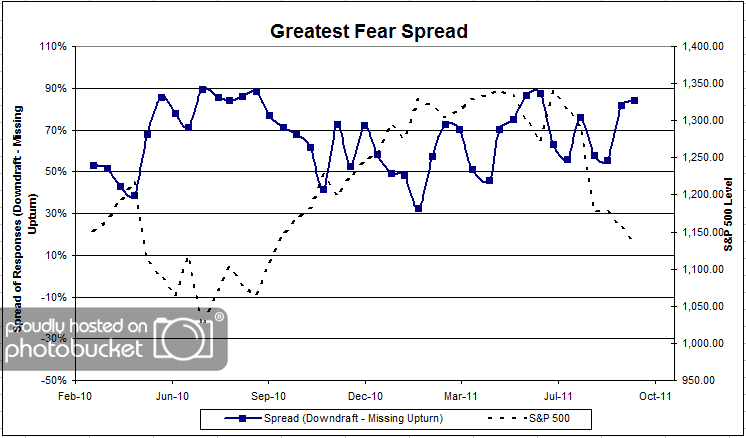
Chart 2. Greatest Fear Spread. Another way to look at this data is to examine the spread between the two groups. The spread rose from 82% to 84% this round.

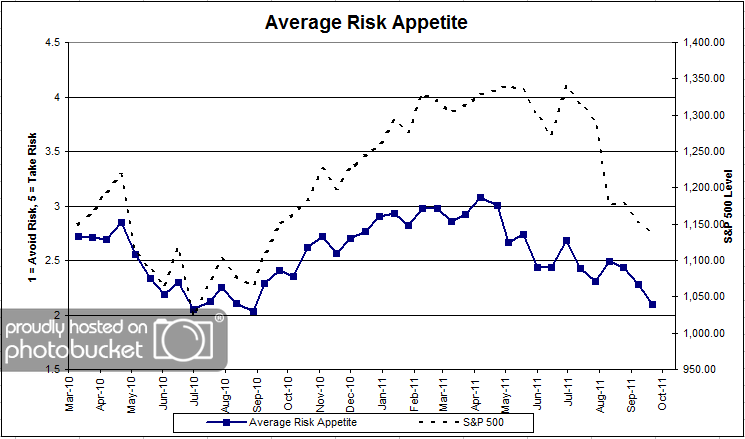
Question 2. Based on their behavior, how would you rate your clients’ current appetite for risk?
avgriskapp 31 Dorsey, Wright Client Sentiment Survey   9/23/11

Chart 3: Average Risk Appetite. Overall risk appetite numbers fell by a large margin this round, from 2.28 to 2.10. These overall risk appetite numbers are the lowest we’ve seen since September of 2010. All in all, it’s been a rough few weeks for client sentiment for both of our major indicators.
riskappbellcurve 25 Dorsey, Wright Client Sentiment Survey   9/23/11

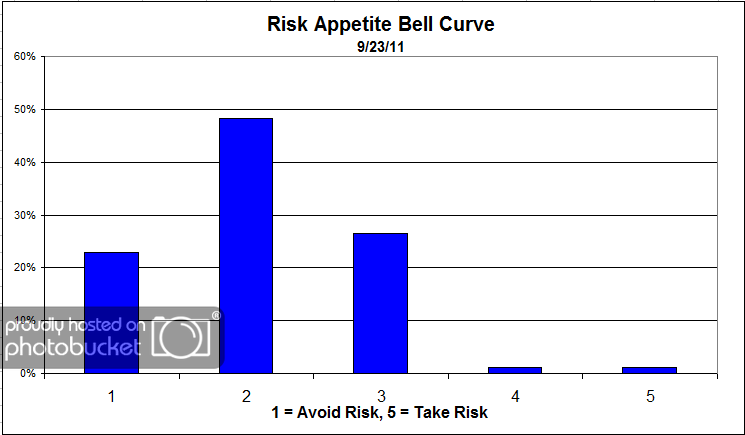
Chart 4: Risk Appetite Bell Curve. This chart uses a bell curve to break out the percentage of respondents at each risk appetite level. With overall risk appetite in the gutter, it’s no wonder that we see the majority of respondents (around 70% of all respondents) looking for either 1 or 2.
avgriskbellcurvegroup Dorsey, Wright Client Sentiment Survey   9/23/11

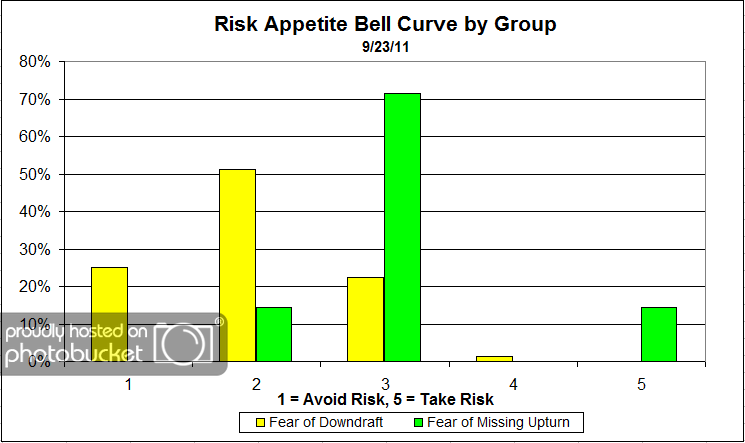
Chart 5: Risk Appetite Bell Curve by Group. The next three charts use cross-sectional data. This chart plots the reported client risk appetite separately for the fear of downdraft and for the fear of missing upturn groups. This bar chart sorts out as we expect, with the fear group looking for low risk and the opportunity group looking for more risk.
avgriskappgroup 21 Dorsey, Wright Client Sentiment Survey   9/23/11

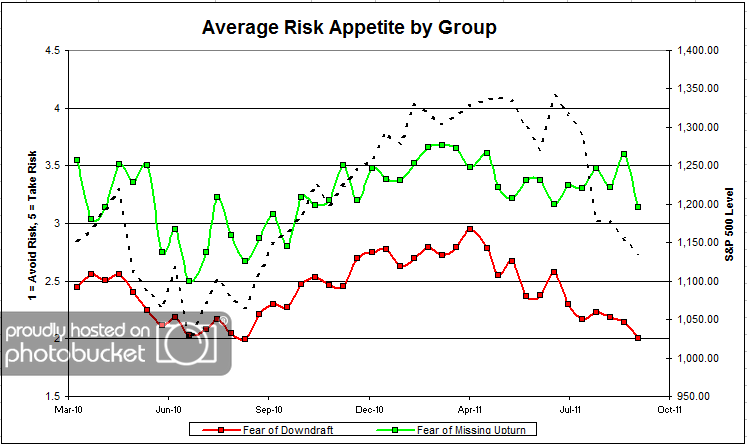
Chart 6: Average Risk Appetite by Group. Both camps’ risk appetite fell this round, and dramatically so. The fear camp’s risk appetite is at the lowest we’ve seen since August of 2010. The more volatile opportunity group’s average dropped dramatically, after a contrarian move up last survey.
riskappspread 31 Dorsey, Wright Client Sentiment Survey   9/23/11

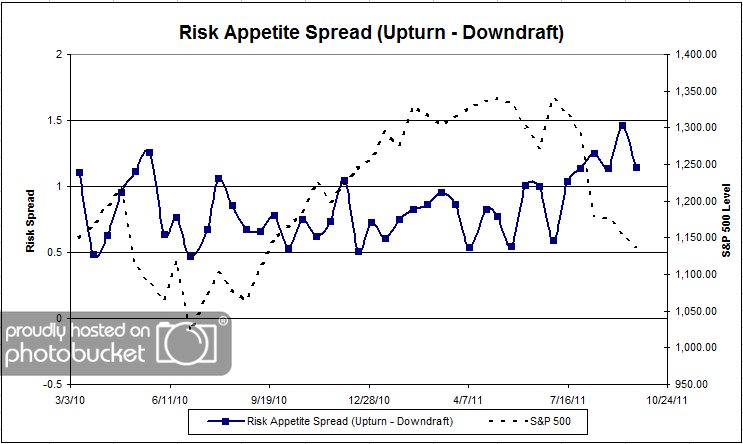
Chart 7: Risk Appetite Spread. This is a spread chart constructed from the data in Chart 6, where the average risk appetite of the downdraft group is subtracted from the average risk appetite of the missing upturn group. The spread fell this round after hitting all-time highs last survey.

This survey, we saw the overall fear number tick higher in the face of a falling market. The overall risk appetite number is now sitting at 1-year lows after a horrible summer for the stock market. The stock market is now down 20% from recent highs, client sentiment is near 1-year lows, and the overall risk appetite numbers are terrible. The only silver lining to this situation is that historically, clients have been terrible predictors of future stock market performance. So when we see client sentiment at these levels, it could mean a rally is around the corner (we hope!).

No one can predict the future, as we all know, so instead of prognosticating, we will sit back and enjoy the ride. A rigorously tested, systematic investment process provides a great deal of comfort for clients during these types of fearful, highly uncertain market environments. Until next time, good trading and thank you for participating.

Posted by:


From the Archives: Who Wins, Who Loses, and Why

October 3, 2011

One of our Senior Portfolio Managers, Harold Parker, has a saying: “To the disciplined go the spoils.” Now there is academic research that supports his point.

From the study by Lo, Repin, and Steenbarger, “Specifically, the survey data indicate that subjects whose emotional reactions to monetary gains and losses were more intense on both the positive and negative side exhibited significantly worse trading performance, implying a negative correlation between successful trading behavior and emotional reactivity.”

That’s a pretty good summation of the problem. The more emotional traders were, the worse they did. Panic and euphoria, which lead to pulling out at the bottom and piling in at the top, are not helpful in financial markets. We find that basing our investment approach on an adaptive, systematic process is very helpful in avoiding the emotional ups and downs of the marketplace.

—-this article originally appeared 9/9/2009. It’s good to keep in mind that emotional reactivity will damage your returns, especially in a market like this.

Posted by:


Dividend Downer

October 3, 2011

Row Rowland has a nice piece at Invest With An Edge on the major flaw of dividend income plans: dividend cuts. Dividend stocks are all the rage nowadays, what with baby boomers starting to retire and stock yields above Treasury yields for the first time in 50 years.

I’ve got nothing against dividend stocks. Heck, Dorsey Wright Money Management selects securities for a series of First Trust dividend UITs. But I agree with Mr. Rowland that many dividend investors severely underrate the odds of their dividends being cut.

The article contains a table of the largest dividend ETFs, reproduced here, that shows how much dividends were cut from 2008 to 2010.

Yes, your dividend ETF is probably on this list. And as you can see, the dividend cuts ranged from 21% to 53%! Dividend ETFs are quite popular with retirees, most of whom wouldn’t be too pleased to take a 20% cut in their income. The only exception shown on the table is the Vanguard Dividend Appreciation ETF (VIG). It suggests that maybe there is some protection in a rising dividend fund, although the initial yield is the lowest of the bunch.

Another potential way to try to reduce the possibility of dividend problems is by using relative strength screening. For the First Trust UITs, we own the highest relative strength dividend payers in each industry group. We believe that strong stocks are less likely to have dividend cuts than stocks that are in a death spiral. There’s probably no perfect way to run a dividend portfolio, but that’s one way to try to capture a higher current yield (roughly 3.9%) with some degree of protection from dividend cuts.

For information on the First Trust Dorsey Wright Relative Strength Dividend UIT, please click here.

Click here for disclosures from Dorsey Wright Money Management. Past performance is no guarantee of future results.

Posted by:


Michael Lewis on Financial Planning

October 3, 2011

Michael Lewis concluded his recent Vanity Fair article “California and Bust” with the following:

When people pile up debts they will find difficult and perhaps even impossible to repay, they are saying several things at once. They are obviously saying that they want more than they can immediately afford. They are saying, less obviously, that their pres­ent wants are so important that, to satisfy them, it is worth some future difficulty. But in making that bargain they are implying that, when the future difficulty arrives, they’ll figure it out. They don’t always do that. But you can never rule out the possibility that they will. As idiotic as optimism can sometimes seem, it has a weird habit of paying off.

His whole article is a fascinating read about the factors that have led California to its present level of over-indebtedness. The article is also great food for thought about the timeless topic of current vs. future consumption and prudent financial planning on both the government and individual levels. Great articles, such as this one by Michael Lewis, have the power to change behavior by all those open to avoiding the unpleasant realities of an underfunded retirement because they allow the reader to visualize the end-game (see the part of the article on Vellejo, CA).

Posted by:


Weekly RS Recap

October 3, 2011

The table below shows the performance of a universe of mid and large cap U.S. equities, broken down by relative strength decile and quartile and then compared to the universe return. Those at the top of the ranks are those stocks which have the best intermediate-term relative strength. Relative strength strategies buy securities that have strong intermediate-term relative strength and hold them as long as they remain strong.

Last week’s performance (9/26/11 – 9/30/11) is as follows:

Tough week for high relative strength stocks, with the top quartile underperforming the universe by 0.90%.

Posted by:






