Dorsey, Wright Client Sentiment Survey Results - 10/7/11

October 17, 2011

Our latest sentiment survey was open from 10/7/11 to 10/14/11. The Dorsey, Wright Polo Shirt Raffle continues to drive advisor participation, and we greatly appreciate your support! This round, we had 91 advisors participate in the survey. If you believe, as we do, that markets are driven by supply and demand, client behavior is important. We’re not asking what you think of the market—since most of our blog readers are financial advisors, we’re asking instead about the behavior of your clients. Then we’re aggregating responses exclusively for our readership. Your privacy will not be compromised in any way.

After the first 30 or so responses, the established pattern was simply magnified, so we are comfortable about the statistical validity of our sample. Most of the responses were from the U.S., but we also had multiple advisors respond from at least two other countries. Let’s get down to an analysis of the data! Note: You can click on any of the charts to enlarge them.

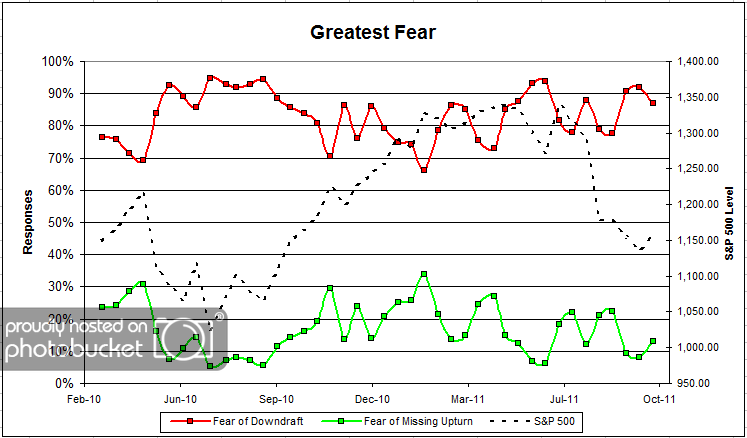
Question 1. Based on their behavior, are your clients currently more afraid of: a) getting caught in a stock market downdraft, or b) missing a stock market upturn?
greatestfear 40 Dorsey, Wright Client Sentiment Survey Results   10/7/11

Chart 1: Greatest Fear. From survey to survey, the S&P rose around +1.7%, and client fear levels responded as expected. Client fear levels dropped from 92% to 87%, while the opportunity camp rose from 8% to 13%. Despite the minor bounce, client sentiment remains poor overall.
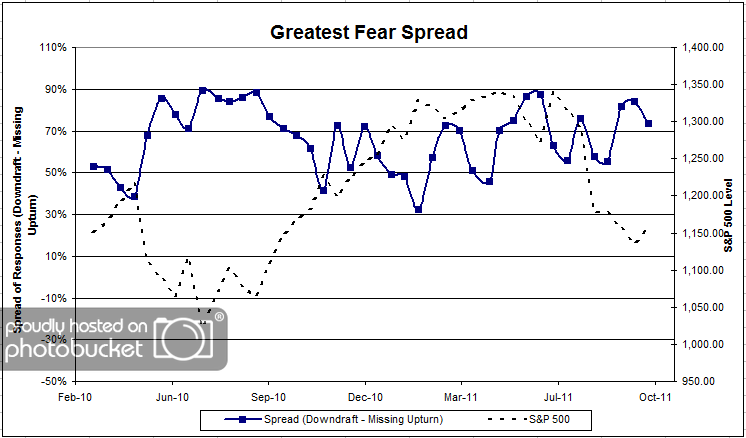
greatestfearspread 41 Dorsey, Wright Client Sentiment Survey Results   10/7/11

Chart 2. Greatest Fear Spread. Another way to look at this data is to examine the spread between the two groups. The spread fell from 84% to 74% this round.

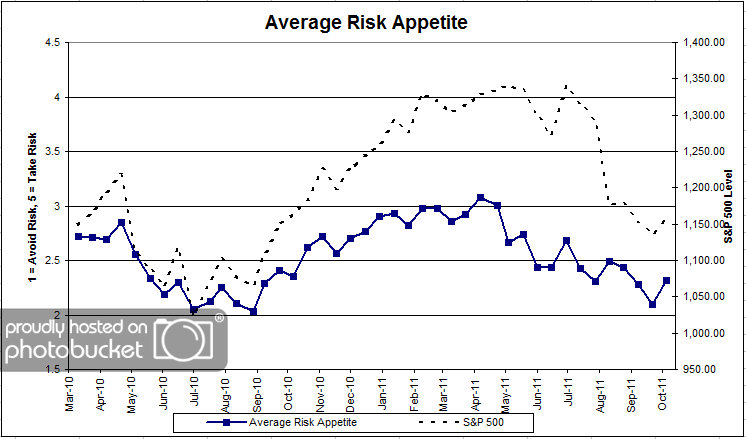
Question 2. Based on their behavior, how would you rate your clients’ current appetite for risk?
avgriskapp 32 Dorsey, Wright Client Sentiment Survey Results   10/7/11

Chart 3: Average Risk Appetite. Overall risk appetite numbers rose this round, as they should in a rising market. This survey the overall risk appetite average was 2.32, up from 2.10 from last time. The overall numbers are still hovering around all-time survey lows.
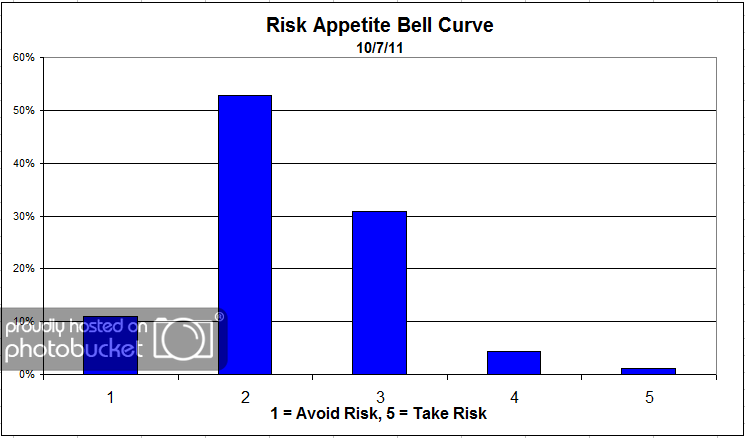
riskappbellcurve 26 Dorsey, Wright Client Sentiment Survey Results   10/7/11

Chart 4: Risk Appetite Bell Curve. This chart uses a bell curve to break out the percentage of respondents at each risk appetite level. Once again, over half the respondents answered 2, and nearly a third answered 3.
riskappbellcurvegroup 13 Dorsey, Wright Client Sentiment Survey Results   10/7/11

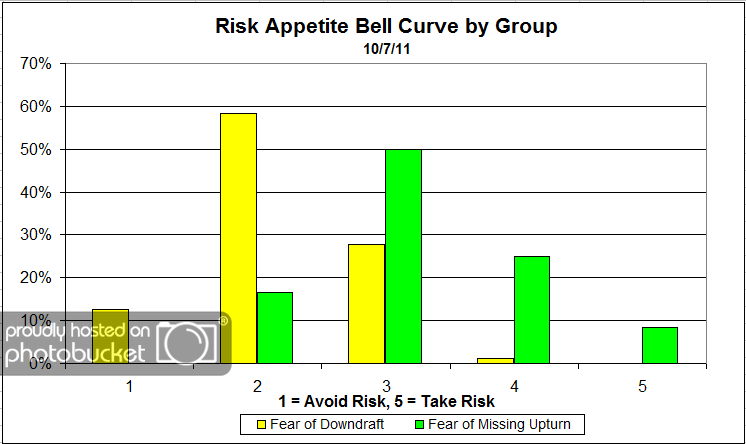
Chart 5: Risk Appetite Bell Curve by Group. The next three charts use cross-sectional data. This chart plots the reported client risk appetite separately for the fear of downdraft and for the fear of missing upturn groups. This bar chart sorts out as we expect, with the fear group looking for low risk and the opportunity group looking for more risk.
avgriskappgroup 22 Dorsey, Wright Client Sentiment Survey Results   10/7/11

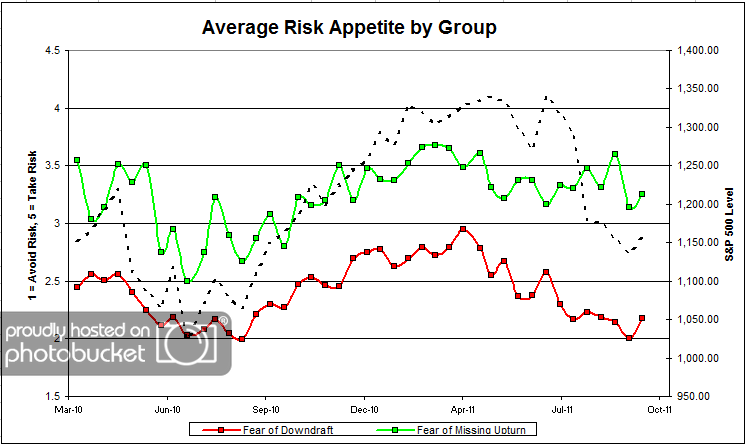
Chart 6: Average Risk Appetite by Group. Both camps’ risk appetite rose this round with the market. Nothing much to see here.
riskappspread 32 Dorsey, Wright Client Sentiment Survey Results   10/7/11

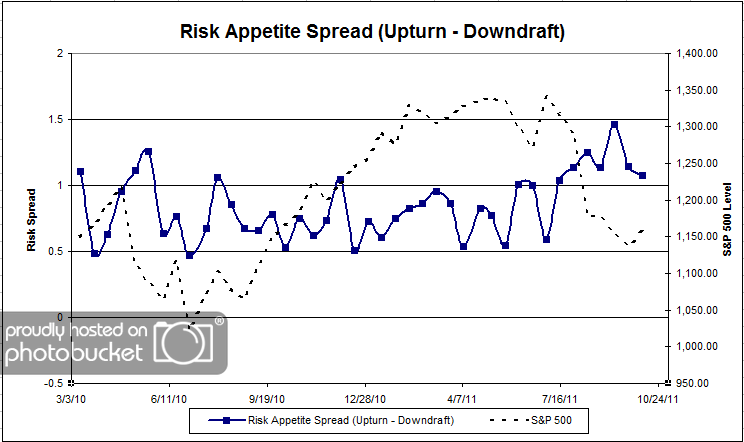
Chart 7: Risk Appetite Spread. This is a spread chart constructed from the data in Chart 6, where the average risk appetite of the downdraft group is subtracted from the average risk appetite of the missing upturn group. The spread nudged lower this round.

This survey, we saw a moderate rally in the market over two weeks, and all of our client sentiment indicators responded as they “should have.” The overall fear levels fell, and the overal risk appetite numbers rose. Everything performed as expected, which is nice to see.

No one can predict the future, as we all know, so instead of prognosticating, we will sit back and enjoy the ride. A rigorously tested, systematic investment process provides a great deal of comfort for clients during these types of fearful, highly uncertain market environments. Until next time, good trading and thank you for participating.

Posted by:


Unstable Correlations: Commodity / Equity Edition

October 17, 2011

Anyone with the idea that there is a dependable relationship (correlation) between equities and commodities over time may be taken aback by the following chart.

Source: MarketSci Blog

Seeking stable relationships between asset classes is fool’s gold. There are good reasons for including many different asset classes in your investment universe, but dependable correlations is not one of them.

HT: Abnormal Returns

Posted by:


Have 401k? Get Help!

October 17, 2011

The self-destructive tendencies of retail investors are well-documented. In the 1950s and 1960s, people used their “play money” in the stock market—their defined benefit pension is what they were counting on for their retirement. Fast forward to today and you will find that everyone is responsible for their own retirement through their 401k balance. All of a sudden everyone has to be an expert in asset allocation and investment selection. Clearly, that’s not going to happen. Most people are ill-suited, either by temperament, interest, or background, to manage their own retirement plans.

But you can usually get help. According to an article in Financial Planning, that would be a very good idea.

Investors who relied on professional help in the form of target-date funds, managed accounts and advice earned nearly three percentage points more than those that did not, according to an analysis of eight large defined contribution plans between 2006 and 2010 by Aon Hewitt and Financial Engines. The plans covered 400,000 participants with $25 billion in assets.

The study found that in those five years, worked who received some form of professional experienced higher returns averaging 2.92 percentage points, net of fees, than those individuals who managed their 401(k) on their own. According to Aon Hewitt and Financial Engines’ projections, a 45-year-old participant who invests $10,000 and receives professional help will have a portfolio valued at $71,400 at age 65, compared to $42,100 for someone who doesn’t get any help.

Interestingly, only about 30% of the plan participants got help. You should strongly consider being one of them.

Posted by:


From the Archives: Emotional Reactions Know No Bounds

October 17, 2011

Lest you think American investors are alone, it turns out that European investors are just as subject to making poor investment decisions on the basis of emotion. One of the reasons that many predictions of Modern Portfolio Theory don’t hold up is that investors are human, and thus not necessarily rational.

This highlights the importance (we think) of using a systematic, quantitative process rather than emotion.

—-this article originally appeared 9/23/2009. I guess the European debt crisis indicates that EU politicians are equally capable of fumbling around as American politicians too! Our Systematic RS process-based on data, not opinion or emotion-strikes me as a good idea.

Posted by:


Weekly RS Recap

October 17, 2011

The table below shows the performance of a universe of mid and large cap U.S.equities, broken down by relative strength decile and quartile and then compared to the universe return. Those at the top of the ranks are those stocks which have the best intermediate-term relative strength. Relative strength strategies buy securities that have strong intermediate-term relative strength and hold them as long as they remain strong.

Last week’s performance (10/10/11 – 10/14/11) is as follows:


The laggards had spectacular performance last week-much of the gains came from laggards in the Energy sector (although everything else had big gains as well).

Posted by:






