Overlooked Amid the Ongoing Euro-Panic

November 9, 2011

Bespoke Investment Group had a nice note the other day on something that has largely been overlooked amid the ongoing Euro-panic:

While economists and the media are busy debating over whether or not the US economy is in or on the verge of a double dip recession, US companies are busy posting record earnings. According to S&P, with 88.1% of US companies having reported, Q3 operating earnings are on pace to total $25.42 for the S&P 500. On a four quarter trailing basis, earnings for the S&P 500 are set to total $94.77, which would eclipse the old record of $91.47 set in Q2 2007.

Yep, earnings matter-and they’re about to set a new record. Market valuation is simply earnings times some multiple. The earnings multiple can vary widely, of course, depending on investors’ optimism or pessimism. It was explained to me long ago that a P/E ratio is really a psychological indicator and should be renamed Price-to-Expectations Ratio. Our own surveys suggest that investors have very little risk appetite at this time, so one would expect the earnings multiple to be relatively low, which it is.

Source: Bespoke Investment Group

Isn’t it nice to see a chart of something going up for a change? It’s difficult to even guess when investor sentiment will change, but when it does, it’s nice to see that some real earnings growth has gone on beneath the surface.

Posted by:


Doing the Math

November 9, 2011

Transaction taxes are being discussed by some politicians and academics as a way to raise revenue and “make Wall Street contribute its fair share.” Index Universe has an article discussing actual historical experience with a trading tax and then follows through with the math to show that the amount of potential revenue is clearly overstated by several magnitudes. The good thing about history is that you can actually learn from the experiences of others.

The best-known example comes from Europe-or Sweden, to be exact-which probably explains why the European proposal has met with such strong opposition. From 1984 to 1991, Sweden implemented a series of taxes ranging from 0.5% on equities to fractional basis points on certain bond trades.

The results were disastrous. As any sane person might expect, trading volumes plummeted in Sweden as investors moved their money to more lubricated markets. Within six years, the options market vanished entirely, futures volumes fell 98 percent, and 50 percent of equity trading moved offshore. Even bonds, which had fractional basis-point taxes, suffered an 85 percent reduction in trading volume.

The article proceeds to calculate that if volumes stayed unchanged, taxes would amount to another 10% of GDP! That’s about 50% of the current entire tax base. As the Swedish example makes clear, volumes won’t be unchanged. Nor does it seem like a good idea to cripple the economy with a potentially enormous tax increase. In Sweden, the revenues turned out to be modest, but the damage to the Swedish financial system was severe.

Perhaps we will learn from history, or perhaps we will simply prove Hegel’s theory: The only thing we learn from history is that we learn nothing from history.

Posted by:


High RS Diffusion Index

November 9, 2011

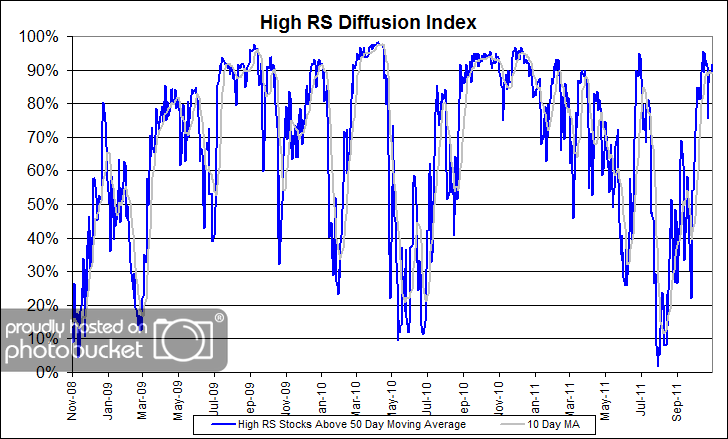
The chart below measures the percentage of high relative strength stocks that are trading above their 50-day moving average (universe of mid and large cap stocks.) As of 11/8/11.

highrss High RS Diffusion Index

The 10-day moving average of this indicator is 89% and the one-day reading is 92%. High RS stocks as a group have been able to hold on after a rough summer.

Posted by: