—-this was originally published 10/26/2009. Although the US dollar has recently held up relatively well versus the Euro (until today!), there is still significant concern about its long-term status.
—-this was originally published 10/26/2009. Although the US dollar has recently held up relatively well versus the Euro (until today!), there is still significant concern about its long-term status.
 Leave a Comment » |
  From the Archives, Just for Fun |
  Permalink

Posted by: Mike Moody
James O’Shaughnessy’s book What Works On Wall Street is required reading for every investment professional as it provides a detailed look at the results of different investment strategies over time. The fourth edition was just released and has the benefit of data that now goes back to 1926, whereas the previous editions only went back to 1963. Any quantitative manager (or user of quantitative strategies) needs to know the historical merits of focusing on different return factors.
O’Shaughnessy details the results of relative strength from 1926-2009:
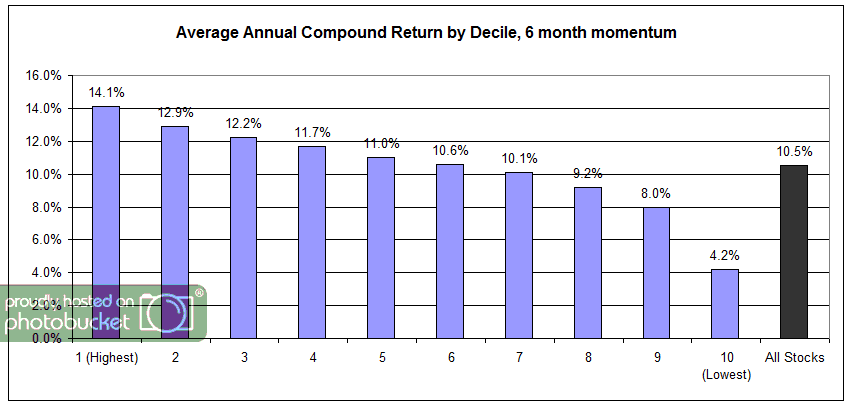
A $10,000 investment on December 31, 1926, in the decile of stocks from All Stocks with the best six-month price appreciation is worth $572,831,563 at the end of 2009, a compound return of 14.11 percent a year. This return dwarfed an investment in the All Stock universe, which turned $10,000 into $38,542,780 over the same period, an average annual compound return of 10.46 percent.
It is also important to point out that O’Shaughnessy found that this relative strength portfolio outperformed the benchmark in 68% of single-year returns, 79% of rolling 3-year returns, 87% of rolling 5-year returns, 95% of rolling 7-year returns, and 98% of rolling 10-year returns.
Also, keep in mind that this is just a generic relative strength strategy based on a 6-month return factor with annual rebalances. His book also showed that using a 12-month relative strength factor also outperformed the benchmark with an compound return of 12.34 percent.
In case you were wondering, a strategy based on buying stocks with the worst 6-month returns and then holding for a year had an annualized return of 4.15 percent! As stated in the book, “If you’re looking for a great way to underperform the market, look no further [than buying relative strength laggards].”
O’Shaughnessy on the symmetry for the relative strength deciles:
The decile returns for All Stocks by six-month price appreciation reveal a perfect staircase, with the performance of decile 1-containing the best six-month price performing stocks-at the top and returns of the other deciles descending in step to the tenth decile, which contains the worst six-month price performers. The top six deciles all beat All Stocks, with the bottom four all underperforming the universe.
Source: What Works On Wall Street
The results are in and they are highly favorable for relative strength investing.
1 Comment | Relative Strength Research | Permalink
Posted by: Andy Hyer
Leave a Comment » | Podcasts | Permalink
Posted by: Andy Hyer
Contained in a Jonah Lehrer article on Frontal Cortex is this gem:
Consider the story of Harry Markowitz, a Nobel Prize-winning economist who largely invented the field of investment-portfolio theory. By relying on a set of complicated equations, Markowitz was able to calculate the optimal mix of financial assets. (Due to loss-aversion, most investors hold too many low-risk bonds, but Markowitz’s work helped minimize the effect of the bias by mathematizing the decision.) Markowitz, however, was incapable of using his own research, at least when setting up his personal retirement fund. “I should have computed the historical co-variances of the asset classes and drawn an efficient frontier,” Markowitz later confessed. “Instead, I visualized my grief if the stock market … went way down and I was completely in it. My intention was to minimize my future regret. So I split my contributions 50/50 between bonds and equities.”
I added the emphasis. When faced with an emotional consequence, even the man who invented the efficient frontier became an irrational investor! Honestly, this is just human. I’ve written a lot about how investors-in reality-make decisions to minimize their chances of looking stupid. This is just what Markowitz did, and we all have this tendency. The assumption that investors would ever be rational was simply a faulty foundation.
If we know that investors are going to act in predictable ways, shouldn’t that be incorporated in the way we approach asset allocation?
3 Comments | Investor Behavior, Markets | Permalink
Posted by: Mike Moody
The chart below is the spread between the relative strength leaders and relative strength laggards (universe of mid and large cap stocks). When the chart is rising, relative strength leaders are performing better than relative strength laggards. As of 11/29/2011:
Using history as a guide, we expect this spread to eventually resume its upward trend. A meaningful positive breakout in this indicator could bode very well for relative strength strategies.
Leave a Comment » | Markets | Permalink
Posted by: Andy Hyer
You are currently browsing the Systematic Relative Strength blog archives for the day Wednesday, November 30th, 2011.