James O’Shaughnessy’s book What Works On Wall Street is required reading for every investment professional as it provides a detailed look at the results of different investment strategies over time. The fourth edition was just released and has the benefit of data that now goes back to 1926, whereas the previous editions only went back to 1963. Any quantitative manager (or user of quantitative strategies) needs to know the historical merits of focusing on different return factors.
O’Shaughnessy details the results of relative strength from 1926-2009:
A $10,000 investment on December 31, 1926, in the decile of stocks from All Stocks with the best six-month price appreciation is worth $572,831,563 at the end of 2009, a compound return of 14.11 percent a year. This return dwarfed an investment in the All Stock universe, which turned $10,000 into $38,542,780 over the same period, an average annual compound return of 10.46 percent.
It is also important to point out that O’Shaughnessy found that this relative strength portfolio outperformed the benchmark in 68% of single-year returns, 79% of rolling 3-year returns, 87% of rolling 5-year returns, 95% of rolling 7-year returns, and 98% of rolling 10-year returns.
Also, keep in mind that this is just a generic relative strength strategy based on a 6-month return factor with annual rebalances. His book also showed that using a 12-month relative strength factor also outperformed the benchmark with an compound return of 12.34 percent.
In case you were wondering, a strategy based on buying stocks with the worst 6-month returns and then holding for a year had an annualized return of 4.15 percent! As stated in the book, “If you’re looking for a great way to underperform the market, look no further [than buying relative strength laggards].”
O’Shaughnessy on the symmetry for the relative strength deciles:
The decile returns for All Stocks by six-month price appreciation reveal a perfect staircase, with the performance of decile 1-containing the best six-month price performing stocks-at the top and returns of the other deciles descending in step to the tenth decile, which contains the worst six-month price performers. The top six deciles all beat All Stocks, with the bottom four all underperforming the universe.
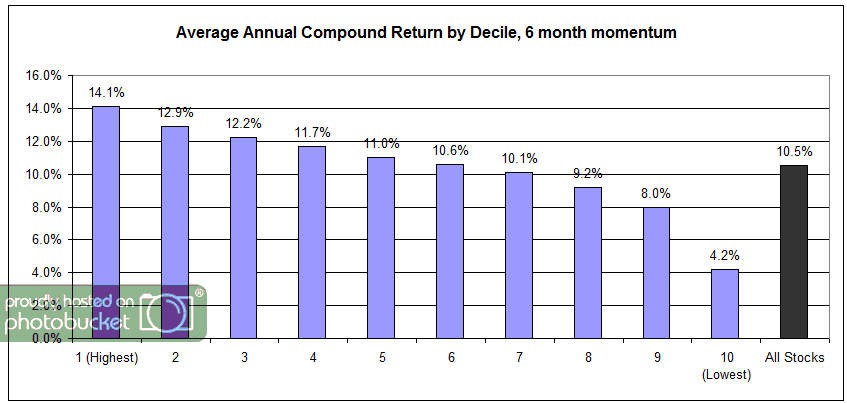
Source: What Works On Wall Street
The results are in and they are highly favorable for relative strength investing.









I find your information most informative and guiding.