Any time a strong asset class goes through a short-term period of underperformance the question always comes up, “Is the trend over?” This is generally when I pull out my crystal ball. In reality, every trend follower must decide the sell criteria for each trade. Will it be based on the trader’s discretion (not recommended), or based on some objective rule set? Using relative strength rank stops is a topic that is covered in the white paper Relative Strength And Asset Class Rotation by John Lewis. For the purposes of the white paper, relative strength ranks were used to determine when to get out of a given trade. One of the most revealing results for the study is just how much different the results are over time by using different relative strength look-back periods for portfolio formation. For example, if you use a 3-month look-back period for your relative strength factor, the results were very different over time than if you used a 6-, 9-, or 12-month look-back period. In fact, the white paper detailed the results of using 1-, 2-, 3-, 9-, 12-, 18-, and 24-month look-back periods for portfolio formation.
Please read the white paper to see the details of the Monte Carlo testing process used for this study. This simulation was done on a universe of ETFs from a variety of asset classes over an 11-year period of time (2000-2010). However, the cumulative mean results are as follows:
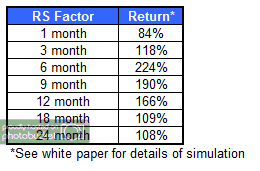
What conclusion can be drawn? The best results over the 11-year period of time came from using a 6-month look-back relative strength factor. For the purposes of the white paper, percentile ranks were used to determine when to get out of a a given trade. Getting out of a position every time its relative strength has a bad month or even bad three months of price performance did not lead to as good of performance over time as using an intermediate relative strength ranking stop.
This underscores the importance of understanding how to thoroughly test a set of decision rules so that you can be best prepared to run those decision rules in real time and with real money! It is human nature to want to bail out of a position after it looks like the trend may be turning. In hindsight, we may well see that indeed we would have been better to get out much earlier. Of course, we may also see that the relative strength stabilized and then moved higher.
The goal with any trend following system is to capitalize on long-term trends. Relative strength is ideally suited to help you accomplish that goal. However, it won’t come without some discomfort along the way. Today, the question may be about gold, but tomorrow the same question will be asked about a different asset class. Relative strength provides a clear process for determining when to get in and when to get out.


 Posted by Andy Hyer







