The case for investing for dividends is nicely summarized in this paper produced by First Trust.
The Importance of Dividends
With interest rates at historically low levels,these are challenging times to invest for income. In this environment, dividend-paying companies may reward investorsseeking income as well as capital appreciation potential. This paper outlines some of the benefits of dividend-paying stocks as well as their significance in today’s market environment.
Reasons to Consider Dividend-Paying Stocks
- Interest rates are at historically low levels
- Key component of total return
- May be a signal of capital strength
Historical Perspective
Investing in dividend-paying stocks is a time-tested strategy that provides an attractive combination of income and capital appreciation potential. A dividend is a distribution of a portion of a company’s earnings which is decided by the company’s board of directors and payable to its shareholders. Companies that pay dividends tend to be mature companies and may be less volatile than companies that do not pay dividends.Corporations are not obligated to share their earnings with stockholders and not all companies do. It is for this reason that dividends may be viewed as an indication of a company’s profitability, as well as management’s assessment of the future.
A Key Component of Total Return
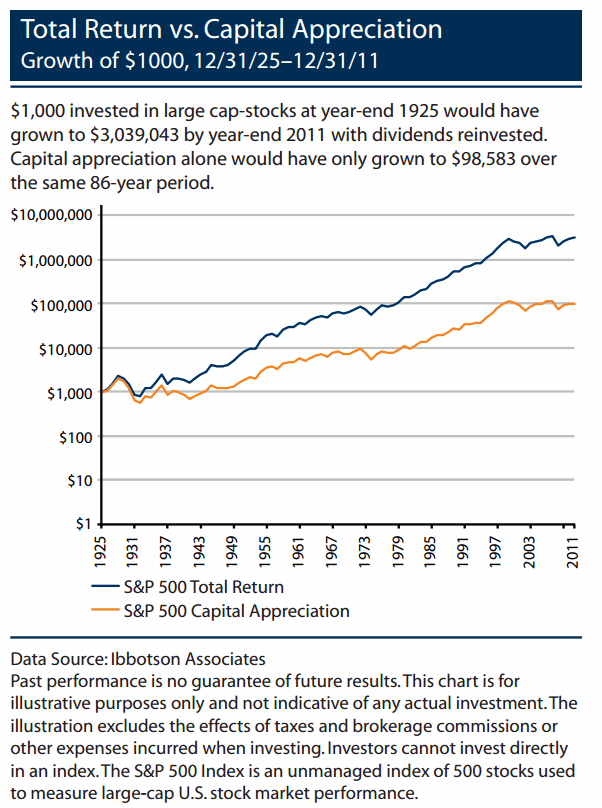
Historically, dividends have made up a significant portion of stock market total return. According to Ibbotson Associates, dividends have provided approximately 44% of the 9.77% average annual total return on the S&P 500 Index from 1926 through 2011. In addition, dividend-payers have historically outperformed non-payers.The chart at right shows that dividend payers in the S&P 500 Index have outperformed non-dividend payers in 21 out of the last 32 years, a period which included both rising and falling markets. Additionally,the dividend payers had a negative return in only 3 of the 32 years versus 10 years of negative performance for the non-payers. According to Standard and Poor’s, in 2011,the payers were up 1.40% vs. a decline of 7.60% for the non-payers. It is important to note that there can be no assurance that companies will declare dividends in the future or that, if declared,they will remain at current levels or increase over time.
Dorsey Wright has partnered with First Trust for several years now to provide relative strength-based UITs, including a Relative Strength Dividend UIT. A key feature of this strategy is that our relative strength analysis is done on a total return basis (incorporating price and yield). We believe that this will have some important performance and risk management benefits over time. Past performance, holdings, and other information about these strategies can be found at www.ftportfolios.com.