Client Sentiment Survey Results - 3/8/13

March 19, 2013

Our latest sentiment survey was open from 3/8/13 to 3/15/13. The Dorsey, Wright Polo Shirt Raffle continues to drive advisor participation, and we greatly appreciate your support! This round, we had 65 advisors participate in the survey. If you believe, as we do, that markets are driven by supply and demand, client behavior is important. We’re not asking what you think of the market—since most of our blog readers are financial advisors, we’re asking instead about the behavior of your clients. Then we’re aggregating responses exclusively for our readership. Your privacy will not be compromised in any way.

After the first 30 or so responses, the established pattern was simply magnified, so we are fairly comfortable about the statistical validity of our sample. Some statistical uncertainty this round comes from the fact that we only had four investors say that thier clients are more afraid of missing a stock upturn than being caught in a downdraft. Most of the responses were from the U.S., but we also had multiple advisors respond from at least two other countries. Let’s get down to an analysis of the data! Note: You can click on any of the charts to enlarge them.

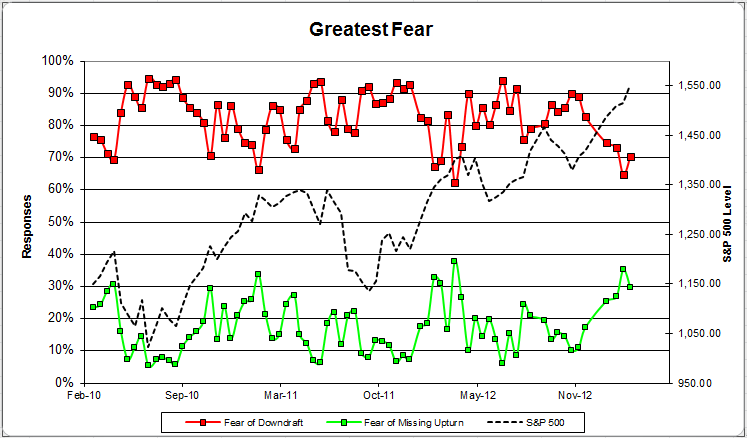
Question 1. Based on their behavior, are your clients currently more afraid of: a) getting caught in a stock market downdraft, or b) missing a stock market upturn?
greatestfear 60 zps92e939ed Client Sentiment Survey Results   3/8/13

Chart 1: Greatest Fear. From survey to survey, the S&P 500 rose just over +2%, and our indicators responded with a mixed bag. The fear of downturn group actually rose from 65% to 70% in a rising market, which we would not expect to see. The upturn group fell from 35% to 30%.
greatestfearspread 2 zpsc448425b Client Sentiment Survey Results   3/8/13

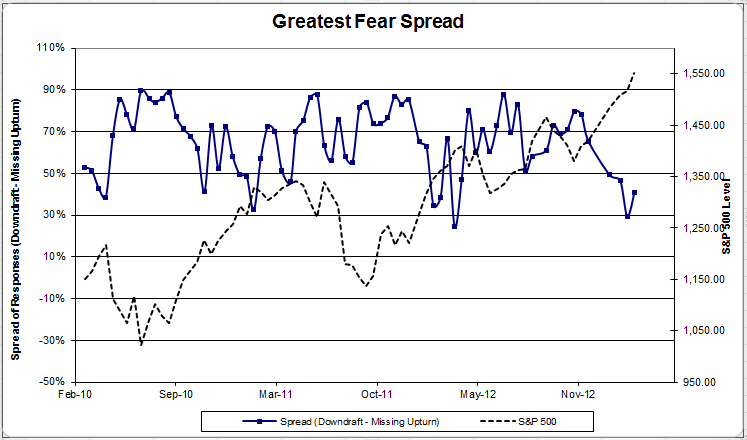
Chart 2: Greatest Fear Spread. Another way to look at this data is to examine the spread between the two groups. The spread rose from 29% to 41%.

Question 2. Based on their behavior, how would you rate your clients’ current appetite for risk?
avgriskapp 50 zps6c4eb14a Client Sentiment Survey Results   3/8/13

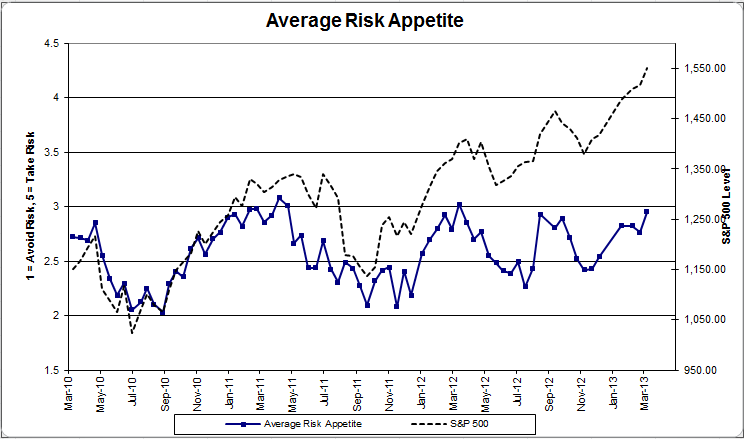
Chart 3: Average Risk Appetite. Average risk appetite jumped this round, from 2.76 to 2.95. We’re sitting just off 1-year highs of client risk appetite at this point. If the market continues to rally, this indicator should be able to break through 3.
riskappbellcurve 37 zps697698e5 Client Sentiment Survey Results   3/8/13

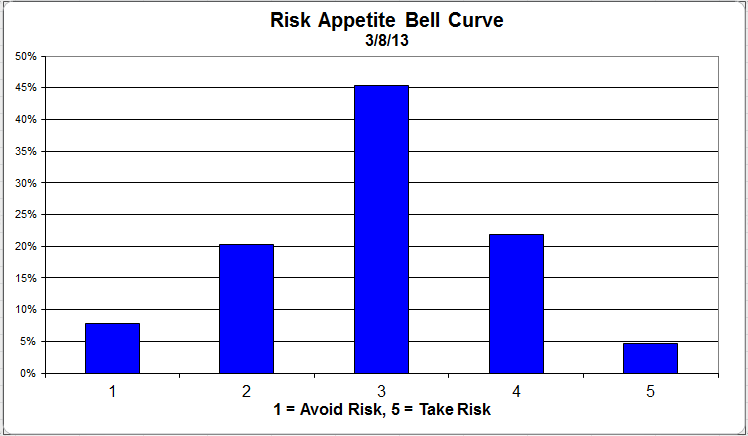
Chart 4: Risk Appetite Bell Curve. This chart uses a bell curve to break out the percentage of respondents at each risk appetite level. This round, nearly 75% of all respondents wanted a risk appetite of 3 or less.
riskappgroup 6 zpsf13fd4e5 Client Sentiment Survey Results   3/8/13

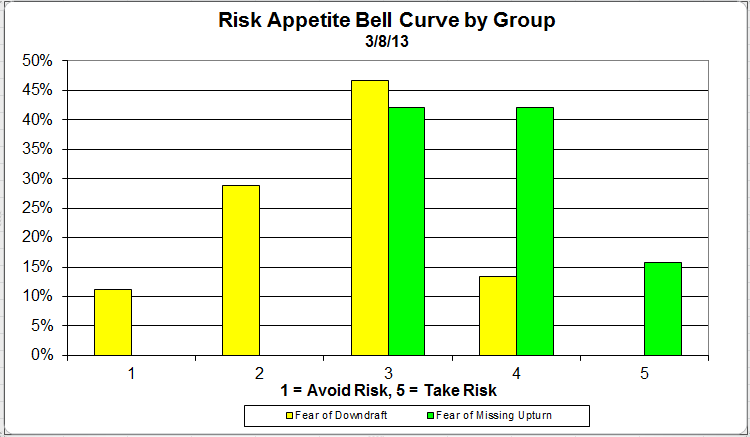
Chart 5: Risk appetite Bell Curve by Group. The next three charts use cross-sectional data. The chat plots the reported client risk appetite separately for the fear of downdraft and for the fear of missing upturn groups. We can see the upturn group wants more risk, while the fear of downturn group is looking for less risk.
avgriskgroup 8 zps74d09f04 Client Sentiment Survey Results   3/8/13

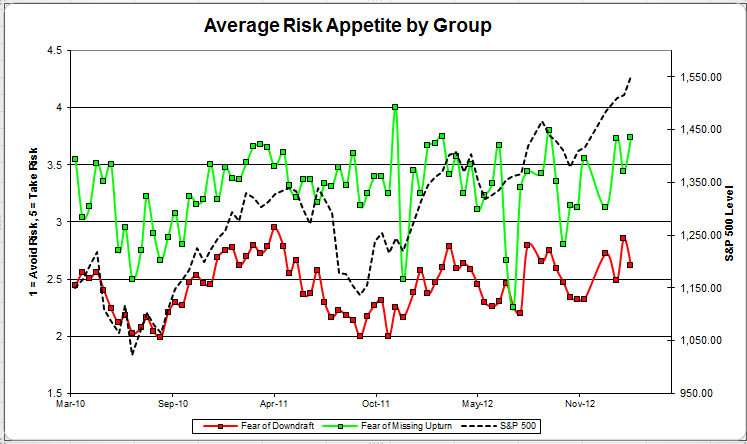
Chart 6: Average Risk Appetite by Group. This round, the downturn group’s average fell, while the upturn group’s average shot higher. This continues to be our most volatile indicator.
riskappspread 50 zps4d2ac9f7 Client Sentiment Survey Results   3/8/13

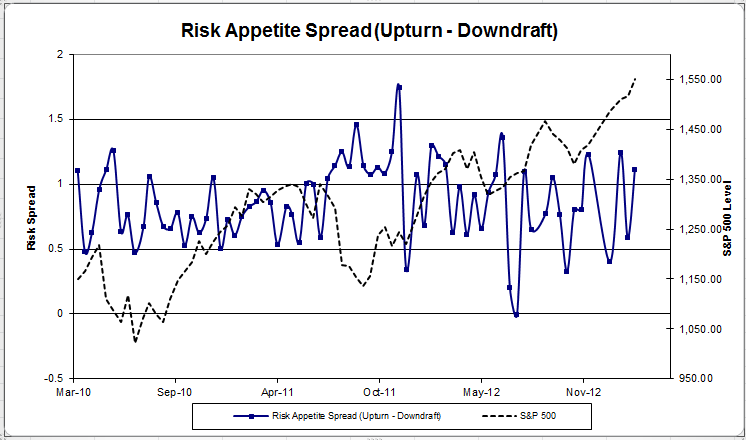
Chart 7: Risk Appetite Spread. This is a chart constructed from the data in Chart 6, where the average risk appetite of the downdraft group is subtracted from the average risk appetite of the missing upturn group. The spread moved higher this round.

The S&P has now managed to rally nearly 10% for the year (as of this writing), and client sentiment has responded favorably. Hopefully, we can see the stock market continue to rally into the second quarter, and clients become more comfortable with taking risk and investing in the market.

No one can predict the future, as we all know, so instead of prognosticating, we will sit back and enjoy the ride. A rigorously tested, systematic investment process provides a great deal of comfort for clients during these types of fearful, highly uncertain market environments. Until next time, good trading and thank you for participating.

Posted by:


Small-Cap Leaders: Flying Under the Radar

March 19, 2013

With the Dow recently hitting a new all-time high, the ongoing strength of the U.S. equity markets has received no shortage of media attention. However, the bulk of the coverage has been focused on the large-cap stocks. This makes sense since those are the names that the larger population is largely familiar with. However, some of the best performance in the U.S. equity markets so far this year has actually come from the small caps. Consider, for example, that the PowerShares DWA Small-Cap Technical Leaders ETF (DWAS) is +17.21% YTD, through 3/18/2013, easily outpacing its cap-weighted benchmarks. This ETF is based on a relative strength index, constructed by Dorsey Wright, which identifies approximately 200 small-cap stocks with the best relative strength. The index is rebalanced quarterly.

The five best performing stocks in the index YTD are as follows:

Not exactly household names. You might be interested to know exactly what it is that these companies do. According to Yahoo! Finance:

Celldex Therapeutics (CLDX), based in Needham, MA:

Celldex Therapeutics, Inc., a biopharmaceutical company, focuses on the development, manufacture, and commercialization of novel therapeutics for human health care primarily in the United States. The company has a pipeline of drug candidates in development for the treatment of cancer and other difficult-to-treat diseases.

Carriage Services (CSV), based in Houston, TX:

Carriage Services, Inc. provides death care services and merchandise in the United States. The company operates in two segments, Funeral Home Operations and Cemetery Operations. The Funeral Home Operations segment offers burial and cremation services, and related merchandise to meet a family’s death care needs, including consultation; removal and preparation of remains; sale of caskets and related funeral merchandise; use of funeral home facilities for visitation and services; and transportation services.

First Financial Holdings (FFCH), based in Charleston, SC:

First Financial Holdings, Inc. operates as the holding company for First Federal Savings and Loan Association of Charleston that provides integrated financial solutions to individuals and businesses. It offers deposit products comprising noninterest-bearing checking, interest-bearing checking, savings, money market, time deposits, certificate of deposit account registry service, and brokered time deposits.

Pharmacyclics (PCYC), based in Sunnyvale, CA:

Pharmacyclics, Inc., a clinical-stage biopharmaceutical company, focuses on the development and commercialization of small-molecule drugs for the treatment of cancer and immune mediated diseases.

Virtus Investment Partners (VRTS), based in Hartford, CT:

Virtus Investment Partners, Inc. provides investment management products and services to individuals and institutions in the United States. The company operates a multi-manager asset management business, comprising various individual affiliated managers, each with its own investment style, autonomous investment process, and individual brand.

I love it that one of the best performers is a funeral home operator—maybe not what comes to mind when you think of an exciting investment. Part of the beauty of applying relative strength to the small-cap universe is that it can pull out companies that may not be getting much of any attention, but there is clearly something positive taking place here. Relative strength thoroughly analyzes the entire small-cap universe and pulls out the best, from a relative strength perspective.

Please see www.powershares.com for more information. Past performance is no guarantee of future returns. A list of all holdings for the trailing 12 months is available upon request.

Posted by:


RS Spread

March 19, 2013

The chart below is the spread between the relative strength leaders and relative strength laggards (universe of mid and large cap stocks). When the chart is rising, relative strength leaders are performing better than relative strength laggards. As of 3/18/2013:

Posted by: