How Do It Know?

March 22, 2013

“How Do It Know?” is the punchline to an old joke. According to Urban Dictionary (with a little of my own copy editing!):

This expression is taken from a joke that describes a person’s failure to grasp the obvious or that demonstrates such intellectual ineptitude as to elicit a comment of “How Do It Know?”

The joke refers to a question posed to a scientist by a student (or in variations, a corporate executive and employee, a Congressman and voter, etc.) “Sir, in your opinion, what is the world’s greatest invention?” asked a student. The scientist replied “The thermos bottle!” “Why?” asked the student, obviously confused. ” Well” said the scientist, “it keeps cold drinks cold in the summer and hot drinks hot in the winter.” Holding up his thermos bottle in awe, he says “How do it know?”

Technical analysts make this joke all the time. The reason is that the stock market is a discounting mechanism and often reacts before the fundamentals become apparent.

Consider, for example, an article in the New York Times, dated March 21, 2013, entitled Sudden Rise in Home Demand Takes Builders by Surprise. Here are a few excerpts from the article, which has series of anecdotes about how the industry was caught off guard with the surprise housing demand.

The housing turnaround seems to have caught almost everyone in the business by surprise. As desirable as the long-awaited improvement may be, the unusually low level of homes for sale is creating widespread problems for buyers and sellers alike, leading to bidding wars and bubblelike price jumps in places that not long ago were suffering from major declines.

Monthly permits for single-family homes in the Sacramento area more than doubled from January 2012 to January 2013, though they are still only a quarter of the level they reached during the bubble. Nationally, the construction industry added 48,000 jobs in February, the biggest increase since 2007.

“You walk into the permit office, and it’s like a ghost town in there,” said Michael Haemmig, president of Haemmig Construction in Nevada City, Calif., about an hour north of Sacramento. He says local governments were caught off-guard by the suddenly renewed interest in building and do not have enough people in place to handle the paperwork.

Here’s what wasn’t caught by surprise: the price charts of housing stocks. Below is a chart of XHB, the ETF for the S&P Homebuilders Index, and Lennar (LEN), one of the larger homebuilders that happens to be in some of our managed accounts. XHB is up more than 100% from the trough in October 2011, while LEN is up around double that much.

How Do It Know?

Source: Yahoo! Finance (click on image to enlarge)

Although this is clearly a well-chosen example, this happens often enough that it is pretty clear that a lot of information is contained in prices. After all, prices simply reflect supply and demand—and often the buyers and sellers are very well informed.

Fundamentalists often deride technical analysis as some kind of voodoo, but supply and demand is pretty firmly rooted in economics. Informed buyers and sellers often catch on far sooner than economists or even most Wall Street analysts. For example, take a look a another chart of the same two items—with one twist. The only difference is the time frame. This chart runs from early 2006 to the end of 2007, a period when the economy was booming and few economists, fundamental analysts, or Fed officials were concerned about a housing bust.

Housing Bust on the Way?

Source: Yahoo! Finance (click on image to enlarge)

As you can see, before 2008 rolled around, the homebuilders had already been cut in half. In price, there is knowledge. That’s because prices contain investor’s expectations, not just what is currently visible. Of course, expectations can change—but prices will adjust to that too.

That’s the point of relative strength analysis. It allows an investor to scan the entire universe of securities and see where the strongest performances are. That’s usually where you want your portfolio to be too.

HT to Abnormal Returns

Past performance is no guarantee of future returns. A list of all holdings for the trailing 12 months is available upon request.

Posted by:


The Ridiculous Efficient Frontier

March 22, 2013

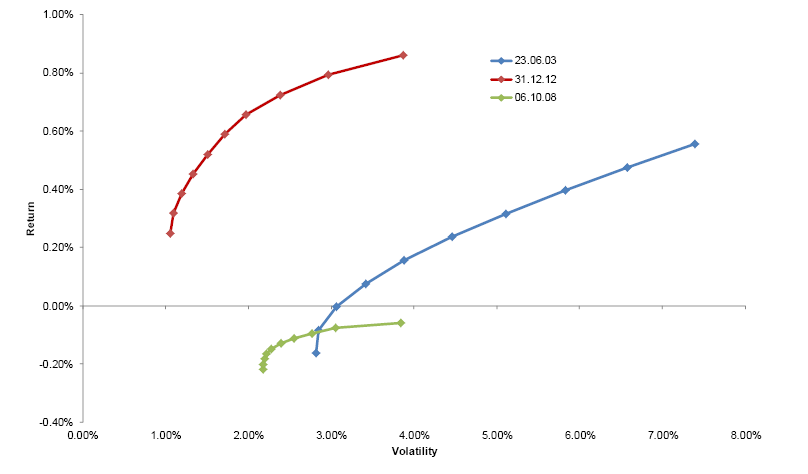
It’s hard to believe this paper was not written ironically. Perhaps I am missing the author’s sense of dry humor? In a paper entitled Principal Component Analysis of Time Variations in the Mean-Variance Efficient Frontier, author Andreas Steiner subjects mean-variance optimization to principal component analysis, a mathematical way to determine the relative importance of factors. He extracted three important factors that determine the efficient frontier. The three factors together explained 99% of the shape of the efficient frontier.

In fact—and this is the funny part to me-one factor explained 95% of the shape of the efficient frontier. And what was that magic factor?

It was the level of returns. In other words, the shape of the efficient frontier depends on the returns of the various assets. If you can predict the returns, you will (mostly) know the shape of the efficient frontier. And, in case you were wondering, the shape of the efficient frontiers varies enormously depending on the time period. Below, for example, is a clip from the paper showing efficient frontiers calculated from trailing data at different times. I’m sure you can see the slight problem—the curves look nothing alike.

ridiculousfrontier zps5d9cf98d The Ridiculous Efficient Frontier

The Ridiculous Frontier

Source: Andreas Steiner/SSRN (click on image to enlarge)

The author writes:

We find that the level factor is highly correlated with average asset returns.

We interpret this result as evidence that successful investment management is mainly driven by return estimates and not “risk management” as has been in the spotlight since the Financial Crisis.

Here’s the immediate question that occurs to my feeble brain, although I’m guessing most 5th graders would be right there with me: If I could predict the return of each asset, why would I need an efficient frontier? Wouldn’t I just buy the best-performing asset?

Indeed, risk management is no big deal if I simply predict all of the asset returns. We’ve discussed many times before that mean-variance optimization is highly dependent upon returns, although correlations and standard deviation play a supporting role. All of these factors are moving targets, none more so than returns. Mean variance optimization, in practice, is a complete bust because obviously no one can reliably and consistently predict returns.

This kind of study—although mathematically rigorous—is silliness of the first degree. It reminds me certain academic follies, like the professors who wondered if monkeys at typewriters really could reproduce the works of Shakespeare. (The short answer is “no.”)

Modern portfolio theory would be relatively harmless if it remained in academia. However, when investors try to use it to build portfolios, it has the potential to cause a lot of damage. Although it is simply another theory that does not work in practice, it is enshrined in many finance textbooks and still taught to budding practitioners. Is it any wonder that we prefer tactical asset allocation driven by relative strength to guessing at future returns?

HT to CXO Advisory

Posted by:


Client Sentiment Survey - 3/22/13

March 22, 2013

Here we have the next round of the Dorsey, Wright Sentiment Survey, the first third-party sentiment poll. Participate to learn more about our Dorsey, Wright Polo Shirt raffle! Just follow the instructions after taking the poll, and we’ll enter you in the contest. Thanks to all our participants from last round.

As you know, when individuals self-report, they are always taller and more beautiful than when outside observers report their perceptions! Instead of asking individual investors to self-report whether they are bullish or bearish, we’d like financial advisors to weigh in and report on the actual behavior of clients. It’s two simple questions and will take no more than 20 seconds of your time. We’ll construct indicators from the data and report the results regularly on our blog–but we need your help to get a large statistical sample!

Click here to take Dorsey, Wright’s Client Sentiment Survey.

Contribute to the greater good! It’s painless, we promise.

Posted by:


Sector and Capitalization Performance

March 22, 2013

The chart below shows performance of US sectors and capitalizations over the trailing 12, 6, and 1 month(s). Performance updated through 3/21/2013.

Numbers shown are price returns only and are not inclusive of transaction costs. Source: iShares

Posted by:


Bond Math

March 22, 2013

Advisor Perspectives ran a recent research piece from Leuthold Weeden on bond math. Although this stuff is fairly well known within the advisor community—or at least I hope it is—it seems to be almost completely unknown to clients. The one bond math item that I think clients would be most shocked to know is this:

One of the better bond forecasting tools over the past several decades involves no inflation forecast whatsoever. It turns out the prevailing yield on the 10-year Treasury has provided a wonderfully accurate forecast of bond market total returns 10 years out. In fact, the correlation between current yields and the subsequent 10-year total return is a stunning 0.96 based on monthly data back to 1930!

The emphasis is theirs. A 96% correlation is exceptionally high, and here’s what it says about bonds going forward: your bond returns are likely to be low. As of 3/15, the 10-year constant-maturity Treasury yield was 2.04%. That’s also, it turns out, the best forecast for bond total returns for the next 10 years.

By the way, that’s not the real return adjusted for inflation. That’s the total return. Most of your clients are not going to be able to afford to retire on a 2% return. They are either going to have to liquidate their account over time or find some way to earn more than 2% over time. Fortunately, there are a lot of alternatives in a well-considered portfolio approach, from equities to tactical asset allocation that might own bonds only periodically.

You really should read the entire article. Doug Ramsey is not only tall, but also a nice guy. And it is his considered opinion that the 10-year Treasury forecast may even be too high. For the most part, I don’t think clients are thinking this way about bond returns. Perhaps you can help them do the math.

Posted by: