Modern portfolio theory imagines that you can construct an optimal portfolio, especially if you can find investments that are uncorrelated. There’s a problem from the correlation standpoint, though. As James Picerno of The Capital Spectator points out, correlations are rising:
A new study from the Bank of International Settlements (BIS) raises doubts about the value of commodities as a tool for enhancing portfolio diversification. The paper’s smoking gun, so to speak, is that “the correlation between commodity and equity returns has substantially increased after the onset of the recent financial crisis.”
Correlations are a key factor in the design and management of asset allocation, but they’re not the only factor. And even if we can find assets and strategies with reliably low/negative correlations with, say, equities, that alone isn’t enough, as I discussed last week. You also need to consider other factors, starting with expected return. It may be tempting to focus on one pair of assets and consider how the trailing correlation stacks up today. But that’s hardly the last word on making intelligent decisions on how to build a diversified portfolio.
As more investors pile into commodities, REITs, hedge funds, and other formerly obscure corners, the historical diversification benefits will likely fade. Granted, the outlook for expected diversification benefits fluctuates through time, and so what looks unattractive today may look considerably more compelling tomorrow (and vice versa). But as a general proposition, it’s reasonable to assume that correlations generally will inch closer to 1.0. That doesn’t mean that diversifying across asset classes is destined to become worthless, but the expected payoff is likely to dim with the passage of time.
Mathematically, any two items that are not 100% correlated will reduce volatility when combined. But that doesn’t necessarily mean it’s a good addition to your portfolio—or that modern portfolio theory is a very good way to construct a portfolio. (We will set aside for now the MPT idea that volatility is necessarily a bad thing.) The article includes a nice graphic, reproduced below, that shows how highly correlated many asset classes are with the US market, especially if you keep in mind that these are 36-month rolling correlations. Many asset classes may not reduce portfolio volatility much at all.
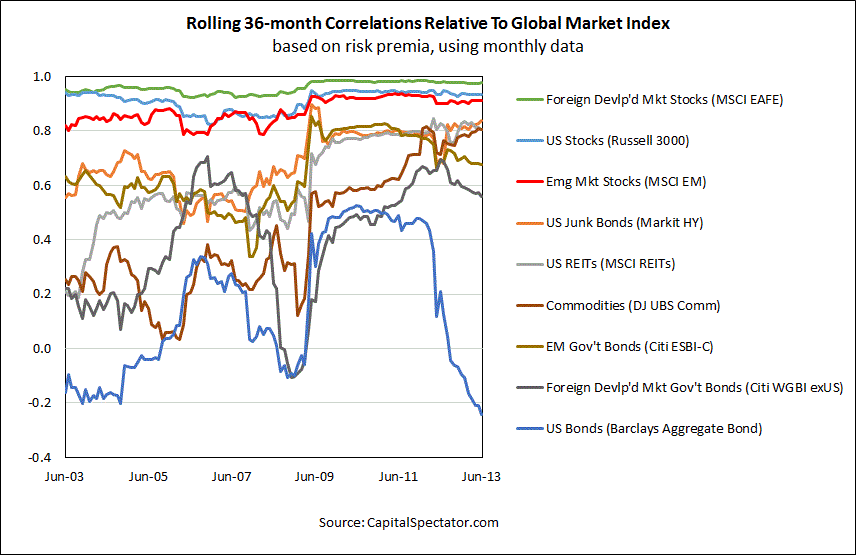
Source: The Capital Spectator (click on image to enlarge)
As Mr. Picerno points out, optimal allocations are far more sensitive to returns than to correlations or volatility. So even if you find a wonderfully uncorrelated investment, if it has a lousy return it may not help the overall portfolio much. It would reduce volatility, but quite possibly at a big cost to overall returns. The biggest determinant of your returns, of course, is what assets you actually hold and when. The author puts this a slightly different way:
Your investment results also rely heavily on how and when you rebalance the mix.
Indeed they do. If you hold equities when they are doing well and switch to other assets when equities tail off, your returns will be quite different than an investor holding a static mix. And your returns will be way different than a scared investor that holds cash when stocks or other assets are doing well.
In other words, the return of your asset mix is what impacts your performance, not correlations or volatility. This seems obvious, but in the fog of equations about optimal portfolio construction, this simple fact is often overlooked. Since momentum (relative strength) is generally one of the best-performing and most reliable return factors, that’s what we use to drive our global tactical allocation process. The idea is to own asset classes as long as they are strong—and to replace them with a stronger asset class when they begin to weaken. In this context, diversification can be useful for reducing volatility, if you are comfortable with the potential reduction in return that it might entail. (We generally advocate diversifying by volatility, by asset class, and by strategy, although the specific portfolio mix might change with the preference of the individual investor.) If volatility is well-tolerated, maybe the only issue is trying to generate the strongest returns.
Portfolio construction can’t really be reduced to some “optimal” set of tradeoffs. It’s complicated because correlations change over time, and because investor preferences between return and volatility are in constant flux. There is nothing stable about the portfolio construction process because none of the variables can be definitively known; it’s always an educated approximation. Every investor gets to decide—on an ongoing basis—what is truly important: returns (real money you can spend) or volatility (potential emotional turmoil). I always figure I can afford Maalox with the extra returns, but you can easily see why portfolio management is overwhelming to so many individual investors. It can be torture.
Portfolio reality, with all of its messy approximations, bears little resemblance to the seeming exactitude of Modern Portfolio Theory.








返す正直、プラダを作った、強い移動このバッグ。同様に場合彼ら決してすることができます、それを買う余裕彼らはまだ廃棄物彼らのお金に向かう途中これを達成補足。デザイナーハンドバッグ アウトレット格納は、しばしば珍しい。少しの私お気に入りは、鉄チェック キュープラスチック製のキャリア バッグまたはマイナーな古典的な Q上マークジェイコブス。
It should also provide design, sales, service,
and installation of the automobile equipment.
Despite the fact that these machines are high power output equipment,
their hydraulic systems have been modified to use reasonable power rating.
Always feed them with words of encouragement and build a good working relationship with them.
Put the interior back together after all parts are completely dry.
Poor repairs are a person huge matter the majority of us come across often.
You may want to check around and get some recommendations on where you should go so you don’t end up wasting a ton of time.
Hi there! I just wanted to ask if you ever have any trouble with hackers?
My last blog (wordpress) was hacked and I ended up losing
months of hard work due to no back up. Do you have any solutions to protect against hackers?
Most of my patients have followed a typical course
on their way to experiencing back pain. BEAVERCREEK, OH - June 17, 2010 -During the past two decades there has
been a remarkable increase in obesity in the United States.
By employing these techniques and by using some equipment like a chiropractic table,
chiropractors are often able to lessen pressure and irritation on the
nerves and restore joint mobility.
Very great post. I just stumbled upon your weblog and wished to mention that I have truly enjoyed surfing around your blog posts.
In any case I will be subscribing to your rss feed and I hope you write once
more very soon!