Between Active and Passive

August 13, 2013

Yep, factor investing is somewhere between active and passive investing:

However, factor investing has taken off in recent years along with passive investing, though not nearly at the same torrid pace, as the shift away from actively managed equity funds continues.

“Passive and factor investing are joined at the hip,” said Samuel Lee, an analyst at Morningstar Inc.

“Passive is based on a lot of academic and finance theory that says it’s impossible to beat the market. Factor investing is an offshoot of that,” Mr. Lee said.

“Factor investors probably started off as Bogle-style buy-and-hold investors, then looked deeper into the research,” he said, referring to The Vanguard Group Inc. founder John Bogle.

The research shows that over time, overweighting companies with favorable prices, profitability, size or momentum can lead to better overall risk-adjusted returns. The key to that, though, is time.

Source: Investment News

Factor investing is passive in its systematic execution, transparency, and relatively low cost and active in its design to be built around return factors that have demonstrated the possibility of outperforming cap-weighted indexes over time.

HT: Abnormal Returns

Posted by:


Gains or Volume?

August 13, 2013

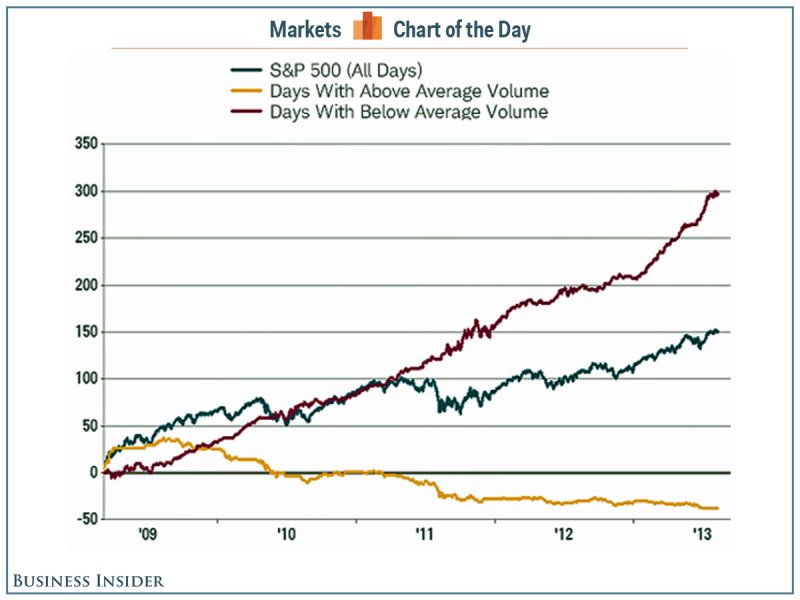
Although many technicians consider volume in their analysis, we have chosen to focus solely on price. As pointed out by Business Insider, those waiting for higher volume to confirm this uptrend are still waiting:

Almost every day since the the bull market began in March 2009, some stock market pundit has complained about low trading volumes.

Some fear that low volume means sell-offs could turn sharp due to lack of liquidity.

However, Charles Schwab’s Liz Ann Sonders points us to this interesting counterintuitive chart from the Bespoke Investment Group.

“The chart breaks out performance the current bull market based on days when volume (using the SPY exchange-traded fund as a proxy) has been above and below its 50-day moving average,” explained Sonders.

“On a cumulative basis, the S&P would be up nearly 300% if you were only invested on the days when volume was below average,” she added. “That’s nearly double the return of the entire bull market! On the other hand, if you were only invested when volume was above average, you would actually be down 37%. Complain if you’d like, but gains are preferred over volume, no?”

“Market bears seem never to be short reasons for gloom; but valuation and volume shouldn’t be among them,” she said.

volume Gains or Volume?


Posted by:


Relative Strength Spread

August 13, 2013

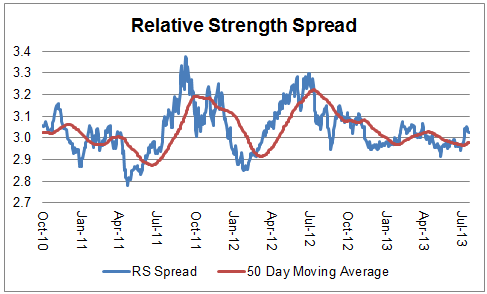
The chart below is the spread between the relative strength leaders and relative strength laggards (universe of mid and large cap stocks). When the chart is rising, relative strength leaders are performing better than relative strength laggards. As of 8/12/2013:

spread 08.13.13 Relative Strength Spread

Posted by: